The Silencing of the Moms

St Patrick’s is often a joyous celebration with parades and lots of beer, the wearing of the green and Irish blessings. Today’s blog is not about that side of being Irish. Caelainn Hogan explored the history and legacy of the mother and baby homes in her book, “Republic of Shame“. Today’s blog shares heavily from a review of her book.

Folktales are powerful because of their purpose: they teach moral through warning. This is what could befall you, they say, this is what happens to badly behaved girls. The S Thompson Motif-Index of Folk Literature itemizes the following categories: Girl carefully guarded from suitors; Girl carefully guarded by mother; Girl carefully guarded by father; Girl carefully guarded from suitors by hag. All four motifs are attributed to several mythologies including those that are Irish. But the last one, “Girl carefully guarded from suitors by hag” is specifically Irish.

The mother and baby homes of Ireland were run by nuns associated with the Catholic Church. These were the depositories for women pregnant out of wedlock. Some of the homes were laundries, some were repurposed workhouses from the famine, and a surprising number actually survived into the early 1990s.  This sad history has enough gravesites, unnamed dead and persecuted women to honestly qualify as a most horrifying folktale.

Even in this modern time, women who gave birth in these homes continue trying to locate the children taken from them and some adults who survived the horrors are still searching for their birth mothers. And as recently as December 2020, the Irish government voted to keep the archives of the mother and baby homes locked for another 30 years, leaving hundreds of people without answers, which in some cases means never having a true answer to their identity.

Hogan wrote her book as a personal quest to investigate the homes and make an issue of two of the system’s most disturbing motifs: silence and female virtue. The author says – “My generation’s perspective is that the mother and baby homes are a thing of the past, but it has an ongoing impact. I was born in 1988, a year after illegitimacy was abolished in Ireland. I spoke to a friend’s mother who was sent to a mother and baby home, also in 1988. That alternative, that could have been my mother’s life. That had quite a deep impact on me.” I understand. In learning about my own family’s origins, I realized what was a miracle to me – that my unwed mother was not sent away to have and give me up for adoption.

The author says, “I wanted to show my experience of coming to terms with this alarmingly recent past and understanding how it continues to impact lives, to admit to my own ignorance even when it affected people I knew, to realize there were institutions around the corner from the house where I grew up that I never knew about, a system built on secrecy but all around us still.”

Adoption law in Ireland still protects the anonymity of the mother—which means many people don’t have access to their birth information – purely because they were born out of wedlock.  Adoption rights are an equality issue. There is still a culture of silence around adoption in Ireland, especially when it comes to adoptees accessing their own information. Ireland’s adoption laws were always intended to keep adoption details as secret as possible. It’s hypocrisy that these laws are represented as protecting the privacy rights of the mothers. The author found that almost every woman she spoke to, who had her child taken from her for adoption, who was sent to these institutions, they have only ever wanted information and answers. These are women who have spent years searching for their children. 

There is much more at the link to the review/interview, if you want to continue reading about this issue as your method of acknowledging all things Irish today.

When A Parent Dies

When a parent dies, children can end up with strangers – either in foster care or through adoption.  At one time as my husband and I were rewriting our trust documents, having learned about the realities of a foster care system that sends a young person out the door with no resources at the age of 18, we made provisions to lower the age at which our children could access the financial accounts we had created for them.  Originally, we were more concerned about immature mismanagement of the funds.  From this new awareness, we realized those funds might be critical to our children’s survival, if they lost us.

Losing a parent at any age can be life changing but losing a parent while still in childhood robs the child of important supports going forward.  Death is absolute, so no well-meaning person can change that reality.  If there is no other person – another parent, grandparent or extended family willing to step in – then child welfare and the courts step in.

Even for a young child, closure is necessary, even if understanding is lacking.   Death is an important and natural part of life. Whenever possible, there should be an opportunity to be with someone in death, who has meant something to you in life. It is true, it can be a traumatic shock the first time one sees a dead person but it is also instructive. The intimacy of “saying goodbye” before a burial can help heal a young person’s loss, all the way into adulthood.

Even adult adopted children can be very wounded by being deprived of experiencing the death of their loved one.  When my mom tried to get her adoption file from the state of Tennessee in the 1990s, she was rejected (she was a Georgia Tann adoptee).  More devastating than the rejection was learning that her mother had already died and that door to connect with her forever closed.

Never deny a child this opportunity.  Think about it – who wouldn’t go to their parent’s funeral, regardless of age?  The reality is that it will hurt.  That is death.  Every child (adopted, in foster care or otherwise) deserves a chance to say goodbye.

Exactly How Is It PRO Life ?

The latest manifestation of “caring” among some conservative people is that we should allow massive amounts of death among the old or immune compromised and just get back to work and crowding public places.

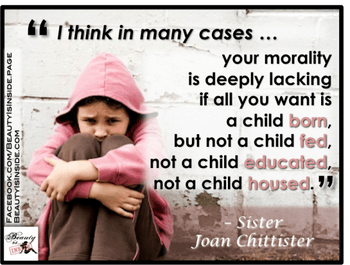
When it comes to MONEY it is clear that Pro-Lifers are really only pro birth.  Once that baby is born, they could care less about the quality of life.  And for some, even better, please surrender that baby to us.  We will BUY your baby through adoption and we could care less about the pain and trauma that you and that baby go through due to our selfishness.

I know this sounds harsh.  I’m not in a generous mood at the moment.  With the Coronavirus, the new trajectory for these Pro-Life people is – let’s sacrifice the old folks on the altar of pandemic and get this over as quickly as possible – so we can go back to living like we want to.

Yesterday, the United States set a new record – the highest single day death count on the planet since this virus began spreading.  And still, they support this president – who lied to us about how lethal this disease was going to be and who did NOTHING to prepare for it.  Even now, he projects blame everywhere else but accepts NO responsibility for his own failure to take this threat seriously in the earliest stages (or even before it reached our own shores from China).

Forgive my rant.  I wonder how many of these people will crowd their churches for Easter ?  Maybe this country would be better off without them – though I wish no one to die from this wretched enemy of too many people.

Too many are Pro life unless you are old, poor or in jail.  Then, they could care less – really.

Why Adoptees Wish They Had Been Aborted

This is not the first time and it probably will not be the last time.  For those of us who are grateful we have a life (and I am one of those), it can be hard to read that adoptees way too often wish they had been aborted and not given up for adoption.  It flies against every happily ever after story you may have ever heard about how wonderful it is to finally create your family thanks to a woman losing her child.  It is not wonderful for that woman nor is it wonderful for that child.

Today, I read one such comment – “I literally would have rather been aborted than adopted. Fuck adoption. It did nothing good for me and only led to years of self hate.”

Another said to a mom who just gave a newborn up for adoption – “Your kept children will be 50 and still talking about the one you gave away.”  This is probably true.  When I found my dad’s genetic family, they said as much.  They knew about him.  Wanted to know him and said his mother NEVER got over giving him up.

One woman gave her daughter up for adoption 14 yrs ago.  She admits it was the hardest thing that she had to ever had to do in her life.  The story gets worse.  Back then the agencies only offered a 5 year open adoption, not an 18 year one.   Guess what ?  the adoptive parents vanished without a trace after 8 years. This mother has’t seen or heard anything from them. She asserts – “I will find her one day.”  Then admits that she has other offspring who are already “looking” for their lost sibling.

Fact is – whether they were family friends before your pregnancy or not, once they have your child, you are pretty much disposable.  Sadly.

And the fact is, most friendships, or even family relationships, aren’t strong enough to stand up to the power imbalance of adoption. It’s like the sword of Damocles hanging over your head.

Yes, there is a decided power imbalance between a desperate pregnant soon to be mother with no access to resources and the people with the money (the adoptive parents, the adoption agencies, the lawyers, the social workers).  The deck is stacked against you and you will need to face this directly, before you take that permanent step.

If you are lucky, someday your child will find you and like my own mom wanted to do, let you know that she survived and is okay.  Worst case, your child will hate you for how her life turned out and wish she had been aborted instead.


Missed Opportunities

Evelyn Grace Johnson (later Harris) at age 2

I’ve only known about this family of cousins since October 2017.  The first time I became aware of this one is because her name appeared on the back of her parents’ gravestone in Pine Bluff Arkansas.  I was at the cemetery to visit the grave of my grandfather, Jay Church Moore.  Nearby was the grave of my mom’s half-sister Javene.  I only missed her by about 2 months because she lived to a very ripe old age.

I googled and found that Evelyn lived in Pine Bluff but could not locate a phone number and so we went on to Memphis that day.  Then in May 2018, we returned to the Arkansas area to visit Evelyn’s sister, Sherry, who gave me so much insight into the family, shared so many pictures and stories that I felt as though I had lived in this, my family, for all my life.

I didn’t see Evelyn during that journey either.  I talked to her on the phone.  She said she wasn’t well but maybe when she was better we could meet.  That day, sadly, didn’t come because she passed away last Friday without us ever accomplishing that someday meeting.

I feel I missed opportunities three times now – once with Javene and then twice with Evelyn.  However, I am blessed that I even know they existed.  For over 60 years, my two parents status as adoptees meant we didn’t know our original family roots.  Now I do.  And so today, I mourn a missed opportunity – while counting my blessings – at the same time.


A Very Sad Reunion Story

In late 1996, a California woman named Terri Vierra-Martinez, had hired a consultant to help track her down the daughter she gave up for adoption.  She sent a letter to the adoptive parents, Jim and Gloria Matthews, asking for a “reunion” with Jonelle.

“I was thrilled that Jonelle’s mother wanted to contact her, because Jonelle had always wanted that,” Gloria told the Greeley Tribune in January 1997. “But then I had to tell Terri that the little girl she entrusted to us is gone. . . . I had to ask myself, ‘Could I have taken better care of her?’”

The families ended up meeting, and Jonelle’s birth mother said she was grateful to know the truth. “This has put some closure in my life,” she told the Tribune. “Jonelle has always been part of my prayers, ever since she was born, and now — not knowing where she is — I’ll continue to pray for her.”

A crew digging this week in the rural land south of Greeley found human remains, Greeley police said. The Weld County Coroner’s Office later determined that it was Jonelle.

On December 20 1984, Jonelle had just finished singing Christmas carols at her Greeley CO school. Her father, Jim, was still out watching her 16-year-old sister, Jennifer, play a varsity basketball game. Her mother, Gloria, was headed to the airport to care for a sick parent in California, according to a story the next year in the Windsor Beacon.

When her father got home later that evening, he found the TV on and Jonelle’s shoes and shawl lying near a space heater. Jonelle was gone.  It is still not known who took her or why or what happened to her in the final hours of her life.

Lifelong Sorrow

It is clear in my mom’s adoption file that my maternal grandmother, shown above holding my mom for the very last time, never intended to surrender her.  She was pressured and exploited by circumstances and the expert manipulation of that baby thief, Georgia Tann, in Memphis.

I read a statistic that said that more than 30% of women who have relinquished children never have another – either because they chose not to, or could not. There is an increased incidence of secondary infertility among natural mothers.

I know that my grandmother never had another child.  I know that while her birth name was Elizabeth, my mom’s birth certificate had her name as Lizzie.  I saw her sign Elizabeth to a note and a postcard she sent to Georgia Tann after losing my mom.  Yet, when she died in her 60s after marrying a second husband, Lizzie is what is on her gravestone.  I can’t help but believe she hoped my mom would find it someday.  My mom died without fulfilling her desire to know about her original mother.  I was the one to find the gravestone and sit beside it and talk with her soul.

There is no way to know why my maternal grandfather left my maternal grandmother in Memphis four months pregnant.  It seems her widowed father sent her away to Virginia to have my mom and I doubt she was supposed to bring my mom back to Tennessee.  It is clear my great-grandfather was unwilling to take the two of them into his home.

It appears that the only time my maternal grandmother had any communication directly with my maternal grandfather (after he left her alone and pregnant) was when he decided to go ahead and divorce her 3 years after they married and two years after my mom was born.  The divorce papers also show her name formally as Elizabeth.  I believe that having lost their child, my grandmother was so filled with shame, she could not face him.  The divorce freed her up to remarry and not long after that he remarried.  My heart is glad they didn’t die alone.

My mom’s adoption file is a constant reminder to me of what they had not done, of the courage they somehow lacked to fight back and of the child in the middle (my mom) they both lost.  I come close to tears every time I revisit this story in my heart’s mind.

Losing A Mom

Many of us have lost our mothers.  Whether we had her for a short time, almost no time at all, like my paternal grandmother who lost her own mother at age 3 mos.  Or whether we had her for a bit longer, like my maternal grandmother who lost her own mother at age 11.  Or whether we had her for much longer.  I lost my mother in 2015 at the age of 61.

My mom carried a deep unhealed wound that was caused by the unintended (unintended by her own mother) separation from her mother when she was exploited due to financial desperation.  When my mom tried in the early 1990s to get her origins information and reach out for contact with her original parents, she was told her mother had already died and that devastated her.

There was an emptiness that my mom carried her whole life and it was real and not imagined.  She was alone in a real sense with the issues that her life presented her with and we all are in reality.

Death is inevitable.  I accepted that almost 20 years ago when I learned I was positive for hep C but would never be treated for that.  Even though I knew nothing about my original grandparents and my own parents were still alive, my OB said he was more worried about my heart than my liver.  It seems he was intuitive.

Having now located who all 4 of my original grandparents were, I also know they all died of heart related causes.  Both of my own parents also died of heart related causes.  So I have to take my own health seriously in the aspects related to that.

Even so, no one can save my life.   We are all born to die and the timing of our death is never known until it is upon us.  What matters to me is the quality of the lifetime that I have available to me.  I do my best to honor that gift.

PTSD

Earl & Louise Little Family

My family recently watched Spike Lee’s Malcolm X.  Malcolm Little was born on May 19, 1925 in Omaha, Nebraska.  His mother, Louise Norton Little, was a homemaker occupied with the family’s eight children.

Malcolm’s father was murdered in 1929 in Lansing Michigan.  Her children were split up and sent to various foster homes and orphanages.  Louise suffered an emotional breakdown several years after the death of her husband and was committed to a mental institution.

In Spike Lee’s movie, it appears as though the children were taken away soon after the father’s death because as a homemaker, Louise had no ability to provide for them and that loss subsequently caused her breakdown.  The movie shows a social worker telling her she can’t properly care for her children after an insurance company rejects financial compensation for his death.

Such an outcome would not be surprising because it happens many times that separating a child from their mother leaves a trauma that is very similar to post traumatic stress syndrome. It is a disorder linked to a traumatic event – characterized by being hyper vigilant, having flashbacks, emotional numbness, avoidance of stimuli associated with the trauma, difficulty sleeping, concentrating, persistent anxiety, etc.

It certainly was a moment in that long movie that got my own attention.

Bottled Up Grief

Ever since I learned about my maternal grandmother, my heart has broken for the grief her life gave her.  She died at an age decades younger than her 2 sisters and 2 brothers.  They did not have her heartbreak.  They were all much younger than my grandmother when their mother died.  My grandmother was 11 years old.

Grief doesn’t vanish when we try to lock it up in a sealed drawer, yet I am relatively certain that is how my grandmother coped.  She didn’t talk about the pain but it didn’t go away.

The thing that makes you crazy isn’t that your mother died, or that you lost custody of your child – both of which happened to both of my grandmothers actually.  It is that you can’t talk about it.

You just want to run away, but you don’t know where you can run to.  There isn’t any where to go.