Not The Same

Someone was asking adoptees if it’s OK to identify as “half adopted.” They were raised by their biological mom but their biological dad was absent. Then they were later legally adopted by mom’s next husband.

She goes on to note – The amount of tone deaf, “Of course, you were adopted” by non-adopted people and one adopted person was really irritating. They have their own loss and trauma, but they had their mother and only learned their father’s name when they were already in their teens.

The responses in my all things adoption group were interesting and somewhat surprising. The points chosen seem valid. I think what might be different is the degree of trauma that accompanies an infant or young child being separated from their mother.

If you were legally adopted, you’re an adoptee. I was adopted twice (blogger’s note – so was my adoptee dad) and not raised by birth parents, but it feels weird to tell someone who was legally adopted that they can’t call themselves adopted.

The person who was adopted gets to identity however they want to, in my opinion. Your identity is valid.

They were adopted, so they could decide – adoptee, half adoptee or not as an adoptee. It is their choice.

Half of their stuff was still changed. They are still not involved with the family of half of them.

Step-parent adoption or kinship adoption –  I do see them as different than a stranger adopting an infant. (Same as the point I made above – less trauma effects in these situations.) Another one added – I’m a kinship adoptee (adopted by maternal grandma) and I identify as a kinship adoptee.

Yet another response – Step parent adoptions are in no way equal to full adoptees. In most cases, step parent adoptees got to stay with their biological mother – therefore not experiencing the “primal wound’ trauma that connects so many adoptees or the trauma of being completely separated from your biological family.

Sure they are “technically” adopted – but not at all in the same way.

The issue arises when they try to say they’ve experienced the trauma discussed by full adoptees or try to say they are privileged voices in spaces where they really are not because they don’t have that shared life experience. Some of these “half” adoptees have even misrepresented themselves in order to dupe hopeful adoptive parents and profit financially as “consultants” or the like.

It really bugs me when those who were adopted by a step parent try to say they are “adoptees” in the same way that I am. Because they just aren’t. Full stop. I’m pretty surprised by the other responses here so far actually.

And a last valid point – Part of me wants to know to what purpose, to what end? A lot of people are just trying to find their identity, to explain some of their trauma responses, to understand how to describe their situation to other people.

But if the purpose is that they want to come into adoptee spaces and converse about adoption as a privileged voice to elevate their own opinions–which has happened before in the adoptee community on TikTok–they most likely will be schooled on that before too long.

I see it as a facet of adoption just like any other. There is a LOT of intersectionality here. People can be adoptees but not infant adoptees, or transracial adoptees, or late-discovery adoptees, all of which come with unique sets of issues. No two experiences will be identical. I recognize I cannot speak for transracial adoptees, for example, and so, I know not to minimize their experiences by pretending mine is just like theirs. I don’t have x, y, or z issues.

Surrogates – Mother Infant Separation

I have wondered about this myself. A women in my all things adoption group asks the question for me and gets lots of answers.

I was adopted and I have trauma from my biological mom as well as some from the foster care system and then after getting adopted as well. I have seen a lot of people in this group mention the trauma a newborn baby automatically has when taken from the mother to be placed with a different family. I am wondering about surrogates then? If a new born baby is instantly traumatized due to the mother putting the child up for adoption, would that not be the same for a woman that is being a surrogate for another – couple or single individual ? For women who are unable to conceive, the choice seems to be either to adopt or have a surrogate. For women who can’t conceive, should they not also be allowed to be mothers ?

First response – No one dies from remaining childless. It’s selfish to intentionally create a child born into trauma. It sometimes takes as many as 3 women to make a baby. 1. One to pay for that because a woman she cares about wants a baby. 2. The biological donors and 3. The surrogate. What a boggling circumstance for the resulting child to wrap their mind around. People should just accept their infertility. The reality is that most of these women only want babies. Truth is that babies aren’t “in need” of someone else to mother them. They are in high demand and sought after by many.

Next perspective – No one is “owed” a baby or parenthood. It’s not a fatal condition if one never becomes a parent. However, if people want to be parents, there are legally free children in the foster care system. Children who need parents – though the best outcome is that they are never adopted but cared for under permanent guardianship – people to act in the role that parents would. Truth is – no one “needs” an infant.

Finally, onto the actual question – “There’s also a lot that’s ethically wrong with surrogacy beyond the babies trauma, which I think is the biggest issue. Jennifer Lahl has written and speaks out against it.” So I went looking and have linked her name to an article. She writes – “Gestational surrogacy involves impregnating a surrogate mother by implanting embryos created from the eggs of the intended mother or egg donor, and the sperm of the intended father or sperm donor. Women and newborns often do not survive gestational pregnancies, and those who do are often affected physically and psychologically.” I’m not certain about the do not survive part but that is what she wrote. You can read the rest of her article at the link in her name here.

And then a counter argument and I’m not saying this one isn’t as biased as the one above. “Couple Speaks Out Against Jennifer Lahl” courtesy of The Surrogacy Law Center. “Lahl explores the issue of third-party reproduction, focusing on several women whose experiences point to what she sees as flaws in the surrogacy process. She argues that surrogacy has become a baby-buying operation that allows wealthy couples to exploit vulnerable women, often those of lesser means.” ~ Susan Donaldson James of ABC News

Jenn and Brad Nixon of Chesterfield County in VA did their best to defeat infertility for 7 years. The Nixon’s chose to use a surrogate, or gestational carrier, after they learned Jenn’s heart problems would make it dangerous for her to get pregnant. Infertility is a disease affecting more than 7 million Americans. While Lahl highlights how affluent couples are using and exploiting surrogate services, objections to her perspective are raised by couples who have experienced infertility and are not in a wealthy income bracket.

Yet while much has been said here and maybe the answer is buried in almost 170 comments and linked responses to them, my heart already knows. Separating an infant from a gestational carrier is no different than separating an infant any time from the mother in who’s womb that baby developed. The least damaging case I know of was of a mother carrying a baby for her daughter. There will still be separation but the grandmother can be expected to remain in the baby’s life throughout at least their childhood and that might mitigate the effects significantly.

That story (which I once wrote about in this blog) is about a 51-year-old grandmother from Illinois who gave birth to her own granddaughter through surrogacy, when her daughter couldn’t conceive. Julie Loving, 51, was the gestational carrier for her daughter, Breanna Lockwood, who delivered a baby girl named Briar Juliette Lockwood. This has inspired a few other instances of grandparent surrogacy, I see.

Julie Loving with Breanna Lockwood and baby

And just adding this perspective because I think it is realistic – I don’t think the whole world must outlaw something because it creates trauma. There are traumatic things happening everywhere. BUT we can help children grow to be happier people – IF we acknowledge that trauma, respect it, be open to talking about it and hopefully maybe healing it. (And being open to the fact that it may never heal). Not all people will eventually be in touch with their trauma. Some will be and some can heal. Some will be and CAN’T heal. Life is a gamble. You will set yourself up for trouble – if you can’t even talk about it or acknowledge it exists.

It Is About More Than That

In my all things adoption group, a woman writes –

Let’s talk about “playing the victim”. I see this come up a lot in this group when adoptees and former fostercare youth are talking about their trauma. I can only speak for myself, but I’d like to explain why this is so bothersome.

This is a group about the realities of adoption. Our conversations are often about adoption. I talk about my adoption trauma a lot in this group. Why? Because it’s relevant to the conversation. The conversations I have in this group are not reflective of the conversations I have elsewhere in my life. This group is only a sliver of my life.

I have trauma from being adopted. I suffer from mental illness. I’ve been diagnosed with BPD (* see below). I don’t blame all of my struggles on being adopted. I can’t say for certain that it is the root of all my problems. But I also can’t separate it. I was relinquished as a newborn. This trauma has always been here. It is a part of the other problems. It is a part of me. But it’s not all of me.

* Note – BPD – Borderline Personality Disorder is a condition characterized by difficulties regulating emotion. This means that people who experience BPD feel emotions intensely and for extended periods of time, and it is harder for them to return to a stable baseline after an emotionally triggering event.

I have trauma from being adopted but I have privilege in other areas of my life. I’m very fortunate to be where I am today. I’ve met many roadblocks as a result of being an adoptee, but I’ve overcome many of them. I’ve made mistakes and suffered the consequences of those mistakes, but I own them. I don’t blame others for my actions.

Being adopted comes with trauma. Being adopted has legal implications that can make things difficult. In a group about facing the realities of adoption, I don’t think it’s “playing the victim” to acknowledge the hard things. You have no idea how anyone has lived their life. We are simply sharing experiences that are relevant to the purpose of this group.

Caught In The Middle

Some circumstances in life are just plain hard to judge. I understand the point of view of this adoptive mother, even so, where is the compassionate middle ground. I haven’t decided. Here is one adoptive mother’s point of view –

I had to discuss with my son’s biological mom that there are boundaries and if she wanted to be involved in any way then she needed to understand them and honor them. My son is MY son, not hers. We came up with a special name that we refer to her as. Never mom. Also we discussed social media. She is never to address him as her son. He is not her son. She is to call him by his given name. I understand that biological moms have to deal with the emotional aspect but so do the adoptive moms. She is no longer his mother. A mother is far more than giving birth. A mother raises you and puts you first. I am very close with his biological mom. I have a great relationship with her for my son’s sake and it was a surrender. She was not forced in any way. But she is not his mother any longer. I am. I accept her role in his life as a special person who loves him. But I am his mother, not her. And she understands and respects that. She is thankful that I allow her to be a part of our family. I didn’t take his mom away from him. She took her role as mom away from herself including by making bad choices and choosing drugs over parenting. I’m his mom and will always be. She will always be a special person in his life but never his mom. Advice to other adoptive moms – set boundaries and don’t let biological moms walk all over you. Let them know their role in the family now.

The person who revealed this mindset commented – I find this very sad and very controlling. What if the child decided one day to call his birth mom “mom” ? She can’t call him her son ? This is sad. Birth parents grieve too. They hurt too. Even parents from foster care. They grieve. They lost their child. I wish we can offer empathy to birth parents especially from foster care instead of looking down on them and using innocent children to hurt them and the child.

I do feel that putting a child in the middle of this situation isn’t fair to the child. The same kind of thing happens very often in divorce. I remember trying to walk that difficult middle ground. “You still have a mother who loves you. And you still have a father who loves you. But we are not going to all live together anymore.” Life is complicated enough. So how to simplify the situation suggested above ?

I do agree with this perspective – “I’m sure the only reason the biological mother agrees with this is so she can have something to do with her son. There is a difference between a ‘mom’ and a ‘mother’ but it is ultimately up to the child to decide how to view each one of these women. Not the biological mom or the adoptive mom.” These two should not be playing their own issues off with the child caught in the middle.

Someone else disagreed and I do see this point as well – No difference between a mother and mom to me. I have two moms and two mothers. Same difference. It’s not confusing. I see no reason to distinguish a difference or set them apart.

And in fact, this is a valid point – If it wasn’t for the biological mom, the adoptive mom wouldn’t even have her son in the first place. I don’t give a damn if the biological mother’s rights where legally severed, she is still his mom at the end of the day and always will be the woman who gave birth to him.

I am still seeking what I sense is an important middle ground. I understand the need for the adoptive mother to be the final say in most of what happens in this child’s life, to maintain her parental authority to make decisions – at least for a minor child. Yet, emotions and feelings are less clear. I believe that most children actually are capable of keeping the two women in a separate yet proper perspective. My heart tells me that is the truth.

What I am sensing is a possessiveness, an ownership of one person over the love of another person, by putting the magical role of motherhood into the middle of this situation. As the divorced mother of a daughter who’s step-mother married her father and so, the two of them raised my daughter, I already understand what a difficult balancing act these situations are. I did attempt to put my daughter’s feelings and interests ahead of my own. My daughter and I have discussed how similar her childhood was to that of someone who was adopted.

It Actually Does Matter

I have known quite a few people who were not entirely happy with the family of their birth but those of us who have been touched by adoption lost the family of our birth. Some of us find our way back. Today’s blog is inspired by a story in Severance Magazine written by Kristen Steinhilber titled My Biology Matters. It Did All Along.

She writes – “It took me more than three decades of fairytale-oriented platitudes and assumptions thrown like bombs my way about adoption to piece together one very relevant thread: everyone who told me that biology doesn’t matter—including both sides of my own adoptive family—had intact bloodlines and genetic histories. And that what they were really saying, whether they meant to or not, was that my biology doesn’t matter.”

I encountered something like this as well. When I was first learning about my original families (both of my parents were adopted), I was attending a writer’s conference in St Louis when one of our members questioned me – If the adoptive family was good, why does it matter? As we talked, it slowly dawned on her that if she wanted to know, it would have been a fairly easy thing for her to learn as much as she wanted to know from her older family members. Not so for adoptees.

She goes on to write – “. . . withholding and secrecy—are encouraged in the world of adoption when it comes to the biology of adoptees. In fact, withholding and secrecy are legally enforced through sealed birth records. So when I found out, I assumed this was normal, understandable, or even maybe for my own good. My adoptive mother may have even believed that herself.” And adds, “since I’d always been told that adoption was such a gift, I didn’t feel I had the right to it. I pushed my own feelings away and suppressed what was in my gut.”

Even my adoptee mom, after being denied her adoption file and being told her mother was already dead, tried to put a good face on it all as she abandoned trying to do a family tree at Ancestry using the adoptive family details saying “it wasn’t real” and I understand that but needed to say at that point “because I was adopted, glad I was.” Though I doubt she really meant that, what else could she say at that point ?

She describes her experience of reunion – “I had a beautiful reunion with them for years and ‘fit’ naturally. Not in the same way that they fit with each other; that’s simply not possible when you miss out on all those years.” This has been my experience in having genetic biological relations reunions – I can feel these are really, truly the people who I am related to and at the same time I can’t make up for all of the years they were living their lives and I wasn’t in them. It affects my feelings towards the adoptive family I grew up with. I’m like my mom in very real ways – they aren’t real anymore, though at one time they were. The love remains for the good people they all were and are, yet they are also “strangers”, not actually related to me in reality. 

I understand it when she says, “The spiritual and psychological isolation of having two families but not belonging to either has ripped me from limb to limb . . .” That’s the painful part of it all. While I do now feel more “complete” and know my ethnic and familial roots, I don’t actually belong to either family group in any real way. It is actually very sad and only now do I allow myself to feel this, brought almost to tears by the truth of it. It is the sense of not belonging that plagues many adoptees and now I understand passes down the family line to their children as well.

She talks about the massive number of adoptees who stand in solidarity for adoption reform. At least, I am one of those now as well.

Shame

I’m only going the summarize this article but provide you with the link because it is well worth your time to read it – I Kept My Family’s Secret For Over 60 Years. Now, I’m Finally Telling The Truth by Yvonne Liu – published in The Huffington Post.

I believe shame had a lot to do with adoption records being sealed to begin with. Closed to access by the very person – the adoptee – is the information matters most to. Early in my “adoption issues” education I encountered the issue of dumpster babies. There are also babies left in a basket. For most of my life, I thought my own father had been left in a basket on the doorstep of The Salvation Army in El Paso TX because his Mexican national mother lacked her family’s acceptance of a mixed race baby who’s father was an American national. Nothing was further from the truth but I was well in my 60s before I knew that. My father never expressed any interest in learning the truth and details of his own adoption and I believe it was because he was afraid of what he might learn. By the time I knew the truth, my dad was already deceased and knew next to nothing.

Today’s story relates to a baby left in a basket in a Hong Kong stairwell near Sai Yeung Choi Street. She was taken to St. Christopher’s Home, the largest non-government-run orphanage on the island. Officials at the orphanage named her Yeung Choi Sze, after the street where she was found.

Infertility was the shame her adoptive mother hid. That is not uncommon among adoptive mothers, especially those of Chinese descent because Confucius believed a woman’s greatest duty was to bring a son into the world. This adoptee’s mother couldn’t produce a son, much less a daughter.

In June of 1960, this baby girl from China landed at O’Hare International Airport. Her adoptive mother was disappointed in the baby she received from the beginning. She was a sick and scrawny baby, clearly malnourished. Her mother’s first reaction upon seeing her was, “Why couldn’t I have a healthy baby like everyone else?” Throughout her life, the family’s story about her was a lie – that she was born in Chicago. Every school form, all of her college and job applications, and even her medical records listed her birthplace as Illinois. 

The adoptee’s parents were never warm emotionally. From a young age, she was afraid to upset her mother, who was often emotionally volatile. Her mother showed her attention when she needed her daughter. If she dared push back on the relentless demands to refill her teapot, type her Chinese cookbook or vacuum the house, her mother would retreat to her bed, sob, and say, “You don’t love me because I’m not your real mother.” Hugging her, the adoptee would desperately proclaim her love for her adoptive mother, telling her, “You’re my only mother.” Then she would quickly and quietly fulfill her mother’s commands.

Her adoptive father was not any warmer emotionally. From her time in the third grade, she threw myself into becoming a star student in hopes of earning her father’s love and attention. After immigrating to America with $50 in his pocket, her adoptive father earned his Ph.D. in organic chemistry while working as a dishwasher on the weekends. He was chronically depressed and withheld any affection from her, even though she wanted that desperately.

The adoptee won a full scholarship to attend a top MBA program and enjoyed a solid business career. She even married the nice Chinese man her mother chose for her. But for as long as her parents were alive – and even after they died – I continued to keep the family’s secret that she had been adopted. Eventually, she told her husband and children but asked them to continue keep the family’s secret. That’s how deep and dark she considered her secret shame to be. I truly believed I would carry it with me until I died. The ancient Chinese beliefs that she must have come from an immoral mother, would mean she was tainted by her origins.

In 2020, locked down by the pandemic and having just turned 61 years old, she finally began questioning why she had internalized her adoptive parents’ shame about infertility and adoption. Feelings of low self-esteem, insecurity and anxiety as well as lingering questions about identity, rejection, belonging motivated her to learn more about adoption. She did a lot of the things I did as well – read books about adoption and joined Facebook groups for adoptees. Like her, I was already in my 60s as well.

She came to realize that there was no reason to hide her truth any longer. It was time to live an authentic life. She had nothing to hide. She choose to tell her truth publicly in The New York Times. A 98-word Tiny Love Stories piece about her adoption. Then my brother (also adopted) gave her a dusty manila file he discovered during pandemic cleaning. It was labeled “Yvonne’s Adoption.” At 62 years of age, she finally read the documents her adoptive parents had deliberately kept hidden from her when they were alive. The yellowed tissue-thin papers held the truth of her beginnings.

She writes, “My heart ached for the baby who languished in that orphanage for 15 long months. Surely a caretaker would have picked up my malnourished and anemic body when I wailed. Surely someone helped me when I still couldn’t sit on my own at 9 months. Surely a hired helper gazed into my eyes as she fed me diluted Carnation formula, water and congee. I sobbed, imagining how that tiny baby must have experienced those first few months of a life that would turn out to be mine.”

For much of her childhood, she was a quiet child, afraid to be a burden. On the rare occasions when she complained or questioned her parents, they would answer, “Where would you be if we didn’t adopt you?” They never said the same thing to her adoptive brother because he fulfilled their traditional Chinese filial duty to have a son to carry on the family name.

Then, she wanted to understand, why the lies ? So she learned Chinese history, read cultural and sociology books, pored over Chinese memoirs and novels, interviewed Chinese cultural experts and people who lived in China at the time her parents had. Now she is able to recognize that her adoptive parents were a product of tradition, circumstances and time.

She was able to realize some gratitude for the circumstances of her life. Because her birth mother loved her, she left me at a busy stairwell to be found. Because she made that choice, the woman has lived a full life. She is also able to be grateful her adoptive parents chose her. She is no longer ashamed of being an adoptee.

You can read more of her writing at YvonneLiuWriter.com. She is currently writing a memoir about adoption, childhood trauma and mental health. 

Valentine’s Day for Adoptees

Searching for a topic for a day like this related to adoptees, I found this Huffington Post blog – Roses Are Red, Violets Are Blue, Adoptees’ Worst Fear Will Likely Come True – by Ben Acheson. The image I chose seemed to fit the sentiments of some adoptees that I have encountered. The subtitle of Ben’s essay notes – What if Valentine’s Day, or relationships in general, were a stark reminder of the most painful and distressing events that you ever experienced? What if they triggered a trauma so terrifically challenging that it forever altered your approach to life? Welcome to Valentine’s Day, and relationships, for adoptees.

Ultimately, Valentine’s Day is about relationships, or the lack thereof. It may evoke unpleasant memories of lost loves, but the nostalgia is normally forgotten by the time the flowers wither and the chocolates disappear. Or does it ?

Take a moment to balk at such a provocative, nonsensical claim; that saving a child through adoption could lead to a life of relationship problems. It is ungrateful and even accusatory to altruistic adopters. It is insulting to those battling depression, Post-Traumatic Stress Disorder and other psychological issues associated with adoption.

The development of intimate relationships can be a major challenge for adoptees. Their first and most important relationship was irreparably destroyed. The person supposed to love them most disappeared inexplicably. Then they were passed to strangers and expected to pretend that nothing happened.

The impact of that severed relationship is colossal. It permanently alters everything they were destined for. It alters how they attach to people. It causes bonding problems. It leaves them angry, sad and helpless. It interferes with emotional development and instils a persistent fear of abandonment within them.

This fear impacts future relationships. Many adoptees fear that what happened once might happen again. They fear that each new relationship, like the very first one, will not last. If their own mother abandoned them, then why won’t others?

It affects their ability to trust. Their trust in adults was shattered when they were most vulnerable. The idea that their mother loved them so deeply that she gave them away is a confusing paradox. Connection, intimacy and love are forever intertwined with rejection, loneliness and abandonment. Being unable to remember the traumatic events only compounds the problem.

Adoptees are sensitive to criticism and have difficulty expressing long-suppressed emotions. They have hair-triggers and lack impulse control, frequently overreacting to minor stresses. They can be manipulative, intimidating, combative and argumentative. Total absence of control over childhood decisions gives them an unrelenting need for control in adulthood. A counterphobic reaction of ‘reject before being rejected’ is a classic sign of stunted emotional development and unresolved trauma. That is not to say that adoptees do not want intimacy. They often want to ‘give everything’. They yearn for a close, trusting connection. They want to let someone ‘in’, but the openness and vulnerability is petrifying. Letting someone ‘in’ also opens the door to rejection.

Even if partners recognize that deep, sensitive wounds exist, they tire of walking on eggshells. The emotional rollercoaster is exhausting. They become sick of the ‘parent-role’ they often assume. Even if the adoptee matures and gains insight into their behavior, the damage may have been done. Partners may reach the breaking point and leave. But who is to say that failed relationships cannot be a blessing in disguise? For adoptees, the important lesson might be that you sometimes need to fail in order to truly succeed.

Broken Family Threads

It is said that it is Black History Month, though many of my friends chafe at that and say it is ALWAYS black history. I understand. Imani Perry’s book South To America has been getting some buzz and as I writer I notice those things.

Yesterday, I read an essay adapted from her book published in Time Magazine’s Feb 14 – Feb 21 2022 issue titled “The Way Home.” It is about her effort to reconnect with a grandmother in Maryland who she is able to know very little about. Was her name Easter Lowe or Esther Watkins ? Was she born in Maryland or Georgia, was she 101 years old or 91.

I realized as I read how much I could relate to her journey to Maryland which is described in the article. Her attempt to get some insight into unknowable people. I recognized my own “roots” journey, often fraught with disappointment and too little too slowly. I am fortunate to know what I know now. Though the African American experience of slavery is not mine, I know how it feels not to know anything about where one came from (both of my parents were adoptees). At one time, I used to tell people I was an albino African because no one could prove me wrong, not even myself. Now I finally do know better.

Slavery was not exactly in my family history but in a way it was. My paternal grandmother was put to work in the Rayon mills in Asheville NC at a young age. She was not allowed to keep her own earnings and was probably expected to do a lot of other chores in the home. Her mother died when she was only 3 mos old and she had to live with a decidedly evil step-mother (from a story I heard about her being tied to a tree in a thunderstorm). She was a run-away slave. When her family visited her grandfather and her aunt in La Jolla California, she refused to return to Asheville and her slave labor there.

Poverty and the Great Depression was likely the cause of both of my grandmothers being separated from their babies. There really was not any family support for them. My maternal grandmother also lost her mother at the age of 11. She also escaped harsh conditions with her widowed father who was a sharecropper. She ran away to Memphis where she met and married my mom’s birth father.

Though I am not black and my family wasn’t enslaved, I can relate to Imani Perry’s story because in very real ways it is my story too. I didn’t grow up with a strong white supremacist’s identity. I was in the minority in Hispanic El Paso Texas and anyway, we didn’t have a clue to our ethnicity. Even so, I do recognize now that being white has put me in a class of advantages and I’ve worked very hard at educating myself by reading every anti-racist type book that has come my way. I celebrate the contributions of Black, African Americans to the diversity and vibrancy of the country of my own birth.

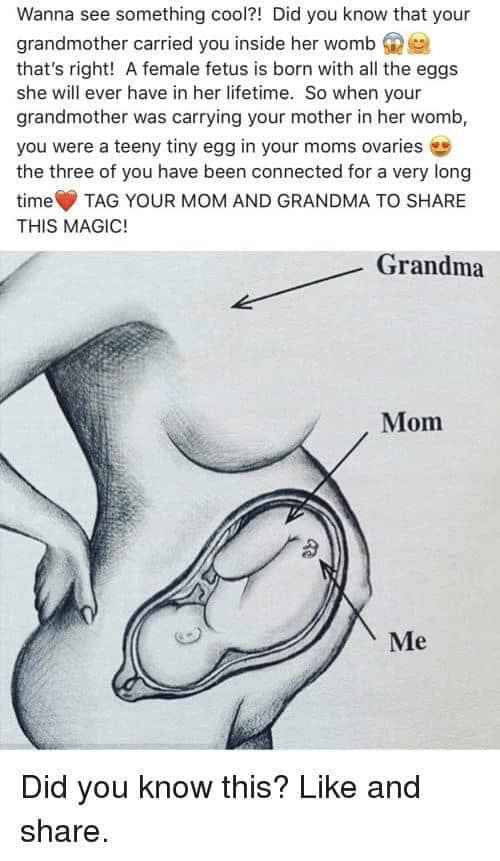
Inside Grandma’s Womb

I think I already knew that all the eggs a woman has were there in her ovaries at the time of her birth. Since we did not grow up with my maternal grandmother (due to my mom having been adopted), I feel a definite fondness for my maternal grandmother who never had another child after having lost my mom due the the schemes of Georgia Tann during her days of stealing and selling babies in Memphis TN to enhance her own wealth. In some strange way, it makes me happy to know that even though Tann could take my mom away from my grandmother, she couldn’t take my grandmother out of the core beginning of each of us.

My mom certainly yearned to know her own mother and was devastated when seeking her adoption file from Tennessee (who denied her as her father’s status of alive or dead was not ascertained) told her that her mother had died some years before.

There is a strong maternal line running down from my grandmother to my mother to me and to my daughter and then my granddaughter. My mom looked a lot like her mother at a certain age. I love feeling that mirror showing through. It is also a happy thought that when I was in my mom’s womb, my daughter’s seed was forming and when she was in my womb, my granddaughter’s seed was forming. We are all connected. Sweet.

Yet Another Story of Misattributed Parentage

Mark Overbay

Story thanks to the Right to Know people.

Every MPE (misattributed paternal event or misattributed parentage) story has a starting point. The discovery comes entirely by surprise for many, whereas it confirms others’ long-held, conscious or subconscious, suspicions. If there truly is one, the typical story involves submitting a direct-to-consumer/recreational DNA test yourself or being contacted out of the blue by someone who has. Mine has a little of each with an added twist.

One afternoon, a friend of mine called me with what he described as “interesting news.” He told me that he and his older sister had taken DNA tests and found something unexpected. He informed me that both had discovered the man they thought their father wasn’t. Their research afterward led them to believe that my father was their BF (birth father). Additionally, they had reached out and somehow convinced my father to submit a DNA test. The results confirmed their research findings. “We,” he informed me, “are half-brothers.” He sent me a screenshot of the DNA evidence to prove it. Because I was already aware of two other half-siblings from my father, this news honestly wasn’t that surprising. I remember laughing with him about the strangeness of our new situation.

What my friend didn’t know, however, is that many years ago, I had also taken a DNA test from the same direct-to-consumer company, primarily because I was ethnicity curious (as both of my own parents were adopted – this was originally my own motivation). When I told him about this, he informed me that I wasn’t on his match list and followed with the question, “You are the adopted one, right?” “Adopted? I was not adopted.” I quickly replied. Confused, he told me that my father had told his sister I was adopted. He must have misunderstood. I was 58 years old and was confident that I wasn’t adopted. My birth certificate listed my father and mother. I had seen it many times. I called his sister to see where this part of the story originated. She repeated her brother’s claim that my father had told her I was adopted. Further, she explained, he had married my mother, knowing she was pregnant with another man’s child.

When I learned the adoption news, I was more than two hours from home and my laptop. I wasn’t laughing anymore. My head was now cloudy and confused. The drive home was a blur. “Could this be possible?” I asked myself, “Was I adopted?” Once I arrived, I quickly checked my DNA matches. Neither my father nor these two new “half-siblings” were there. As I surveyed my 80,000 + matches, none matched my surname. I found that it was 100% confident regarding the connections tied to my mother. However, most of my “close” matches were surnames utterly foreign to me.

It was true then; I had been “adopted” by my BCF (birth certificate father). But, unfortunately, my mother had taken her secret to the grave. My BCF had told a stranger rather than me. I found out I was an NPE from a friend who was a completely unrelated NPE (nonpaternal event, also sometimes nonparental event). My friend was right about the adoption but wrong about the two of us. We were not related. In a nutshell, that’s how my story began.

Life does not prepare you for such moments. As abrupt and shocking as it was, this revelation explained so much. My physical appearance, personality, and temperament differed significantly from my father’s. I was athletic; he was not. We had little to nothing in common and even less to talk about. We have not spoken in many years. Those who knew both my father and me well commonly joked that I must be “the milkman’s child.” My wife has known my father for more than 30 years and never once thought we were related. I laughed these comments off, but I really couldn’t disagree. The differences were problematic to me. I knew enough about genetics to know that much of what defines our identity, the sense of who we are, is inherited. I feared that I would start to see undesirable attributes of my father revealing themselves in me one day.

The realization that I was adopted lifted an incalculable weight from my shoulders. The fear that I would someday become my father was a burden more significant than I had previously appreciated. Yet, strangely perhaps, as the reality set in, this genetic enlightenment was validating and liberating for me. The truth had freed me.

You can read the rest of his happy ending family reunion story here – Mark Overbay.