I’ve Seen The Damage

In my young adulthood, I saw some of the worst. Any substance addiction is not an easy nut to crack. It’s impact on parenting can’t be denied. Today’s story asks this question – Is it possible to support someone in parenting in ways that are physically and psychologically safe while that person is using meth?

A family friend who is incarcerated has a baby who has been in foster care since birth. The baby will be returned to her when the mother gets out of prison when the baby is about a year old. A parent-child rehab program will be provided, follow up substance use disorder programs will be offered, and the mother has access to familial financial support as well as support with housing and childcare (though she has currently declined childcare assistance). But she permanently lost custody of her first child due to inadequate care of the infant as a result of daily meth intoxication, and I want to ensure that that doesn’t happen again. She has had relapses every time she has left prison or rehab or psych facilities throughout her entire adolescence and adulthood (but she is a very young adult). I hope she doesn’t resume use, but I was wondering if anyone had any advice for helping her keep and take good care of her baby/ toddler even if she continues to struggle with addiction to the point that eliminating use of meth is not possible for her.

A physician comments – Being under the influence of drugs is NEVER safe. There is NEVER a safe amount of use that is ok. You can’t hit “the pause button” in being the person that is responsible for child while you get high and think that your entire constitution and judgment isn’t taxed and under the influence for a considerable amount of time after. If you are still using, then do not trust yourself that you are actually caring for your self, and much less adequately caring for additional humans who are critically growing and very needy, independent beings.

However, another person had a very different perspective – you see it at its worst. You don’t see it functioning day to day. Big difference. My SIL was a functioning parent with substance use disorder for decades. My neighbor as well. Many others I have known. It’s like anyone dealing with chronic disease. They need support.

The doctor responded – I deal with addicts, families, social workers, lawyers every single day. That’s 70% of who is in an ICU bed right now that we are caring for and all paying for. Yes, I agree they do need support 100%. They do not need to be responsible for a child while *using* drugs. Blessing to your SIL to have a support system around her, like a loving family that cares enough to do that. Most addicts do not have what your SIL has. That is not the reality of most people in this world, and one of the reasons they get into addiction to begin with. There is no such thing as a safe amount of drugs. It doesn’t work like that. Your brain gets rewired and your judgment is altered.

To which the person responded – I am so tired of people not understanding that there are people that are functional but still struggling with substance use disorder. They hear the word drugs and they make some serious assumptions about the person. I am going to “not all” here because I am so tired of the assumptions being made when it comes to substance use disorder.

Many have a support system for when they are active that keeps children safe. Being that support system is important. I didn’t see one comment from anybody saying that the original poster should be a support system. The only thing I’m seeing is people saying “nope can’t parent” “drug user? can’t parent”. People parent with disabilities that can also put children at risk, but nobody says a thing about them losing their kids.

Functional drug use IS a thing ! Stop making broad brush stroke assumptions of those challenged with substance use disorder !

Bottom line, there is this – The safety of the child has to come first. If someone is actively using they are at risk for psychosis (and if you haven’t seen that in someone you love I pray you never do). Absolutely the most terrifying thing I’ve ever seen and I felt unsafe as an adult being around someone in that state. It’s extremely dangerous for the child if the parent is seeing things that aren’t there, having delusions, etc. If you know someone is actively using around a small child you should either be intervening yourself or reporting them.

Recovery is possible and family and friend support play a big role in that. Just because someone has relapsed doesn’t mean they will again. It also doesn’t mean they will be using around their child. It’s great that’s she’s willing to go into treatment with baby. I would do everything you can to support her and let her know you see her beating the odds and are proud of her if you have the kind of relationship you can talk about those things.

And there was this advice – Her focus should be finding employment with medical insurance so that she is not on welfare and is not a target for state intrusion. She should focus on taking care of her children, being physically active and healthy, join a gym, exercise, garden, take care of her house. Keep the rif raf away from her house. Maintain normal hours – no rotating cast of strangers through the house – no visitors after 10 pm. Work hard at maintaining a schedule and sticking to it. She probably has ADHD and should get medication like Ritalin or Wellbutrin for it, which will address chemical imbalances that she has. She has to work extra hard at keeping up appearances – she’ll be held to a higher standard of care than other mothers. She can’t mess up. Nothing is worse for a child than having their parent taken away from them and even if she cannot take care of her child full time, every effort should be made to have her do as much as she possibly can for her child as a parent, not as a visitor.

I’ll end with this observation – it is hard to overcome generations of addiction, mental illness, and poverty. It’s just not simple.
The Legacy Of Family Separation

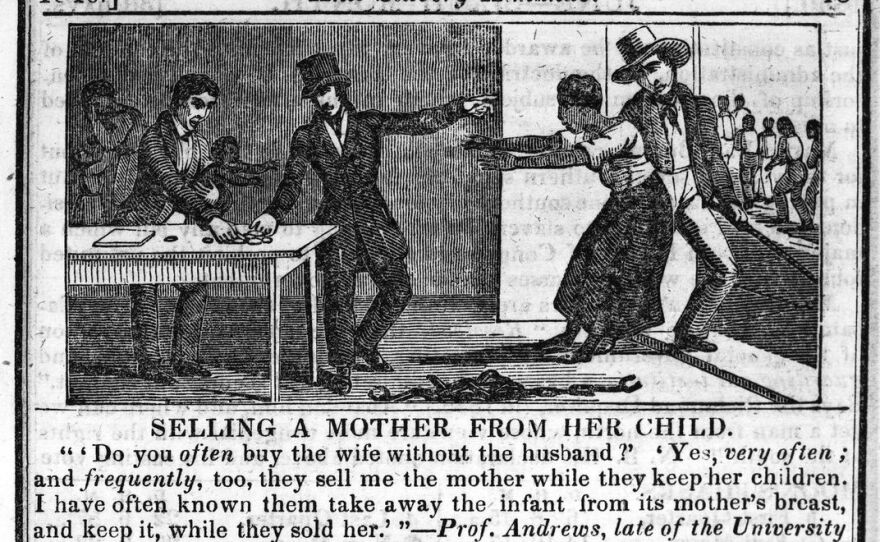
Since today is Juneteenth, a federal holiday that recognizes the date when the last enslaved persons were finally informed of their freedom, I thought about all of the children that were taken away from their parents, primarily from their mothers, during the period when slavery of Black people was common in these United States.

Black Perspectives is the award-winning blog of the African American Intellectual History Society (AAIHS). They are deeply committed to producing and disseminating cutting-edge research that is accessible to the public and is oriented towards advancing the lives of people of African descent and humanity. From the Black Perspectives website, LINK>Slavery and America’s Legacy of Family Separation by Vanessa M. Holden. Forced family separation was always a fixture of the lives of enslaved people. Enslaved children were a lucrative business. The expansion, maintenance, and future of slavery as an economic system depended on these children, particularly after the close of the American trans-Atlantic trade in 1808. 

One such story comes from Harriet Mason, who remembered her mistress forcing her to leave her home and family in Bryantsville, Kentucky, to work in Lexington as a servant at the age of seven. She remembered, “when we got to Lexington I tried to run off and go back to Bryantsville to see my [mother].” The grief of a childhood spent away from her family at the whim of her owner led her to suicidal thoughts, “I used to say I wish I’d died when I was little.” Even in her old age she was firm that, “I never liked to go to Lexington since.”

Slaveholders borrowed against their human property. They gifted enslaved children to their white sons and daughters as children, upon their marriages, or as they struck out to begin their slaveholding legacy. And of course, slave children could be sold down the road and down the river. Children knew that at any moment this could happen to them.

Blogger’s Note – Last night, my oldest son wanted to know if anyone in our family had benefitted from the labor of slaves. Eventually, it was suggested that every American has. I know that among my mother’s own genetic, biological family there were slave owners (I saw one will that was stipulating slaves by first name and who they were to be given to). I also know that side of my family also fought on the side of Confederates in the US Civil War. I’m not proud of being the descendent of these realities.

From the linked article – To profit from slavery and participate in slaveholding, Lexington’s white residents did not even need to own, buy, or sell a single slave. Someone made the shackles. Someone ran slave jails. Someone generated the official documents needed to transfer property. Someone hired enslaved children to work in their homes and businesses. Adults running with children from officials who would separate them was a feature of fugitivity during American slavery. To produce the “fugitive” category, a range of institutions sprang up. Local money paid sheriffs, courts, and officials to uphold the law that protected slaveholders’ rights to their human property. Someone printed runaway ads. Someone made money on enslaved peoples’ bodies at every juncture.

Along with physical labor, children deemed by the state to have unfit parents and placed into adoptive homes, perform emotional labor. Adoptees not only lose their birth families in the process, but they also lose ties to culture, language, country, history, and identity, and must contend with societal expectations that they be grateful for a “better life” in the face of it all. Children of color adopted by white parents also face racism in their new homes and communities. There is emotional labor too in being the physical body that allows white families to appear more liberal or multicultural, even if the opposite is true. In the United States, adoption is an industry and, as adoptee advocates continue to warn, it is poised to profit from family separation. There is already precedent for keeping children in the United States after a parent has been deported and awarding custody to American adoptive parents over immigrant parents caught up in immigration proceedings or because they were detained or incarcerated.

Black families are separated by the bond and bail system, incarceration, the child welfare system, and the criminalization of poverty. All can lead to family separation and the loss of one’s children. Child welfare advocates also recognize the link between the disproportionate number of Black children in the foster care system and the pipeline from foster care to prison.  All of these contemporary systems of power are echoes of legal and social structures that devalued enslaved parents and profited from enslaved children during American slavery.

We need to acknowledge these links to the history of American slavery and the ways that African Americans continue to endure discrimination. Following the money exposes the truth.

Vital Record Fraud

One of the issues that disturbs adoptees the most is that their original birth certificates were changed to make it appear as though their adoptive parents actually gave birth to them and usually their names were changed as part of that. This happened to BOTH of my own adoptee parents.

Some one adoptee asks – If birth certificates are such a “vital” record – why are the vital records of adoptees sealed and fraudulent ones put in their place?

At the Adoptee Rights Law Center’s LINK> The United States of OBC anyone can search the status for their state. There you can find out about any restrictions that limit an adult adoptee’s right to obtain an original birth certificate. Only in eleven states (indicated by checkmark) do adult adopted people have the right to obtain their own original birth certificates upon request. Early in my own roots discovery journey, I bumped my head against both Virginia and California who said I would have to get a court to approve my request (thanks to my mom’s adoption being part of the Georgia Tann scandal in Tennessee, when I received her full adoption file records, her original birth certificate from Virginia was there). The birth parents, the adoptive parents and both of my parents were already deceased. As their descendant, under such circumstances which would reasonably mean no one who had reason to object was still alive, I was still denied.

I enjoyed the answer from one adoptee – Because it is vital to maintain the “as if born too” facade. It is much like entering a witness protection program.

Initially the original birth certificates were sealed only from the public. Eventually, the reasoning became to protect the adoptive family from interference by the birth family. According to a document in the University of Michigan Journal of Gender and Law titled LINK> Surrender and Subordination: Birth Mothers and Adoption Law Reform

For more than thirty years, adoption law reform advocates have been seeking to restore for adult adoptees the right to access their original birth certificates, a right that was lost in all but two states between the late 1930s and 1990. The advocates have faced strong opposition and have succeeded only in recent years and only in eight states. Among the most vigorous advocates for access are birth mothers who surrendered their children during a time it was believed that adoption would relieve unmarried women of shame and restore them to a respectable life. The birth mother advocates say that when they surrendered their children, their wishes were subordinated and their voices silenced. They say they want to be heard now as they raise their voices in support of adult adoptees’ rights to information in government records about their birth mothers’ original identities.

Opponents of restoring access, in “women-protective rhetoric” reminiscent of recent anti-abortion efforts, argue that access would harm birth mothers, violating their rights and bringing shame anew through unwanted exposure of out-of-wedlock births. Opponents say they must speak for birth mothers who cannot come forward to speak for themselves. Birth mother advocates respond that the impetus historically for closing records was to protect adoptive families from public scrutiny and from interference by birth parents, rather than to protect birth mothers from being identified in the future by their children. They maintain that birth mothers did not choose and were not legally guaranteed lifelong anonymity. They point out that when laws that have restored access have been challenged, courts have found neither statutory guarantees of nor constitutional rights to, anonymity. They also offer evidence that an overwhelming majority of birth mothers are open to contact with their now grown children.

One had some interesting contemplations – thinking all about adoptees and how we basically prove a large side of nature bs nurture. And I mean the nature part. Our world likes to think that nurture is most important and that we always have a choice. We are a puzzle piece that society and the world doesn’t want us to fit into the big picture, we challenge people’s beliefs that they think are naturally instilled in them, when really it’s all just a bunch of bullshit that has been shoved down everyone’s throats. Even with doctors – good luck getting into the genetics department. The whole thing is gate kept. Really makes me wonder if our existence proves something scientifically that we are aware of, that would change the way people see things.