Preventing Foster Care Placement

Jill Chaifetz (b 1964-d 2006) Children’s Rights Advocate

I stumbled on this today – Jill Chaifetz once remarked, “The American foster care system has developed a remarkable immunity to reform.” In 1992, Chaifetz founded the Legal Services Center at The Door, a New York youth development agency. Through the center, she provided legal advice to young people, including many who were in foster care or homeless.

I had hoped to find information on reforming the nation’s child welfare system into one that equitably supports children and families in their communities as a means to prevent foster care placements. Such perspectives are hard to come by. The pro-adoption narratives are strong and pervasive.

The scientific evidence is conclusive. Parent-child separations lead to a host of long-term psychological, social, and health problems that are not necessarily resolved upon reunification. In particular, the disruption of biological stress regulation mechanisms in the body are further taxed by the absence of parental support. The science is clear: policies that separate families have devastating and long-term developmental consequences for children and their families.

The Annie E Casey Foundation has a series of three 60 minute episodes at this LINK>The Unlearning of Child Welfare: Webinar Series Explores How to Rebuild the Child Welfare System. Creating a Child and Family Well-Being System. The third video explores – What Can An Equitable Foster Care Experience Look Like Going Forward ?

Swapped at Birth

Richard Beauvais and Eddy Ambrose

It may not appear to be an adoption story but it is. The story of two men living alternate reality lives. Both of the men ended up in foster care as children. Richard Beauvais, 68, believed he was Indigenous. Eddy Ambrose, who shares the same birthday, always understood that he was of Ukrainian descent. I learned about this story this morning in LINK>The Guardian by Leyland Cecco. After a series of DNA tests, the two men learned they had been mistakenly switched at birth.

It is expected that today, the two men will receive an official apology in Manitoba. The painful saga highlights the fragile nature of identity and the complex meaning of family as well as embodying the damaging effects of Canada’s colonial policies.

“To have the core understanding of who you are – and who your parents were and who your siblings were – taken away from you, is a shattering experience,” said Bill Gange, the Winnipeg-based lawyer who represents both men. “But this apology is also for the siblings who didn’t grow up with the brother they should have, for the parents that never knew their own child. I don’t think either man knows what it will fully mean for them down the line, but hopefully it will help them.”

In 1955, the staff in a newly-opened rural hospital gave each of the families the wrong baby.

Eddy Ambrose was born to a Cree mother and French father, would spend his youth in the farming community of Rembrandt, oblivious to his Métis roots. The parents who raised him taught him Ukrainian folk songs. They died when he was young and in the years that followed, he was cared for by other family members until he was placed in foster care with a family he came to love immensely.

Meanwhile, 60 miles away, Richard Beauvais life experience reflected the pernicious nature of Canada’s attempts to break Indigenous families and culture. He grew up on the eastern shore of Lake Manitoba speaking French and Cree. His father, Camille, died when he was three years old. His mother, Laurette, struggled to raise Richard and six other children.

Beauvais recalls foraging in the dump to feed siblings. He was barred from speaking Cree and French while attending a residential day school. When he was around eight or nine, he became one of the thousands of victims of an episode which became known as the “Sixties Scoop”, in which the government forcefully removed thousands of Indigenous children from their families and placed them in the foster system. Officials entered the family’s house, striking Beauvais’s sister when she could not stop crying, and then herded the children into a car.

He was teased as a child for being Indigenous. “I saw what the government did to Indian kids because they thought I was an Indian kid. Not many white people have seen what I’ve seen. It was brutal and it was mean.” But he was eventually adopted into a family that he came to love immensely.

In 2020, Richard took a DNA test – a Christmas gift from his daughter – to learn more about his father’s French heritage. Instead, the test suggested he had Ukrainian and Polish ancestry. “He thought it was a scam, one that didn’t even acknowledge his Indigenous roots,” said Gange. Richard believed he ran the only fully Indigenous fishing crew in the region.

Gange is trying to work out a settlement agreement. He suspects there are more cases that will be revealed as home DNA tests become more and more common. “None of this would have happened and nobody would have known if they hadn’t taken tests. The challenges they faced in the child welfare system, especially Richard, are problematic,” said Gange. “But the redemption of both men, who ended up with beautiful foster families who loved them so much, is also a powerful testament to what family can mean.”

13 Years !!!

It actually doesn’t come as a surprise to any of us who are well informed about foster care in these United States. Even so, it is still possible to surprise me never-the-less. NPR described today that LINK>Texas could face fines over dysfunctional foster care system. Texas has been in litigation over its foster care system for nearly 13 years. A federal court is now weighing whether to impose hefty fines over the system’s inability to make progress.

Not only Texas but America’s foster system is in crisis. Sadly, Texas’ network is among the most troubled. NPRs story includes details of self-harm by one foster care youth – “I always get judged for my arms.” NPR notes – The 18-year-old’s left arm is covered in scar tissue from hundreds of self-inflicted cuts.

She explains – “people didn’t want to keep me. Or I feel like people didn’t want anything to do with me because I look like I’m insane. But in all reality, we’re not insane. We just are looking for somebody to love us.” NPR notes – Since she was 14, she spent her time being shuttled between treatment centers and psychiatric hospitals, often changing doctors and medications each time, never finding stability. So now, more than a dozen placements and 230 different medications later, she says the state’s child welfare system is a lie.

Children without placement hotels exist because Texas doesn’t have enough places for children, the ones with high mental health needs. Federal court monitors call these placements dangerous, noting in its reports times when kids got assaulted, ran away or were sex trafficked. And for more than three years, what was supposed to be a temporary placement for kids has often lasted for weeks or months. The state says it has cut the numbers of children without placement in half, but it’s still more than 100 kids a month. It’s cost $250 million over three years.

Texas has been aggressively refusing and opposing reform. It is a big system with lots of problems, but the state’s leadership is just not willing to work cooperatively to get it fixed or to find solutions. Federal District Judge Janis Jack calls the bureaucracy that produced these ongoing failures horrible. One in four caseworkers leave within a year of being hired. One person asks – “if state leaders can spend billions erecting barriers on Texas’ southern border, why can’t they fix this?”

NPR notes – Texas is not the only state to deal with legal fights over foster care. Alabama, Mississippi and Kansas have all dealt with federal oversight. Many still are. One former foster care youth says Child Protective Services (in Texas) was so bad that she would have rather stayed with her abusive family.

Child Removal

A point was made in my all things adoption group that “Child removal is a separate issue from adoption.” My image comes from a post at Generocity by Steve Volk titled LINK>Black families confront a child welfare system that seems intent on separating children from parents. I already had encountered information about that before.

In my group, an adoptee admits – It was 100% right for me to be removed from my biological mother, it was 100% wrong for me to be adopted when I could’ve aged out of the system. I was 17 when I got adopted. I had less than 8 months til I turned 18.

Another adoptee says – there’s a big difference between foster care and infant adoption but the effects on us remain the same. Not one of us, who care about reform, advocate for a child to remain in harm. Those with a lived experience of adoption and foster care know – it often does more harm than good.

One adopted as an infant says –  I have to remind people that external care may be necessary but adoption is not. I required external care. I did not required adoption.

One person with experience with the foster care court system has questions – Why is adoption considered to be creating permanency and pushed so heavily? Initially one would think cost of care, but when subsidies are factored in, is this cost really an issue? I guess there could be more governmental cost incurred due to employing caseworkers, etc. Is the current system a “fix” for the broken system where kids remained in long term foster care most of their lives and never have a “family” atmosphere? Where did the Adoption and Safe Families Act come from, that made it a federal law that kicks in at 15 to 22 months after removal?

Some possible answers come – society, on the whole, has specific views about adoption that have been absorbed into the mainstream view. What percentage of people in the whole of society are CONSCIOUSLY AWARE that an adoption can be disrupted by the adoptive parents, that children are rehomed by their adoptive parents, or that adopted children are over-represented in residential treatment centers? Only a small percentage of people who have no experience with adoption know these things. However, there are also people who ARE involved in some part with adoption situations that don’t realize these either.

There are systemic issues. Some stem from sociological issues that could be addressed on a larger scale (and, to an extent, are now being addressed on social media). Because of systemic issues, removals happen that shouldn’t. Those children are sold to couples who can afford to pay, instead of giving their actual parents support. 

From another – Honestly. It makes adults feel better that this brings permanency and that it makes the kid feel stable. It only brings that, if you’ve told the kid that’s what brings stability. The local foster group always bashes anyone who says they’re going for guardianship. Telling them how the biological family will be dragging them into court every month. Saying how it’s awful and the kids deserve better.

And yet another perspective and a story from real life – it came out of frustration with children being held in foster care and shifted from home to home with no permanency over many years (5-10 or more) while parents made no progress towards reunification. The United States loves big one-size-fits-all solutions to complex problems. This act created massive incentives for states to get kids out of foster care and into adoptive homes. Arizona is one of the WORST examples. My friend was forced to adopt her granddaughter after just 12 months in care. Had she not been adopted by her grandma, Child Protective Services was going to place her with strangers who would. She was young (about 3), blonde and white appearing (although ~3/4s Hispanic), healthy, etc. Quickly out the door for a kid like her. Did the girl need to be removed from her situation with her mother? 100% but the timeframe for reunification was totally unrealistic. The mother eventually did get sober and stable but it took her 5 years, not 1. They eventually went to court to vacate the adoption and won a huge settlement from the state. After living with her mother for a few years, this girl is now back with my friend as her guardian because the mother could not stay sober, housed etc. But she is safe and loved and with family without being adopted. This time Child Protective Services was not involved. Incidentally, my friend was raised by her aunt because her own mother had many issues and my friend was never adopted. She wanted to do the same for her grandchild (as she is now) but the state forced her to do it their way.

An adoptee wants to clarify – When people just say they’re anti-adoption, it sounds to abused kids like you think they should be left with their abusive birth parents no matter what. When you’ve been abused by your birth parents, some people act like that’s their right – you’re their property. It’s very important to know that’s NOT what you mean.

One transracial adoptee notes – my mother did nothing wrong but my brother and I were taken. He’s still out there somewhere because the Catholic church recommended we didn’t stay together.

One person notes – it should also be possible to support families *before* abuse becomes an issue. Our society isn’t equipped for that right now. Our government would prefer to throw money at foster care, rather than at family preservation.

From an adoptive/foster care parent – There’s a difference between feeding the adoption industry and helping kids whose family has let them down. I’ll always push to help parents get the resources and help they need, but I also believe that kids deserve a safe space to grow up. Some parents/relatives get it together and some don’t. That’s a reality.

blogger’s note – I share what I do in this blog to help others, without a direct familial experience of adoption or foster care, understand the long term effects of decisions that are being made every day that directly affect many children and their families.

We Were Once A Family

You probably remember the horrific story – In March of 2018, an SUV carrying two adults and six children drove off a cliff along Pacific Coast Highway. It was deemed a murder-suicide at the hands of Jennifer and Sarah Hart, a white lesbian couple who adopted the Black children from two families in Texas children on board.

The above and what follows are thanks to a story online by LINK>WBUR about Roxanna Asgarian, author of the book who’s cover is above. When the Houston reporter sought out the birth families of those children, she discovered a flawed and over-burdened child welfare system that routinely mistreats Black families. What started as a newspaper assignment turned into Asgarian’s new book.

The birth mother of three of the six children was battling drug addiction. Her children were cared for by their aunt and a father figure, who was not related to them. They were removed by Child Protective Services when the aunt asked their birth mother to babysit one day because she could not find any other childcare. The other three were removed from their birth family for reasons of supposed medical neglect. Actually, one of the children was bitten by ants at a birthday party. Their birth mother had not been able to find a ride for them to the hospital.

The adoptive mothers, the Harts, had been investigated multiple times for abuse and mistreatment. Even so, the children were never removed from their care, even when they displayed bruises and malnourishment. Asgarian says, “I knew immediately when I was let into the homes of the birth family of three of the kids that this was a child welfare story. It seemed increasingly clear as time went on that the systemic part of the story was being totally overlooked.”

You can read an excerpt of her book at the link above.

The Legacy Of Family Separation

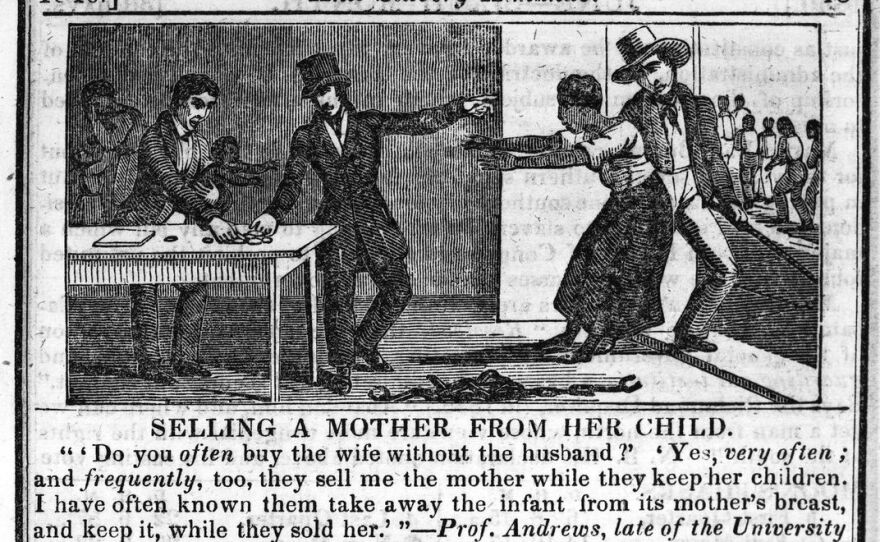
Since today is Juneteenth, a federal holiday that recognizes the date when the last enslaved persons were finally informed of their freedom, I thought about all of the children that were taken away from their parents, primarily from their mothers, during the period when slavery of Black people was common in these United States.

Black Perspectives is the award-winning blog of the African American Intellectual History Society (AAIHS). They are deeply committed to producing and disseminating cutting-edge research that is accessible to the public and is oriented towards advancing the lives of people of African descent and humanity. From the Black Perspectives website, LINK>Slavery and America’s Legacy of Family Separation by Vanessa M. Holden. Forced family separation was always a fixture of the lives of enslaved people. Enslaved children were a lucrative business. The expansion, maintenance, and future of slavery as an economic system depended on these children, particularly after the close of the American trans-Atlantic trade in 1808. 

One such story comes from Harriet Mason, who remembered her mistress forcing her to leave her home and family in Bryantsville, Kentucky, to work in Lexington as a servant at the age of seven. She remembered, “when we got to Lexington I tried to run off and go back to Bryantsville to see my [mother].” The grief of a childhood spent away from her family at the whim of her owner led her to suicidal thoughts, “I used to say I wish I’d died when I was little.” Even in her old age she was firm that, “I never liked to go to Lexington since.”

Slaveholders borrowed against their human property. They gifted enslaved children to their white sons and daughters as children, upon their marriages, or as they struck out to begin their slaveholding legacy. And of course, slave children could be sold down the road and down the river. Children knew that at any moment this could happen to them.

Blogger’s Note – Last night, my oldest son wanted to know if anyone in our family had benefitted from the labor of slaves. Eventually, it was suggested that every American has. I know that among my mother’s own genetic, biological family there were slave owners (I saw one will that was stipulating slaves by first name and who they were to be given to). I also know that side of my family also fought on the side of Confederates in the US Civil War. I’m not proud of being the descendent of these realities.

From the linked article – To profit from slavery and participate in slaveholding, Lexington’s white residents did not even need to own, buy, or sell a single slave. Someone made the shackles. Someone ran slave jails. Someone generated the official documents needed to transfer property. Someone hired enslaved children to work in their homes and businesses. Adults running with children from officials who would separate them was a feature of fugitivity during American slavery. To produce the “fugitive” category, a range of institutions sprang up. Local money paid sheriffs, courts, and officials to uphold the law that protected slaveholders’ rights to their human property. Someone printed runaway ads. Someone made money on enslaved peoples’ bodies at every juncture.

Along with physical labor, children deemed by the state to have unfit parents and placed into adoptive homes, perform emotional labor. Adoptees not only lose their birth families in the process, but they also lose ties to culture, language, country, history, and identity, and must contend with societal expectations that they be grateful for a “better life” in the face of it all. Children of color adopted by white parents also face racism in their new homes and communities. There is emotional labor too in being the physical body that allows white families to appear more liberal or multicultural, even if the opposite is true. In the United States, adoption is an industry and, as adoptee advocates continue to warn, it is poised to profit from family separation. There is already precedent for keeping children in the United States after a parent has been deported and awarding custody to American adoptive parents over immigrant parents caught up in immigration proceedings or because they were detained or incarcerated.

Black families are separated by the bond and bail system, incarceration, the child welfare system, and the criminalization of poverty. All can lead to family separation and the loss of one’s children. Child welfare advocates also recognize the link between the disproportionate number of Black children in the foster care system and the pipeline from foster care to prison.  All of these contemporary systems of power are echoes of legal and social structures that devalued enslaved parents and profited from enslaved children during American slavery.

We need to acknowledge these links to the history of American slavery and the ways that African Americans continue to endure discrimination. Following the money exposes the truth.

Enforcement Inequality

Back when we were expecting my oldest son, I really wanted a homebirth. I had been knocked out for my daughter’s birth and I really wanted to experience my next birth fully. Sadly, it was not to be. I was eventually convinced that the risk of passing on the hepC virus was greater with vaginal birth, than with a cesarean. Though deeply disappointed, it mattered to me not to pass on the virus (which I only recently was cured of). During the pregnancy, I became a member of the Friends of Missouri Midwives because midwifery was illegal in Missouri and they were working hard to get midwives accredited in my state.

This is why a recent story about a Black couple caught my attention. You can read the latest in The Guardian at this LINK>‘Family policing system’: how the US criminalizes Black parenting. Temecia Jackson told the story of the moment when police officers and child protection services agents had “stolen” her baby from her Dallas home. Her story was about how her newborn baby was taken from her because she opted to follow a midwife’s recommendation over a physician’s. Dr Anand Bhatt was concerned the family had the wrong idea about the treatment he recommended. Therefore, Bhatt wrote in a letter to child protective services (CPS) indicating that he had trouble getting in touch with the family.

The story has sparked outrage across the country. The family policing system is a structurally racist apparatus that disproportionately separates Black and Indigenous children from their families, one that traces its origins to chattel slavery, according to Dorothy Roberts, a University of Pennsylvania law professor. She is also the author of Torn Apart: How the Child Welfare System Destroys Black Families – and How Abolition Can Build a Safer World.

Temecia chose to give birth at home with a licensed midwife. Her daughter Mila Jackson was born on March 21st. Mila had developed a severe case of jaundice. The family chose to pursue the treatment recommended by Dr Bhatt at home with their midwife. Mila remains in a foster home. The family’s next hearing has been delayed until April 20th.

I believe I have previously written about another case in this blog. That would be the one related to Bianca Clayborne and Deonte Williams’s five children. Tennessee authorities “kidnapped” their children in February after a highway police officer stopped the family as they drove to Chicago for a funeral and found a small amount of marijuana in their car. The couple has since regained custody of their children but the kids spent more than a month and a half traumatized in foster care.

Roberts believes that the inequality in enforcement actions is due to the racial stereotyping of Black families, who are seen as unfit to take care of their own children. Black families are disproportionately impoverished and therefore encounter a child welfare system that, Roberts added, was designed “to handle the problems and struggles of impoverished families and to handle them in a very punitive and a cruel way by accusation, investigations and separation – and in many cases, termination of parental rights.” Temecia Jackson and her family’s conflict with their doctor in Texas about their newborn’s medical treatment raised a similar question about whether the Black parents’ decision-making – to choose at-home care instead of hospital care – had been devalued, Roberts added.

I would note here also that my grandson had jaundice after birth and was successfully treated AT HOME using phototherapy. This is treatment with a special type of light (not sunlight) which is used to treat newborn jaundice. The light makes it easier for the baby’s liver to break down and remove the bilirubin from the baby’s blood. Phototherapy aims to expose the baby’s skin to as much light as possible.

Progress in Washington State

Washington House Bill 1747: “Keeping Families Together” would encourage guardianships over termination of parental rights when possible. Black and Brown families are especially vulnerable — in Washington, Indigenous children are 2.7 times more likely and Black children are 2.4 times more likely than white children to experience the termination of both parents’ rights. This bill would help to reduce racial bias and inequities in the child welfare system.

Jamerika Haynes-Lewis who wrote an op-ed, LINK>HB 1747 Offers a Pathway to Keeping Families Together, for the South Seattle Emerald a year ago in January 2022 write – I think of my own experience as a foster child in the system. My world completely changed at 5 when I stepped into my first foster home. Though I had relatives and other people that could have served as guardians, this option was not considered. Instead, adoption was the only choice. This event led me to moving from the Eastside of Tacoma to becoming one of few Black children in Poulsbo, Washington. Away from my family and community connections, I suffered immensely from racism and an identity crisis. And I had to experience this alone, on my own.

I am unable to determine the current status of HB 1747’s effort. I did also find Washington House Bill 1295 at The Imprint LINK>Hidden Foster Care, which would guarantee legal counsel for hundreds of parents ensnared in “hidden foster care” — informal placements arranged outside of court oversight. In a practice deployed to varying degrees nationwide, social workers with the state’s Department of Children, Youth, and Families offer parents the option of voluntarily handing over their children to friends or family. In exchange, parents can provide input on where they would like to have the children stay without the dictates of a formal foster care placement. Legislation introduced by Rep. Lillian Ortiz-Self (D) would provide public defenders for those parents, who currently face separation from their children through contracts with the child welfare agency known as “voluntary placement agreements.” Such arrangements have been criticized by social work scholars and child welfare advocates, who say they can be coercive and strip parents of their due process rights.

“When you look at representation for such a critical decision in your life — whether or not to place your children in the care of the state — we just want to make sure that parents fully understand what they’re stepping into and what their options are,” Rep. Ortiz-Self said in an interview last week.

Optimistically, I believe that activists will continue making progress and will endeavor to remain informed as well as sharing what I learn here.

Siblings Bill of Rights Act

Change may come slowly but it does come. In New Jersey there is now a Siblings Bill of Rights Act. This includes –

  • Have access to phone calls and virtual visits between face-to-face visits with their sibling;
  • Be placed in the closest proximity possible to other siblings who are not in out-of-home placement or if placement together is not possible, when it is in the best interests of the child;
  • Have the recommendations and wishes of the child and of each sibling who participates in the permanency planning decision documented in the DCF case record and provided to the court;
  • Know, or be made aware by DCF, of expectations for continued contact with the child’s siblings after an adoption or transfer of custody, subject to the approval of the adoptive parents or caregiver;
  • Be promptly informed about changes in sibling placements or permanency planning goals;
  • Be actively involved in the lives of the child’s siblings, e.g., birthdays, holidays, and other milestones;
  • Not be denied sibling visits as a result of behavioral consequences when residing in a resource family home or congregate care setting; and
  • Be provided updated contact information for all siblings at least annually, including a current telephone number, address, and email address, unless not in the best interests of one or more siblings. 

Recently signed by Governor Phil Murphy, the law recognizes that children placed outside their home have several rights related to maintaining sibling relationships, including the right to remain actively involved in the lives of their siblings and to have their voice heard in the permanency planning process for their siblings. “In what could very well be the most difficult time of their young lives, it is our hope that this bill will allow siblings in the child welfare system to maintain some measure of stability and continuity,” Murphy said.

“One of this Administration’s goals has been to make sure the children and families in this state’s welfare systems are treated with compassion and empathy,” said Murphy. “I was deeply moved, as I’m sure my counterparts in the Legislature were, by the compelling recommendations of the Youth Council who shared their lived experiences of their time during the child welfare process.” The Council consisted of 24 members ages 14-23 who are or were previously involved with one of DCF’s programs such as Child Protection & Permanency or the Children’s System of Care. Youth Council members stressed that sibling relationships were crucial for maintaining stability and ensuring future success. 

DCF Commissioner Christine Norbut Beyer said the new law “represents the power of shared leadership and the importance of having individuals with lived experiences in a meaningful role at the table.”

“Ensuring children can maintain relationships with their siblings, arguably the people who best understand what they are going through, we can provide them with more stability and the possibility of invaluable, life-long family connections.” Assemblywomen Gabriela Mosquera (D-Gloucester), Carol Murphy (D-Burlington), and Lisa Swain (D-Begen) said in a joint statement.

“New Jersey has taken a stance on sibling rights — that they matter, they exist, and this is now the law,” Jack Auzinger, a member of the DCF Youth Council, said. 

~ story courtesy of Steve Lenox of Tap Into Patterson News – LINK

National Adoption Awareness Month

The original intent of this effort was NOT to take newborn babies away from their first parents but to raise awareness about ALL of the children in foster care who may age out of the system without supportive people in their lives.

In his LINK> proclamation, President Biden committed to “extending the adoption tax credit to legal guardianships — including grandparents, aunts, uncles, and other relatives — which would make it easier for loving family members to care for children who need their support.  This measure could also help reduce racial inequities in our country’s child welfare system, which too often render some children of color more likely to be removed from their homes and cut off from their families and communities.” This is a reform to the adoption system long advocated by activists and that I frequently mention here.

President Biden also said – The Department of Health and Human Services will provide training and technical assistance to State child welfare agencies in order to better support LGBTQI+ youth, whose needs are often unmet in the foster care system, and take steps to ensure all youth are placed in supportive environments. 

Additionally, the administration is committed to ensuring that older adolescents transitioning from the foster care system have access to housing and education and can pay their bills and prepare for adulthood. President Biden has proposed increased funding for the John H. Chafee Successful Transition to Adulthood program by 70 percent. John Chafee was a Republican, Governor of Rhode Island and a US Senator. He also served in the Marine Corps. He died in 1999.