13 Years !!!

It actually doesn’t come as a surprise to any of us who are well informed about foster care in these United States. Even so, it is still possible to surprise me never-the-less. NPR described today that LINK>Texas could face fines over dysfunctional foster care system. Texas has been in litigation over its foster care system for nearly 13 years. A federal court is now weighing whether to impose hefty fines over the system’s inability to make progress.

Not only Texas but America’s foster system is in crisis. Sadly, Texas’ network is among the most troubled. NPRs story includes details of self-harm by one foster care youth – “I always get judged for my arms.” NPR notes – The 18-year-old’s left arm is covered in scar tissue from hundreds of self-inflicted cuts.

She explains – “people didn’t want to keep me. Or I feel like people didn’t want anything to do with me because I look like I’m insane. But in all reality, we’re not insane. We just are looking for somebody to love us.” NPR notes – Since she was 14, she spent her time being shuttled between treatment centers and psychiatric hospitals, often changing doctors and medications each time, never finding stability. So now, more than a dozen placements and 230 different medications later, she says the state’s child welfare system is a lie.

Children without placement hotels exist because Texas doesn’t have enough places for children, the ones with high mental health needs. Federal court monitors call these placements dangerous, noting in its reports times when kids got assaulted, ran away or were sex trafficked. And for more than three years, what was supposed to be a temporary placement for kids has often lasted for weeks or months. The state says it has cut the numbers of children without placement in half, but it’s still more than 100 kids a month. It’s cost $250 million over three years.

Texas has been aggressively refusing and opposing reform. It is a big system with lots of problems, but the state’s leadership is just not willing to work cooperatively to get it fixed or to find solutions. Federal District Judge Janis Jack calls the bureaucracy that produced these ongoing failures horrible. One in four caseworkers leave within a year of being hired. One person asks – “if state leaders can spend billions erecting barriers on Texas’ southern border, why can’t they fix this?”

NPR notes – Texas is not the only state to deal with legal fights over foster care. Alabama, Mississippi and Kansas have all dealt with federal oversight. Many still are. One former foster care youth says Child Protective Services (in Texas) was so bad that she would have rather stayed with her abusive family.

Conceived In A Mental Hospital

Gloria Taylor

My adoptee father was never interested in learning about his origins. I get it. Sometimes, DNA testing brings an uncomfortable truth to light, as it did for this woman. She shares her story at Right to Know >LINK Gloria Taylor.

Gloria writes that “In 2019 I finally got the nerve to confront my then 89 year old mother when she came to visit from California. Little did I know when I asked the question that I would experience another shock. It turned out the man I believed to be my biological father was instead my uncle. His younger brother was my BF. My mother met him while working at a State Mental Hospital where he was a patient. All that played over and over in my head was I was conceived in a mental hospital. I felt like I was trapped in someone else’s nightmare.”

“I felt sick, and I remember thinking not my perfect mother. Suddenly the memories of my childhood came rushing in; never feeling like I belonged, overwhelming sadness, not looking like anyone in my family, and always feeling something was off about me. I was crushed. I was surprised to learn I am 52% European, 40% African (with 9 % being Afro Caribbean), 5% Asian, and 3 % Hispanic. I was shocked to learn of the Asian, Caribbean, and Hispanic heritage.”

She further shares – “I have always had this self loathing destructive side. I would look in the mirror and think how ugly I am. I often thought about suicide, and I would cut my arms to relieve the pressure in my head. I still struggle with finding something good about myself. I have always self identified as black, although it was always apparent in my family growing up we were of mixed ethnicity. My maternal grandmother was also multiracial. Discovering my ethnicity breakdown, led me down a another road of emotional turmoil. I’m still trying to figure out where I ethnically fit.  At this point in time I choose to identify as mixed.”

She ends her essay with this – “I am no longer angry, and have forgiven my mother. I understand there are things that happened in her life that probably led her down this road. I think sometimes we forget our parents are human too. I still can’t seem to find my place in either family, and feel I exist in a space somewhere between both worlds. I grieve for all that was lost, but am hopeful that in time I will find my place.”

I hope that in time, she finds peace.

Adverse Childhood Experiences

For several months now our entire country and most of the world has been living with toxic stress.  It’s the kind of stress that puts you on edge and keeps you there, day after day after day.  If you have felt stressed, imagine what it would be like to experience adversity and/or abuse — not having enough to eat or being exposed to violence – then think, what if the one experiencing this is still a child.

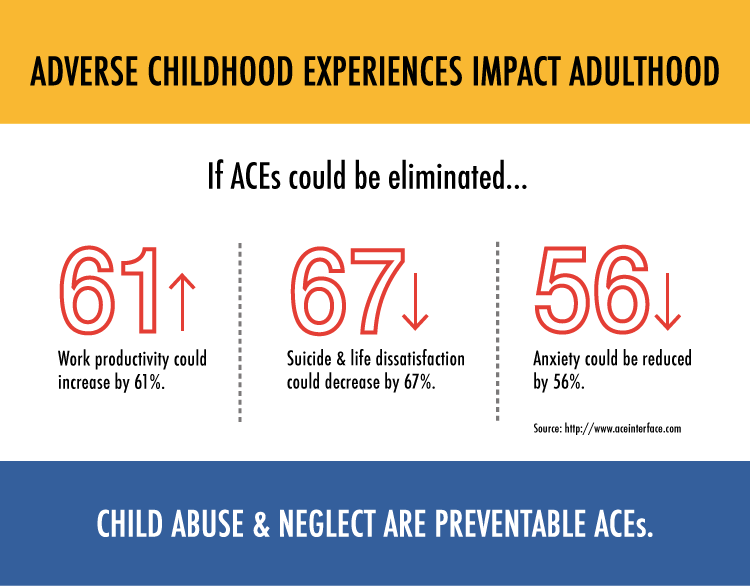
Factors such as divorce, domestic violence or having an incarcerated parent are called adverse childhood experiences (ACEs). Four or more ACEs can result in chronic health conditions such as heart disease or diabetes. In the long term, living with ACEs or other negative factors, such as poverty, can literally change your brain chemistry.

What does it look like for a young person to live with several ACEs and no supports ?  What does a foster parent experience when bringing a middle school or teenage foster youth into their home ?

It might be not being able to sleep without a light on. Or it could be eating even when one is full or not hungry. Some children become “runners” — they leave school whenever they become upset.

And the symptoms can become even worse.  The child may become a cutter; may be suicidal. Such children can have trouble forming appropriate friendships. Maybe they trash their room; in one fight-or-flight moment, climb out of their window and tumble to the ground. Even jump out of a moving car.

A foster parent could find themselves restraining the child physically by wrapping their arms around the child’s shoulders or waist, using all their strength to keep the child from leaving or hurting their self. Maybe you raised your hand only to motion toward something and the child flinched or even ducked.

And your heart breaks for this young person.  You had hoped they knew you would never hit them.  You are a foster parent.  You signed up for this because you thought you had something to give — time and care and love — to kids who desperately need that.

You might become the person the county calls when a child is removed from a home and has nowhere else to go, or when a foster family needs a break. This is known as emergency respite.

Most foster kids want to be happy.  After a lifetime of abuse and neglect, they may not know how.  A foster parent is also there to be a support for reunification with the biological family.

The best foster parents build a fortress of protective factors around their foster children. Protective factors are those things that most of us take for granted — a friend to call when we need advice; someone to help whenever we aren’t enough on our own.

Some of us are born privileged to have built-in protective factors (a supportive family, enough money).  Most foster kids will need to collect them from somewhere else (perhaps a chosen family made up of friends). At school, they require trauma-informed teachers and staff who understand how ACEs can be reflected in behavior.

National data shows that more than 20 percent of children up to age 17 have experienced two or more ACEs.  Beyond abuse (physical, emotional, sexual) and general neglect these include the loss of a parent to death, divorce and abandonment.  A family member addicted to drugs or alcohol.  A family member that is incarcerated. Being exposed to domestic violence and mental health issues among the family’s members.

Brain toxicity exists. A child can have post-traumatic stress disorder. ACEs are not limited to low-income neighborhoods, domestic violence and substance abuse take place in higher income homes and are every bit as toxic. Learn to look at all people through a trauma-informed lens. Ask, if you suspect this, “What happened to you?” and then listen without adding your own opinions.

Every domestic-violence shelter worker or child-care provider, anyone who works for child-protective services, anyone associated with family court, law enforcement personnel and physicians – ALL need to be trained appropriately to deal with trauma related behavior

Trauma is not the fault of any child.  Understanding ACE impacts allows adults to see the reason behind the behaviors.  Baby steps in a positive direction are progress.