The Legacy Of Family Separation

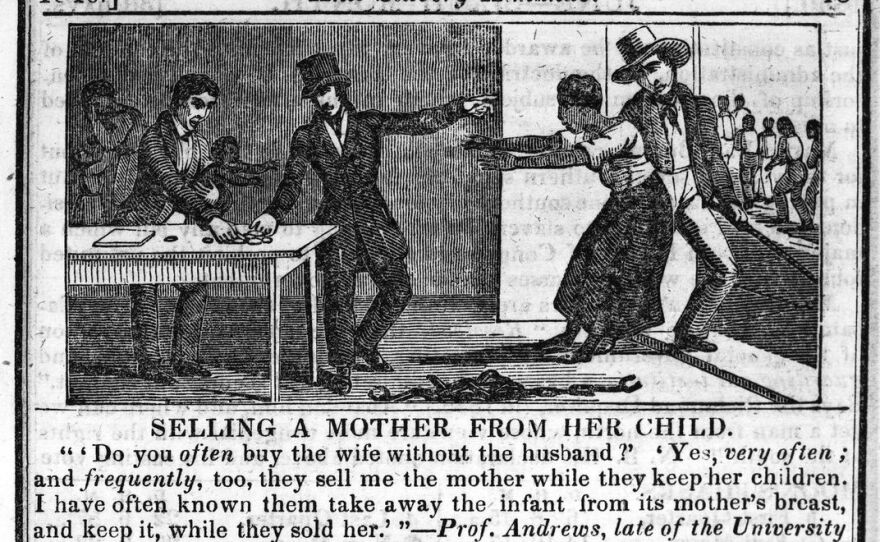
Since today is Juneteenth, a federal holiday that recognizes the date when the last enslaved persons were finally informed of their freedom, I thought about all of the children that were taken away from their parents, primarily from their mothers, during the period when slavery of Black people was common in these United States.

Black Perspectives is the award-winning blog of the African American Intellectual History Society (AAIHS). They are deeply committed to producing and disseminating cutting-edge research that is accessible to the public and is oriented towards advancing the lives of people of African descent and humanity. From the Black Perspectives website, LINK>Slavery and America’s Legacy of Family Separation by Vanessa M. Holden. Forced family separation was always a fixture of the lives of enslaved people. Enslaved children were a lucrative business. The expansion, maintenance, and future of slavery as an economic system depended on these children, particularly after the close of the American trans-Atlantic trade in 1808. 

One such story comes from Harriet Mason, who remembered her mistress forcing her to leave her home and family in Bryantsville, Kentucky, to work in Lexington as a servant at the age of seven. She remembered, “when we got to Lexington I tried to run off and go back to Bryantsville to see my [mother].” The grief of a childhood spent away from her family at the whim of her owner led her to suicidal thoughts, “I used to say I wish I’d died when I was little.” Even in her old age she was firm that, “I never liked to go to Lexington since.”

Slaveholders borrowed against their human property. They gifted enslaved children to their white sons and daughters as children, upon their marriages, or as they struck out to begin their slaveholding legacy. And of course, slave children could be sold down the road and down the river. Children knew that at any moment this could happen to them.

Blogger’s Note – Last night, my oldest son wanted to know if anyone in our family had benefitted from the labor of slaves. Eventually, it was suggested that every American has. I know that among my mother’s own genetic, biological family there were slave owners (I saw one will that was stipulating slaves by first name and who they were to be given to). I also know that side of my family also fought on the side of Confederates in the US Civil War. I’m not proud of being the descendent of these realities.

From the linked article – To profit from slavery and participate in slaveholding, Lexington’s white residents did not even need to own, buy, or sell a single slave. Someone made the shackles. Someone ran slave jails. Someone generated the official documents needed to transfer property. Someone hired enslaved children to work in their homes and businesses. Adults running with children from officials who would separate them was a feature of fugitivity during American slavery. To produce the “fugitive” category, a range of institutions sprang up. Local money paid sheriffs, courts, and officials to uphold the law that protected slaveholders’ rights to their human property. Someone printed runaway ads. Someone made money on enslaved peoples’ bodies at every juncture.

Along with physical labor, children deemed by the state to have unfit parents and placed into adoptive homes, perform emotional labor. Adoptees not only lose their birth families in the process, but they also lose ties to culture, language, country, history, and identity, and must contend with societal expectations that they be grateful for a “better life” in the face of it all. Children of color adopted by white parents also face racism in their new homes and communities. There is emotional labor too in being the physical body that allows white families to appear more liberal or multicultural, even if the opposite is true. In the United States, adoption is an industry and, as adoptee advocates continue to warn, it is poised to profit from family separation. There is already precedent for keeping children in the United States after a parent has been deported and awarding custody to American adoptive parents over immigrant parents caught up in immigration proceedings or because they were detained or incarcerated.

Black families are separated by the bond and bail system, incarceration, the child welfare system, and the criminalization of poverty. All can lead to family separation and the loss of one’s children. Child welfare advocates also recognize the link between the disproportionate number of Black children in the foster care system and the pipeline from foster care to prison.  All of these contemporary systems of power are echoes of legal and social structures that devalued enslaved parents and profited from enslaved children during American slavery.

We need to acknowledge these links to the history of American slavery and the ways that African Americans continue to endure discrimination. Following the money exposes the truth.

Almost Never Acceptable

It’s very hard to understand why ANYONE would choose to take another mom’s (or dad’s) child either through adoption or by becoming a foster caregiver. The only acceptable path I see is true kinship, when their parents are dead, ie they are orphans (both of my parents were adoptees and I thought they were orphans when I was a child – I was totally ignorant that biological family existed and was living lives unknown to me). Other than that, no possible excuse.

So here are some questions for adoptive parents and foster caregivers to contemplate: How do you not see what an absolutely horrible thing this is to do? Have we as humans become so blind that we see taking another mother’s child as a good thing? Where is the accountability for adoptive parents and foster caregivers since they are contributors to this huge problem of family separation? Why are we constantly talking about the best interest of the child and not the best interest of the family? Do adults who lose their children not count as well?

A better choice is guardianship and not adoption – if there are children who have arrived in your home, who aren’t able to be with their first/birth family. Allowing them their identity and knowledge of their genetic family.

One should feel absolutely sick to their stomach, if they’ve built their own ‘motherhood’ on another woman’s brokenness and loss. How cruel and selfish, to be so focused on your infertility loss, that you failed to see the other humans in your family’s picture.

No one advocates kids being abused. 

Our society needs to be doing something before a crisis sets in. Maybe the parents need support and some intervention but this should occur WAY before it becomes necessary to remove children from their natural home. Maybe those parents didn’t have a good role model, to show them how to parent properly. Without a role model for how it is done, it can really be an impossible task. Maybe if, as a society, we didn’t leave so many parents unsupported, there would be no need for adoptive parents and foster caregivers.

I know that this sounds very utopian. The challenge is actually translating this into the real world solutions. So how would real world people make a difference for families where the children have been separated from their parents for apparently valid reasons involving the child’s welfare? Here are some ideas related to foster care . . .

The social end goal for that situation is reunification of the children with their parents. There are a lot of steps along the way. Weekly urine analysis requirements, parenting classes, drug counseling, therapy, visits/phone calls with kids, parents needing housing, a job, education, showing up to court.

As a foster parent your job should be to walk along side the parents as an additional support to them in their own efforts. You can’t make anyone do anything, but you can support them, encourage them and remind them of the ultimate goal. You can help pay for those weekly urine analysis requirements, if $10 a week is too much. You can help them get signed up for parenting classes, you can drive them to parenting classes. You can help them find a drug program and get started with therapist. You can provide transportation and support after those sessions. You can go to court and support them and advocate for them. You can help them get to visits, or call them instead of waiting for them to call. You can help by providing resources for housing/jobs. Transportation, if needed.

And then after you’ve helped, you’ve taught them a lot about where to access the resources they need. You’ve shown them what they can do for themselves. And now, they may have many of the skills they need to be successful. You’ve lead them to goal by supporting them and making them feel safe that you aren’t only there to take their children away. Now they can find their own way to parenting their children properly.

And the inconvenient truth is this – too many foster parents flat out refuse to spend any time with the children’s parents or even talk to them because they look down on them as inferior and damaged and not worthy of help. Yes, it is true that some children’s parents are not safe, but it is more true that most of these parents simply need some help to be safe.

#NotMyNAAM

It was almost two years ago now, that the door opened for me on my parents adoptions.  I had already lived 6 decades of my life and both of my adoptee parents had passed away.  In this brief amount of time, I have been able to become “whole” as regards my parents original parents – ie I now know who my grandparents were and something about each of their individual stories but thanks to adoption, I’ll never know them.

As I began to educate myself about all of the aspects related to adoption, I also truly began to understand there was something rotten in adoptionland.  I have also begun to learn about better alternatives for seeing to the well being of children and hopefully to the healing and repair of their original families.  Society has a long way to go.  I digress and not really.

The paradox for my own self comes when I consider the reality of my own existence.  Two major aspects of that have become crystal clear for me in the last two years.  [1]  I would not exist but for adoption – my parents would have never met.  [2]  It is a miracle that I was not given up for adoption as well.  Conceived by an unwed teenage mother in the deepest part of the Baby Scoop Era, I believe it was my dad’s adoptive parents who insisted that he quit the university he had only started to study at and do the “right” thing, marry my mom and go to work.

So becoming aware of ALL of the problems with adoption presents quite a quandary for me personally.  Even so, I am a #NeverAdoption convert now.  November is National Adoption Awareness Month.  It is NOT a time to celebrate the ripping apart of families to support a profit-driven and often ignorant practice but a month to begin to educate yourself if you believe adoption is all unicorns and rainbows, ie happy endings always.

#NotMyNAAM