12 years ago my brother got married and had a baby very young. About two years into the marriage his wife wanted to separate, so they were co-parenting. She then decided she wanted full custody and made a laundry list of allegations against my brother in order to obtain that, but ultimately was not successful. When that failed, she told him he was not the father— which turned out to be true. At this point my brother had raised this child for 3 years and loved being a father and was absolutely devastated. A series of events led to him making the decision to step aside and sign away his parental rights so that the mother, real father, and baby could be a family. It shattered him and he processed it like a death of a child.
9 years have past since he stepped away. Since then the biological father has completely disappeared and she has been remarried 4 separate times. She has been placed in an involuntary psych hold on 2 separate occasions and has some serious mental health struggles.
Fast forward to this month. Everyone in my family, including myself and my husband, have received letters from Texas Child Protective Services (where the mother lives— all of us are in New York) looking for family of this child and saying there is an open case. We responded saying that we know of the child in question and are awaiting more information.
My questions are: Does this letter mean the child is in CPS (Child Protective Services) custody/the system ? What happens here, since we are not actually blood related to this child ? Does this mean the mother has been deemed unfit in some way ? Or that other family has been unresponsive to this search for connections to this child ?
The grandparents on the mother’s side are incredibly abusive, and her sibling is in jail for shooting a gun at someone in a park. It seems the biological father’s family wants no part of this child’s life. I have no idea what any of us in my family would do from here— my brother is married and now has a 4 month old— and no one in my family is in a great place to take in a child, nor am I sure that would be the right thing to do ? But we are all very concerned— we loved this child deeply and were heartbroken when all of this took place. I know at this point she is a traumatized pre-teen who has probably been through hell and back. I guess I’m just wondering what the right thing to do in this situation is, and looking for context for what this CPS letter means in terms of the child’s welfare.
One knowledge response was – They are clearly looking for Fictive Kin. Please try to discover more and if / how your family (especially your brother) can get involved for the youth’s sake.
Similarly – They are looking for fictive kin. This can be anyone who has had any connection with the child (neighbors, parent’s co-workers, religious community, teachers, etc.). It’s heartening to know that CPS has actually contacted you all. The best way to get a better picture of what’s going on to with the child is to respond to the CPS letter. You’ll most likely be placed in contact with a social worker who’s been working on the case. I have a list of questions you can ask (see below). Hoping for the best for the child, her natural mother, and your brother.
Here is a list of questions for a situation such as this –
Reason for Placement:
Can you tell me a bit about what led to the child being placed in foster care ? Just trying to understand their backstory a bit.
How’s the child handling the transition into foster care ? Any particular challenges they’re facing ?
Legal Proceedings/Termination of Parental Rights:
Has there been any progress or updates regarding legal proceedings or the possibility of terminating parental rights ?
How’s the child navigating through any legal stuff ? Are they aware of what’s happening, and how are they coping with it ?
Child’s Development:
What’s the current living situation like for the child ? How are they adjusting to it ?
Can you tell me a bit about the child’s personality and interests ? Just trying to understand what makes them tick.
How’s the child doing in school ? Are there any particular subjects or activities they excel in ?
Do they have any hobbies or talents that they’re passionate about ? Just curious about what brings them joy.
Family Dynamics/Relationships:
How often does the child get to see or communicate with their biological family ? And how are those interactions going ?
How do they get along with their foster family and peers ? Any budding friendships or challenges they’re facing ?
Support and Services:
What kind of support services are available to the child and their foster family ?
Are there any particular cultural or religious considerations we should keep in mind while caring for the child ?
Future Plans/Goals:
What are the long-term goals or plans for the child’s placement ? Any steps you’re taking to work towards those goals ?
How can we, as their foster family, best support them in their growth and development ?
Health and Well-being:
Are there any health concerns or medical needs we should be aware of ? How are you addressing those ?
How does the child express their feelings or emotions ? And how can we help them develop healthy coping skills ?
At least one mom in my own mom’s group decided to have a child with no man in sight. For same sex female couples who want children but want to be ethical about doing the right thing, what are the options ? One offers her experience.
I’m a queer parent to a donor-conceived child and also have adopted kids through foster care.
The topic has come up before but is always interesting to me and just inherently homophobic—that women who have conceived a child by having sex are encouraged to keep and raise the child – no matter what: mental health issues, extreme poverty, abusive partners—but then, queer people are told there’s no ethical way to have a child. So somehow sex with a man makes it ethical and idealized?? So having sex gives you a right to parent – no matter what, and if you can’t get pregnant by having sex, you have no right to have children and should go mentor kids….there’s just no way to view this stance as anything but homophobia.
The ethics of sperm donation, in my opinion, based on learning from donor conceived people and also my experience as someone abandoned by my father, is that anonymous sperm donation is not ethical. I chose to conceive with a known donor who has no interest in parenting/co-parenting but is a known and present figure in our lives. [blogger’s note – I agree that any reproductive donors ought to be known. Every person should have access to their genetic background.]
Fostering is a different story. When we went into it, we were open to adopting (if things went that way) but really tried to approach it as us supporting a family in crisis by being that safe healthy person who could watch the kid(s) until the parents got back on their feet. We fostered 8 children and have adopted 4, which statistically is in line with our state’s averages that 50% of placements reunify. Our first adoptee has 3 siblings in two different families, neither of which was willing to take her. Our second adoption is a sibling set of three, with few healthy family members, a lot of criminal involvement and in incarceration, and years of trying to find a way for parents or family to be a resource. There were only a couple of healthy family members but they were unwilling to take on 3 young children. Unlike the usual assumptions, we had zero plans to adopt them and would have gladly welcomed family for them. Yet if we didn’t adopt them, they would have been moved again to non-relatives, which would have increased their trauma, so we did the right thing for them. I don’t say this for any accolades—I say it because the reality for these kids is that at this moment in time, we’re their best option.
So yes, in my opinion, there are ways to ethically raise children, even if you can’t have sex with a man.
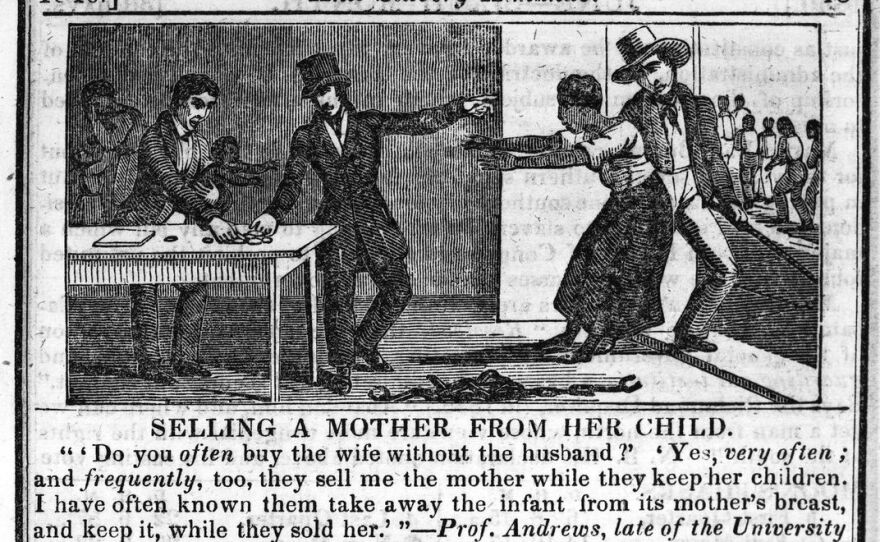
Since today is Juneteenth, a federal holiday that recognizes the date when the last enslaved persons were finally informed of their freedom, I thought about all of the children that were taken away from their parents, primarily from their mothers, during the period when slavery of Black people was common in these United States.
Black Perspectives is the award-winning blog of the African American Intellectual History Society (AAIHS). They are deeply committed to producing and disseminating cutting-edge research that is accessible to the public and is oriented towards advancing the lives of people of African descent and humanity. From the Black Perspectives website, LINK>Slavery and America’s Legacy of Family Separation by Vanessa M. Holden. Forced family separation was always a fixture of the lives of enslaved people. Enslaved children were a lucrative business. The expansion, maintenance, and future of slavery as an economic system depended on these children, particularly after the close of the American trans-Atlantic trade in 1808.
One such story comes from Harriet Mason, who remembered her mistress forcing her to leave her home and family in Bryantsville, Kentucky, to work in Lexington as a servant at the age of seven. She remembered, “when we got to Lexington I tried to run off and go back to Bryantsville to see my [mother].” The grief of a childhood spent away from her family at the whim of her owner led her to suicidal thoughts, “I used to say I wish I’d died when I was little.” Even in her old age she was firm that, “I never liked to go to Lexington since.”
Slaveholders borrowed against their human property. They gifted enslaved children to their white sons and daughters as children, upon their marriages, or as they struck out to begin their slaveholding legacy. And of course, slave children could be sold down the road and down the river. Children knew that at any moment this could happen to them.
Blogger’s Note – Last night, my oldest son wanted to know if anyone in our family had benefitted from the labor of slaves. Eventually, it was suggested that every American has. I know that among my mother’s own genetic, biological family there were slave owners (I saw one will that was stipulating slaves by first name and who they were to be given to). I also know that side of my family also fought on the side of Confederates in the US Civil War. I’m not proud of being the descendent of these realities.
From the linked article – To profit from slavery and participate in slaveholding, Lexington’s white residents did not even need to own, buy, or sell a single slave. Someone made the shackles. Someone ran slave jails. Someone generated the official documents needed to transfer property. Someone hired enslaved children to work in their homes and businesses. Adults running with children from officials who would separate them was a feature of fugitivity during American slavery. To produce the “fugitive” category, a range of institutions sprang up. Local money paid sheriffs, courts, and officials to uphold the law that protected slaveholders’ rights to their human property. Someone printed runaway ads. Someone made money on enslaved peoples’ bodies at every juncture.
Along with physical labor, children deemed by the state to have unfit parents and placed into adoptive homes, perform emotional labor. Adoptees not only lose their birth families in the process, but they also lose ties to culture, language, country, history, and identity, and must contend with societal expectations that they be grateful for a “better life” in the face of it all. Children of color adopted by white parents also face racism in their new homes and communities. There is emotional labor too in being the physical body that allows white families to appear more liberal or multicultural, even if the opposite is true. In the United States, adoption is an industry and, as adoptee advocates continue to warn, it is poised to profit from family separation. There is already precedent for keeping children in the United States after a parent has been deported and awarding custody to American adoptive parents over immigrant parents caught up in immigration proceedings or because they were detained or incarcerated.
Black families are separated by the bond and bail system, incarceration, the child welfare system, and the criminalization of poverty. All can lead to family separation and the loss of one’s children. Child welfare advocates also recognize the link between the disproportionate number of Black children in the foster care system and the pipeline from foster care to prison. All of these contemporary systems of power are echoes of legal and social structures that devalued enslaved parents and profited from enslaved children during American slavery.
We need to acknowledge these links to the history of American slavery and the ways that African Americans continue to endure discrimination. Following the money exposes the truth.
Someone noted – Foster Care causes 61% of All Child Abuse in America. So I went looking and found this, at The Annie E Casey Foundation – LINK>Child Welfare and Foster Care Statistics. KIDS COUNT is a robust source of the best available data on child well-being in the nation. This includes state-by-state data on child abuse and neglect and children living in out-of-home care from the National Child Abuse and Neglect Data System, the federal Adoption and Foster Care Analysis and Reporting System, and the National Youth in Transition Database. These data help our Foundation and leaders across the country to monitor trends, assess the child welfare system, and advance policies and practices to improve outcomes for children, youth and families — particularly for children of color who are overrepresented in the system and more likely to experience negative outcomes.
KIDS COUNT offers more than 60 measures of child welfare, encompassing how many children and youth are in the system, the rates at which they enter it, their demographic characteristics (including race and ethnicity when available) and their experiences in foster care, exiting care, being adopted when applicable, aging out of the system and more. In addition to child welfare statistics at the national and state levels, KIDS COUNT also provides data by territory, when possible. Policymakers, child welfare agencies and others have used these data for decades to understand how well the system is meeting the needs of vulnerable children, youth and families, and how it can be strengthened so that all abused and neglected children can heal and grow up with safe, stable families.
Children and youth who experience trauma, including abuse or neglect, are at increased risk for long-term emotional, behavioral and physical health problems, among other challenges. The data measures high-risk behavior, such as juvenile justice system involvement and substance abuse, difficulties with mental health, physical health and academic performance. The consequences of child maltreatment can be mitigated with equitable access to trauma-informed services and nurturing, lasting family relationships and support.
Foster care is meant to provide safe, temporary living arrangements and support services for children who have been removed from their families due to maltreatment, lack of safety or inadequate care. The rate of children entering foster care has hovered at 3 or 4 per 1,000 for two decades. Kids ages 1 to 5 make up the largest share (29% in 2021) of children entering care. National data also show that Black and American Indian and Alaska Native children continue to be overrepresented among those entering foster care. The reasons for this are complex, and efforts to improve racial equity in child welfare have been underway for many years.
In encouraging news, placements with relatives increased from 25% to 35% during 2000–2021, while placements in group homes or other facilities were cut in half, from 18% to 9%. Fewer children are placed in pre-adoptive homes (4% in 2021) or have trial home visits (5%), and some older youth live independently with supervision (2%). Over a third of foster children and youth experience more than two placements each year, meaning their living arrangements change at least three times a year. Child welfare agencies are working to minimize these moves, as they are disruptive, stressful and often traumatizing. Stable relationships and home environments are critical for healthy child and youth development.
Of the more than 54,000 kids adopted out of the child welfare system in 2021, over half were young kids ages 1 to 5, consistent with previous years. Most of these adoptions are by the foster parents (either relatives or non-relatives), who cared for the children while in foster care. Unfortunately, the median amount of time in foster care has increased over the last decade — from 13.2 months in 2011 to 17.5 months in 2021, based on children who exited care in each year. However, the percentage of kids who spent 5+ years in care declined slightly from 7% to 5% in the same time period. Among children who exited foster care in 2021, about a third (35%) were there less than a year, while nearly half (48%) spent 1 to 3 years in care and 12% stayed in foster care 3+ years.
More than 19,000 youth left foster care in 2021 without reuniting with their parents or having another permanent family home. Thankfully, this figure has declined since peaking at nearly 30,000 in 2008. The transition to adulthood is a significant and challenging developmental phase of life for all young people, but youth aging out of foster care on their own must face this without the support of a stable, loving family. Many also lose access to services and supports that were offered to them through the foster care system. Not surprisingly, these youth and young adults are more likely to experience behavioral, mental and physical health issues, housing problems and homelessness, employment and academic difficulties, early parenthood, incarceration and other potentially lifelong adversities. In line with the racial inequities noted earlier, youth of color are more likely to experience these challenges. The trajectories of these young people are not unavoidable. They can be positively influenced by policies and practices that ensure these vulnerable youths receive culturally-responsive, trauma-informed transition services and support to navigate the steps to adulthood, achieve stability and reach their full potential.
We don’t always see the flip side of adoptee reunions but I do read about them sometimes in my all things adoption group. Here’s one I read about today –
I found my birth family 2021. It’s probably been more painful to find them, than great. It has brought me a lot of tears and hurt and confusion to be honest. My birth mom is in Jail and will be forever. I will never meet her. On the other hand, I have a large birth family. My adoptive parents are wonderful people, My adoptive mom is African American and my adoptive dad is white. Upon finding my birth family, turns out they are extremely Mexican. Although, of course, I’m Mexican by blood, I have no idea of the culture or even the Spanish language. I have found it harder to fit in and to feel like “one of them,” I had been told I have an older sister. Let me tell you, I thought it’d be rainbows and unicorns….NOT. It is so hard to break through her high wall. She is very introverted and private. I know she’s trying but there’s been times she shuts me out, whenever she goes through whatever stuff.
I just feel as if, still today, they all don’t feel at all like “family,” as much as I want them to. I feel like such an odd ball around them, when they talk about childhood memories and all… I just sit there feeling like an outcast. I didn’t have a sibling growing up, so I think I’m craving that more than the sister I have found … She grew up with siblings, so she doesn’t crave the same way I do…and it sucks. Anyway, I found out the other day that my birth aunt is on Hospice. I was invited to go and say my goodbye’s. I’m not heartless but I just feel as it’s not my place, since I have only talked to her 3 times since I found them. I don’t wanna offend anyone by not going. But I honestly don’t want to go… and I’ve just been dealing with my own stuff. I hate to hurt other people’s feelings, I mean if I don’t go, would they think less of me or that I just “don’t care ” or ..
Another adoptee replied – it bothers me so much when people say “oh they can just find them when their adults” because like you said, you missed out on so much and feel like an outcast. My birth mother has dementia and other medical issues and her niece is very controlling and just when I thought I had made some headway with being able to see her, she went in the hospital and no one told me, until I was on my way to visit on Christmas day when I texted my uncle. Then, I didn’t know where she was because it was being kept a secret from other family members (who I don’t even talk to). Anyway, sorry to spill part of my long story but just so you know, I understand how you feel.
For myself as well. Not an adoptee but the child of 2 adoptees who has found family that my parents were robbed of ever knowing. It is true, one can’t make up for all those missing years of family interactions that one doesn’t have, after living apart for decades. I find that I now don’t feel truly “related” to all my adoptive family and I don’t feel a part of my genetic family. It sucks really.
It doesn’t take long if spending time among adoptees to learn about the strong link between foster care and adoption. Foster care is often the first step in that direction as children are removed from their parents and placed with strangers. The official goal is reunification of the family when it is deemed safe for the children to be returned to their parents. That does happen in many cases after an emotionally damaging experience for all concerned. Other times the parent’s rights are terminated and in the case of infants and young children, often these are adopted by the foster parents or some other hopeful adoptive parent. And in too many cases, these young children “age out” in the system and are thrown out into the world as young adults with few supports, though that situation has improved somewhat in recent years.
Yesterday, I learned about the link between the building pictured above and foster care. Dr Joseph DeJarnette was a proponent of racial segregation and eugenics, specifically the compulsory sterilization of the mentally ill. He was known to idolize Nazi Germany and took the facility under his management from a resort-like treatment center to an apocalyptic prison nightmare. His determined efforts resulted in the passage of the “Eugenical Sterilization Act of 1924” (a.k.a Racial Integrity Act). This new act reinforced racial segregation by preventing interracial marriages and classifying “white” as being pure 100% Caucasian. Men and women who were admitted to his hospital were involuntarily sterilized to prevent the conception of mixed race human beings. DeJarnette also forcibly sterilized single mothers, alcoholics, those with mental conditions and epilepsy, the poor, and the incarcerated. Dr DeJarnette not only performed countless sterilizations but also medical procedures on his patients like electroshock therapy and lobotomies.
He died in 1957. DeJarnette became a state institution with a focus on children’s behavioral health issues. It is at that point in the history of this place that my interest today became awareness. If you believe emotional energy leaves traces of residual energy in a place, then in that sense DeJarnette is believed haunted. A young woman writing an op-ed for LINK> The Huffington Post brought that awareness to me.
At the age of 14, the author was relatively new to the foster care system and waiting for a bed to open up at a long-term facility. The author walked those halls, recognizes the once-grand arches that frame the doorways, the bedrooms with graffitied walls. She says, “Dr. Joe’s evil spirit is said to walk the halls. Some say they’ve heard children’s voices in the darkness or moans and other noises from the former patients reported to have perished due to medical experiments. I doubt the teens who once lived there were aware of Dr DeJarnette by name. I wasn’t. However, the building’s ties to eugenics were among the first things new kids learned about the center.”
She goes on to note that she asked – “Why did they do it?” And the answer she got was – “They think your kids are gonna end up like you. If we don’t have babies, they’ll be less of us and more of them.” She says – “I wasn’t totally sure what more of them meant but I understood less of us. Less of me.” She also shares that she lived in DeJarnette during the winter with the holidays were approaching. It was her first Christmas in the system. Her expectations were perpetually low back then. She fixated on the phrase anything you want when asked to provide a Christmas wish list with one condition – as long as it’s less than 10 dollars. She remembers asking for a Def Leppard tape even though she no longer had her boom box. Receiving the tape symbolized hope and the belief that someday, she would have a tape player again.
We don’t often consider what it is like for a teen living in foster care. That they don’t have typical teenage memories like going to the homecoming dance, having their first date, a sweet 16 party or getting a driver’s license. What she did get was a strong sense of her ability to survive. She made it through the system and didn’t become a statistic. She says that she is thriving today. She says of that residual energy – “when you consider the collective traumas and experiences of all those who spent time in that cavernous, state-run institution, there was plenty of haunting going on. It wasn’t ghosts, though. It was us.”
Pro-Adoption advocates are likely to cheer the increased availability of newborn infants for adoption if the Supreme Court does basically, at least in effect, overturn Roe v Wade. Adult adoptees will mostly mourn the likelihood.
On this day, I found an interesting blog titled – Christians: We’re NOT READY to Abolish Roe v Wade. The author admits – “I am a man. I am an adopting father. I am a minister. I am Christian. These are my inherent biases right at the top.” He also writes – “as I’ve observed pro-life culture throughout my adult life, I’ve noticed a problem – We’re not ready for it. We’re not ready for all the babies. Literally.”
He adds this thought – If Roe v Wade is overturned, many of these new babies could eventually end up in the foster care system or be put up for private adoption. And not just once, but every single year. The foster care system as it stands today is already stressed – 400,000 + children are already in a system that is underfunded, understaffed, and suffers from a lack of certified families available to foster and adopt. An additional 600,000-1 million children every yearwill overwhelm the foster care system in every possible way.
He asks – Are you willing to put your feelings aside and sacrifice space in your heart and home for children who need stability while their family situation is sorted out, knowing they could be reunified with their birth families? Are you prepared to give up several weekends to undergo the education necessary to foster? He also asks – Are you prepared to spend thousands of dollars to adopt privately?
One of the problems I have had with the whole Pro-Life movement is that it is NOT about quality of life. It is only about getting babies born – and then, who cares what kind of life they or their mother have after that?
These babies that result from ending Roe v Wade may not be white infants; and if coming through foster care, these will likely be children with a host of behavioral, mental, emotional, and spiritual problems. When these children age out of foster care at the age of 18, they will likely end up incarcerated and having babies of their own who will then also end up in the foster care system. Imagine having nowhere to go during Christmas. Imagine having no family to celebrate your birthday with you. That’s what it’s like for children who age out of foster care. Foster care children (in the literal and legal sense) are refugees in their own country.
This one could get some Conservatives’ attention – To be ready for all these post-Roe v Wade babies, we’re going to have to pay more in taxes, mostly on the state level. Many conservatives want abortion to end, but also want to cut the government programs that help mothers and families who decide to keep their babies to survive financially. This would also include stipends from the state that go to foster families to help them cover the additional costs of caring for these children. Are you willing to say that the babies need to live, but need to do it without the aid that sustains them? I believe that this question actually repeats the primary goal of the Pro-Life movement – birth but no financial aid for families.
He then asks – Christians, are you willing to accept that comprehensive sex education beyond abstinence must happen to reduce pregnancies?
Reality bites, doesn’t it ? In conclusion – If you are NOT prepared to do more than vote and post on Facebook concerning abortion, then stop calling yourself pro-life. You are pro-birth. You want the children to be born, but you’re not willing to do anything for them after they are born, and thus you condemn them to a life where they’re much more likely to be mired in poverty, crime, incarceration, and a continuing cycle of giving birth to unplanned children.
Whether it gets through or not, it is a step in the right direction. New legislation authored by California Rep. Karen Bass (D), would drastically change that standard: Under the 21st Century Children and Families Act, states could not even attempt to permanently sever children from their parents until they’d been in foster care for two full years consecutively, barring extreme circumstances — and even then it would be up to the states, and no longer a federal mandate. The reason that this is important is that the 1997 Adoption and Safe Families Act (ASFA) requires states to terminate parental rights when a child has been in foster care for 15 of 22 consecutive months. Granted this is just a tiny step.
“This bill is an important first step in moving away from cookie-cutter timelines that have caused devastating harm to children and families for decades,” said Kathleen Creamer, managing attorney of the family advocacy unit for Community Legal Services in Philadelphia.
Existing exemptions would be maintained for certain “aggravated” circumstances, such as when parents have committed sexual abuse or have been involved with the death of another child. But the legislation would free parents from the federal timeline when their custody rights are threatened due to incarceration or immigration detention — or in cases where they are actively working with the court to overcome hurdles in their lives to successfully bring the family back together. Parents are not subjected to the federal timeline if their children are placed with relatives.
Under the bill, if a state so chooses, it could eliminate all timeline requirements, except in cases involving aggravated circumstances.
Bass announced her landmark legislation in a news release Thursday. “It’s time to update old child welfare laws,” she said. “More needs to be done to improve foster kids’ options for stability in their lives. Premature modification of parental rights too often leaves children in foster care with no legal family.”
The legislation is at the earliest possible stage, and far from guaranteed, with many elements that could lead to controversy, including strengthening the rights of prospective LGBTQ parents. The bill could also be challenged by representatives of the adoption industry, policy watchers said.
“With respect to the timelines, we’ll be looking at those proposed changes carefully and considering how they affect children and families involved in foster care, especially BIPOC children and families, given the systemic discrimination they face,” said Mary Boo, executive director of the North American Council on Adoptable Children.
Children removed from their homes following allegations of abuse or neglect remain in foster care while their parents address the issues that landed them there, issues typically arising from extreme poverty. Under family and dependency court oversight, local child welfare systems must mitigate the circumstances that led to the child’s removal into foster care, offering the parents therapy, anger management, parenting classes and drug treatment, as well as the time necessary to overcome situational crises such as homelessness or illness.
Charles Redding barbecues for his two children last Easter at the home of a relative in St. Paul, Minnesota. The family is now in dependency court fighting to stay together.
But that time is often not enough. The pandemic has brought heightened scrutiny to the “cruelty” of federal timelines. Parents such as Charles Redding of Minnesota have fought to regain custody of their children when circumstances are stacked against them to no fault of their own. Redding, for instance, had emerged from jail with no computer to attend court-mandated hearings and online classes, and the local center where he needed to go for drug testing suspended services. Earlier this year, Redding’s two children sobbed through a virtual court appearance, imploring a Hennepin County juvenile court judge to give their dad more time to secure stable housing for them to live together.
David Kelly, a former official in the U.S. Children’s Bureau, called the bill introduced this week “a critical, long overdue step toward justice for families,” adding: “I hope it proves a galvanizing moment for realizing the family children need most is their own.”
Bass is a longstanding champion of children and parents caught up in the foster care system — families who are disproportionately Black and Native American. She is among those emphasizing that the bar for reunification is often too high, and the impact of permanent family separation too damaging to continue the federal standards as they currently exist.
“The changes that I’m proposing today focus the foster care system on the child and the idea that children should be at the center of our efforts,” Bass stated.
Her legislation would require that before moving to terminate parental rights, states must describe the steps they took and services they provided to help keep a family together. It would also mandate data collection on the accessibility and availability of those services.
Shanta Trivedi, director of the Sayra and Neil Meyerhoff Center for Families, Children and the Courts at the University of Baltimore said that while states are already required under law to provide services under a “reasonable efforts” standard, the proposed law will ensure that protocol is followed for every family.
“This puts teeth into the ‘reasonable efforts’ requirement that were previously absent,” Trivedi said.
The bill has another key element: It adds sexual orientation, gender identity and religion to federal nondiscrimination protections that previously only included race and ethnicity. Under the proposed law, states and agencies they contract with could not “deny to any person the opportunity to become an adoptive or a foster parent” based on those additional factors. The provision would directly challenge laws in nearly a dozen states that permit faith-based providers to exclude members of the LGBTQ community by following religious ideology in choosing which foster and adoptive parents, or even which youth in foster care, they will and will not serve.
The legislation proposed by Bass retains current legal requirements that adoptions cannot be delayed to match children with families of the same race, gender, culture and religion. But it instructs states to consider such factors if that is requested by the child or their birth parent.
When the Adoption and Safe Families Act became law decades ago, nearly a third of all foster children had been in the system for at least three years. The timeline was designed to push those cases in the direction of adoptions or guardianships so that children didn’t languish with uncertain futures.
Since then, adoptions from foster care have more than doubled — from 30,000 in 1998 to 66,000 in 2019. Over the past decade, federal statistics show that the number of children awaiting adoption has also increased, by more than 20%.
The attempt to rewrite ASFA comes at a time when some are pushing for its outright repeal, including Jerry Milner, the Trump-era head of the U.S. Children’s Bureau. Along with Kelly, his former deputy, Milner now leads a consulting group helping state and local systems interested in significant reforms of their child welfare systems, including the strengthening of family bonds so children can avoid permanent family separation.
Critics of the current timeline that pushes for termination of parental rights after 15 months describe it as arbitrary and unjust to the families who mostly come from communities of color where daily life and the weight of historic and systemic injustice can bear down on home life. Advocates for parents say the federal timeline also penalizes people in recovery for substance abuse or seeking treatment for mental health challenges — complex healing that can take time and involve relapse and setbacks.
In a February 2021 op-ed, Creamer and Chris Gottlieb, co-director of the NYU School of Law Family Defense Clinic, described the social context around the original law: “Passed in the wake of the now-debunked ‘crack baby’ scare, and at the same time as nefarious federal laws on crime and welfare, it reflected the racial and class biases that were ascendant at the time and that to this day continue to inflict harm on children, youth and families.”
Under the proposed legislation, a 24-month timeline was selected to align with the Family First Prevention Services Act, a 2018 law that overhauled the federal child welfare system to decrease reliance on group homes and emphasize foster care prevention. But as it is currently worded in the Bass bill, states could choose not to abide by the two-year timeline — the legislation as written uses the word “may” — not “shall” — while continuing to receive federal funds for the children who remain in foster care.
“We are hopeful that this is just the beginning of making sure that states have the flexibility they need to embrace and uphold family integrity,” said Shereen White, director of policy and advocacy for the national nonprofit Children’s Rights.
Child welfare policy consultant Maureen Flatley, who helped craft both the original Adoption and Safe Families Act and Bass’ new bill, said the additional protections for parents would not only help more children reunify with their families, it could reduce the number of young adults who leave foster care alone and disconnected from stable housing, income or a support system.
Flatley said while the timelines can succeed at creating a greater sense of urgency around permanency for foster youth, roughly 22,000 youth still age out of foster care each year with no legal family ties. Meanwhile, many of their parents may simply have needed more time to complete court-ordered service plans.
“By maintaining those family connections and those relationships, we may be able to mitigate and limit the number of kids who are aging out alone,” Flatley said.
Under the 1997 Adoption and Safe Families Act, states have received financial incentives to push foster children along the adoption path, despite critics’ objections. Bass’s bill does not address adoption incentives, instead taking aim at timelines that lead to the termination of parental rights — a critical first step for children to be adopted.
Still, even staunch detractors of the existing law applauded Bass’s attempt to update it through a social justice lens.
“I don’t know what the chances are for passage, but the fact that we can even have this discussion shows that the racial justice reckoning finally is reaching child welfare,” said Richard Wexler, an outspoken foster care critic and executive director of the National Coalition for Child Protection Reform. “If it passes, it will improve the lives of, ultimately, millions of children.”
I was reading through a story this morning. No idea of the reasons this young father is incarcerated but he seems to care about his child in foster care. I’ll do my best to sum up the situation and share someone else’s personal experience in a similar situation.
A baby girl was placed with a foster family. The father won’t be released for another 4 years. The mom has never shown up for court dates. The father was forced to since he is in the state’s control. The foster parents were petitioning the state for a ruling of abandonment on behalf of the little girl in their care. In court, this father said that he did want his daughter. He claims he has previously sent a list of family members who might be willing to care for her until he is released. The caseworker is now doing background checks on his family members to determine if any of these are suitable to care for his daughter until he is available. This foster parent is angry because this little girl has been with her since birth. So she claims that placing this little girl with anyone else will be traumatizing because her foster parents are the only parents she has ever known. She actually says, “I pray that none of his family are suitable.”
The response from experience – my dad was in jail when my mom lost her rights and the state REFUSED to keep me in foster care till he got out (less than a yr sentence). My dad was so mad about it he ended up flipping out in court and getting more time added onto his sentence because he threatened the lives of everyone in the court room once he learned they were forcing against his rights. My dad got remarried a few years after he got out and ended up having 6 more kids that he still has custody of. He and his new wife kept a portrait of me hanging in their bedroom my entire childhood but I never knew that because I had a closed adoption. My adoptive parents would speak badly about my dad for being in jail. They said he was violent, unhinged, etc etc. I definitely get some of my zest from him!! He was never the psychopath they made him out to be. Just a desperate young dad in a bad situation. He swears to this day that the state kidnapped his daughter. Fathers “rights” are hardly exist. The state could wait until this dad can get out of jail and acquire the stability to take care of his daughter. If there are other family members willing to help out, then great! The state should have been looking for them from the beginning!
If the state has someone in custody, they shouldn’t be hard to track down to discuss custody arrangements and extended family.
Co-founded last year by artist Mark Bradford, philanthropist and collector Eileen Harris Norton, and social activist Allan DiCastro, Art + Practice (A+P) “encourages education and culture by providing life-skills training for foster youth in the 90008 ZIP code as well as free, museum-curated art exhibitions and moderated art lectures to the community of Leimert Park.”
Art + Practice is seeking to enrich the neighborhood and change lives with a focus on the community’s foster youth.
In California, there are more than 55,000 youth in foster care, the largest foster care population in the nation, according to A+P. An untold number of youth transition out of foster care without the resources for higher education and the skills for employment, leaving them susceptible to post-traumatic stress disorder and vulnerable to homelessness and incarceration.
Bradford has responded to what he calls a crisis in the foster care system by partnering with the The RightWay Foundation, which serves current and emancipated foster youth. Together, the organizations are providing job training and mental health services to local youth in a creative and educational environment.
“They need jobs, places to live and then we can talk about everything else,” says Bradford. He further explains why he decided to take up the cause: “I feel like artists are outsiders for one reason or another and in many ways foster youth through no volition of their own are outsiders,” Bradford says. “So I thought well one outsider group to another, maybe we can create a platform, and maybe we can create a conversation.”
Mark Bradford has been named one of Time magazine’s 100 Most Influential Persons for 2021. That is how I learned about his focus on youth transitioning out of foster care.






 Missing Mom