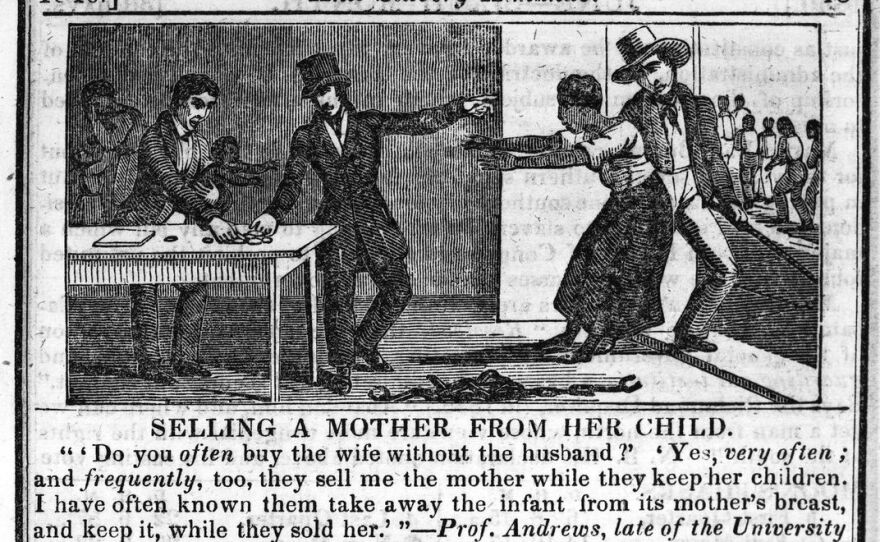
The Legacy Of Family Separation

Since today is Juneteenth, a federal holiday that recognizes the date when the last enslaved persons were finally informed of their freedom, I thought about all of the children that were taken away from their parents, primarily from their mothers, during the period when slavery of Black people was common in these United States.

Black Perspectives is the award-winning blog of the African American Intellectual History Society (AAIHS). They are deeply committed to producing and disseminating cutting-edge research that is accessible to the public and is oriented towards advancing the lives of people of African descent and humanity. From the Black Perspectives website, LINK>Slavery and America’s Legacy of Family Separation by Vanessa M. Holden. Forced family separation was always a fixture of the lives of enslaved people. Enslaved children were a lucrative business. The expansion, maintenance, and future of slavery as an economic system depended on these children, particularly after the close of the American trans-Atlantic trade in 1808. 

One such story comes from Harriet Mason, who remembered her mistress forcing her to leave her home and family in Bryantsville, Kentucky, to work in Lexington as a servant at the age of seven. She remembered, “when we got to Lexington I tried to run off and go back to Bryantsville to see my [mother].” The grief of a childhood spent away from her family at the whim of her owner led her to suicidal thoughts, “I used to say I wish I’d died when I was little.” Even in her old age she was firm that, “I never liked to go to Lexington since.”

Slaveholders borrowed against their human property. They gifted enslaved children to their white sons and daughters as children, upon their marriages, or as they struck out to begin their slaveholding legacy. And of course, slave children could be sold down the road and down the river. Children knew that at any moment this could happen to them.

Blogger’s Note – Last night, my oldest son wanted to know if anyone in our family had benefitted from the labor of slaves. Eventually, it was suggested that every American has. I know that among my mother’s own genetic, biological family there were slave owners (I saw one will that was stipulating slaves by first name and who they were to be given to). I also know that side of my family also fought on the side of Confederates in the US Civil War. I’m not proud of being the descendent of these realities.

From the linked article – To profit from slavery and participate in slaveholding, Lexington’s white residents did not even need to own, buy, or sell a single slave. Someone made the shackles. Someone ran slave jails. Someone generated the official documents needed to transfer property. Someone hired enslaved children to work in their homes and businesses. Adults running with children from officials who would separate them was a feature of fugitivity during American slavery. To produce the “fugitive” category, a range of institutions sprang up. Local money paid sheriffs, courts, and officials to uphold the law that protected slaveholders’ rights to their human property. Someone printed runaway ads. Someone made money on enslaved peoples’ bodies at every juncture.

Along with physical labor, children deemed by the state to have unfit parents and placed into adoptive homes, perform emotional labor. Adoptees not only lose their birth families in the process, but they also lose ties to culture, language, country, history, and identity, and must contend with societal expectations that they be grateful for a “better life” in the face of it all. Children of color adopted by white parents also face racism in their new homes and communities. There is emotional labor too in being the physical body that allows white families to appear more liberal or multicultural, even if the opposite is true. In the United States, adoption is an industry and, as adoptee advocates continue to warn, it is poised to profit from family separation. There is already precedent for keeping children in the United States after a parent has been deported and awarding custody to American adoptive parents over immigrant parents caught up in immigration proceedings or because they were detained or incarcerated.

Black families are separated by the bond and bail system, incarceration, the child welfare system, and the criminalization of poverty. All can lead to family separation and the loss of one’s children. Child welfare advocates also recognize the link between the disproportionate number of Black children in the foster care system and the pipeline from foster care to prison.  All of these contemporary systems of power are echoes of legal and social structures that devalued enslaved parents and profited from enslaved children during American slavery.

We need to acknowledge these links to the history of American slavery and the ways that African Americans continue to endure discrimination. Following the money exposes the truth.

Adoptees Deserve Better

Steve Inskeep, is a co-host of NPR’s “Morning Edition” and “Up First.” He is an adoptee and an adoptive father. He penned an op-ed in the New York Times recently titled For 50 Years, I Was Denied the Story of My Birth. I share excerpts below.

In 1968, a woman appeared for an interview at the Children’s Bureau, an adoption agency in Indianapolis. She was in her 20s and alone. A caseworker noted her name, which I am withholding for reasons that will become apparent, and her appearance: She was “a very attractive, sweet looking girl,” who seemed “to come from a good background” and was “intelligent.” She had “blue eyes and rather blonde hair,” though the woman said her hair was getting darker over time, like that of her parents.

Her reason for coming was obvious. She was around 40 weeks pregnant. She told a story that the caseworker wrote down and filed in a cabinet, where it would rest for decades unseen. The expectant mother said she had grown up in Eastern Kentucky’s mountains, then migrated north as a teenager to find work after her father died. She was an office worker in Ohio when she became pregnant by a man who wasn’t going to marry her. The most remarkable part of her story was this: When she knew she was about to give birth, she drove westward out of Ohio, stopping at Indianapolis only because it was the first big city she encountered. She checked into a motel and found an obstetrician, who took one look and sent her to the Children’s Bureau. She arranged to place the baby for adoption and gave birth the next day.

The baby was me. Life is a journey, and I was born on a road trip. I spent 10 days in foster care before being adopted by my parents, Roland and Judith Inskeep, who deserve credit if I do any small good in the world.

In recent decades, open adoption has been replacing closed and sealed adoptions. The rules governing past adoptions change slowly. Mr Inskeep was not allowed to see his birth records. Everything he has shared about his biological parents was unknown to him growing up. He says, “They were such a blank, I could not even imagine what they might be like.”

His adopted daughter is from China, and like many international adoptees, she also had no story of her biological family. A social worker suggested to him that his adopted daughter might want to know his own adoption story someday. So I requested my records from the State of Indiana and was denied. Next I called the Children’s Bureau, where a kind woman on the phone had my records in her hands, but was not allowed to share them.

In 2018, the law in Indiana changed. Many adoptees or biological families may now obtain records unless another party to the adoption previously objected. In 2019 the state and the Children’s Bureau sent me documents that gave my biological mother’s name, left my biological father’s name blank and labeled me “illegitimate.” On a hospital form someone had taken my right footprint, with my biological mother’s right thumbprint below it on the page.

I saw something similar on my mom’s adoption file records. Tennessee had changed the law in the late 1990s for the victims of the Georgia Tann scandal only, sometime after they denied my mom but no one ever told her. My cousin told me she got her dad’s file (he was also adopted from The Tennessee Children’s Home) after my dad died in 2016 and that is why I now have the file my mom was denied on flimsy reasoning (her dad, who was 20 years old than her mom could not be proven to have died, though her mom had died and the state of Tennessee didn’t really try very hard).

Mr Inskeep writes – It’s been nearly two years since I first read those documents, and I’m still not over it. Knowing that story has altered how I think about myself, and the seemingly simple question of where I’m from. It’s brought on a feeling of revelation, and also of anger. I’m not upset with my biological mother; it was moving to learn how she managed her predicament alone. Her decisions left me with the family that I needed — that I love. Nor am I unhappy with the Children’s Bureau, which did its duty by preserving my records. I am angry that for 50 years, my state denied me the story of how I came to live on this earth. Strangers hid part of me from myself.

2% of US residents — roughly six million people — are adoptees. A majority were adopted domestically, with records frequently sealed, especially for older adoptees. Only nine states allow adoptees unrestricted access to birth records. Indiana is among those that have begun to allow it under certain conditions, while 19 states and the District of Columbia still permit nothing without a court order (I came up against this in Virginia). Also California, when my dad was born, I could get nothing out of them. Florida also remains closed.

This spring, more than a dozen states are considering legislation for greater openness. Bills in Florida, Texas and Maryland would ensure every adoptee’s access to pre-adoption birth records. Proposals in other states, like Arizona, would affirm the rights of some adoptees but not others. The legislation is driven by activists who have lobbied state by state for decades. Many insist on equality: All adoptees have a right to the same records as everyone else.

Equality would end an information blackout that robs people of identity and more. Mr Inskeep notes what my mom (an adoptee) often said to me – “I was never able to tell a doctor my family medical history when asked.” For that matter, until I learned who my original grandparents were from 2017 into 2018, I didn’t know mine either because BOTH of my parents were adoptees.

Closed adoption began as “confidential” adoption in the early 20th century, enabling parents and children to avoid the stigma of illegitimacy. Records were sealed to all but people directly involved. In a further step, by midcentury, even parties to the adoption were cut out. Agencies offered adoptive parents a chance to raise children without fear of intrusion by biological parents, and biological parents a chance to start over.

Access to information about one’s genetic background, heritage, and ancestry is a birthright denied only to adoptees. An adoptee is expected to honor a contract made over his or her body and without his or her consent.