Using Adoptees for Social Media Clout

This came up in my all things adoption group. Many were aware that this couple had adopted their daughter. Some of the comments included –

From an adoptee – They make themselves seem like these saviors – baby’s mom chose them. They have so much access to resources, they couldn’t help baby’s mother???

From a kinship adoptee – Using their adopted children for clout. Some even use their adopted child’s race for clout.

Another adoptee – these two make me absolutely sick to my stomach. They adopted her right around when I was learning lots about the primal wound. I ended up having to block/hide any content from them because the thought of that little baby being taken away from her mother was effecting me massively.

A mother of loss to adoption writes – it’s alarming to me how many people use adoptees for social media clout.

Adoptive Parent Perspective

A birth mother posted a photo, 17 years later, upon reunion with the daughter she gave up for adoption. The birth mother wrote – “Every year on her birthday, every Mother’s Day, every holiday, every moment that passed, I felt her absence.”

In response, an adoptive mother wrote – Speaking from the other side of the equation, it IS heartbreaking to know that after a lifetime of love and effort in raising your child, that ultimately you’re never going to be enough for them. You’ll ultimately be forced to share what it usually means to be a parent.

I full understand the point of view of the adopted child. Trust me when I say, there is a lifetime of pain for everyone involved. The biological mother suffers a lifetime of separation and uncertainty. The adopted child suffers from not knowing the particulars about their own biology.

And then there is a double dose of suffering for the adoptive parents. To begin with, usually one of the adoptive parents are unable to have biological children, so the adoptive parents are forced to mourn the loss of the children they will never have.

Next comes the search for a child in need, then, there is the huge financial burden. No matter what avenue you choose, it ends up costing tens of thousands of dollars in paperwork and other fees. Then the adoptive parents are forced to go through almost 2 years of background checks and in home assessments. Again I full understand how necessary these steps are. That being said, it is still a LOT of stress and costs that biological parents don’t have to incur and deal with.

Adoption is difficult for everyone involved, and honestly, if asked if I would go through the adoption process again ? My choices may not be the same. This is something that people, particularly adoptive parents, usually refuse to share publicly.

Our Very Own Chimera

I learned a long time ago that a little bit of every baby one carries in pregnancy stays in the mother as some of that baby’s cells. Was reminded of that recently by a Medium notifications of an essay by an adoptee, Mindy Stern LINK>My Dead Mother and Me, (which I couldn’t actually read much of because I am no longer a Medium member) and went looking for more. I found this – LINK>Fetal Maternal Microchimerism. This phenomenon gets its name from the chimera, a creature you might have heard of in Greek mythology that was part goat, lion, and dragon, hence the image I selected for today. Fetal Maternal Microchimerism explains situations where a mother’s body contains stem cells from her child in her body for years after childbirth. 

Stem cells are the building blocks of life. They’re found in our body’s tissues, blood, organs, and immune systems. Once in the body, they use chemical cues from neighboring cells to grow into the same material as their surroundings. What makes them so unique is their ability to help repair or replace damaged or diseased cells within the body. Because of this innate ability, they can treat various medical conditions such as blood disorders, cancers, and immunodeficiencies. You may surrender your baby to strangers to raise in what is referred to as adoption but bits of that baby will be with you always.

When a woman is pregnant, she experiences placental immune suppression, which keeps the body from viewing the baby as an “intruder.” Scientists believe this occurrence allows for microchimerism because it will allow the fetus’ cells to sneak past the mother’s immune defenses without being marked as foreign. Since this immune suppression can remain for several months after delivery, there is ample time for the fetal cells to establish themselves and become a part of the mother’s body. Women do not produce Y chromosomes, yet research findings suggest that the Y chromosomes come from the cells of their sons being transmitted during pregnancy (blogger’s note – which interests me as I have given birth to 2 sons). Scientists have found fetal cells in scar tissues, specifically scars left by C-sections. It is theorized that these cells from the baby help the mom recover after birth by repairing wounds (blogger’s note – both of my sons were delivered C-section).

Both child and mother benefit from this exchange of fetal cells. The mutual desire to survive requires cooperation from both mother and baby. The baby’s innate desire to survive is prominent long before birth. Looking out for their mother’s health ensures the baby can develop safely. Science is proving that there is a very deep fetal-maternal bond. With my sons, I know I influenced their taste in food and, beyond my heartbeat and voice, my emotional energy enveloped them in utero. A newborn is not a blank slate, where it can be assumed the gestating mother can be easily replaced. The relationship between a mother and her child goes far beyond the nine months of pregnancy. Maybe someday, we will no longer separate the two of them, as is currently encouraged by governmental pro-adoption policies.

Sometimes The Pain Is Great

Black History Month

Trauma is stored in the DNA that is passed down through generations to descendants. One of the worst traumas that our country of the United States is guilty of is how long slavery lasted and how it was followed by Jim Crow laws. We still have a long way to go.

Today a Black mother who was coerced (and she is quick to note that coercion is not consent) but who believed lies about having an open adoption that would allow her ample contact with her son, who is being raised by white adoptive parents, was ranting. Her pain is palpable. My heart breaks as I read her words.

One hears echoes of that ancestral trauma in her first thoughts – Adoptees are bought and sold. You can change their name, their entire birth certificate & identity. They are then tasked with fulfilling the role you paid for them to fill.

She notes that due to this being a transracial adoption – it does not allowing the child’s body to give and receive all of the genetic input they would get with the biological parents, when they live & grow together. Instead the adoptive parents are fine with that and not because “the lifelong trauma of adoption + no genetic mirrors + maternal separation + finding out he was stolen and his parents wanted him back + unseasoned cultural trauma + possible religious trauma + the trauma of being transracially adopted & mean kids shit on him for it all throughout his life ” but believe he is better off than “2-3 years of trauma + therapy + reunification”.

What she seeks is that they give the child back to its biological family, noting that is not abandonment, it’s reunification. Also that a child will still seek out their true parents, even when raised by genetic strangers.

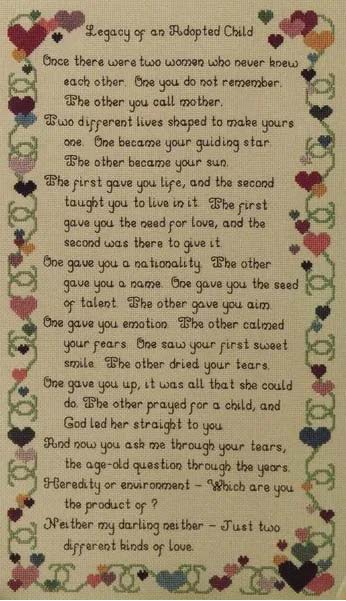
Heredity Or Environment

I had not heard of this poem before but read about it today. A lot of adoptees are familiar with it and many hate it (so a word of advice to adoptive parents – just don’t). One notes that for an adopted child – culture, facial features, accents – all of it is so important. Blogger’s note – for the child of 2 adoptees, all of that mattered to me as well.As to the question – heredity or environment ? – I would quickly say that I am the product of both.My ancestors’ genes and the Mexican border region where I grew up.

One adoptee notes that – for some reason A LOT of adoptive parents seem to not really like their children… (Not all of them but MORE THEN I could have imagined). Blogger’s note – I would say that my adoptee mom often felt like she disappointed her adoptive mother. Now that I have the whole adoption file from the state of Tennessee, I can see letters in my adoptive grandmother’s easily recognizable handwriting about how over the moon happy she was initially with my baby mom. But children grow up – always.

One adoptee actually re-wrote the poem – (Blogger’s note, the sentiments match so much I’ve read over the last few years)

Legacy Of An Adopted Child
The Rewrite

Once there were two women,
who never knew each other

One you learned how not to remember,
the other you learned to call mother

Two different lives,
shaped to make you a pretend one

One became your deep black hole,
The other your imploding sun

The first one gave you life,
yet chose to give you away

The second taught you to live it,
in all but fake way

The first gave you a need for love,
that soon would be denied,

The second there to give it,
if only you learn to comply

One gave you a nationality,
that they chose you to not live,

The other changed your name,
your own mother chose to give

One gave you emotions,
that you would soon learn to squash,

The other fed your fears,
that they themselves had taught

One saw your first sweet smile,
still chose to hand you off,

The other dried your tears,
forgetting your deep loss

One made an adoption plan,
which sounds so politically correct,

The other prayed for a child,
and thinks God let her collect.

And now you ask me through your tears,
which of these you’re a product of,
One, my darling, one

Adopters can be so smug

~ Joy Belle, 2018

A transracial adoptee also wrote one and said “I’ve always hated that poem”.

The Fallacy of the Transracially Adopted Child

Once there were two women who never knew each other
One you don’t remember, one paid to be your mother

Two women’s lives forever changed to shape your little one,
Leaving you with trauma that could never be undone.

One gave you ethnicity, and one erased your name,
and then was called your rescuer for “saving” you from pain.

One gave you emotions that you struggle to suppress
with performative gratitude to mask your deep duress.

One coerced to give you up, told it was best for you,
But if she’d had that 30k, she could have raised you too.

One prayed for her own white babe, but met with sticker-shock,
And then she saw your bargain price on the modern auction block.

That same one finally took you home, her consolation prize
with curly hair, and plump full lips, brown skin and deep brown eyes

The other one left wondering if she made the right decision,
Or if her heart will ever heal from the pain of your excision.

And so you wonder through countless years
Of expectations and hidden fears

Was your arrival preordained by a hand from heaven above,
Or did your 2nd mom purchase you to fill her need for love?

~ Renata Hornik, 2021

Blogger’s note – The originaI version is author unknown. I do hope the poets don’t object since I do not have express permission to share these, though they are signed with a copyright date. These are true unfettered adoptee voices and I honor them today by sharing their feelings with my readers.

Society’s Unseen Realities

For some time now, I’ve been slowly reading through The Tao of Physics by Fritjof Capra. I’ve always been fascinated by the science of physics, even though I may not totally understand a lot of it. I’ve almost finished Capra’s book and the big thing I took away from it is how interconnected EVERYTHING is.

So it was that I was attracted to a Medium piece – LINK>Exploring Quantum Connections in Adoption by Shane Bouel. You may or may not be able to read it. I will excerpt some parts in case.

Shane notes – “The state of one entangled particle instantly influences the other, similar to how the separation of a mother and child through adoption can have far-reaching emotional consequences.” The separation of a mother from her child leads to complex emotions and psychological challenges for both of them. Adoptees may experience conflicting emotions as they navigate their relationships with both their birth mother and adoptive family. Birth mothers, too, may grapple with complex emotions related to the decision or lack of, to place their child for adoption. He says that “Ultimately, the goal is to create a more empathetic and compassionate environment for adoptees and their birth families.” His goal is my goal in publishing this blog as well.

An intricate web of relationships connect individuals to their environment. Quantum mechanics finds that particles are interconnected and influence each other’s states – regardless of distance. The concept of attachment has a parallel in the idea of entanglement. Particles are intrinsically linked. Adoptees navigate the uncharted territory of identity and belonging. The separation experienced by adopted individuals parallels the entangled state of particles. The emotional journey of adoptees . . . is intertwined with societal perceptions, recognition, and acknowledgment.

Dr Sue Morter delivered the message at Agape last Sunday and photons were very much a part of how she described energy acting. Shane writes – “Quantum mechanics, traditionally applied to the microscopic realm, is gradually revealing its influence on macroscopic effects, including DNA interactions and biophoton communication within the body. This bridge between the quantum and the macroscopic echoes the connection between the unseen emotional trauma of adoption and its far-reaching implications on adoptees’ lives.” And in fact, in Capra’s book, he describes the understandings being applied on a large scale to the whole cosmos.

Shane emphasizes – “The historical instances of forced adoption and exploitation highlight the need for societal acknowledgment and reconciliation.” In conclusion, he says “. . . the emotional threads of adoption connect lives in ways we may not fully perceive.”

Shane’s writing seeks to lift standards of ethics and morality related to adoption by sharing the truth he perceives and has experienced.

Really Missing The Point

This graphic image was posted in another group than the one indicated. It was posted in a group for all people who have an experience of adoption. I have learned a lot there. In the beginning, I didn’t know squat. I will admit it. Both of my parents were adoptees, both of my sisters gave up babies to adoption and even in my own life, I unintentionally lost physical (but not legal) custody of my first born daughter. All of this, I have learned, is at least somewhat, if not directly, related to my parents having been taken from their original mothers in the first year of their life.

So I did come into this particular group believing that adoption was a good thing. I got smacked down right out of the gate in getting to know this group. I shut up and started learning. One adoptive parent who adopted the children in her family out of the foster care system system, admits similarly – “There are a lot of things in this group that are hard to read. I will admit that my feathers were ruffled at first and thought I should leave. I’m so glad I didn’t because I have learned a lot that I hope will make me a better adoptive parent. The truth is spoken here. Sometimes the truth hurts but maybe that just means we need to learn to be comfortable being uncomfortable.”

One adoptee said – You know what pisses me off the most – about how they claim how “mean” adoptees are? The adoptive parents and foster parents that think that they can just “erase” the fact that the child was not born to them.  Then, they think that when adoptees correct them, and say that our past SHOULDN’T and CAN’T be erased, we’re being mean.  Like seriously, you want a “beautiful and life changing” relationship, but when somebody that has experienced what adoption is, and explains how to change it, it’s met with closed ears and we’re told “not every adoption is traumatic.”  It’s absolutely infuriating.  We’re trying to educate you, but honestly, you just want to continue to believe the stereotype and stigma that “adoption is all butterflies and rainbows” and it’s not.  It’s just not. 

One says – the anger is being treated as the minority opinion among adoptees, a voice that doesn’t matter and shouldn’t be as loud as that of grateful adoptees, because it is abusive to adoptive parents or hopeful adoptive parents. 

To which one adds this clarification – I am more than my anger, and my anger doesn’t mean what I say is just out of anger. Calling people angry paints them as emotional and irrational, claims they see the world through a distorted lens or may make rash decisions. Being “angry” is a intentional mischaracterization.

No, when I’m angry, it’s because the research shows adopted people are suffering but “oh it’s just angry adoptees who had bad experiences projecting their trauma.” I’m angry because adoption in the US is a multibillion-dollar industry that commodifies the wombs and children of people in crisis, but hopeful adoptive parents don’t want to hear how they contribute to the demand for a domestic supply of infants. I’m angry when arrogant adoptive parents seem to think their kid’s experience will be the one that escapes trauma but they sound EXACTLY like my parents, and they don’t want to hear that.

I’m angry when people think there’s a magical formula where their kid will never have any hard questions for them, never develop any complicated emotions about adoption, never want to know where they came from. I’m angry when people assume any curiosity about our roots means SOMETHING about how we feel about our adoptive families. I’m angry when the people who could have a direct impact on the quality of an adopted child’s life come in here – expecting they won’t be told they have to learn and grow and change.

blogger’s note – A book consistently recommended in the all things adoption group (and one I have read myself) is Nancy Newton Verrier’s – The Primal Wound. What makes her unique is firstly – she is the mother of two daughters, one adopted and one her biological, genetic child. She also has a master’s degree in clinical psychology and is in private practice with families and children for whom adoption is a major component of their reason for seeking her out. She has both – heard much and experienced much – directly.

Unrecognized Trauma

I came upon this article – LINK>The Unrecognized Developmental Trauma of Early Relinquishment in Adoption by Meggin Nam Holtz in Visible Magazine. The link was shared due to someone else’s interest in researching both the positive and negative effects of adoption and that resulted in someone pointing to this link as one they have found useful.

In response to the initial research interest, one adoptee noted – unfortunately I think it’s harder to find the studies and statistics because no one wants to crush the pretty package of “adoption is beautiful.” However, if you check out the statistics of children raised by their biological parents vs raised by unrelated people, the kids raised by unrelated people are more likely to be abused, suffer various issues and not have the greatest outcomes.

The challenge is – We can’t even fully use that research since as soon as the child is adopted, they no longer fall into the “unrelated” category. My personal opinion is that, if research was honest, we’d see a lot less “natural” parents and their children listed under abusers or abused, in the mental health statistics. But again, society doesn’t want to acknowledge that taking someone else’s child and claiming it as your own might not be so great for the kid in the long run.

Also, if using google to research, I’m fairly certain you will be pulling up what everyone else is, ultimately, it’s a matter of what you’re willing to accept. You can go pretty much anywhere in the internet world and see undeniable proof of the negative outcomes of adoption, I hope all of those lived experiences that adopted people are telling the world aren’t secondary in your mind, due to them not being the result of technical studies done.

In other words – a Google search will give you the rainbows and unicorns story most of the time.

The link above is from a paper used in a Master of Social Work graduate school professional seminar related to child trauma. She notes that she is a female adopted person who was adopted in infancy and a clinical social worker working with the adopted population. VISIBLE Magazine® is an online publication committed to making storytelling accessible and inclusive. The publication actively privileges the work of those whose voices have been intentionally ignored or suppressed by traditional media outlets.

Meggin Nam Holtz notes – Permanent physical separation between birthing mothers from their babies is commonly referred to as “relinquishment” in the context of adoption. This discussion article will explore developmental effects of relinquishment occurring at birth and in the early days of an infant’s life.  Examination of neurological, attachment, and developmentally positive outcomes attained through maintaining physical interactions between mothers and their infants during the first hours and days of infant life sheds light on what is missed if a separation occurs.  Contrary to conventional beliefs and attitudes that a baby will not remember or be affected by early life experiences, the neurological impacts of stress in very early life such as relinquishment should be re-framed, acknowledged, and understood as a form of developmental trauma.

She goes on to frame the issue (and cites papers & studies) – there is a misconception in conventional attitudes that young children cannot and will not remember traumas experienced in their first few years of life. It is commonly believed that children “removed at birth may be spared the impact of ACES” (Adverse Childhood Experiences) and although adoptions that take place at an earlier age are often associated with better outcomes, adoptees who experience relinquishment at all ages are vastly overrepresented in mental health and substance abuse clinics, are at higher risk for mood disorders, mental health issues, and are four times more likely to commit suicide than non-adoptees.  Adoptees are an unrecognized marginalized group deserving of specialized services that are currently lacking.  

She hopes that her article debunks the myth that when placed into the best of circumstances, adoptees separated from their birth mothers in early life, do not face challenges due to long lasting developmental, emotional, and behavioral effects. The truth from the adoptees themselves is otherwise.

From there, she shares some of the history of adoption – From 1937 to 1965, the number of adoptions in America grew from 8,000 to over 70,000 due to the fact that newborns, as opposed to older children, became available. [blogger’s note – Actually, my parents were born and adopted in the 1930s.] And then adds that in the present day, there is often no waiting period at all between the actual birth and placing a newborn into the arms of an adoptive family. [blogger’s note – My parents DID spend at least the first months of their lives with their birth mother before being given to unrelated persons to raise.] She indicates that denying a newborn the smells, tastes, movement, and sounds of its birth mother creates a stress response.

There is much more in her paper, and if you are at all interested, I would suggest reading it.

Child Removal

A point was made in my all things adoption group that “Child removal is a separate issue from adoption.” My image comes from a post at Generocity by Steve Volk titled LINK>Black families confront a child welfare system that seems intent on separating children from parents. I already had encountered information about that before.

In my group, an adoptee admits – It was 100% right for me to be removed from my biological mother, it was 100% wrong for me to be adopted when I could’ve aged out of the system. I was 17 when I got adopted. I had less than 8 months til I turned 18.

Another adoptee says – there’s a big difference between foster care and infant adoption but the effects on us remain the same. Not one of us, who care about reform, advocate for a child to remain in harm. Those with a lived experience of adoption and foster care know – it often does more harm than good.

One adopted as an infant says –  I have to remind people that external care may be necessary but adoption is not. I required external care. I did not required adoption.

One person with experience with the foster care court system has questions – Why is adoption considered to be creating permanency and pushed so heavily? Initially one would think cost of care, but when subsidies are factored in, is this cost really an issue? I guess there could be more governmental cost incurred due to employing caseworkers, etc. Is the current system a “fix” for the broken system where kids remained in long term foster care most of their lives and never have a “family” atmosphere? Where did the Adoption and Safe Families Act come from, that made it a federal law that kicks in at 15 to 22 months after removal?

Some possible answers come – society, on the whole, has specific views about adoption that have been absorbed into the mainstream view. What percentage of people in the whole of society are CONSCIOUSLY AWARE that an adoption can be disrupted by the adoptive parents, that children are rehomed by their adoptive parents, or that adopted children are over-represented in residential treatment centers? Only a small percentage of people who have no experience with adoption know these things. However, there are also people who ARE involved in some part with adoption situations that don’t realize these either.

There are systemic issues. Some stem from sociological issues that could be addressed on a larger scale (and, to an extent, are now being addressed on social media). Because of systemic issues, removals happen that shouldn’t. Those children are sold to couples who can afford to pay, instead of giving their actual parents support. 

From another – Honestly. It makes adults feel better that this brings permanency and that it makes the kid feel stable. It only brings that, if you’ve told the kid that’s what brings stability. The local foster group always bashes anyone who says they’re going for guardianship. Telling them how the biological family will be dragging them into court every month. Saying how it’s awful and the kids deserve better.

And yet another perspective and a story from real life – it came out of frustration with children being held in foster care and shifted from home to home with no permanency over many years (5-10 or more) while parents made no progress towards reunification. The United States loves big one-size-fits-all solutions to complex problems. This act created massive incentives for states to get kids out of foster care and into adoptive homes. Arizona is one of the WORST examples. My friend was forced to adopt her granddaughter after just 12 months in care. Had she not been adopted by her grandma, Child Protective Services was going to place her with strangers who would. She was young (about 3), blonde and white appearing (although ~3/4s Hispanic), healthy, etc. Quickly out the door for a kid like her. Did the girl need to be removed from her situation with her mother? 100% but the timeframe for reunification was totally unrealistic. The mother eventually did get sober and stable but it took her 5 years, not 1. They eventually went to court to vacate the adoption and won a huge settlement from the state. After living with her mother for a few years, this girl is now back with my friend as her guardian because the mother could not stay sober, housed etc. But she is safe and loved and with family without being adopted. This time Child Protective Services was not involved. Incidentally, my friend was raised by her aunt because her own mother had many issues and my friend was never adopted. She wanted to do the same for her grandchild (as she is now) but the state forced her to do it their way.

An adoptee wants to clarify – When people just say they’re anti-adoption, it sounds to abused kids like you think they should be left with their abusive birth parents no matter what. When you’ve been abused by your birth parents, some people act like that’s their right – you’re their property. It’s very important to know that’s NOT what you mean.

One transracial adoptee notes – my mother did nothing wrong but my brother and I were taken. He’s still out there somewhere because the Catholic church recommended we didn’t stay together.

One person notes – it should also be possible to support families *before* abuse becomes an issue. Our society isn’t equipped for that right now. Our government would prefer to throw money at foster care, rather than at family preservation.

From an adoptive/foster care parent – There’s a difference between feeding the adoption industry and helping kids whose family has let them down. I’ll always push to help parents get the resources and help they need, but I also believe that kids deserve a safe space to grow up. Some parents/relatives get it together and some don’t. That’s a reality.

blogger’s note – I share what I do in this blog to help others, without a direct familial experience of adoption or foster care, understand the long term effects of decisions that are being made every day that directly affect many children and their families.

The Legacy Of Family Separation

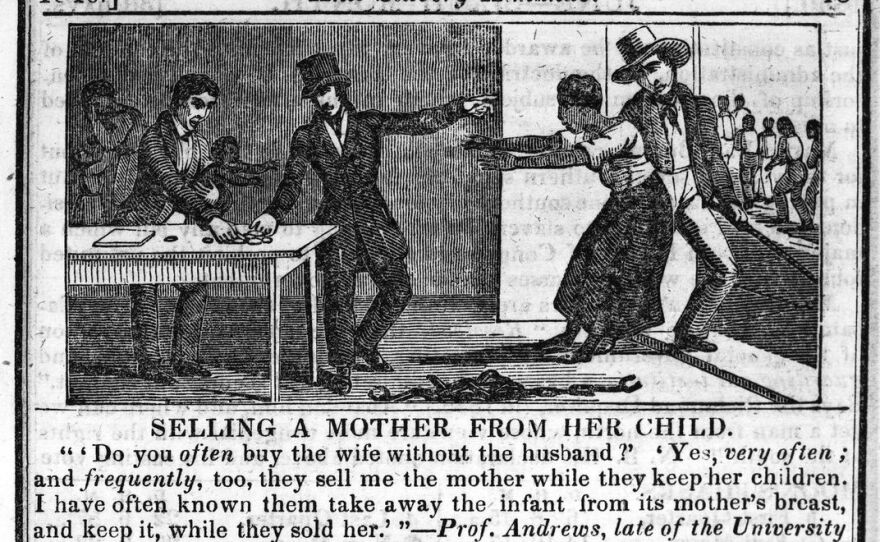
Since today is Juneteenth, a federal holiday that recognizes the date when the last enslaved persons were finally informed of their freedom, I thought about all of the children that were taken away from their parents, primarily from their mothers, during the period when slavery of Black people was common in these United States.

Black Perspectives is the award-winning blog of the African American Intellectual History Society (AAIHS). They are deeply committed to producing and disseminating cutting-edge research that is accessible to the public and is oriented towards advancing the lives of people of African descent and humanity. From the Black Perspectives website, LINK>Slavery and America’s Legacy of Family Separation by Vanessa M. Holden. Forced family separation was always a fixture of the lives of enslaved people. Enslaved children were a lucrative business. The expansion, maintenance, and future of slavery as an economic system depended on these children, particularly after the close of the American trans-Atlantic trade in 1808. 

One such story comes from Harriet Mason, who remembered her mistress forcing her to leave her home and family in Bryantsville, Kentucky, to work in Lexington as a servant at the age of seven. She remembered, “when we got to Lexington I tried to run off and go back to Bryantsville to see my [mother].” The grief of a childhood spent away from her family at the whim of her owner led her to suicidal thoughts, “I used to say I wish I’d died when I was little.” Even in her old age she was firm that, “I never liked to go to Lexington since.”

Slaveholders borrowed against their human property. They gifted enslaved children to their white sons and daughters as children, upon their marriages, or as they struck out to begin their slaveholding legacy. And of course, slave children could be sold down the road and down the river. Children knew that at any moment this could happen to them.

Blogger’s Note – Last night, my oldest son wanted to know if anyone in our family had benefitted from the labor of slaves. Eventually, it was suggested that every American has. I know that among my mother’s own genetic, biological family there were slave owners (I saw one will that was stipulating slaves by first name and who they were to be given to). I also know that side of my family also fought on the side of Confederates in the US Civil War. I’m not proud of being the descendent of these realities.

From the linked article – To profit from slavery and participate in slaveholding, Lexington’s white residents did not even need to own, buy, or sell a single slave. Someone made the shackles. Someone ran slave jails. Someone generated the official documents needed to transfer property. Someone hired enslaved children to work in their homes and businesses. Adults running with children from officials who would separate them was a feature of fugitivity during American slavery. To produce the “fugitive” category, a range of institutions sprang up. Local money paid sheriffs, courts, and officials to uphold the law that protected slaveholders’ rights to their human property. Someone printed runaway ads. Someone made money on enslaved peoples’ bodies at every juncture.

Along with physical labor, children deemed by the state to have unfit parents and placed into adoptive homes, perform emotional labor. Adoptees not only lose their birth families in the process, but they also lose ties to culture, language, country, history, and identity, and must contend with societal expectations that they be grateful for a “better life” in the face of it all. Children of color adopted by white parents also face racism in their new homes and communities. There is emotional labor too in being the physical body that allows white families to appear more liberal or multicultural, even if the opposite is true. In the United States, adoption is an industry and, as adoptee advocates continue to warn, it is poised to profit from family separation. There is already precedent for keeping children in the United States after a parent has been deported and awarding custody to American adoptive parents over immigrant parents caught up in immigration proceedings or because they were detained or incarcerated.

Black families are separated by the bond and bail system, incarceration, the child welfare system, and the criminalization of poverty. All can lead to family separation and the loss of one’s children. Child welfare advocates also recognize the link between the disproportionate number of Black children in the foster care system and the pipeline from foster care to prison.  All of these contemporary systems of power are echoes of legal and social structures that devalued enslaved parents and profited from enslaved children during American slavery.

We need to acknowledge these links to the history of American slavery and the ways that African Americans continue to endure discrimination. Following the money exposes the truth.