Barefoot & Pregnant in the Kitchen

Someone in my all things adoption group shared –

So I am in a tag group (about men) and someone posted a meme of some guy spouting off about how as women our goal should be to have and care for kids etc…

Well, I wrote that attitudes like that make infertile people feel as though kids are the be all and end all and can end up negatively impacting families.

And, of course I got comments saying let’s not judge infertile women and how there is nothing wrong if someone can’t/doesn’t want to raise a child because there is always someone else who would love to adopt them.

I’m sorry but I disagree.

Very rarely does it happen that a woman carries a child for 9 months, delivers that baby and then is like “naw, just kidding, I don’t want you.”

More often, mothers are separated from their babies due to poverty.

Now that I’ve become enlightened, I am always going to judge people who know they have a scared poor pregnant person up against the wall.

In contract law, if there is unequal bargaining power, the contract may be voided. So why are adoption contracts even allowed to stand? My desperate maternal grandmother never intended to give my mom up. Georgia Tann exploited her with threats that her good friend, the Juvenile Court Judge Camille Kelley, would declare my grandmother an unfit mother – which she in no way was. She tried to get my mom back 4 days after she was coerced into signing the Surrender Papers but no way were they going to let go of my mom – an adoptive mother was on her way from Nogales Arizona to Memphis Tennessee to pick her up.

There is a clear imbalance of power when a woman or couple are poor, or homeless, or addicted to some maladaptive substance. And to have any woman sign Surrender Papers right after giving birth is clearly criminal.

It leaves many of us honestly wondering why our society always paints adoptive parents as knights in shining armor. Most people in modern society think adoptive parents are saints.

So You Want To Help A Child ?

Many people go into foster care with good intentions. They really want to help a child who might need it. Here are some words from a woman who did that.

So, having been a foster parent, I want to just get out there to those considering it to say – don’t. Child protection is a corrupt vehicle of systemic abuse. The system abuses children, and as cogs in that machine, you are participating. If you ‘have a heart’ for children or ‘feel called’ or whatever it is, let me suggest you can do any of the following:

1. Volunteer as a CASA. These advocates listen to kids and represent their position in court. No one listens to foster kids, and this is a genuine chance.

2. Volunteer at a local women’s shelter, as a domestic violence or sexual assault advocate, or within the shelter childcare system.

3. Support wellness courts, programs that serve addicts, and programs in your community aimed at helping with food security or relieving poverty. Most children are removed because their parents are struggling with addiction.

4. If you truly want to be a foster parent, license for transitional care or teens, and don’t waiver.

5. Donate your kids clothes and baby items.

What else can you think of that might help?

My family has long taken our obsolete toys to our regional women and children’s shelter for those fleeing domestic violence (children do grow up and we bought more things at Christmas – trying it make it magical like we experienced as children ourselves – than we should have and while it was a lot of fun to open all those presents on Christmas morning, many – sad to say – remained on shelves and were never looked at again. Happy they get a second chance). We have also taken the children’s outgrown clothes and the women’s clothes no longer need by me to the same place.

It is a small thing. Nothing to win awards for but it is some thing. Do what you can. It matters.

Magnolia – Again

Magnolia – 2020 Gerber Baby

I previously wrote about Magnolia in this blog.  She is recently back in the news.  On September 7, 2020, the Congressional Coalition on Adoption Institute (CCAI) announced that it had named a baby called Magnolia as one of their 2020 “Angels in Adoption” honorees. Magnolia, from the San Francisco Bay Area, rose to fame in May 2020 when Gerber announced that she was the first (known) adopted Spokesbaby.

Infant adoption is not a simple story of adorable angels, even when they are cute enough to be a Gerber Baby.  The Angel award is meant to celebrate “the extraordinary efforts of individuals, couples, families, and organizations who work tirelessly to advocate for children in need of a family.”

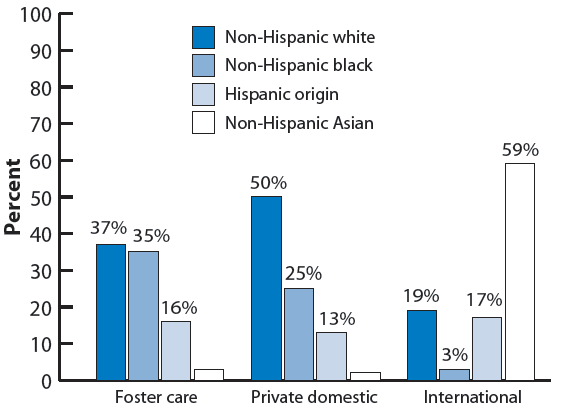
Creating a connection between this apparently worthy, child-centered mission and adopted infants like Magnolia creates a false narrative. The truth is that there are approximately 30 waiting families for every infant voluntarily placed for adoption. It is unlikely that anyone needs to be convinced to adopt these babies. Also, these children already have a family — the family they were born to — who don’t have the resources to be able to parent their child in the way they would like.

It is true that there are approximately 100,000 youth in need of permanency in the US foster care system — but they are almost entirely older children who have experienced trauma, and there are fewer families interested in adopting them. In other words, domestic infant adoption doesn’t need a Spokesbaby — but families in poverty and foster youth without permanency do.

Obviously, it is not actually possible for Magnolia to have made extraordinary efforts to advocate for children in need of a family. It is the choices of adults (her adoptive parents, Gerber, CCAI) to cast her in this role. This highlights how the narrative is already being written and spoken for her, by individuals and organizations that want to promote infant adoption as an unqualified good. And it is deeply concerning that Magnolia, who has no voice and choice in the matter, has twice been made the literal poster child for adoption, before she can even speak in complete sentences, much less articulate her thoughts on what it means to her to be adopted.

Thanks to a Medium article from which the thoughts above were taken (because I do AGREE with every word I’ve shared as though it came from my very heart), I learned about PACT – An Adoption Alliance focused on children of color who end up adopted.

Here is their overview statement –

Pact is a non-profit organization whose mission is to serve adopted children of color. In every case, the child is always our primary client. In order to best serve children’s needs, we provide not only adoptive placement but lifelong education, support, and community for adoptees and their families on issues of adoption and race. Our goal is for every child to feel wanted honored and loved, a cherished member of a strong family with proud connections to the rich cultural heritage that is his or her birthright. We advocate for honesty and authenticity in matters of race and adoption. We strongly believe that adopted children’s and adults’ connections to birth family and birth heritage should be respected and maintained. We also strive to identify and counteract “adoptism,” an unfortunately common social prejudice that challenges the legitimacy of the choice to place a child for adoption or to build a family by adoption. Finally, as an organization committed to children of color, we feel it is essential to educate ourselves and others about the pervasive power of race and racism as they affect our children, our families, ourselves and our society.

Losing My Grandparents

My Granny, My Dad and My Granddaddy

Both of my parents were adopted.  So the grandparents I grew up with in my childhood were never actually related to me.  They were influential though.  The two people shown above often cared for me and my sisters over weekends.  I think mostly to get us into their church, the Church of Christ, as contrasted with the church our mom was raising us in, the Episcopal church.  My dad didn’t go to church at the time.  He worked shift work in a refinery, often double shifts, and so was mostly asleep when he wasn’t at work, except for meals.  Maybe he would watch a little TV or read a news magazine or the local paper.

My mom conceived me while she was still in high school and my dad had just started at the university out of town.  I think these two people shown above made certain my dad quit his dreams of a higher education and married my mom and went to work to support his young family.  Not that he didn’t want to marry my mom.  They were married over 50 years until death did them part and they died only 4 months apart.  My dad’s adoptive parents insisted I have a biblical name to save my damaged soul because of my illegitimate conception.

All of my grandparents had already died – and in fact my parents had already died as well – when I went in search of my original grandparents.  Though I doubted I would ever know who my dad’s father was because his mother was unwed and he was given her maiden name at birth.  I do now know who ALL 4 of my original grandparents were, their names and their ancestry.  I didn’t expect, that in learning who my original grandparents were, I would in effect “lose” my grandparents (those people who adopted my own parents as infants).

But I did.

Though I know I have a “history” with these people who adopted and raised my parents, they no longer feel like my grandparents.  And my true biological and genetic grandparents have taken their place in my heart and imagination, even though I have scant knowledge (but some) of these people whose genes are in me and helped create who I am at the level of physicality.  I have connected with some cousins who share the same original grandparents and what I know of my original grandparents is thanks to anything they have shared with me about these people.

I don’t love the people who raised my parents any the less but they are so far back in my own past now.  Though I had occasional interactions with them up until their deaths, as living people they are receding for me.  They are fading . . .

My original grandparents didn’t lose my parents due to anything worse than poverty and a lack of family support.  That doesn’t say much for my parents own original grandparents, who did not seem to care about my parents very much.  I’ve only heard that my mom mattered to her dad, which was a happy surprise for me and quickly warmed my heart towards that man.  My dad’s father probably never even knew he existed.  His mom was self-reliant and he was a married man, so she just handled it alone.

It is strange.  I was robbed of my original grandparents by the Great Depression, Georgia Tann and the Salvation Army.  Both of my grandmothers eventually re-married.  If they could have been sustained somehow, I know they would have raised their children because every indication is that they loved their babies and mourned their loss until they died.

Nothing makes up for these losses really but at least, I do know where I came from – which is more than my parents knew.  They died completely ignorant of who their own original parents were.  And that is very sad.

Charging Parents For Foster Care

I remember when I divorced my first husband, the issue of child support came up in court.  I had heard horror stories about unending conflict in child support issues.  I wanted none of it.  My ex had already told me he would never pay child support.  I believed him.  His attitude was if I wanted his support for our child I had to stay married to him.  In a weird turn of events, after leaving my daughter temporarily with her paternal grandmother for care while I tested myself to see if I was even able to drive an 18-wheel truck cross-country, my daughter ended up being raised by her dad.  Eventually, he re-married and she grew up in a yours, mine and ours family when they had a child together and she had already brought a child with her to the marriage.  I didn’t want to interfere in what I considered a good situation for my daughter – mindful of the old biblical story and the baby the kind almost cut in half to satisfy two women both claiming the child as their own.  Only recently, after over 40 years of believing this fantasy, my daughter told me it wasn’t such a good situation growing up there.  My heart still grieves to know that.

This is a bit of a digression but not really because today I have learned that when children are taken by the state and placed in foster care, the original parents become liable for child support to cover the costs of their children being placed into foster care.  It seems that everything this government does is stacked against families and intent on keeping people enslaved to poverty regardless of how hard they try to improve their lives.  Even though I lost much in not raising my daughter, I do not regret forgoing the constant conflict of fighting for child support.  I don’t know what the best answer is as regards responsibility – I suppose better human beings but sometimes the deck really is stacked against people in general.  It is so sad.

Most families in the child protective services system also interact with the child support enforcement system. A potentially important effect of child support enforcement on the duration of out-of-home foster care placement. Requiring parents to pay support to offset the costs of foster care results in delays of a child’s reunification with a parent or other permanent placement. While this is a short-sighted and unintended effect, longer stays in foster care are expensive for taxpayers.  Without a doubt, extended placements in foster care has consequences on a child’s well-being. When the policies and the fundamental objectives of public systems are viewed in limited perspective and inconsistently coordinated we all suffer.

The child protective services (CPS) system can be seen as a safety net of last resort. While removing children from their parents’ care is an extreme intervention, recent estimates suggest that in the US 6% of all children and 12% of black children will have experienced out-of-home care by the time they reach the age of 18. Most children and families with CPS involvement also interact with other social service systems that can have very different goals and models of administration and financing. This lack of coordination often leads to substantial, though unintended, negative consequences for both for the families involved and the taxpayers who pay for these services.

The scope of the child support enforcement system is generally limited to establishing and enforcing nonresident parents’ financial obligations to their children. In contrast, the CPS system is responsible for assuring child safety, permanency and well-being, so its scope and responsibilities extend well beyond financial resources. The scarcity of studies regarding CPS-child support interactions may reflect important differences in their policies and the goals of these programs or a limited recognition of the potential importance of their interaction, but research in this area has been hampered by the limited availability of relevant survey data and the technical challenges associated with the analysis of administrative data from separately managed systems.

Requiring parents to pay support results in a longer foster care spell and it definitely decreases the economic resources a separated parent needs to achieve the conditions CPS sets forth for reunification.  This would indicate that this policy is fiscally counterproductive.  And the reality is that there are low levels of collection and additional costs in seeking to enforce these child support payments.

Most children enter foster care due to neglect, rather than abuse, with low income an important risk factor for parents losing custody of their children.  Safely and quickly reunifying families is an important priority and it will reduce both disruption to children and the public costs of foster care.  I know personally how difficult it can be to be a single mother.  When I rejected child support as a very young woman, I was overly confident about my ability to provide for my self and my child.

The truth is children living in single-parent families are over-represented in the CPS system.  Child support can play a particularly critical role in the income packages of low-income single-parent families.  Some evidence suggests that increased child support may reduce the risk of child welfare involvement.  Historically, the government has often retained child support payments from low-income families receiving cash assistance to offset welfare costs, but in recent years policies have changed to allow more child support to be passed through to resident parents receiving assistance—making welfare and child support complements, rather than substitutes.

The change in policy to prioritize economic support to families over cost-recovery for government has not been extended to children in foster care. Federal guidance and state policies generally call for child support orders to offset government costs, rather than directly benefit children, when children are placed out of home.  Federal policy calls for child support previously directed from nonresident to resident parents to be redirected to the state, and, for those that do not have orders, new orders are established for both pre-placement resident and nonresident parents to cover the costs of foster care incurred by the state.


Why Is Adoption So Common Here ?

It’s a known fact that other countries have very few adoptions annually. Some as few as 100-300. This is vastly lower than the US obviously. One of the main contributing factors is the better social programs in those countries.  We don’t have that in the US.  Other countries focus on helping families stay together.

I do believe that if we provided families with what they needed, like some of these other countries do, the percentage of parents losing their children would be significantly lower.  Domestic infant adoption would basically cease to exist.

What needs to change for there to be fewer adoptions overall ?

Some thoughts in answer to that question . . .

Universal healthcare and an adequate minimum wage.  Readily available, affordable childcare for working families.  Both generous paid maternity and paternity leave. Paid vacation time which allows for families to create happy memories (I had that in my 50s and 60s era childhood). A good educational system.  Just the basic stuff I grew up believing this country provided (even if it wasn’t actually the truth, which I now understand in maturity).

I do believe that if we actually supported families, the adoption rate might drop 80%.  I do believe the vast majority of adoptions are caused by poverty or I would imagine if we actually supported all moms, it would reduce it by at least 80%. I do believe the vast majority of adoptions are caused by poverty or religion based coercion utilizing shame to get young women to give up their child.

The nature of capitalism is such, that society won’t do these things to keep families thriving.  It isn’t that we can’t, if the tax structures were in place to raise taxes on the wealthy.  Many people in our society have bought the Republican line about Trickle Down Economics.  The belief that if we help the 1% have more, they will help the rest of us do better too. That has never proven a reality – plain and simple.

Until we as a society decide that every citizen is worthy of a good quality of life, broken families will continue to be way too common.

Case in point – Australia.  They don’t have an exorbitant income tax, but they do have universal health care, subsidized childcare, parental leave, sick leave, a minimum wage etc. Support payments are available to family members who take on caring roles. So do the UK and New Zealand.

If one looks at the number of children adopted each year in Australia, the number is about 300.  That’s ALL children who are adopted from infants to teens. They do not have an adoption “market” (yes, it is a BIG $$$ business in the US).  Taxes in Australia may be higher than in the US but they know that they are getting plenty of services in return.

Sadly, the problem here in the US is entrenched inequality and cultural bigotry.  Many countries outside of the US have much better social programs – most EU countries, Canada, Switzerland and Australia.  Knowing this, it is pretty amazing that this country won’t do better.  We are the richest nation in the world, but most of our money goes into the pockets of our richest citizens.  America is the country with the most billionaires in the world.

It is way past time for a change. That change requires accessible, affordable family planning (birth control and terminations), no private for profit adoption agencies and an end to the manipulation and coercion (Christian) of expectant mothers.

Sadly, adoption has become so ingrained in the American worldview as a means to getting a child that our society is hostile to the idea of children staying with who they were born to. It is all about who has money and who doesn’t.  Anyone with the financial means who wants a child is basically able to, in effect, buy one from someone who doesn’t have the financial means to help their family stay together.  Money is the driver of the for profit adoption complex. Sadly, given all I have shared above, I don’t see any of it changing any time soon.  I wish I could be more optimistic about it.

Clueless

“Hey guys.I’m a single woman who’s plan was to start applying to adopt/foster in my state. Sad story was that my social worker said that I wasn’t allowed to receive any government help like 0. I have to have a job which that’s mandatory at least with this agency. And I’m not complaining about having a job either or I’m still planing on working at some point the thing that caught me off guard was her response to government aid must be 0. Yes all the way from food stamps to government funded apartments that’s a huge No, causing disqualification to apply. I spoke with my therapist and since I have bipolar 1 she told me that it would be best to postpone the plan of adoption/foster care all together for now, my therapist even said that she does not want me to feel sad if at the end foster/adoption care is not an option for me even if I truly wanted to make a difference, since the agency is strict on keeping government out of the picture.
Any thoughts?
Advice?
Does this sound fair or unfair ?”

It’s hard to know where to start . . .

Not surprisingly, came this satirical response –

Um. Totally unfair. You should totally be jobless and on government assistance because you’ll get PLENTY of money to live on saving these kids from their parents on government assistance. If you take like 8 kids at a time you’ll make serious bank, and BONUS if you take some older kids with the younger kids you never have to do anything because the older kids can do all the cooking and cleaning and diaper changes! Yay! Also, f**k this bitch.

More to the point, came this one –

Someone sounds like they need to get their own life in order before, erm, “helping” (themselves to someone else’s children)…

And even more to the point –

Yes, it is very reasonable. FYI, they may also want to talk about your being bipolar, review your meds and/or want to talk to your therapist or get a statement from them that they recommended you would do well with foster care. Here’s the thing: all of the kids in foster care are going through big time trauma. They need someone who is financially and emotionally stable to help them through it.

In a lot of cases, poverty and mental illness have a lot to do with why the kids came into care. It’s kinda hypocritical to take them out of that just to place them right back into it. For example, the case plan might say that the parents have to get a job to get the kids back. So in the meantime, they stay with you, but you don’t have a job?

It’s great that you want to help, but what do you mean by foster/adopt? If you’re getting into foster care to adopt, just don’t, you won’t have the right mindset and it will not be good for you or the kids. What do you mean by your agency keeping government out of the picture? Foster Care =government, so I’m not really understanding that.

And finally –

She should talk to all these birth families who lose their biological children for bipolar disorder and because they were seeking mental health help and were in poverty or disabled. This post makes me angry because it seems so out of touch with reality.

Foster kids are not a prop or little adventure to embark on. You can’t just (or SHOULDN’T just) be a foster parent because you randomly decide you “love kids” and “it’s your calling.”

You can’t just decide you’re gonna be a foster parent when nothing in your life is in order to do so.

Mental health, unemployment, needing to rely on the system….. these are some of the causes for kids to be removed from their biological parents.  Our society would be better off extending the services and finances to the natural families so that they can keep their own children.

How Poverty Affects Adoptions

I don’t know if anyone has done a study on the percentage of children given up for adoption due to simple poverty (and poverty is not simple, I realize this).  I know it was a factor in both of my grandmothers losing custody of my parents and it was certainly a factor in my losing custody of my daughter.  Divorce and lack of child support left me desperate enough to temporarily leave my daughter with her paternal grandmother.  That ended up with her staying with her dad and a step-mother for the remainder of her childhood.  It was a factor in my sister losing custody of her daughter – she was denied government assistance because she was living with my parents during her pregnancy.  Therefore, because they didn’t want financial responsibility for my sister and her child, they pressured her to surrender her daughter to adoption.  This is all in only my own family of birth.

Someone asked – Do you believe that financial illiteracy is the reason people are poor and that programs teaching life skills like checking, bank accounts, and savings would work to eliminate poverty ?  While these skills are useful for any maturing adult, I don’t think they would eliminate poverty. Rich people have bigger safety nets. Financial illiteracy is not the reason people are poor and there are rich people who don’t know how to manage their money as well.

Someone answered the question – why are people poor ? With this – Capitalism. Rich people exploit others to gain wealth, keep money/land/resources for themselves, create systems that work to their advantage (and poor people’s disadvantage), pass it on to their kids who in turn use their wealth to get richer. Scarcity mindset is real and in my experience rich people are the most paranoid about losing any wealth. There is more than enough to take care of each other but our system doesn’t by choice. Some people think “if only poor people managed their money, they could accumulate wealth.” This completely misunderstands how wealth is acquired and horded in this country.

Generational and systemic poverty plague the poor. How can you climb a ladder in a system built to make the rich richer and keep the poor poor ? Our economic system is built upon the 1% wanting to make that difference bigger every day.  How can anyone achieve socioeconomic upward mobility when your grandparents were poor.  Therefore, your parents had to sacrifice an education and instead find work to support themselves and their families.  Then their children end up in the exact same situation. The deck is simply stacked against the impoverished.  This tends to become a *major* generational trend.  Even assistance is created in such a way that it keeps the poor poor.

Case in point – Medicaid and Food Stamps. As soon as a person gets a non-minimum wage job, they lose  their benefits.  Without these, health care and groceries are significantly more expensive than slightly above minimum wage will cover. The result ?  You’ve either got a person making $20/hour, but barely making ends meet if at all.  Or a person without resources and access to food and healthcare, simply because they would rather be self-supporting.

One mother wrote – I gave up my first two kids to adoption because I was broke.  I didn’t know how much help shelters could be.  I kept my third child thanks to a shelter and I got on my feet.  I now have a place of my own for us to live in.  I wish I would have known how to keep my children before.

I do believe as a society we can do better than we have been doing.  I don’t know how we get there.  If we supported families adequately, children could remain where they want to be – in the family they were born into.


Adverse Childhood Experiences

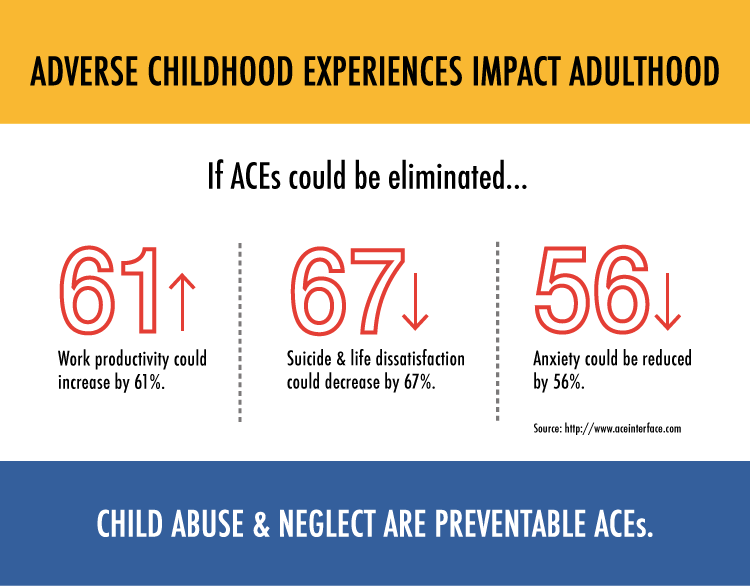
For several months now our entire country and most of the world has been living with toxic stress.  It’s the kind of stress that puts you on edge and keeps you there, day after day after day.  If you have felt stressed, imagine what it would be like to experience adversity and/or abuse — not having enough to eat or being exposed to violence – then think, what if the one experiencing this is still a child.

Factors such as divorce, domestic violence or having an incarcerated parent are called adverse childhood experiences (ACEs). Four or more ACEs can result in chronic health conditions such as heart disease or diabetes. In the long term, living with ACEs or other negative factors, such as poverty, can literally change your brain chemistry.

What does it look like for a young person to live with several ACEs and no supports ?  What does a foster parent experience when bringing a middle school or teenage foster youth into their home ?

It might be not being able to sleep without a light on. Or it could be eating even when one is full or not hungry. Some children become “runners” — they leave school whenever they become upset.

And the symptoms can become even worse.  The child may become a cutter; may be suicidal. Such children can have trouble forming appropriate friendships. Maybe they trash their room; in one fight-or-flight moment, climb out of their window and tumble to the ground. Even jump out of a moving car.

A foster parent could find themselves restraining the child physically by wrapping their arms around the child’s shoulders or waist, using all their strength to keep the child from leaving or hurting their self. Maybe you raised your hand only to motion toward something and the child flinched or even ducked.

And your heart breaks for this young person.  You had hoped they knew you would never hit them.  You are a foster parent.  You signed up for this because you thought you had something to give — time and care and love — to kids who desperately need that.

You might become the person the county calls when a child is removed from a home and has nowhere else to go, or when a foster family needs a break. This is known as emergency respite.

Most foster kids want to be happy.  After a lifetime of abuse and neglect, they may not know how.  A foster parent is also there to be a support for reunification with the biological family.

The best foster parents build a fortress of protective factors around their foster children. Protective factors are those things that most of us take for granted — a friend to call when we need advice; someone to help whenever we aren’t enough on our own.

Some of us are born privileged to have built-in protective factors (a supportive family, enough money).  Most foster kids will need to collect them from somewhere else (perhaps a chosen family made up of friends). At school, they require trauma-informed teachers and staff who understand how ACEs can be reflected in behavior.

National data shows that more than 20 percent of children up to age 17 have experienced two or more ACEs.  Beyond abuse (physical, emotional, sexual) and general neglect these include the loss of a parent to death, divorce and abandonment.  A family member addicted to drugs or alcohol.  A family member that is incarcerated. Being exposed to domestic violence and mental health issues among the family’s members.

Brain toxicity exists. A child can have post-traumatic stress disorder. ACEs are not limited to low-income neighborhoods, domestic violence and substance abuse take place in higher income homes and are every bit as toxic. Learn to look at all people through a trauma-informed lens. Ask, if you suspect this, “What happened to you?” and then listen without adding your own opinions.

Every domestic-violence shelter worker or child-care provider, anyone who works for child-protective services, anyone associated with family court, law enforcement personnel and physicians – ALL need to be trained appropriately to deal with trauma related behavior

Trauma is not the fault of any child.  Understanding ACE impacts allows adults to see the reason behind the behaviors.  Baby steps in a positive direction are progress.


Adoption Or Foster Care

I’ve been reading a book about one girl’s experiences in foster care to better inform myself about a system I have no experience with.  Adoption ?  Though not adopted myself nor have I given up a child to adoption, I have LOTS of experience – both parents were adoptees and both sisters gave up a child to adoption.  I also spend significant time each day within a private Facebook group that includes original parents, adoptees and former foster youth, and adoptive (or hopeful) parents.  I learn a lot there that broadens my perspectives.

Some of the major differences I am understanding – foster care does not alter the child’s identity (doesn’t change their name or birth certificate).  Foster care is less permanent or certain.  The goal in a lot of foster care is eventual reunification of the family unit.  The quality of foster care varies but a bad placement can be gotten out of.  Not all foster parents treat the foster child well nor do they really care about what is happening to the child.  Some actually do it for the money (NOT saying most or all do it for that reason).

Adoption is a PERMANENT solution to what is a temporary problem when talking about an unwed mother or a poverty situation.  Adoption does provide a more certain home environment than foster care does but the double edge sword is that if it is an awful placement, most of the time the child is simply trapped there (I’ve read enough nightmare stories to believe this).  That said, there are also “second chance” adoptions where the adoptive parents want to be rid of a troublesome child.  This is very sad for the child as it sends a debilitating message about the worth of that child.

Most of the time, adoptive parents change the child’s name and to some extent their cultural identity if it is a transracial adoption.  Some adoptive parents hide the date and/or location of the child’s birth to place an obstacle in the way of the parent/child unit reuniting.  Genetic family bonds are broken or permanently lost.  Even when such direct family is recovered later in life, so much life experience and inter-relationship is lost that it is nearly impossible to rebuild.  I understand this as I have been able to learn what my own parents could not – who my original grandparents were.  Along with learning that, I have acquired new family relationships with genetically related aunts and cousins.

I acknowledge that not all children are going to be parented by the people who gave birth to them.  This is a reality.  I would also argue that as a society we do NOT do enough to keep families intact and could do much better.  I would further add that MONEY plays a HUGE role in perpetuating the separation of mothers from their children.  That money could be better spent with less traumatic outcomes on the natural family and its supports.