Thinking Of The First Family

There are many factors in life that can tear a family apart. In today’s story, a woman worries about how many pictures/videos/information would be inappropriate ? She worries that she is communicating too often and hurting his biological family because they see what an amazing child he is, and maybe they feel sad that his mom can’t raise him. Back story is – she is currently in the process of adopting her almost 15 year old foster son, who has been with me for over 2 years. He wants her to adopt him. His family has become their family (except his mom, whom he has decided to temporarily cut ties with, due to her toxic behaviors towards him).

An adoptee notes – their feelings are not your responsibility. Give them space to come to you with issues, before you assume they have one. I really think you’re overthinking this. She replies – “That’s what I’ve been doing. I just wanted to make sure that it was correct.”

A mom who is not able to raise her child writes – for me there could have never been a “too much” situation. If they are content with what you are doing, keep doing it. Thank you for thinking of his first family as well. blogger’s note – I ended up not being able to raise my first born child. I never got “too much” and would have always welcomed “more”.

Someone suggested using the LINK>Back Then app. The person added – You can add as many people as you want to and give them permissions to only view/like/comment or to upload photos as well. And it’s basically just social media for your kids’ photos. We use it as a place to (over) share photos of our two kids because I don’t post them a lot on Facebook. You can upload pics and videos, people can view, like, and comment. It’s a place where you can put up as much as you want and they can choose whether to access it or not.

Another adoptee notes – There’s no such thing as communicating too much. If they don’t reply or they’re rubbed the wrong way, that’s their issue. It’s inevitable that they’ll have feelings about seeing his photos. People don’t recover from a family being split apart. It affects everyone, forever. Just keep communication open.

Another mom like the one above notes – I would have loved to regularly see photos of my kids when they were growing up, and maybe if I’d been allowed ongoing contact at a safe level (which our main problem was poverty, I don’t know what the adoptive parents told the kids was the reason they couldn’t have contact, like were they worried that the kids would catch the poverty ?). If they had, maybe I wouldn’t still be so angry at everyone involved.

Someone in a similar situation with a teenager shared – We’re fostering a 17 year old that also wants to be adopted, she’s been with us a year and knows if she does or doesn’t, it won’t change anything with us. And her wishes were only to stay in touch with her 2 brothers. They stay with us every other weekend.

We Were Once A Family

You probably remember the horrific story – In March of 2018, an SUV carrying two adults and six children drove off a cliff along Pacific Coast Highway. It was deemed a murder-suicide at the hands of Jennifer and Sarah Hart, a white lesbian couple who adopted the Black children from two families in Texas children on board.

The above and what follows are thanks to a story online by LINK>WBUR about Roxanna Asgarian, author of the book who’s cover is above. When the Houston reporter sought out the birth families of those children, she discovered a flawed and over-burdened child welfare system that routinely mistreats Black families. What started as a newspaper assignment turned into Asgarian’s new book.

The birth mother of three of the six children was battling drug addiction. Her children were cared for by their aunt and a father figure, who was not related to them. They were removed by Child Protective Services when the aunt asked their birth mother to babysit one day because she could not find any other childcare. The other three were removed from their birth family for reasons of supposed medical neglect. Actually, one of the children was bitten by ants at a birthday party. Their birth mother had not been able to find a ride for them to the hospital.

The adoptive mothers, the Harts, had been investigated multiple times for abuse and mistreatment. Even so, the children were never removed from their care, even when they displayed bruises and malnourishment. Asgarian says, “I knew immediately when I was let into the homes of the birth family of three of the kids that this was a child welfare story. It seemed increasingly clear as time went on that the systemic part of the story was being totally overlooked.”

You can read an excerpt of her book at the link above.

Why Is It Different Here ?

How come infant adoption doesn’t exist in countries with social safety nets??

Because women don’t willingly give up babies without coercion and desperate circumstances.

The point above is that many countries outside the US have less than 200 adoptions annually…some only a handful. WHY?

  • Because they don’t allow it to be a multi billion dollar industry
  • It is NOT privatized
  • It is illegal to adopt on your own – no internet/friend matches
  • They have a social support system to help families stay together.

Some additional comments –

The social nets in the US need serious overhaul. I work in a hospital and some of the situations I’ve seen people in are heartbreaking, infuriating, sickening. It makes sense that countries with ACTUAL support see fewer broken families all around.

It was sad to see this one – I wish it was like this everywhere. I’m from Ukraine and it’s a sh*tshow – lots of kids abandoned, horrific dysfunction, zero support. It’s terrible.

Safety nets include but are not limited to: proper science based sex ed, access to birth control of the patients choice, access to medical care, plus abortion accessibility. Access to housing and therapy. I have found a lot of people assume support is $$$ and while that is true to a degree, it is not the whole picture. Building community is the best thing we can do. To which someone else noted – but realistically money solves a ton of issues.

From an adoptee – Safety nets and social resources are so important. It is deeply disturbing that we pay so much lip service to “children are our greatest resource” and pretending that we are all about “family values,” but when push comes to shove, it’s really about greed and selfishness. We need to elect politicians who are more interested in people than money and power.

A transracial adoptee notes – I hate it when they try to make it seem like there are soooo many abandoned babies. Even if there is an expectant mom who wants to give birth (which how many pregnant people are truly willing to give birth, especially in a country with a high mortality rate, to just relinquish the baby) but does not want to parent (as in they have the ability/support/the means to parent but truly do not want to & wouldn’t/couldn’t abort), then what about the father? And if he really absolutely does not want to parent, do they really not have a single family member or honestly even close family friend who would take in the baby? Like the leap to having absolute strangers adopt the baby is just too much for me honestly. I frankly find it a bit hard to believe that there are so many situations where there are 2 capable expectant parents who simply don’t want parent and for not a single family member be capable/willing to take care of the child.

Another explains –  it’s the private adoption industry taking the foster care statistic of approximately 100,000 post-Termination of Parental Rights youth in this country, and just conveniently not mentioning that almost none of them are babies or toddlers. And then, if challenged, they will say ‘but this prevents them from ending up in foster care, aging out without a family,’ although I imagine that would not be relevant to the majority of parents who relinquish privately.

Which brought this recognition – I’ve actually found it incredibly bizarre how some very educated and intelligent people in my life, people who understand systems of oppression in regards to other demographics, a) don’t seem to get that no one gets pregnant to happily turn around and relinquish and b) refuse to understand that different age groups in the foster care system likely have different needs and require different approaches.

And this story from an expectant mother – I’m 42, expecting my 4th. My 1st, I was a single mother when her father left when she was 15 months old. I was a single mother for 10 years when I met my husband. But I thrived. I had a career, bought my own house, could afford a comfortable life. When I married, we had 2 boys over 8 years of marriage. My husband comes from a long line of mental illnesses, which he inherited. Both our boys are special needs, ASD among others. I’m in the middle of a long divorce as my husband is dragging it out and controlling it all as long as he can. I’m now a single mother for a second time. Eventually started casually seeing someone and got pregnant the second time we were together. He immediately jumped ship and was adamant he doesn’t want anything to do with it. Doesn’t want to be on the birth certificate. Nothing. This pregnancy will make me a single mother for essentially a 3rd time, at the age of 43. I am over being a single mother. I don’t want to do this for 40 years straight. I am older. I have no family that would take a baby. I had zero interest in abortion, I live in a state where it’s still legal, but that’s not something I agree with and I couldn’t live with myself. So, yes, I’m the mom that would carry to term just so I wasn’t killing the baby. I also couldn’t live with the what if’s with adoption. So I’m simply left with parenting. Do I want to? No. It’s simply the only option that doesn’t leave me with what ifs for the rest of my life. I fit everything you said is a far stretch. Father does not want, I would not abort, I have already been a single mother most of my entire adult life, so I know I CAN do it, but I don’t want to anymore. I’ve lived that phase of my life. I’m currently reliving that phase of my life with 2 challenging kiddos. And now, my awful luck has me starting all over again a 3rd time. And being in this position, I’ve come to realize there are lots of older women in my position for different reasons. Thought they went through menopause, Birth Control failed, whatever. Married, divorced, there are lots of us. So many people think this is a “young mom” issue, but there is an older crowd no one considers because we aren’t the norm.

Another agreed – the majority from the statistics I’ve seen who are getting abortions are married or divorced older women. I don’t see many choosing adoption at that age.

And a perspective from the United Kingdom – The UK has plenty of adoption, largely because our social services and safety net are so full of holes, struggling families don’t get help and their kids get taken away. What we don’t have is abandoned babies or people voluntarily giving up their infants. Because we have free, readily available abortion for people who really don’t want a kid, free healthcare (even if the government is currently running the service into the ground) and enough of a basic safety net (however fraying) that is usually sufficient that people who choose to give birth don’t feel they have to then give away their children due to poverty. I have a mountain of criticism for the ways our society is failing families, and letting them fall apart, but I still look at the United States in horror at how much worse it is.

Only Ever About Babies To Adopt

I thought this over a year ago, when the Dobbs decision was first leaked, before it was announced by the Supreme Court. Yesterday, I came across a widely diverse piece in the LINK>Politico Magazine Friday Read where “Thinkers from across the political spectrum reckon with the dramatic and unpredictable ways the country has already changed since the historic Supreme Court decision.” They titled their piece – ‘I Underestimated the Depth of Outrage’: A Year in Post-Roe America.

One piece written by Robin Marty, author of The New Handbook for a Post-Roe America, reads – “. . . the Christian conservative activists and politicians behind our total abortion ban abandoned their pretext that this was ever about anything other than making babies for their families to raise.” It occurs to me that with dwindling numbers of people going to brick and mortar churches, taking the babies of “heathens” (woman who did not remain chaste and conceive in marriage) and indoctrinating them in the faith is one way to increase their numbers.

She notes “. . . we have not seen one single public policy introduced that would help a person avoid pregnancy — no subsidizing of affordable, accessible contraception, no expansion of Medicaid for pregnancy prevention or earlier prenatal care, no additional funding for hospitals, clinics or other medical centers that are feeling the burden of additional pregnant patients needing services.”

“Instead, we saw a Legislature that created more subsidies for adoption and fostering — despite the fact that the foster care system is already underwater. The Legislature couldn’t even muster enough support among themselves to pass tax breaks for the predominantly Christian crisis pregnancy centers that are allegedly supporting mothers during pregnancy. We passed death certificates for stillbirths and “baby boxes” for abandoning newborns (now up to 45 days post-birth instead of just three). We saw an attorney general who argued that pregnant people could be jailed for taking abortion pills — who was then forced to walk back his words. We saw a lawmaker try to codify that same threat into law before his colleagues killed his bill in committee.”

She asks – What (do) the conservatives really want out of an “abortion-free” nation ? It is a place where people are forced into pregnancy, where their personal health and liberty has no relevance, and where the ideal outcome is a live infant by whatever costs. After all, they have plenty of “good” Christian families to raise them.

blogger’s note – I wonder what the real outcome will be ? – more single, unwed, mothers are choosing to keep and parent their own babies. There will be more children raised in poverty and more stressed out mothers trying their best to provide for their families. Maybe the “extra” number of babies they actually get out of this will be less than they thought there would be.

Another one, Abby M. McCloskey (who is a Republican) admits – “I have been disappointed that the rollback of abortion rights in red states — like mine, Texas — hasn’t been met with more robust financial support and protection for mothers and children. I understand that more government support is a turnoff for conservatives, especially in our fiscal environment. But in this case, I believe it’s the wrong place to draw a red line. As someone who values life and believes in the importance of strong families, it is a logical extension of the pro-life argument to protect and value life at all of its stages.”

She notes – One basic way to improve support for families is to provide a baseline level of wage support and job protection if a parent chooses to take time off of work to care for their baby, (which we know is associated with better outcomes for both parents and kids). Lack of job protection and financial insecurity are the leading reasons why (more parents don’t take time off from work following the birth or adoption of their child); few low-wage or hourly employees have paid family leave options from their employers.

She adds that she will be looking with great interest at what GOP presidential candidates propose this next cycle to support families, especially for the women impacted by the end of Roe.

blogger’s note – Of course, if people who can afford to pay for adoptions end up with the “extra” babies, the actual genetic, biological parents won’t need to the government to help them fund the raising of their own children. There are many more points of view in the Politico article at the link above.

The Legacy Of Family Separation

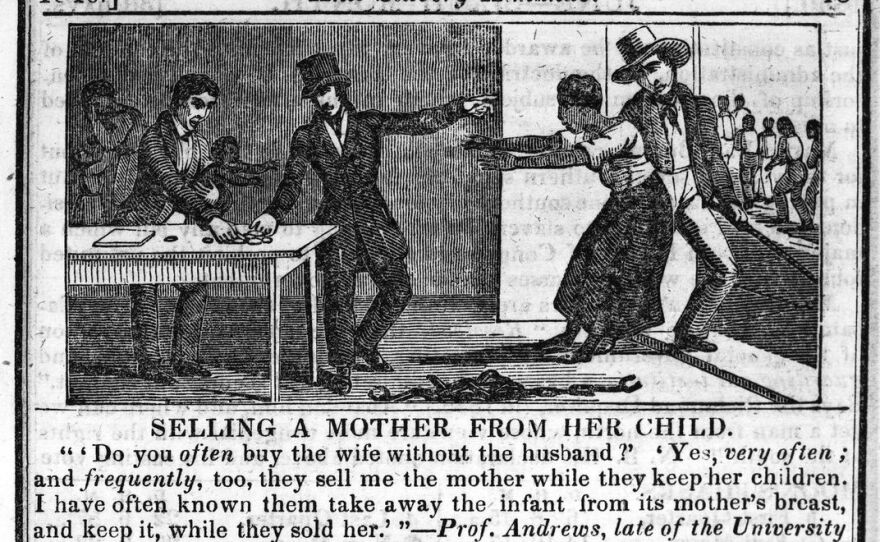
Since today is Juneteenth, a federal holiday that recognizes the date when the last enslaved persons were finally informed of their freedom, I thought about all of the children that were taken away from their parents, primarily from their mothers, during the period when slavery of Black people was common in these United States.

Black Perspectives is the award-winning blog of the African American Intellectual History Society (AAIHS). They are deeply committed to producing and disseminating cutting-edge research that is accessible to the public and is oriented towards advancing the lives of people of African descent and humanity. From the Black Perspectives website, LINK>Slavery and America’s Legacy of Family Separation by Vanessa M. Holden. Forced family separation was always a fixture of the lives of enslaved people. Enslaved children were a lucrative business. The expansion, maintenance, and future of slavery as an economic system depended on these children, particularly after the close of the American trans-Atlantic trade in 1808. 

One such story comes from Harriet Mason, who remembered her mistress forcing her to leave her home and family in Bryantsville, Kentucky, to work in Lexington as a servant at the age of seven. She remembered, “when we got to Lexington I tried to run off and go back to Bryantsville to see my [mother].” The grief of a childhood spent away from her family at the whim of her owner led her to suicidal thoughts, “I used to say I wish I’d died when I was little.” Even in her old age she was firm that, “I never liked to go to Lexington since.”

Slaveholders borrowed against their human property. They gifted enslaved children to their white sons and daughters as children, upon their marriages, or as they struck out to begin their slaveholding legacy. And of course, slave children could be sold down the road and down the river. Children knew that at any moment this could happen to them.

Blogger’s Note – Last night, my oldest son wanted to know if anyone in our family had benefitted from the labor of slaves. Eventually, it was suggested that every American has. I know that among my mother’s own genetic, biological family there were slave owners (I saw one will that was stipulating slaves by first name and who they were to be given to). I also know that side of my family also fought on the side of Confederates in the US Civil War. I’m not proud of being the descendent of these realities.

From the linked article – To profit from slavery and participate in slaveholding, Lexington’s white residents did not even need to own, buy, or sell a single slave. Someone made the shackles. Someone ran slave jails. Someone generated the official documents needed to transfer property. Someone hired enslaved children to work in their homes and businesses. Adults running with children from officials who would separate them was a feature of fugitivity during American slavery. To produce the “fugitive” category, a range of institutions sprang up. Local money paid sheriffs, courts, and officials to uphold the law that protected slaveholders’ rights to their human property. Someone printed runaway ads. Someone made money on enslaved peoples’ bodies at every juncture.

Along with physical labor, children deemed by the state to have unfit parents and placed into adoptive homes, perform emotional labor. Adoptees not only lose their birth families in the process, but they also lose ties to culture, language, country, history, and identity, and must contend with societal expectations that they be grateful for a “better life” in the face of it all. Children of color adopted by white parents also face racism in their new homes and communities. There is emotional labor too in being the physical body that allows white families to appear more liberal or multicultural, even if the opposite is true. In the United States, adoption is an industry and, as adoptee advocates continue to warn, it is poised to profit from family separation. There is already precedent for keeping children in the United States after a parent has been deported and awarding custody to American adoptive parents over immigrant parents caught up in immigration proceedings or because they were detained or incarcerated.

Black families are separated by the bond and bail system, incarceration, the child welfare system, and the criminalization of poverty. All can lead to family separation and the loss of one’s children. Child welfare advocates also recognize the link between the disproportionate number of Black children in the foster care system and the pipeline from foster care to prison.  All of these contemporary systems of power are echoes of legal and social structures that devalued enslaved parents and profited from enslaved children during American slavery.

We need to acknowledge these links to the history of American slavery and the ways that African Americans continue to endure discrimination. Following the money exposes the truth.

Foster Care Reform

Discussion topic from my all things adoption (and foster care because they are very much intertwined) – Being a foster caregiver means you are contributing to a flawed and broken system. It makes you part of the problem.

Foster carers don’t like to hear that, they prefer to feel they are saviors. They will use terms like they are a “soft place for these kids to land while their parents work on the issues that got them there” or they just want to be a “place these kids feel safe and loved”. They want to “make a difference” in these kids lives because that feels all warm and cozy and is the perfect look at me social media moment.

Lovely sentiments..I’ll say good intentions as well, but they are only that..lovely sentiments that mean nothing when you have a corrupt, controlling, biased system watching over you. Your hands are tied.

How can you better help kids other than being a foster caregiver and taking your instructions from a corrupt system? What specific changes need to be made in child welfare for it to even be remotely something someone should consider aligning themselves with?

Some of the thoughts on this –

Becoming a CASA advocate. It’s free, and the classes are typically offered 2-3 times a year. Connecting with kids through programs like Boys and Girls Club, Big Brother Big Sister. Reaching out to vulnerable families and offering help directly to them.

The biggest change is that the resources given to fosterers need to be redirected to families in need and family preservation as a whole. Poverty should never be a cause for removal.

One notes – the system needs to look for more kin. This idea that only the next of kin can take children supports the system not putting any effort into keeping kids with family. Half the time they don’t even look for family. They say they do, but they don’t.

It should go without saying but still it must be emphasized that nobody wants kids in an unsafe situation (even though Child Protective Services regularly leaves children in awful situations). And I’m sure there are instances where a trained non-relative’s residence is the best place to support the child. But those services must be disconnected from the foster system as we know it.

From a social worker in the field of family preservation – the continued participation of foster parents is propping up the system. I work in a system with many examples of how easy it is to eliminate the need for fostering. Kinship care is one – here, kinship is defined according to Indigenous cultures, which is any person involved in the child’s life, culture, or community. Family preservation programming is another, either through social supports coming into the home or the family moving into a residential facility with all needed supports in place. Another option is supported living placements for youth; they live independently in their own apartment with support workers and services integrated as needed.

Stop viewing being poor as a moral fault or think it automatically makes you a bad parent.

A former foster parent writes – I stopped being a foster parent when I realized how little support and care the parents received. I think it was actually a social worker than made me realize it when she said you and every other foster parent are no different than the parents. You could easily be in their same situation. I think more foster parents need to realize they are no different and start thinking about what they would want if they were in the same situation.

Personally if my kids were removed I would want full access to them, their healthcare, their school records and sports. I would want for them to be returned as quickly possible. That being said I am clueless and ignorant on how to help and how to support these families. I feel like the biggest problem in our area is drugs. Other than carrying Narcan, I don’t know how else to support help these families staying together. To which, someone else suggested – You can get involved with your local women’s shelter, Domestic Violence Shelters, etc – that is a start.

Yet another notes – there are some areas that are beginning amazing programs that foster whole families, either in home or out of home. LINK>Saving Our Sisters is a great place to start, volunteering as a sister on the ground. I love that you understand and empathize with parents. That’s rare and appreciated.

Another option is helping with food pantries and clothing pantries. Personally, I refuse to have anything to do with goodwill or salvation army because they are beyond problematic. LINK>The Trevor Project is another wonderful organization to get involved with to help at risk LGBTQ youth. Churches are also a great place to reach out to. Many of them have programs that help the community, but always need help.

There are courses you can take through Red Cross that offer Infant CPR and Child Care Certifications. Go into online community pages and explain that you are a former fosterer and you have infant CPR training (basically put out your credentials) and offer to help with child care.

I could go on and on but there is always another way to address social problems beyond tearing genetically related, biological families apart.

Stupid Reasons

From a foster parent – I recently had a teen placed with me. This teen was removed for stupid reasons, cannot be placed with kin for more stupid reasons, she wants to be with her family, family is safe and caring and there is really no reason she should have been removed (except poverty=neglect and racism). She was placed with me so that she could keep in contact with family and do visits since they’re in the same city as I am. CPS or DCFS or whatever are saying that she cannot have unsupervised contact with anyone in her family, and there is one person in particular she is not to have any contact with at all. But these people are not dangerous and she wants to spend time with them.

My question is, how should I allow or not allow contact with these people ? I have already said that the family members, besides the one prohibited one, can spend the night here and be here whenever I’m here, because that’s allowed. But I’m wondering, do you all think I should allow unrestricted contact with these people, even if CPS says it’s not allowed ? Any difference in advice for the prohibited family member ? If I allow unrestricted contact and we get caught, the consequences for her are much greater than for me. She, at least for now, seems willing to follow the rules and won’t have contact, if I tell her she can’t. But I hate to tell her she can’t, when there’s really no danger, as far as I can tell. I’ve hinted to her that she’s allowed to go out on her own, and she doesn’t have to tell me where she’s going, so that’s what we’re doing for now. One time I drove her to her family member’s house and stayed outside in the car while she went in, so she had privacy with them but I was still kind of there. My thinking is that I don’t want her sneaking around trying to see them, and I don’t want her to feel guilty for wanting to be with her family, and if she hadn’t been removed (which she shouldn’t have been), she’d have full access to them.

Some responses –

From a Guardian Ad Litem – My feedback is a pretty strong no – I LOVE what you’re doing here, and honestly if I were the CASA on your case and knew about this, I’d strongly consider keeping your secret. But these conditions are non-optional in my area (and we have stupid arrangements too, but I’ve never had one quite this bad) and you are going to be at very high risk of losing the placement (and possibly your license) if they find out about this. This child is unlikely find another placement as child-centered as you, and in my area she might end up sleeping in the social worker’s office for days or weeks. I think you tell this young person that you are willing to do everything within the limits of the system to help, but you agreed to respect these constraints. You’re enforcing them because you value the child and their safety/stability of your placement, NOT necessarily because you feel they’re just. That distinction will not be lost on a teen.

From a Kinship Carer – You are playing a dangerous game, if you knowingly allow unsupervised contact. Her next placement will very very likely not be so kind. Whatever the stupid reason that the one person is totally no contact, abide by it. For the others, having them over while you are in another room is wonderful. Sitting outside in the car is likely not enough to constitute “supervision.” I’ve been in your position. It is very frustrating to spend hours and hours discreetly “supervising” (from another room) so as to not interfere and to allow the family normalcy. But weigh your light level of supervise vs what most placements would do and continue to follow the rules as lightly as you can. And hope that the family does their tasks, so she can go home sooner rather than later.

From an Adoptive Parent – If you do not follow DHS visitation plan restrictions that will be seen as failure to protect…she will likely be removed…and your home will likely be closed…sometimes they will accept she “snuck out” but if they decide otherwise – it is likely teen will be labeled a flight risk and it is likely that they will remove her. She will find herself in a shelter unable to see anyone…I had a teen who would run away often. There were a few times they made her go to a shelter or another home and would not allow her back with me…ultimately however, she did age out of my home.

From a Kinship Guardian – I feel like letting a trusted teen go out does falls within reasonable and prudent care (especially if you’re told a destination. Even one that turns out to be inaccurate) , but if it comes up that you probably knew the forbidden family was being visited against case rules, you run the risk of losing your license. It’s up to you to decide if that risk is worth it. Your heart is absolutely in the right place.

From an Adoptee – Even the child knows she should follow the rules. You need to follow the rules. Be a good example. We may not always like the rules but we will hate the consequences of not following them a whole lot more.

From a Foster Parent – Being a foster parent sucks. So many rules and hardly ever in the best interest of the kids. She mentions LINK>Life360. which I had never heard of. Life360 offers advanced driving, digital, and location safety features and location sharing for the entire family.

Another one recommends – I would not stretch the confines of the foster care plan. Stick to the rules. If she wants to go home – her best chance of getting there is by sticking to the rules.

Another Foster Parent writes – Do not violate court order. She will be removed and you will lose your license. Continue to advocate with her caseworker and GAL. Know that she will probably try to go around the restrictions. As long as you are not actively encouraging or enabling it, then it is OK. We have had that happen before. We had teenagers use their phones to be in contact with people they are not supposed to be in contact with. They typically understand that this is what teenagers will do, but if they find out that you are facilitating and encouraging it, it’s all over. And the next foster home may not be as understanding as you are. What we have done is supervised visits where we could see, but not hear them. Depending on the level of supervision required. Then we are able to advocate strongly that visits can move to unsupervised because of how well they are going. We’ve been able to get visits, moved to unsupervised within a visit or two.

An Adoptive Parents asks a question that was on my own mind – how old the teen is in this situation ? Are you trying to run out the clock for a 17 year old or is she 13, with many critical years ahead ? Also is there a reunification plan in place ? Because never mind your own license, you are aiding and abetting something that undermines the actual reunification of the child with her family. You could be ruining the family’s chances to reunite ! Your heart is in the right place but you have to play by their rules and learn to play the game to speed up reunification. And that’s what I would be telling your foster child too. Learn to play the game, voice the frustration with the system, find ways to take back control where you/she can within the confines of the limitations they’ve imposed, find ways to help the family reunite and focus your frustrations and energy there, rather than trying to sneak around it.

From a Foster Parent – Contact the teen’s GAL and encourage them to advocate for family placement/more contact/etc. While it took a while, I’ve seen this work in the long run. That and continue to encourage visitations with family and then report back to everyone (CPS, foster care, GAL, etc) how well things are going and your thoughts on reunification. You can help the teen to advocate for themselves as well. Depending on their age, they could maybe write a letter to the judge or even speak for themselves in court.

Another Adoptee writes – Honestly this is where you ask her, if she would like to help fight the broken system with you by her side. This type of case (poverty, racism) should be investigated further and should be fought head on, to make changes, instead of sneaking around the system.

A Foster Parent writes – In the system, life is a long hard road. You need to model pushing back against injustices, without breaking the law. The foster care to prison pipeline is hard to avoid – the last thing she needs is a shove. Push reunification and push unsupervised visits, but also chill.

Lastly from one more Foster Parent – Great foster parents, in my opinion, bend rules – but don’t break them. They also advocate/ask hard questions and push people like the caseworker and GAL or CASA to be able to defend why the rules are currently what they are. For instance, maybe supervision is required. Zoom has an option to record, so we just sent the link to the caseworker for documentation, though I doubt they ever opened it. It was still far from ideal, but it allowed a bond to continue and allowed us to show consistent appropriate contact which, I believe, allowed boundaries to be moved more quickly. Try to think out of the box with the rules given to you. Can she have contact with the person who is allowed absolutely no contact, if it’s in a therapeutic setting ? Are you willing to provide transportation ? Those types of things. It is still your legal obligation to follow the rules and keep your teen safe. I certainly wouldn’t risk your license to do so, or risk adding the additional trauma of a move, or a possible change of placement further from friends and family, etc.

National Former Foster Youth Month

Cindy Olsen McQuay

I didn’t even know but my all things adoption community appreciates the voices of former foster care youth as much as it does adoptees. So I saw the graphic and then read – May is National Former Foster Youth Month. A month when former foster youth use our voices. As a demographic of the population expected to be grateful for being “saved”, it high time we spoke up and corrected the perception that society has about our situations.

When I googled it though, that was not the focus even though it should be. I saw focus on foster parents and adoptions. One year, wanting to learn more about foster care as I have no experience with the system (I only see stories about it), anyway I found a book – LINK>Foster Girl, A Memoir by Georgette Todd. That certainly expanded my awareness by seeing things through one person’s experiences as told in the written word.

In California the counties with the highest median incomes have the lowest number of children in foster care, and vice versa. The poorest counties have the highest number of children in foster care. If the stipends that are used to employ other people to care for the children of poor families were used to help create families with less generational trauma, while minimizing the stigma throughout society of being on government assistance, we as society would be wholly better off.

Please take the time this month to amplify the voices of former foster youth, listen to what we have had to endure, and consider ways in which our suffering does not have to be carried into the future.

From Chris Chmielewski, LINK>Foster Focus – I love May. I love learning what foster care groups are passionate about this year. Then June 1st will appear and we disappear from your consciousness. We go back to being the first or last story on the newscast. We become the story on your newsfeed you pass by. We fade back into the background. That isn’t the case for me. I run the nation’s only monthly foster care magazine, Foster Focus. I am a former foster kid. I care about the kids in care and the kids who age out, get too old for the state to care for, every single day. Every month is foster care month for me because it deserves to be.

He goes on to note – Kids will still enter foster care at age 9, on average, and stay in care for more than two years. Traumatized kids will still be misdiagnosed and given psychotropic medications they don’t need. There will still be kids who will attend 10 schools and move to a dozen homes while in care. Kids in care will still fuel the pipeline that is Human Trafficking. 

When they leave care, they will populate your prisons, somewhere in the neighborhood of 40-70 percent of all prisoners spent time in foster care, depending on the source. They will fill your streets. Former foster kids account for nearly 50 percent of the homeless population in this country. They aren’t going to go away just because the calendar says it is summer. The road ahead is long and filled with the obstacles that thwart progress. 

Enforcement Inequality

Back when we were expecting my oldest son, I really wanted a homebirth. I had been knocked out for my daughter’s birth and I really wanted to experience my next birth fully. Sadly, it was not to be. I was eventually convinced that the risk of passing on the hepC virus was greater with vaginal birth, than with a cesarean. Though deeply disappointed, it mattered to me not to pass on the virus (which I only recently was cured of). During the pregnancy, I became a member of the Friends of Missouri Midwives because midwifery was illegal in Missouri and they were working hard to get midwives accredited in my state.

This is why a recent story about a Black couple caught my attention. You can read the latest in The Guardian at this LINK>‘Family policing system’: how the US criminalizes Black parenting. Temecia Jackson told the story of the moment when police officers and child protection services agents had “stolen” her baby from her Dallas home. Her story was about how her newborn baby was taken from her because she opted to follow a midwife’s recommendation over a physician’s. Dr Anand Bhatt was concerned the family had the wrong idea about the treatment he recommended. Therefore, Bhatt wrote in a letter to child protective services (CPS) indicating that he had trouble getting in touch with the family.

The story has sparked outrage across the country. The family policing system is a structurally racist apparatus that disproportionately separates Black and Indigenous children from their families, one that traces its origins to chattel slavery, according to Dorothy Roberts, a University of Pennsylvania law professor. She is also the author of Torn Apart: How the Child Welfare System Destroys Black Families – and How Abolition Can Build a Safer World.

Temecia chose to give birth at home with a licensed midwife. Her daughter Mila Jackson was born on March 21st. Mila had developed a severe case of jaundice. The family chose to pursue the treatment recommended by Dr Bhatt at home with their midwife. Mila remains in a foster home. The family’s next hearing has been delayed until April 20th.

I believe I have previously written about another case in this blog. That would be the one related to Bianca Clayborne and Deonte Williams’s five children. Tennessee authorities “kidnapped” their children in February after a highway police officer stopped the family as they drove to Chicago for a funeral and found a small amount of marijuana in their car. The couple has since regained custody of their children but the kids spent more than a month and a half traumatized in foster care.

Roberts believes that the inequality in enforcement actions is due to the racial stereotyping of Black families, who are seen as unfit to take care of their own children. Black families are disproportionately impoverished and therefore encounter a child welfare system that, Roberts added, was designed “to handle the problems and struggles of impoverished families and to handle them in a very punitive and a cruel way by accusation, investigations and separation – and in many cases, termination of parental rights.” Temecia Jackson and her family’s conflict with their doctor in Texas about their newborn’s medical treatment raised a similar question about whether the Black parents’ decision-making – to choose at-home care instead of hospital care – had been devalued, Roberts added.

I would note here also that my grandson had jaundice after birth and was successfully treated AT HOME using phototherapy. This is treatment with a special type of light (not sunlight) which is used to treat newborn jaundice. The light makes it easier for the baby’s liver to break down and remove the bilirubin from the baby’s blood. Phototherapy aims to expose the baby’s skin to as much light as possible.

Family Preservation

This is the topic my heart wanted to write about yesterday but I just didn’t have time to do it justice. Then, today I saw a post by a FB adoptee friend on the topic and thought I really need to address this today. These kinds of coincidences always have an impact on me.

After sharing that she still struggles to heal the deep seated abandonment wound within her. She ends her story with “Family preservation. Even if that family is just a mother and her baby. These are the seeds we should be planting today if we want a better future for our children and grandchildren. We can find a better way to care for children whose family won’t or can’t.”

In googling around on the topic, yesterday, I found what is usually the argument against LINK>Fatal Preservation in something called the City Journal. The author, Dennis Saffran is a Queens-based appellate attorney, writer, and former GOP candidate for the New York City Council. Okay, I know. There are situations where the parents are so damaged themselves that they are not good for their own children. No one who cares about kids would suggest that there are not some situations where the children do need to be removed for their own safety. It is true that any good thing can be taken to extremes.

Dennis notes – “It is hard to imagine a more conservative-sounding name for a social policy than family preservation. But in fact, those on the Left who are usually the most hostile to ‘family values’ and parental rights have shaped the policy into its present form and are its most vehement and dogmatic advocates. Family preservation is a classic example of a seemingly sensible and humane liberal reform gone awry because of the ideological single-mindedness of its supporters. The policy now badly hurts those it was meant to help.”

Even so, a rational application of family preservation and reunification efforts by the child welfare agencies in our states has merit. It is true, sometimes parents are not given the time they truly need to address their various issues. A rush to move cases through the courts does cause a miscarriage of what really does need to happen to keep families together.

As a movement, LINK>Family Preservation is actually fairly old (dating back to the 1890s) but has been poorly and improperly applied at times. Family preservation was the movement to help keep children at home with their families rather than in foster homes or institutions. This movement was a reaction to the earlier policy of family breakup, which pulled children out of unfit homes. Extreme poverty alone was seen as a justified reason to remove children.

And that still happens today – poverty is often the main reason that children are removed from their biological, genetic parents. I did like this article in Huffington Post on the topic – LINK>Lifting Families Out of Poverty, One Crib at a Time by Katherine Snider.

She notes – “There are too many stories of need in this country. And nearly all of them start the same way — with the unspeakable stress endured by families in poverty. They tell of parents who reuse disposable diapers; children who are sent home from school for hygiene issues because shampoo and soap are luxury items for a poor family; parents who can’t afford a crib so they put their newborn babies to sleep in a dresser drawer, a hamper, or in a cardboard box. These are the everyday, constant challenges for families in poverty.” Blogger’s note – I was originally put to sleep in a dresser drawer after I was born. That is not abuse, just necessity. I will also note, that although we did use a bassinette, my children never slept in a crib but that is another story for some other day.

One final observation – this country really does not care about families as much as it pretends to. There is a severe lack of resources and the will to supply them does not exist. Money still talks, profit in the adoption industry motivates and adoptive parents still rule over the lives of many children, especially babies, that could have been raised, given adequate supports, by the mothers who gave birth to them (with or without a father present in that household).