The History of Adoption

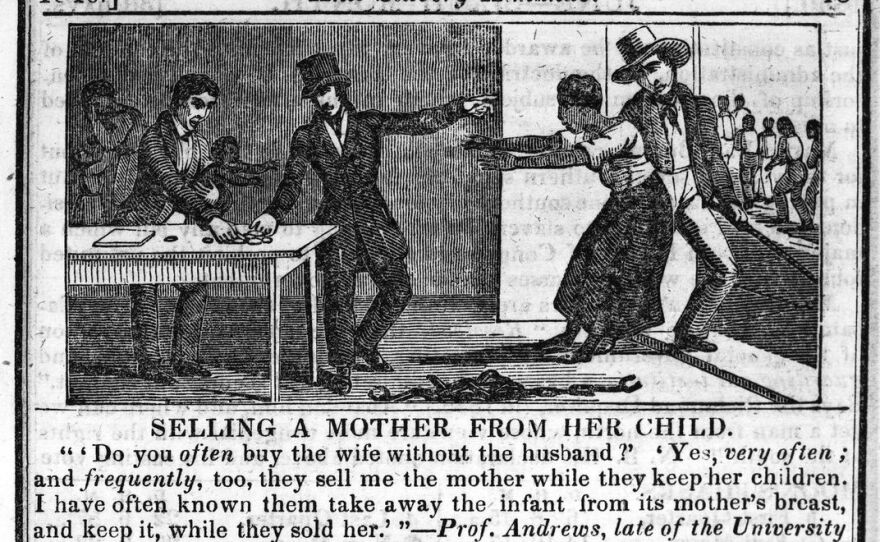
She explains in LINK>Dame how the historical traumas of family separation have shaped contemporary adoption in the US. How infants and children are valued and for what purposes. And since I don’t believe in burying this country’s history of slavery, I was happy to see her highlight that “Many of America’s earliest relinquishing mothers were enslaved Black women whose children were often sold away from them.” 

Or how about this history ? Native American mothers fled to the hills with their children and grandchildren to hide from government officials intent on sending the children to military-run boarding schools. Also in the 19th century, poor white mothers in eastern cities, many of them immigrants, struggled to care for their children due to poverty, widowhood, illness, or simply having more children than they had the capacity to parent. They surrendered them to foundling homes or institutions that labeled the children “orphans” despite the fact they had living parents. 

Of course, Gretchen Sisson doesn’t neglect to mention the scandal of Georgia Tann of the Tennessee Children’s Home Society in Memphis (from whom my own mother was adopted).

A favorite adoptee writer, Tony Corsentino knows Sisson and by chance I received a notification – Relinquished, 1: The Adopter Hustle – from him about the book yesterday. He writes about the title of her book, that it is a verbal adjective for adoptees like him. He also notes that “In another sense, relinquishing parents are themselves relinquished: relegated, marginalized, generally voiceless in the joyful clamor that attends every new adoption.” He writes that – Gretchen notes in her book that “it is adopted and displaced people who have led movements for abolishing adoption as it is currently practiced.” He says further that “The book’s aim is to present the authentic voices of parents who have lost their children to adoption.”

Corsentino goes on to say – “. . . because its arguments are a crucial part of the case for reform and abolition of adoption, I regard this book as a landmark in the history of research on adoption, and one of the most valuable scholarly contributions to the struggle for adoptee justice in the entire history of that struggle.” In his essay, he shares an excerpt that makes the case that it is NOT either adoption or abortion. From pgs 63-64 of Sisson’s book – “women who’d recently had abortions found that none of them seriously considered adoption, mostly because they believed it would be too emotionally traumatic.”

“These feelings about adoption were equally held by focus groups of both “pro-choice” and “anti-abortion” women, all of whom considered adoption to be emotionally painful not just for mothers, but for the children who would be relinquished. In another study examining the decision-making of women who’d had an abortion, most of them were unequivocal in ruling out adoption, with one participant alluding to the flawed reasoning of anti-abortion advocates: I don’t want to give my child away to nobody, and I’m not … and that’s the part they don’t understand. I can’t just be bearing a child for 9 months, going through the sickness and then giving my child [away]. I can’t.

Tony adds – “Our social world involves . . . Adoption agencies and hopeful adoptive parents (that )have become entrepreneurial; they hustle for birthparents.” “chasing pregnant people, luring them, seducing them.” They “use the techniques of search engine optimization to ensure that a wide range of phrases a person with an unplanned pregnancy might Google will call forth ads promoting relinquishment for adoption.”

Please DO read his entire essay !!

Sometimes The Pain Is Great

Black History Month

Trauma is stored in the DNA that is passed down through generations to descendants. One of the worst traumas that our country of the United States is guilty of is how long slavery lasted and how it was followed by Jim Crow laws. We still have a long way to go.

Today a Black mother who was coerced (and she is quick to note that coercion is not consent) but who believed lies about having an open adoption that would allow her ample contact with her son, who is being raised by white adoptive parents, was ranting. Her pain is palpable. My heart breaks as I read her words.

One hears echoes of that ancestral trauma in her first thoughts – Adoptees are bought and sold. You can change their name, their entire birth certificate & identity. They are then tasked with fulfilling the role you paid for them to fill.

She notes that due to this being a transracial adoption – it does not allowing the child’s body to give and receive all of the genetic input they would get with the biological parents, when they live & grow together. Instead the adoptive parents are fine with that and not because “the lifelong trauma of adoption + no genetic mirrors + maternal separation + finding out he was stolen and his parents wanted him back + unseasoned cultural trauma + possible religious trauma + the trauma of being transracially adopted & mean kids shit on him for it all throughout his life ” but believe he is better off than “2-3 years of trauma + therapy + reunification”.

What she seeks is that they give the child back to its biological family, noting that is not abandonment, it’s reunification. Also that a child will still seek out their true parents, even when raised by genetic strangers.

Black Family Separations

I was thinking about what I should write about today and knowing that February is Black History Month, I thought I would simply acknowledge that although slavery was outlawed long ago (if you don’t include our prison population), it is not true that this country has ceased taking Black children disproportionately from their families. The topic is so vast, I cannot even hope to do justice to the injustice in today’s blog.

Child Protective Services, the official name in many states, is the government agency that responds to reports of child neglect and abuse and is mandated to protect children, but their often reckless approach wreaks havoc on Black families daily. Black parents often reach out to hospitals, physicians, and other agencies for help with their children. Suddenly the tables are turned, the parents are accused of child mistreatment or endangerment and children are taken away.

It is not uncommon for white adoptive parents to adopt a Black child (and this is often the least expensive option available to them). Often these children are relocated to predominantly white neighborhoods. “It’s just completely false to think that White people are going to come in and save Black children that is part of that same ideology that we can go back to slavery as the origins of this idea that White people need to save Black children from their families. It’s been false, not only false but in a racist White supremacist ideology that paints Black parents and families and communities as if they’re defective and harmful,” said Dr. Dorothy Roberts, a University of Pennsylvania professor of law and sociology.

According to the National Center for Juvenile Justice, Black people comprise about 13 percent of the total United States population and 25 percent of youth in foster care. One example – in Philadelphia, Black people are 42 percent of the population and 65 percent of the youth in foster care. The Philadelphia Department of Human Services is legendary for its removal of Black children from their homes.

Black families are subject to more significant intrusion and strident judgment at every contact stage, including disproportionate reports to Child Protective Services, subsequent investigations, and child removal.

A Need To Know

Today, I read this from an adoptive mother – my adoptive daughter wants to research her background with a DNA test. She wants to know her origins and research whatever comes up. We homeschool and she wants to do this as part of her schooling. She just turned 14, so the questions I have are:

(1) Which DNA company is best ?

(2) How do we handle the info she gets ? No one knows who her natural father is, including her natural mother.

I don’t know if it would name a dad. How would we handle that, since her natural mother doesn’t even know who he is ? The father certainly has no clue he created a child.

The adoption is closed. She doesn’t have contact with her natural mother but I do. Honestly, I’d let there be contact but my husband is against it.

This is something I’ve had experience with. Both of my parents were adoptees. Neither really knew anything about their origins. My mom tried to find out with Ancestry but other than some ethnicity information, it didn’t get her where I think her heart wanted to go. I didn’t even know that she had done this, until I did Ancestry simply because I never knew my ancestry. I used to joke I was an albino African because no one, including myself, could say otherwise. I thought my dad was at least half Hispanic. My mom did have a bit of Mali, probably because her ancestral line included slave owners. My dad was half Danish. Who knew their complexion could be so dark ?

I did make progress with both Ancestry and 23 and Me. It helped that I had some names to go by. I rarely pay much attention to either these days. 3rd and 4th cousins don’t mean much. Ancestry was helpful in putting together my ancestor’s family trees and looking at human migrations as well as employment history where noted. 23 and Me brought me into contact with my paternal grandmother’s family. My dad’s father doesn’t seem to have ever known about his son. There is still extensive family in Denmark. My DNA has helped me prove my legitimacy as a family member.

Today, I read this – “Your DNA matches are probably your relatives. But a DNA test only suggests a relationship exists.” That is as truthful as it gets and as informative. Without names, it is only a mystery to solve.

From another child of adoptees I read this (it also proved useful for my nephew in his own search and connected him with his true father – information my sister tried to hide from ALL of us) – We used Ancestry, 23&Me as well as Search Angels to find my grandparents. Ancestry was the best in terms of ethnicity and finding my grandmother’s side of the family. Search Angels used the Ancestry information to find grandfather’s information.

I highly recommend this tool for getting answers, but you also need to be prepared for a lot of information that will generate more questions, as well as open the door to biologically related family. This is a GOOD thing for your 14 year old but she also needs support at home while processing this information. If your husband is going to cause issues, I would bring her therapist in to be part of this journey. I’d also add some extra sessions where you can join and create a plan for how to support her.

This is such an important thing for her to do and you owe it to her to support her. Remove any barriers that will cause guilt, shame, frustration at home. It will bring you all closer. If your husband gets in the way, be ready for her to resent him (and possibly you) over time.

The Legacy Of Family Separation

Since today is Juneteenth, a federal holiday that recognizes the date when the last enslaved persons were finally informed of their freedom, I thought about all of the children that were taken away from their parents, primarily from their mothers, during the period when slavery of Black people was common in these United States.

Black Perspectives is the award-winning blog of the African American Intellectual History Society (AAIHS). They are deeply committed to producing and disseminating cutting-edge research that is accessible to the public and is oriented towards advancing the lives of people of African descent and humanity. From the Black Perspectives website, LINK>Slavery and America’s Legacy of Family Separation by Vanessa M. Holden. Forced family separation was always a fixture of the lives of enslaved people. Enslaved children were a lucrative business. The expansion, maintenance, and future of slavery as an economic system depended on these children, particularly after the close of the American trans-Atlantic trade in 1808. 

One such story comes from Harriet Mason, who remembered her mistress forcing her to leave her home and family in Bryantsville, Kentucky, to work in Lexington as a servant at the age of seven. She remembered, “when we got to Lexington I tried to run off and go back to Bryantsville to see my [mother].” The grief of a childhood spent away from her family at the whim of her owner led her to suicidal thoughts, “I used to say I wish I’d died when I was little.” Even in her old age she was firm that, “I never liked to go to Lexington since.”

Slaveholders borrowed against their human property. They gifted enslaved children to their white sons and daughters as children, upon their marriages, or as they struck out to begin their slaveholding legacy. And of course, slave children could be sold down the road and down the river. Children knew that at any moment this could happen to them.

Blogger’s Note – Last night, my oldest son wanted to know if anyone in our family had benefitted from the labor of slaves. Eventually, it was suggested that every American has. I know that among my mother’s own genetic, biological family there were slave owners (I saw one will that was stipulating slaves by first name and who they were to be given to). I also know that side of my family also fought on the side of Confederates in the US Civil War. I’m not proud of being the descendent of these realities.

From the linked article – To profit from slavery and participate in slaveholding, Lexington’s white residents did not even need to own, buy, or sell a single slave. Someone made the shackles. Someone ran slave jails. Someone generated the official documents needed to transfer property. Someone hired enslaved children to work in their homes and businesses. Adults running with children from officials who would separate them was a feature of fugitivity during American slavery. To produce the “fugitive” category, a range of institutions sprang up. Local money paid sheriffs, courts, and officials to uphold the law that protected slaveholders’ rights to their human property. Someone printed runaway ads. Someone made money on enslaved peoples’ bodies at every juncture.

Along with physical labor, children deemed by the state to have unfit parents and placed into adoptive homes, perform emotional labor. Adoptees not only lose their birth families in the process, but they also lose ties to culture, language, country, history, and identity, and must contend with societal expectations that they be grateful for a “better life” in the face of it all. Children of color adopted by white parents also face racism in their new homes and communities. There is emotional labor too in being the physical body that allows white families to appear more liberal or multicultural, even if the opposite is true. In the United States, adoption is an industry and, as adoptee advocates continue to warn, it is poised to profit from family separation. There is already precedent for keeping children in the United States after a parent has been deported and awarding custody to American adoptive parents over immigrant parents caught up in immigration proceedings or because they were detained or incarcerated.

Black families are separated by the bond and bail system, incarceration, the child welfare system, and the criminalization of poverty. All can lead to family separation and the loss of one’s children. Child welfare advocates also recognize the link between the disproportionate number of Black children in the foster care system and the pipeline from foster care to prison.  All of these contemporary systems of power are echoes of legal and social structures that devalued enslaved parents and profited from enslaved children during American slavery.

We need to acknowledge these links to the history of American slavery and the ways that African Americans continue to endure discrimination. Following the money exposes the truth.

A Mother’s Daughter

Nanisca and Nawi

We watched The Woman King last night. Afterwards, my husband said, there’s your mom’s blog for tomorrow and I thought, yes, it fits and is appropriate. Nawi was conceived in rape. When her mother, Nanisca, escapes she finds herself with child. However, due to her life’s career as an Agojie warrior, she cannot raise her baby. In deep grief for having to let her go, she cuts her babies arm to insert a keepsake into it, a shark’s tooth, with no real intended outcome except to “mark” her baby in some manner.

The child is given to missionaries to raise but is adopted out. Her adoptive father attempts to sell her to an older man as one of his wives but the girl rejects him because in their initial meeting, he is already beating her. So her father takes her to the king’s palace to leave her for whatever his use of her will be. She also becomes a Agojie warrior. Eventually, her mother realizes, almost to her horror, that this is her own daughter returned to her. After a rocky reunion, the two women reunite as mother and daughter. The movie is a strong statement about the bonds of fierce sisterhood and female empowerment.

Maria Bello conceived the movie after visiting Benin. It was inspired by the true story of the West African kingdom of Dahomey during the 17th to 19th centuries. The Smithsonian magazine has an article on LINK>The Real Warriors Behind ‘The Woman King’ and an image of them. The Agojie became known to Europeans, who called them Amazons, seeing in them similarities to the warrior women of Greek mythology. The Woman King is therefore based on a true story but with extensive dramatic license. Though the broad strokes of the film are historically accurate, the majority of its characters are fictional. Nanisca and Nawi share names with documented members of the Agojie but are not exact mirrors of these women. King Ghezo reigned 1818 to 1858 and his son Glele reigned from 1858 to 1889. Together they presided over what’s seen as the golden age of Dahomean history. An era of economic prosperity and political strength.

The real Ghezo did successfully free Dahomey from its tributary status in 1823. But the kingdom’s involvement in the slave trade does not end (as it does in the movie) according the historical record. Dahomey was a key player in the trafficking of West Africans between the 1680s and early 1700s by selling their captives to European traders. The presence of Europeans and their demand for slaves was also one of the reasons for the monumental scale of Dahomey’s warfare.

In truth, Ghezo only agreed to end Dahomey’s participation in the slave trade in 1852, after years of pressure by the British government, which had abolished slavery (for not wholly altruistic reasons) in its own colonies in 1833. Though Ghezo did at one point explore palm oil production as an alternative source of revenue, it proved far less lucrative, and the king soon resumed Dahomey’s participation in the slave trade.

Portraying the Agojie, through Nanisca’s actions, as critics of the slave trade makes for a nice story. It probably is not historically accurate. Though these women were symbols of strength and power. They were complicit in a problematic system. They were under the patriarchy of the king and therefore participants in the slave trade. We also recently watched Black Panther, the all-woman Dora Milaje regiment is based on the Dahomey warriors.

The first recorded mention of the Agojie dates to 1729. The unit was possibly formed earlier, toward the beginning of Dahomey’s existence at the time of King Huegbadja who reigned from 1645 to 1685. He created a corps of woman elephant hunters. Queen Hangbe ruled briefly as regent following the death of her brother in the early 18th century. Some believe she may have introduced the women warriors as part of her palace guard. The Agojie reached their peak in the 19th century under Ghezo. Due to the kingdom’s ongoing wars, Dahomey’s male population had dropped significantly. This created an opportunity for women to replace men on the battlefield. The Agojie included volunteers and forced conscripts. Regiments were recruited from slaves, some of them captured as early as 10 years old. They also included the poor and girls who were rebellious like Nawi.

All of Dahomey’s women warriors lived in the royal palace alongside the king and his other wives, inhabiting a largely woman-dominated space. Aside from eunuchs and the king himself, no men were allowed in the palace after sunset. The Agojie they were restricted from having sex with men. To become an Agojie, recruits underwent intensive training, including exercises designed to harden them to bloodshed. In 1889, a French naval officer, Jean Bayol, witnessed Nanisca while still a teenager undergo a test (her person inspired the general in The Woman King). She had not yet killed anyone but easily passed the test by walking up to a condemned prisoner, swinging her sword three times with both hands. Then she calmly cut the last flesh that attached the head to the trunk and squeezed the blood off her weapon to swallow it.

Dahomey’s women warriors upset the French men’s understanding of gender roles and what women were supposed to do in a civilized society. The women’s flaunting of ferocity, physical power and fearlessness was manipulated or corrupted as Europeans started to interpret it for their own goals. The existence of the Agojie were simply more reasons for the French to conduct their civilizing mission, seeking to impose European ideals on African countries.

After facing defeat at the Battle of Atchoupa on April 20 1890, Dahomey agreed to a peace treaty assenting to French control but the peace lasted less than two years. Over the course of seven weeks in fall 1892, Dahomey’s army fought valiantly to repel the French. The Agojie participated in 23 separate engagements during that short time span, earning the enemy’s respect for their valor and dedication to the cause. One battle brought a moment of clarity for Dahomey’s king. He now realized the inevitability of their kingdom’s destruction. The last day of fighting was one of the most murderous of the entire war, beginning with the dramatic entrance of the last Amazons as well as the elephant hunters whose special assignment was to direct their fire at the officers. The French seized the Dahomey capital of Abomey on November 17 1892. After the war, some of the surviving Agojie followed their king, Béhanzin, into exile in Martinique.

French colonization proved detrimental to women’s rights in Dahomey. The colonizers barred women from political leadership and educational opportunities. Nawi, the last known surviving Agojie with battlefield experience, died in 1979 at an age well over 100 years old.

Below is the movie trailer –

What Was Lost

From Alex Haley’s Roots – orally passed down family lineage and baby naming ritual

From an article about the series in LINK>The New Yorker that speaks to my heart, being the child of two adoptees who was robbed of knowing my genetic grandparents –

“The desire to know who we are helps to explain the second of two pulls we ordinarily feel toward grandparents. The first attraction, and the one that as children we understand more clearly, is toward something easeful, generous, and amusing about grandparents, and about the way they handle us when we are around. They can be a wonderful escape from the stringent regimes of parents, with their endless admonitions about how we should behave. Grandparents allow us to grow; they like to watch us obeying something inside ourselves—something that we know only vaguely but that is completely familiar to them. Long retired from the strenuous business of shaping their children, our parents, they are often ready to coddle and indulge us, to refresh themselves in our youthful curiosities, and to enjoy our affections. They are also ready to talk a lot—about the past, about when they were young, about their own parents and grandparents. At such times, they look at us with something mildly searching and wistful in their eyes, hoping, no doubt, to see some early and fugitive version of themselves. We understand this only later, when we become aware of the second pull that these old people were exerting upon us all along; we realize that in listening to their talk we, too, were listening for some earlier and fugitive echoes of ourselves. We were drawn to them for the odds and ends of their memory, without which we would be less whole, or, at the least, left to invent a greater portion of ourselves.”

I actually have no memory of my adoptive grandparents trying to talk with me when I was a child about their own past, their youth and families. There was once though after I was well into my adulthood, when my adoptive maternal grandmother came to visit me in Missouri. She grew up here and we found her childhood home in Eugene and our great luck was that the owner allowed us to come inside. My grandmother shared with me what had changed in the house and me told stories about what it was like growing up there. We went by the cemetery where many of her own relations were buried. Memorable was a story about traveling by wagon over the Gasconade River to buy supplies in some larger town.

I certainly invented stories about my own “roots” as we knew nothing. My dad was half Mexican, left on the doorstep of the Salvation Army. True, my adoptive paternal “Granny” did obtain him there. His birth mother was working there but the Salvation Army had taken legal possession of him (as shown in his adoption papers). Thanking that wonderful Granny of mine for writing his birth mother’s name in the margin of her request for Texas to issue a new birth certificate for him. That amended birth certificate had to come from California, as he was born at the Door of Hope home for unwed mothers in Ocean Beach (near San Diego).

Turns out his dark complexion came from his Danish immigrant father who was not yet a citizen and was a married man. Sadly, he never knew he had a son. I did hear stories from my dad about how he almost starved to death in Magdalena New Mexico where his adoptive parents and an aunt and uncle (she was one of my Granny’s sisters) were trying to strike it rich by digging a mine there. About the time the adults went to town for supplies and my dad brought the cow into the cabin to milk it as it was very cold and snowing. My dad shot rabbits for food.

My invented story about my mom was that she was half Black. Not true at all, though she did have a smidgeon of Mali genes in her, most likely from the paternal line’s ownership of a few slaves. I saw that detail in a will. The deceased deeded the slaves by name to surviving family members. It was found in a binder lent to me by a family historian that I met near Memphis TN, where my mom was adopted. Neither her mom nor her dad were Black.

My heart sorrows for what my genetic grandparents might have been able to tell me.

Certainly, my adoptive grandparents had a HUGE influence on me. Their culture became some part of my parents (the adoptees); and through my parents, my self as well. Not minimizing how important our close relationships with these people during our growing up years was. Just so much was also lost and there is truly no way to fully recover that.

We All Have The Same Beginning

Most of my life (over 6 decades actually), I had no idea of what our family genetic history was because BOTH of my parents were adoptees with no knowledge of their origins. As I watch Christmas greetings go by with cultural flavors, I am happy to realize my own – Danish, Scottish, Irish and English with touches of Ashkenazi Jew, Neanderthal and even a bit from Mali (I suspect from the slave holding line on my mom’s paternal side).

I never knew my genetic ancestors but I feel them in me more strongly now that I have some idea of where I came from. If you are still in the seeking/searching mode, I wish you every success in connecting the dots as I was able to do for my own self (my parents were already deceased, so my discoveries came too late to share with them but I suspect if there really is some place beyond this physical life – which I do happen to believe there is – then my parents have had their reunions with their birth parents and know even more than I do now).

From your blogger on this Christmas Day – thank you for reading. I send you spirited blessings and hope that everything around you this year is Merry & Bright !!

Reproductive Justice

Yesterday, this blog was about the rights of fathers, today it is about the Reproductive Justice Movement. Reproductive justice includes the right to abort a pregnancy but also the right to raise a child in a safe and supportive community.

Why Reproductive Justice ? The experiences of Black, brown and Indigenous women who have been sterilized, abused, or punished for bearing children. Welfare laws based on misleading impressions of so-called welfare queens – Black women who allegedly had babies to collect welfare checks but wasted the money. These stereotypes have led to welfare policies that discourage welfare recipients from having more children by reducing their benefits.

The white-dominated reproductive rights movement’s “choice” framework privileges the most socially advantaged people in society. Those who have the ability to make choices. It doesn’t take into account social structures, power arrangements of race, class, gender, heterosexism, immigration status, religion – all of which shape one’s ability to have reproductive autonomy.

High Black maternal mortality is a matter of reproductive justice. States that have passed or will soon pass abortion bans have the worst healthcare systems, the highest maternal mortality, especially Black maternal mortality, and the highest infant mortality. As a result of [the supreme court decision] Dobbs, we’ll see increases in maternal mortality – deaths of pregnant people who intended to carry to term – because their health will be compromised.

It includes ending police violence, abolishing prisons, and all the inhumane carceral approaches to meeting human needs that have a profound impact on one’s reproductive life. Prisons are a major impediment in the United States to reproductive freedom. People who have had their children taken away by a discriminatory child welfare system that targets Black neighborhoods for family separation do not have reproductive freedom. To me, reproductive justice is inextricably linked to the fight against the prison industrial complex and the family policing system.

The reproductive justice framework is more effective than the reproductive choice approach. the movement for reproductive justice must be aligned with movements for housing, abolishing the prison industrial complex, environmental justice, and economic justice, because all of those movements are essential to supporting freedom, including reproductive freedom.

Movements seeking to limit or abolish the power of the criminal legal system and the prison industrial complex are relevant to opposing Dobbs’ assault on reproductive freedom. People are already being arrested and imprisoned for stillbirths and miscarriages; that standard will be applied to abortions as well. Recognizing the interconnected nature of these challenges is essential.

Today’s blog leans heavily on an interview in LINK> The Guardian of Dorothy Roberts. She is an internationally renowned scholar of race, gender, and the law at the University of Pennsylvania, who has dedicated her career to exposing attacks on Black women’s reproductive rights dating back to slavery and persisting to the present. 

You can learn more about Reproductive Justice at this LINK> SisterSong. Reproductive Justice combines reproductive rights and social justice.

Broken Family Threads

It is said that it is Black History Month, though many of my friends chafe at that and say it is ALWAYS black history. I understand. Imani Perry’s book South To America has been getting some buzz and as I writer I notice those things.

Yesterday, I read an essay adapted from her book published in Time Magazine’s Feb 14 – Feb 21 2022 issue titled “The Way Home.” It is about her effort to reconnect with a grandmother in Maryland who she is able to know very little about. Was her name Easter Lowe or Esther Watkins ? Was she born in Maryland or Georgia, was she 101 years old or 91.

I realized as I read how much I could relate to her journey to Maryland which is described in the article. Her attempt to get some insight into unknowable people. I recognized my own “roots” journey, often fraught with disappointment and too little too slowly. I am fortunate to know what I know now. Though the African American experience of slavery is not mine, I know how it feels not to know anything about where one came from (both of my parents were adoptees). At one time, I used to tell people I was an albino African because no one could prove me wrong, not even myself. Now I finally do know better.

Slavery was not exactly in my family history but in a way it was. My paternal grandmother was put to work in the Rayon mills in Asheville NC at a young age. She was not allowed to keep her own earnings and was probably expected to do a lot of other chores in the home. Her mother died when she was only 3 mos old and she had to live with a decidedly evil step-mother (from a story I heard about her being tied to a tree in a thunderstorm). She was a run-away slave. When her family visited her grandfather and her aunt in La Jolla California, she refused to return to Asheville and her slave labor there.

Poverty and the Great Depression was likely the cause of both of my grandmothers being separated from their babies. There really was not any family support for them. My maternal grandmother also lost her mother at the age of 11. She also escaped harsh conditions with her widowed father who was a sharecropper. She ran away to Memphis where she met and married my mom’s birth father.

Though I am not black and my family wasn’t enslaved, I can relate to Imani Perry’s story because in very real ways it is my story too. I didn’t grow up with a strong white supremacist’s identity. I was in the minority in Hispanic El Paso Texas and anyway, we didn’t have a clue to our ethnicity. Even so, I do recognize now that being white has put me in a class of advantages and I’ve worked very hard at educating myself by reading every anti-racist type book that has come my way. I celebrate the contributions of Black, African Americans to the diversity and vibrancy of the country of my own birth.