Hard To Process

As much as I share here, the truths can be hard to process. Many will simply go on and have the experience, even if they have been warned in advance about the challenges they will face and more importantly the life they are going to impact with their decision to adopt a child.

Many come into my all things adoption group having already taken that step to adopt a child. So, they are learning in hindsight but at least they are trying to understand what they are involved in at that point. Life is like that. No matter how many people try to tell you something you don’t want to hear, you are going to go your own way regardless, and then you learn in the fire of reality.

One of those hard to process realities is when an adoption begins as what is defined as “open.” It is not uncommon for these to become more “closed” over time, even if that was not the intention going in. Today’s story is a typical experience.

My son’s adoption is open by name only at this point. His genetic, biological mother and I texted for the first 2 years but I have not heard from her for the last 9. I send pictures and updates 3 times a year because that is our agreement. She has not seen him or spoken to him since his placement day and he was placed with an interim care family at birth.

My question is for other first mothers. My son has recently expressed interest in speaking with his original mother. I know that having a relationship with her will make a huge difference in his health and happiness long-term. I want to be respectful of her needs and desires but I would like to see if there is any possibility of facilitating contact. My thinking is that it will be easier to start contact at this age (he is now 11 years old), in case his feelings and questions get more complicated as he gets older, which seems likely. I plan to send her an email suggesting the possibility of speaking or meeting at some point in the near future. Is there anything I could say / should not say to make this easier? I don’t want to push, just to be a catalyst if this is possible.

I am happy to ask him what questions he might have and let her know ahead of time, or structure the meeting/phone call/emails in any way that would make it easier for her. I know it is hard for her and I wonder if contact would make things easier. Of course, there is so much that I don’t understand about her experience. What I do know is that there is a whole world of relationship between them – whether they meet or not. I know I am a bystander to that and I am fine with it. I just want to create an opening for them and see what they will make of it. Do you have any insights or advice for me as I navigate this?

She began her request with – Some of the truths about adoption as shared here have been hard to process but I am happy that I am learning. That is why I have titled this blog as I did. To reach out among adoptees and former foster care youth is to be vulnerable to hearing perspectives that may be uncomfortable.

Some selected responses – sending updates 3 times a year because that is your agreement is a generic way to manage what is a very paramount relationship. Regardless of what you agreed to, you should have done more. Sticking to an “agreement” does not show her how much she matters. Keeping her in his life all the time is what should be done, until she tells you not to. Moms make agreements usually for much less than they actually want because they walk on eggshells around hopeful adoptive parents. She does not have to answer, but you should have been showing her more often, how much she counts.

This woman’s response was –  It’s been hard to know how to be in a relationship with completely one-sided communication.  In the absence of communication about what her wanted,  the agency social worker advised me to stick to the agreement. We discussed text vs email and I was advised that text might be too immediate, if she wanted to withdraw at that time. I would have much preferred being in closer contact and being able to send off a photo or thought whenever it struck me. I see now that the guidance that I got was not great and that I should have explicitly asked her for clarification about what she wanted.  I was trying to honor what I thought she wanted, which seemed to be more distance. It’s been so confusing navigating this without any guidance. 

One of those first mothers replied – Stay out of their relationship as much as you can. It is not about you at all and he AND his mother need to know that you understand that. To which the woman replied – Do you mean once a contact relationship is established by me? I could facilitate our son sending an email himself but I would be afraid of the disappointment of not getting a response. He is still pretty young, he is not feeling a pressing need to get in touch (consciously at least), just casually said to me that we should call her and say hi on his birthday. This is mostly being led by me seeing that things will get more complicated as he gets older and hoping to create an opening for them now. But once contact is established (if!) this is invaluable for me to know.

Another first mother answered – I think sometimes adoptive parents try to reassure or instill pride in the original mother by showing or telling them how well their child is doing. I would hold off on that. Natural mothering instincts are suppressed, when you place a baby. That mother needs to know her child is hurting. She needs to know there is a hole only she can fill and that it will remain empty without her. I can only imagine how hard that would be to say and hear and feel as an adoptive parent but in my opinion the first mother needs that. They need to hear they are needed as a mom. So much of what happens during and after placement tells the original mother that they are no longer mothers. If she does not feel like a mom, she will not act like it. Which is never best for a child.

An adoptive parent asked – how do you do this without causing shame to the mom? The response from a first mother was – the mother needs to feel shame. It’s part of our journey and a pivotal moment on our way to accepting accountability for our actions. I know it’s tempting to relieve that ,especially if you’re concerned with how that mother will react. But saving someone from their emotions only hinders their progress. And I’m not saying try to force shame on her or say things to purposefully hurt her. I am saying if you tell a first mother her child is hurting and needs her, and if her response to that is feeling ashamed, that’s ok. That’s how a mother should feel, when they learn they’ve hurt or are hurting their child.

An adoptive mother shared – Our kid’s mother and I tackled that conversation in the past year.  I opened the conversation with the need of the child – “Child m is struggling with xyz, what do you think about that? You would have the best insight as child m’s mom.” I know about her background from conversations we have had previously, so I was also able to mirror some of what she had shared back. For me, the conversation was focused on what she thought was best or what the child needed. Not on did she do that as a kid or gaining like medical background from her. Because that feels like I’m just gaining information, not asking her to brainstorm or advise me. I also started to ask her permission for other parenting decisions to gain her input. That also helped us build that kind of relationship. And it can be small things too like child c wants to pierce their ears, is that okay with you? Child s has asked to try public school instead of private what are your thoughts? Child e is going out for xyz play, did you ever act or sing? Any advise for child e? For us, this reaffirms her as their mom because she is. It also gives us a way to update her about her kids and their life choices, events etc without it always being the same “so and so is great, here’s some photos of them smiling.”

Another first mother admitted – I know that if my children’s adoptive mother reached out saying my kids wanted contact, I would JUMP on it. Anytime, anywhere, any way I could. But then again, I couldn’t imagine having the option to see my kids and not taking it. I would traverse the depths of Hell to get that opportunity. My advice would be to reach out and just tell her that her child wants to get to know her, and that the door is open for her.

Without Secrecy or Shame

The mom’s group related to my youngest son once divided ourselves into tell/don’t tell. After that, we could no longer discuss, within the whole group, the medical technology that had brought all of us together. Our children were all born within a 4 month window of time. We’ve only gotten together once (and not all of us made it to the event) when our children were 2 years old. One woman who gave birth to twins developed a rapid breast cancer and is no longer with us. As to the others, I often wonder how the ones who were “don’t tell” will manage the reality of inexpensive DNA testing and matching services that are ubiquitous today. Though I never ask . . .

My family was always open about the truth but also did not make a big issue of it. Locally, I really didn’t think it was anyone else’s business. After our egg donor did 23 and Me, I got my husband a kit. Then we got both of our sons kits. That gave us an opportunity to talk over one Sunday night dinner about the whole circumstance of how we came to have them. They seem to understand that they would not exist any other way. As their biological mother (though they don’t have my genes – at least not from the egg that became them – who knows what all goes on in the womb ?), I don’t detect any difference in our relationships with one another – thankfully.

So, yesterday, I read this story that, of course, spoke to me in very personal ways. I suppose part of my own reasons for honest transparency had to do with the fact that I am a child of 2 adoptees and until after they had both died, I knew next to nothing about our origins. My only regret is that I didn’t uncover those details while they were still alive.

The story was part of LINK>Huffpost Personal and was submitted by Julee Newberger titled – My Parents Hid The Truth Of My Birth From Me. I Almost Did The Same To My Own Daughter. It is subtitled – “The longer we waited, the more anxious I became. If we didn’t tell her soon, I feared it could do lasting damage to our family.”

She explains – “When I was my daughter’s age, I believed I was the biological daughter of my doting mom and dad, who said they tried to have children for more than 10 years until, at last, I arrived. But I always sensed that something was amiss. There were no pictures of my mother pregnant or stories about my birth. Nobody in the family had my crooked smile or blue-green eyes. I’d overheard some whispered conversations about adoption, but whenever I asked my parents, they shut it down.”

“By the time an older cousin confirmed that I was adopted, I was in my early 40s and both my parents had passed away. This midlife discovery left me with tangled emotions and no way to work through it with the two people I’d loved and trusted most. It’s possible that my parents thought they were saving me from stigma or that they feared I’d abandon them in lieu of my biological family.”

Regarding the conception of her daughter, she notes – “I also experienced something I hadn’t anticipated ― a sense of shame, as if I had cheated nature. At 44, maybe I wasn’t supposed to be a new mother, and by extension, this beautiful baby wasn’t truly mine. . . . feeling like an imposter, somehow less ‘legit’ than the other moms.” Up until her daughter’s questions about ethnicity, she had told herself that it was too soon to explain donor conception to a child who was too young to understand how a baby was made.

So, this is how it proceeded – “As soon as she started asking about her ancestry, I bought a book called ‘You Began as a Wish’ by Kim Bergman, which talks about all the different ways kids are conceived. My husband and I planned for all of us to read it together, but my daughter preempted that by pulling the book out of a box of Amazon purchases after school.” The author continues, “My whole body tensed as she began reading aloud and asking questions: ‘So all kids are made up of sperm, an egg, a womb’ … ” So, Julee came out with it – “Remember we told you that Mommy had trouble getting pregnant at first?” I said matter-of-factly. “Well, an anonymous donor gave us an egg so that we could have you.”

“After a while, I could see recognition in her warm brown eyes, different in color and shape than my own. “So, I’m related to somebody else,” she said. The author notes – “A recent study on third-party reproduction. Results showed families have better outcomes when parents tell kids about their conception early on, ideally by the time they’re 7 years old. The longer we waited, the more anxious I became. If we didn’t do it soon, I feared it could do lasting damage to our family.”

blogger’s note – I don’t regret any of our choices. The situation is simply my family’s reality and we are far from alone in our circumstances. It is a whole new world thanks to medical progress.

Not Giving Her Up

Isabel and Lucy

In The Light Between Oceans, eventually truth and one’s conscience force a fierce mother to give up the child which isn’t actually hers. This sometimes happens in adoptions when the biological genetic parent decides they are not going to surrender their child to others to raise.

The story is a study in consequences. Every action begets a reaction. Every decision has its consequences, some unintended, but which have the capacity to cause the loss of happiness for the people involved. A lighthouse keeper and his wife discover a baby in a small boat alongside the child’s dead father. Isabel, his wife, has suffered through two miscarriages. The baby is like a gift from the sea and what the woman needs to heal the grief of her infertility. So, of course when the baby girl washes ashore in a small boat, Isabel adopts the infant as her own. Though truth be told, even though he loves his wife dearly, the husband has misgivings from the beginning, which will eventually force him to do the right thing by the woman who’s child the little girl actually is.

The movie is all about love, and the various forms of love; that between a husband and his wife, and that of a mother for her child (whether or not biological). The lighthouse keeper knows that he is required by law to report the discovery of the dead man and baby. However, his wife fears that the baby will be sent to an orphanage. She persuades her husband to pass the baby off as their own daughter, and though reluctant, he agrees out of the love he has for her and concern for the pain she suffers. He buries the baby’s father on the island and the couple names the infant girl Lucy.

When the man sees a woman kneeling in front of a grave bearing the names of her husband and infant daughter who were lost at sea, the date on the memorial stone matches the date that they found the baby girl. This causes him to realize that Lucy is likely the woman’s biological daughter. He writes anonymously to that woman to tell her that her husband is dead but that her infant daughter is safe, loved and well cared for.

This woman’s husband was German and she had married him shortly after the end of World War I. That marriage had therefore been controversial in their local community. When her husband is accosted in the street by a drunken crowd, he then jumped into a rowboat and fled with his baby daughter. In the boat with the baby was a unique silver rattle. Tormented by his conscience, he sends the child’s mother the rattle anonymously as proof that the baby actually is her lost child. Ultimately, this action leads to the lighthouse keeper’s arrest. His wife, Isabel, is angry that he is willing to give Lucy away after she has lived with them for several years.

After the little girl is returned to her biological family, she  runs away in an effort to return to the lighthouse and her “real parents.” She is found and taken back to her biological mother. The child’s original name was Grace and after she has begun to finally bond with her biological mother and maternal grandfather, they agree to call her “Lucy Grace” as a compromise with the little girl’s demands. At the end, though Isabel has passed away, the now 27-year-old woman finds the lighthouse keeper who had maintained the “no contact” ruling handed down for 18 years. Before her death, Isabel had written a letter to Lucy, in case she ever sought contact with the couple on her own. After reading it, the emotional young woman thanks the only father she knew for the first four years of her life, for rescuing and raising her on the lighthouse island.

The story reminded me of my cousin. She spent several years being raised by her (our) grandmother. It was traumatic for her to be wrest away by her biological mother’s return. She resented her aunt who was able to remain with the grandmother, when she was forced to leave someone she dearly loved.

Most of the time, when biological parents demand the return of a baby they had previously given up for adoption, the child has not had several years to bond with someone else. When that does happen, it can be very difficult for a child to give up the “fantasy” of the only parents that child has ever known. This happens rarely but on occasion, especially in the case of a father who did not originally consent to the adoption but is later given custody by a court of law.

The movie trailer –

I Just Want To Know Why

The story of LINK>Penelope Cumler from the Right To Know website.

She was the youngest of 6 children – her father an ordained minister and her mother a housewife, then a teacher, then a nurse. Her parents “fought a lot. There was little affection, considerable distrust, and a general sense of chaos and hopelessness. Resentments and anger always seemed to simmer close by. Financial hardships that didn’t make sense for educated, middle class parents, and the shame of this that must be hidden.”

At 32, she begged her father to tell her why he didn’t like her—had never liked her. He became angry. He denied that he treated her differently, and told her to grow up, adding “What’s wrong with you, anyway?” And then, her father dropped dead of a heart attack, and then she was blamed for “causing trouble”. She just wanted to know why the whole family shunned her.  It never seemed to be about her, about who she was, or her behavior. It was just her existence. Her presence. 

Ten years later, she remembered visiting a cabin by the sea and playing with a little boy who was 3 years younger than she was. She asked her mother, “who that man was that we visited at his cabin by the sea. Why did we visit him?” The first time, she said he was just a family friend. “But…”, she began to say. And then something entirely unthought came out of her mouth before she could even consider it. “Was he my father?” Without meeting her gaze, her mother answered, “Why would you think that? That is crazy. You’re crazy.”

Several years later, she was in her fifties by now and her mother was in her 80s. She tried asking again but this time her mother surprised her by how strong her reaction was – “You’re abusing me! Stop abusing me!” Before leaving her after that visit, she couldn’t even look at her mother, couldn’t give her a hug goodbye. Then her mother died.

Then, she shares how she finally got her answer – Four years later, working in the garden on an autumn day, the name of the son of the man in the cabin by the sea, with whom I had played as a little girl, fell into my head like the whisper of a ghost in my ear. Within minutes I found him on social media. Within hours he responded. Within ten sentences sent back and forth he asked, “Can I be honest with you?” and then, “You are my half-sister.”

All she had ever wanted was the truth, a truth she had the right to know, a truth consciously and aggressively denied her. She notes – The universe seems to be tapping more frequently and insistently lately, “Tell your story, tell the truth, get it out there…and let it go.” She admits – “I feel surprisingly unaffected by the shame my parents must have felt. I attribute this to the sense that I never felt cared for and didn’t trust them and, because they showed me no mercy, I have no sympathy for how their reputations may suffer.” She believes that finally knowing the truth has in many ways saved her life.

The Legacy Of Family Separation

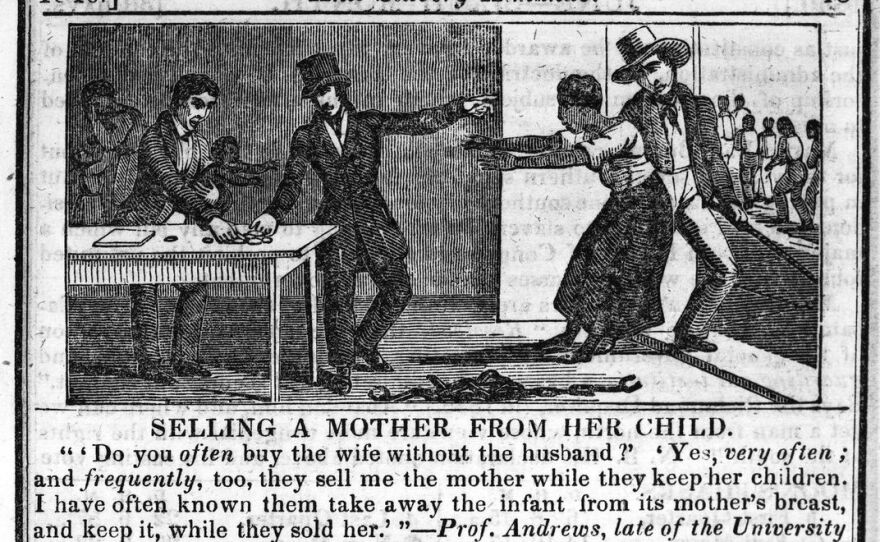
Since today is Juneteenth, a federal holiday that recognizes the date when the last enslaved persons were finally informed of their freedom, I thought about all of the children that were taken away from their parents, primarily from their mothers, during the period when slavery of Black people was common in these United States.

Black Perspectives is the award-winning blog of the African American Intellectual History Society (AAIHS). They are deeply committed to producing and disseminating cutting-edge research that is accessible to the public and is oriented towards advancing the lives of people of African descent and humanity. From the Black Perspectives website, LINK>Slavery and America’s Legacy of Family Separation by Vanessa M. Holden. Forced family separation was always a fixture of the lives of enslaved people. Enslaved children were a lucrative business. The expansion, maintenance, and future of slavery as an economic system depended on these children, particularly after the close of the American trans-Atlantic trade in 1808. 

One such story comes from Harriet Mason, who remembered her mistress forcing her to leave her home and family in Bryantsville, Kentucky, to work in Lexington as a servant at the age of seven. She remembered, “when we got to Lexington I tried to run off and go back to Bryantsville to see my [mother].” The grief of a childhood spent away from her family at the whim of her owner led her to suicidal thoughts, “I used to say I wish I’d died when I was little.” Even in her old age she was firm that, “I never liked to go to Lexington since.”

Slaveholders borrowed against their human property. They gifted enslaved children to their white sons and daughters as children, upon their marriages, or as they struck out to begin their slaveholding legacy. And of course, slave children could be sold down the road and down the river. Children knew that at any moment this could happen to them.

Blogger’s Note – Last night, my oldest son wanted to know if anyone in our family had benefitted from the labor of slaves. Eventually, it was suggested that every American has. I know that among my mother’s own genetic, biological family there were slave owners (I saw one will that was stipulating slaves by first name and who they were to be given to). I also know that side of my family also fought on the side of Confederates in the US Civil War. I’m not proud of being the descendent of these realities.

From the linked article – To profit from slavery and participate in slaveholding, Lexington’s white residents did not even need to own, buy, or sell a single slave. Someone made the shackles. Someone ran slave jails. Someone generated the official documents needed to transfer property. Someone hired enslaved children to work in their homes and businesses. Adults running with children from officials who would separate them was a feature of fugitivity during American slavery. To produce the “fugitive” category, a range of institutions sprang up. Local money paid sheriffs, courts, and officials to uphold the law that protected slaveholders’ rights to their human property. Someone printed runaway ads. Someone made money on enslaved peoples’ bodies at every juncture.

Along with physical labor, children deemed by the state to have unfit parents and placed into adoptive homes, perform emotional labor. Adoptees not only lose their birth families in the process, but they also lose ties to culture, language, country, history, and identity, and must contend with societal expectations that they be grateful for a “better life” in the face of it all. Children of color adopted by white parents also face racism in their new homes and communities. There is emotional labor too in being the physical body that allows white families to appear more liberal or multicultural, even if the opposite is true. In the United States, adoption is an industry and, as adoptee advocates continue to warn, it is poised to profit from family separation. There is already precedent for keeping children in the United States after a parent has been deported and awarding custody to American adoptive parents over immigrant parents caught up in immigration proceedings or because they were detained or incarcerated.

Black families are separated by the bond and bail system, incarceration, the child welfare system, and the criminalization of poverty. All can lead to family separation and the loss of one’s children. Child welfare advocates also recognize the link between the disproportionate number of Black children in the foster care system and the pipeline from foster care to prison.  All of these contemporary systems of power are echoes of legal and social structures that devalued enslaved parents and profited from enslaved children during American slavery.

We need to acknowledge these links to the history of American slavery and the ways that African Americans continue to endure discrimination. Following the money exposes the truth.

Foster Parents and Trauma

I just read a post from a hopeful adoptive parent who is kin to a child and would like to adopt them out of foster care – “I just found a Go Fund Me for the foster moms fighting us for custody of my cousin. Is there a point where it really is better for my cousin to stay where he’s at ? They keep arguing about the trauma the move will cause. He just turned a year old recently. They make me feel like a monster for trying to step up and keep him connected to his biological family and that I’ll cause him significant trauma.”

And there was this reply from someone who was in foster care during their youth – Trauma lol. Let that child be a child they don’t want – they could care less about trauma. I was in 24 foster homes. Foster parents don’t pull the trauma card or bonding card with kids they don’t want.

Right now they’re lying and hoping to drag the case out. The truth is they’re causing trauma. I’m sorry to say this but being ripped away from your foster family can’t be compared to being ripped away from your biological family. They want to compare it but they can’t. It’s more painful to be ripped away from your biological family than a foster family. A foster family, you don’t lose anything. Losing your biological family causes life long issues. They want to sound important but they’re not.

And I speak as someone who had only one good foster home (out of 24). Explain how adoption is legal after kids spend years in foster care or with their caregiver, only to be ripped away. My advice is fight until the end. It’s better to be fought for. One day the child will know the truth.

And a foster parent writes – If they were truly concerned about the move causing more trauma they would be working with you on visits and a transition plan. This isn’t about the baby it’s about them. We’ve transitioned a little one before and by the time we made the final move he was just as bonded to his aunt as he was to us. Transitions can happen in a way that is fun and easy for the little one – IF everyone works together. I am so sorry you are going through this. Keep fighting.

Nature Provides

I listened to a message delivered on Mother’s Day by a man from Africa who made the point that Nature provides for needs even before they are needed. He said – When you were born, I did not hear you praying for the breastmilk. When you were in the womb, you were supplied with all of the nutrients you received actively. Receiving that from fluid. As soon as you stepped out into life, that knowing of life went ahead of you and provided breastmilk from your mother for you. You didn’t pray for that. You didn’t decree for that. Life went ahead of you, providing what you needed before you would need it. Before we are born, mother’s first breastmilk contains the Colostrum that is needed to immunize your body. Life goes ahead of you, providing the air you need to breathe.

At some point he said – You cannot pray to God to save you from the storm, when God is the storm. If God is all there is, it includes Itself. The storm is simply what Life is trying to express through you and as you. Don’t tell God to fix the storm of problems in your life.

That has had me actively contemplating what this means in regard to domestic infant adoptions. The infant is denied their mother’s breastmilk (at least in most cases, there are probably exceptions, where the mother does this even if the infant is being adopted). Yet this is a powerful, spontaneous, creative, loving and intelligent universe. It is an ever-giving, ever-blessing universe. Fine tuning Itself. It is all that is, so adoption must be part of that, it cannot be otherwise (as much as it pains me to admit this).

Yet, also today I read this from a childhood adoptee – My adopted parents and I had a terrible relationship. I was an undiagnosed autistic with various sensory issues and special interests, they were conservative Christians convinced my special interests (mainly classic rock & heavy metal) were demonic. My struggles and their parenting clashed constantly, resulting in me being out of the home during most of my 13-18 years. I haven’t spoken to them since early 2016. My birth mother told me two weeks before my 24th birthday last year that she “wished she’d have swallowed me”, at which point I cut contact.

Mother’s Day is a bit hard for me. I was a momma’s boy as a kid, and 0/2 of my mothers care for me, or are proud of me. I wish I had a mom to bring flowers to, and thank for always being there for me, but the truth is, neither of them were. I spent most of my teens in group homes, and most of my big life milestones I went through alone.

My mother in law is amazing, and has been supportive of me so deeply since she has come to know me. I thank her every chance I get. I appreciate her so very much, but still sometimes, it feels like something, no, someone is missing. When my wife is lonely, or upset, or excited, she calls her mom. And when I’m in a whole other state, alone (as my wife is away doing grad school at another program), I sometimes wish I had a mom to call.

Certainly, Life has provided him with places to go. Life has provided him with a wife who’s mother is good to him as well. This is a hard one for me to work through but I don’t doubt the truth behind it all. Life goes ahead of you, providing what is needed, before it is needed. That is some kind of cold comfort that can warm a heart that has grown cold with life’s difficulties.

My Life’s Purpose

In 2012, I participated in an online course with Jean Houston titled Awakening to Your Life’s Purpose. In 2016, I spent a week at her home in Oregon with other participants attending what was titled Electing Yourself. I remember that she was certain that Trump would not be elected but as we all know, he was (regardless of how one might interpret the validity of his election).

In the August 2016 Salon, I took the “hot seat” and commented that I had not discovered my Life’s Purpose previously. I didn’t discover it at that Salon either.

But beginning in the fall of 2017, I began a personal roots journey to discover who my genetic grandparents were, since both of my parents were adoptees and both died with almost no knowledge of their origins (1930s closed, sealed adoptions). I succeeded beyond any of my wildest dreams and now feel whole in ways I did not feel for almost 6 decades of my life. Now that I and my related family members know who these people were, no one can take that back away from any of us. I am still integrating my own new awareness and this has had to include re-owning my relatives via adoption. Once I knew my family’s truths, for awhile, the adoptive family no longer felt “real” to me. Now I can embrace all of them (personally known and never having met) as important in my own lifetime.

Part of that new understanding was realizing what a minor miracle it was that my unwed, high school student mother had not been forced to give me up for adoption.

I believe I was preserved in the family I was conceived within to reconnect the severed threads of my family’s origins. Having done that, I continue to educate myself about all things adoption and that has led me to write this daily blog (with some gaps unavoidably occurring). Sometimes, I think I have written enough, sharing what I learn with anyone else who is interested for whatever reason. But there always seems to be something more to say. My daughter once said to me – it seems like you are on a mission. I accept that is true – I do what I can to spread the word about the trauma and unintended consequences experienced by adopted persons. Until there isn’t anything more to share, I will continue to write here.

The late Dr Wayne Dyer wrote in Staying on the Path, pg 68 – “A purpose is not something that you’re going to find. It’s something that will find you. And it will find you only when you’re ready and not before.” Dr Dyer actually died just before my own mother did in 2015. My dad died a short 4 months later. They had been high school sweethearts and remained married for over 50 years. Both were gone before I could share my own family origin discoveries with them.

Adoption Reform Is Reproductive Justice

The article LINK>Meet the New Anti-Adoption Movement in The New Republic by Emily Matchar is dated September 1 2013 but the need for reform has not progressed all that much. True more states do now allow adult adoptees to have access to their original birth certificates and that is a very precious document for those who are able to obtain one. It is subtitled – the surprising next frontier in reproductive justice.

Adoption has long been perceived as the win-win way out of a a difficult situation. An unwed mother gets rid of the child she’s not equipped to care for; an adoptive family gets a much-wanted child. But people are increasingly realizing that the industry is not nearly as well-regulated and ethical as it should be. There are issues of coercion, corruption, and lack of transparency that are only now being fully addressed.

The past decade (note that she is referring to before 2013, however much remains as described here) has seen the rise of a broad and loose coalition of activists out to change the way adoption works in America. This coalition makes bedfellows of people who would ordinarily have nothing to do with each other: Mormon and fundamentalist women who feel they were pressured by their churches, progressives who believe adoption is a classist institution that takes the children of the young and poor and gives them to the wealthier and better-educated, and adoptive parents who have had traumatic experiences with corrupt adoption agencies.

They’ve formed several grassroots activist organizations, including Parents for Ethical Adoption ReformOrigins-USA, and Concerned United Birthparents. Some call themselves adoption reformers. Others prefer terms such as “adoption truth advocate.” A few will come straight out and say they’re anti-adoption. They want, among other things, a ban on adoption agencies offering monetary support to pregnant women. They want to see laws put in place guaranteeing that “open” adoptions (where birthparents have some level of contact with their children) stay open. They want women to have more time after birth to decide whether to terminate their parental rights. These activists have become increasingly loud of late, holding prominent rallies, organizing online, and winning several recent legislative victories.

I belong to such a private, members only, community on Facebook – Adoption:Facing Realities. Discussions in that community can be difficult and uncomfortable for some (often the adoptive – including “hopeful” – or foster parents who join). I remember getting slammed almost immediately when I arrived. I had a positive perspective on adoption since BOTH of my parents were adoptees. I have learned so much there, stuff one doesn’t encounter often online or out in the world. Adoptees and former foster care youth are privileged voices in that community. It is NOT a support group for adoptive or foster parents. They do not promote a rainbows and unicorn perspective on adoption.

Reproductive justice activists see adoption reforms as equally important to the issues of abortion and contraception, when it comes to men and women having full control of their destinies. It is true that adoption in America has changed vastly since the end of the so-called “Baby Scoop Era,” That ended in the early 1970s. During that era, many pregnant young women were “sent away” and their babies put up for adoption. During the 50 years of legalized abortion, along with a drastic lessening of the stigma against unwed mothers (I personally know several), the number of babies available domestically has been shrinking since the mid-’70s. In fact, one of the arguments put forth by Justice Alito was that ending abortion would increase the supply. Back in 1963, about 9 percent of babies born to unmarried women were placed for adoption. In 2013, that number was 1 percent. At the time this article was written, there were about 14,000 domestic infant adoptions per year, which was only about 15 percent of US adoptions – with the rest from foster care or internationally sourced, which has now in 2023 also decreased as those country’s governments clamp down on the export of their own citizens. 

You Should Be Grateful

From her own website LINK>The Adopted Life“Your parents are so amazing for adopting you. You should be grateful!”

Angela Tucker is a Black woman, adopted from foster care by white parents. She has heard this microaggression her entire life, usually from well-intentioned strangers who view her adoptive parents as noble saviors.  She is grateful for many aspects of her life, but being transracially adopted involves layers of rejection, loss and complexity that cannot be summed up so easily. Tucker centers the experiences of adoptees through sharing deeply personal stories, well-researched history and engrossing anecdotes from mentorship sessions with adopted youth. These perspectives challenge the fairy-tale narrative of adoption giving way to a fuller story that includes the impacts of racism, classism, family, love and belonging. 

The search for her biological family was documented in the 2013 film “Closure.”

From the LINK>Seattle Times – Her new book from Beacon Press, “You Should Be Grateful: Stories of Race, Identity, and Transracial Adoption,” explores Tucker’s life experience, her work with transracial adopted youth and the history of adoption in America. It’s both a powerful manifesto and a hopeful text that calls for reshaping how we talk and think about adoption.

The book uses terms from John Koenig’s “The Dictionary of Obscure Sorrows.” Angela uses terms like “ghost kingdom” and “postnatal culture shock.” Angela says, “in the same way John Koenig feels there aren’t enough words to adequately describe all of our emotions, I feel that way about transracial adoption. We’re kind of boxed into things like, for kids, you’re an Oreo: Black on the outside, white on the inside. That morphs in adulthood, and what I hear adoptees I mentor talk about is [being a] racial imposter. I think it’s important we find new words that can articulate the complexity of our layers and also honor the truth of it.”

“It’s a beautiful thing to grow up having parents who understand at the root that an adoption is a sad thing, that we wish an adoption didn’t have to happen. I had parents who acknowledged that pain for all of us. I know so many adoptees for whom that part is not allowed any space. Even for those adopted for reasons that are legitimate, there’s still a loss. And bypassing that and going straight to, ‘You’re here now, look at this great life,’ many adoptees now can articulate it feeling like gaslighting. ‘Maybe I am crazy to wish for and to long for being connected to my kin. I have my own room, I have three square meals a day, I get to do all these extracurriculars. I must be crazy for not being more thankful for it.’ That gaslighting is, in this sense, synonymous with confusion.” 

More in the Seattle Times interview linked above.