I don’t have a bad adoption story. But, it was hard, really hard, because I always missed my mother. Then, I relinquished my daughter at age 19, the exact same age my mother was when she relinquished me.
Just recently, after a lifetime of searching, I located my mother. It was beautiful and painful and healing and heartbreaking all at the same time, because we fit. And, she’s a lovely, kind, intelligent, woman of faith. She would’ve been a wonderful mother!
To realize this is devastating. I was told it was a “better life” when, in reality, it would’ve just been different. I missed her every day. I spent the first 45 years of my life believing adoption was something brave and beautiful, even when it separated me from my mother and then again later from my own daughter. I realized the decisions that were made FOR me as an infant, and, even worse, the decisions I made FOR my daughter were, in fact, a tragic mistake. We were told it was a “selfless decision”; that my mother ‘loved me so much” she gave me away.
Love=Abandonment.
You can read the entire essay here – Dear Adoption, I’m Trying to Unravel the Mess You Made
An adult adopted woman wrote – My biological daughter is 30, married with 1 child and she is struggling so much with similarities to abandonment issues that I had all my life. Her self esteem is very low, she does not feel she’s worthy of her husband, sees him as being the better person as a father and in their relationship a better husband than she is a wife. I see her trying to sabotage her relationship which reminds me of myself doing the same because I always thought people would leave me because I’m not good enough. I had to leave them first (I find this remark interesting because I am the child of 2 adoptees and I have always been the one to leave a romantic relationship) or make them leave me to prove my point to myself. She has no abandonment experiences. She’s always been loved and cherished by her father and I. I am thinking it’s epigenetics like you’ve talked about.
Our children and grandchildren are shaped by the genes they inherit from us, but new research is revealing that experiences of hardship or violence can leave their mark too. Unlike most inherited conditions, this was not caused by mutations to the genetic code itself. Instead, the researchers were investigating a much more obscure type of inheritance: how events in someone’s lifetime can change the way their DNA is expressed, and how that change can be passed on to the next generation.
This is the process of epigenetics, where the readability, or expression, of genes is modified without changing the DNA code itself. Tiny chemical tags are added to or removed from our DNA in response to changes in the environment in which we are living. These tags turn genes on or off, offering a way of adapting to changing conditions without inflicting a more permanent shift in our genomes.
If these epigenetic changes acquired during life can indeed also be passed on to later generations, the implications would be huge. Your experiences during your lifetime – particularly traumatic ones – would have a very real impact on your family for generations to come. There are a growing number of studies that support the idea that the effects of trauma can reverberate down the generations through epigenetics.
A lot of epigenetic research requires a proof by elimination and looking at what may be the most consistent explanation. Many of the times when trauma is thought to have echoed down the generations via epigenetics in humans are linked to the darkest moments in the ancestor’s personal history. The idea that the effect of a traumatic experience might be passed from a parent to their offspring is still regarded as controversial by many people.
The consequences of passing down the effects of trauma are huge, even if they are subtly altered between generations. It would change the way we view how our lives in the context of our parents’ experience, influencing our physiology and even our mental health. Knowing that the consequences of our own actions and experiences now could affect the lives of our children – even long before they might be conceived – could put a very different spin on how we choose to live. Despite picking up these echoes of trauma down the generations, there is a big stumbling block with research into epigenetic inheritance: no one is sure how it happens.
A recent paper has revealed strong evidence that RNA (rather than DNA) may play a role in how the effects of trauma can be inherited. Researchers examined how trauma early in life could be passed on by taking mouse pups away from their mothers right after birth. The model is quite unique. It mimics the effects on dislocated families, or the abuse, neglect and emotional damage that you sometimes see in people. Different lengths of RNA molecules were linked to different behavioral patterns: smaller RNA molecules were linked to showing signs of despair.
The science of epigenetic inheritance of the effects of trauma is still in its early stages. It is suggested that if humans inherit trauma in similar ways to the mammal experiments, the effect on our DNA could be undone using techniques like cognitive behavioral therapy. That there is a malleability to the system. Healing the effects of trauma in our lifetimes could put a stop to it echoing further down the generations.
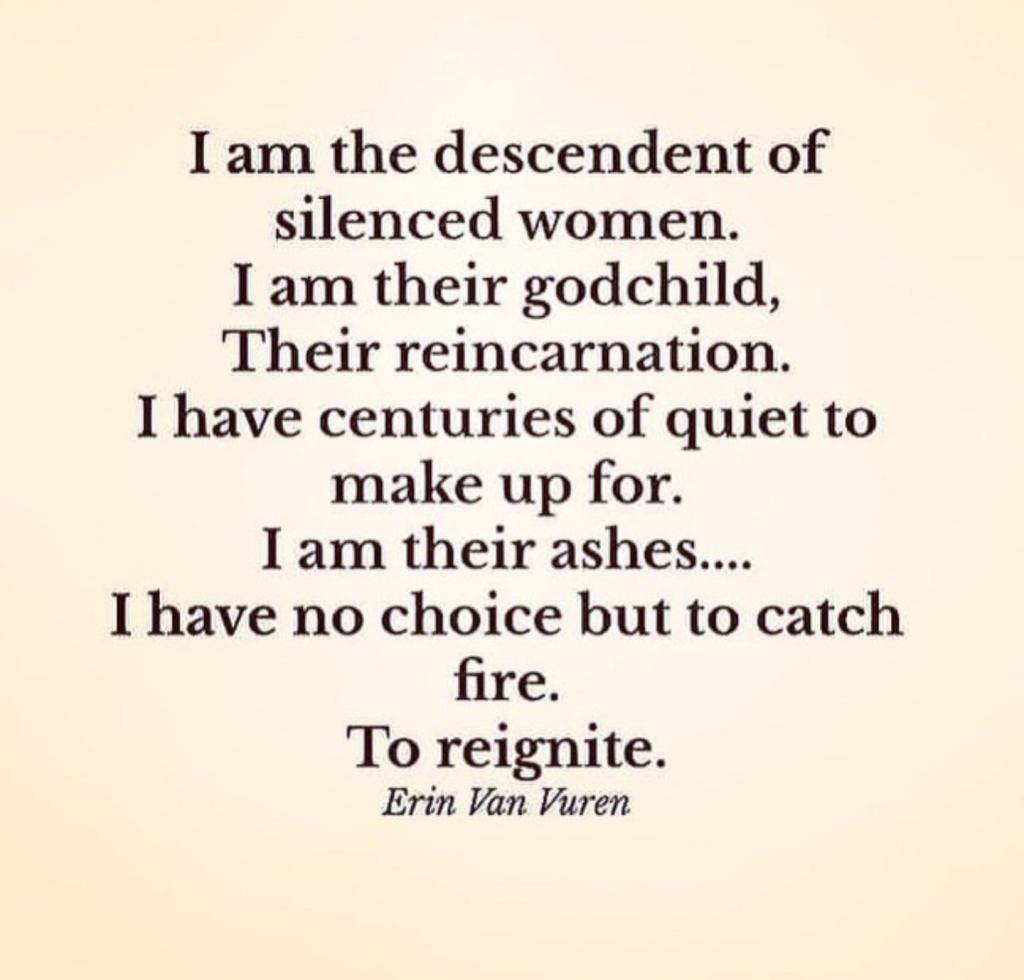
When I saw this graphic, it went straight to my heart like an arrow. My grandmothers, forced by circumstances to give up their first born, and in two cases only child (which includes a grandfather who never was given the benefit to know he had a son), to go on with their lives as though nothing happened.
I don’t think I’ll ever truly 100% get over it and I probably should not because adoption is still a thing that drives mothers and their babies apart. I now have an unflinching awareness of what it means to be adopted.
At almost 70 years old now, having to live through a full 6 decades before I knew the truths of my origins, I do fell as though I was born to re-connect the broken threads of my family’s beginnings, that I have somehow managed to fulfill my destiny in having been born at all.
In learning about my family’s ancestors, I also discovered what a miracle it was that in the mid-1950s, I was not given up for adoption, with my parents forced to suffer the same fate their own parents encountered. My teenage mother and my father only having just started on his university studies – both interrupted when I decided to take up residence in my mother’s womb.
My grandparents could not tell their own stories of loss that hurts for a lifetime because no one would have been sympathetic regarding their plight but for adult adoptees today, there is a growing awareness of the trauma and pain of being cut off from one’s roots and some are even choosing to attempt parenting when they had thought to give up their child and they are finding a lot of support in society all around them.
May the reform of attitudes continue to take over the dominant narrative that adoption saves babies and children from a worse fate.
For many indigenous women, political action regarding children was not about campaigns for subsidized day cares or cultural arguments about gender, work, and parenting. Child welfare was a literal fight to keep Native children in their homes and in their nations.
During the 1970s, Native American women activists understood the crisis of child adoption (which had grown rampant in the postwar era) as more than a personal issue affecting individual families. The removal of Native children from their homes and communities compromised not only parental rights but also tribal sovereignty. Technically, indigenous nations had a legal advantage in the battle for control over Indian child welfare because the right to oversee issues related to children living on reservations existed as an implicit aspect of sovereignty. In practice, however, state courts and welfare agencies largely misunderstood or ignored tribal authority and the interests of indigenous communities and removed Native children from their homes at arresting rates—an average of one quarter of Native American children lived away from their parents during the early 1970s
In response, Native women activists created a child welfare political agenda that not only kept children in their communities but also addressed the problems that sometimes led to foster and adoptive placements. Although they acknowledged that there were legitimate issues, such as alcoholism, that required some parents to surrender their children, activists did not interpret the current crisis as the result of inadequate parenting. Nor did they place blame exclusively on culturally insensitive child welfare systems. Rather, activists condemned poverty and the vestiges of colonialism for the problems that precipitated child removals. One activist asserted that ‘‘the process of colonization has brought more destruction to these family ties than any internal changes … could have ever created.’’ According to this woman and others, while colonization created the problems indigenous families faced—solutions to them rested with Native nations. Both the programs’ indigenous women activists established and their petitions to the federal government to uphold the right of the tribes to control child welfare focused on increasing tribal agency in addressing the fundamental difficulties that Native families confronted. These activists gained strength from their citizenship in Native nations and framed their work against child removals in the context of tribal sovereignty.
The history of non-Native people intervening in the lives of indigenous families is a long one; arguably as old as the history of colonization itself. The Indian Child Welfare Act (ICWA) of 1978 is Federal law that governs the removal and out-of-home placement of American Indian children. … ICWA established standards for the placement of Indian children in foster and adoptive homes and enabled Tribes and families to be involved in child welfare cases.
“They closed the boarding schools and opened up CPS (Child Protective Services), but it’s the same thing – they’re still coming in and taking our children,” Cetan Sa Winyan said. The Cherokee Nation of Oklahoma, the Oneida Nation of Wisconsin, the Morongo Band of Mission Indians of California and the Quinault Indian Nation of Washington are petitioning the Supreme Court to request that the Indian Child Welfare Act remain intact.
The state of Texas is challenging the constitutionality of ICWA, claiming it’s a race-based system that makes it more difficult for Native kids to be adopted or fostered into non-Native homes. Another argument is that the law commandeers states too much, giving federal law imbalanced influence in state affairs.
A Supreme Court response to the tribes’ petition and the petition filed by the plaintiffs is due on October 8th.
Tribes and advocates argue that ICWA is culturally- and politically-based, not race-based, because tribal nations have political status as sovereign governments under federal law. Cherokee Nation Deputy Attorney General Chrissi Nimmo said the tribe will put all the resources it has into making sure ICWA is protected. “ICWA attempts to keep children connected to their tribe … and an attack on that is absolutely an attack on tribal sovereignty,” Nimmo said.
In the case of Brackeen v. Haaland, the Brackeens — the white, adoptive parents of a Diné child in Texas — seek to overturn ICWA by claiming reverse racism. Joined by co-defendants including the states of Texas, Ohio, Louisiana, and Indiana, they’re being represented pro bono by Gibson Dunn, a high-powered law firm which also counts oil companies Energy Transfer and Enbridge, responsible for the Dakota Access and Line 3 pipelines, among its clients.
An article in The Sunday Post about Forced Adoption describes DES as a synthetic hormone developed to mimic estrogen which was given to young mothers to dry up their breast milk after their babies were taken for adoption. Diethylstilbestrol, known as DES, has been linked to a number of breast and vaginal cancers, gynecological abnormalities and infertility in the children and grandchildren of women given the pills.
Forced adoption campaigners are calling for a public awareness campaign to alert the women involved, as well as their children and grandchildren. In Scotland, there were 60,000 forced adoption victims with most of those women losing their baby simply because they were not married. Unmarried mothers who were forced to give up their babies were given a controversial drug now linked to cancers and life-changing conditions which can be passed on to future generations.
The film-maker Caitlin McCarthy has made a movie screenplay titled Wonder Drug that exposes the dangers and cover-ups. She said: “I’m affected by DES because it had been given to my mother during a pregnancy. My doctor recognized the abnormalities in my cervix was as a result.“ The effects of DES are as horrific as Thalidomide, but there’s been silence so very few victims will even realize they were exposed.
“The high rate of breast cancer in women today shows it’s not paranoia for us to wonder that we, and future generations, could die from a drug we were exposed to. The high instance, effects and use of this drug has yet to be fully explained and exposed. We need to know what to look for in the way of symptoms. This should happen before any apology.” However, politicians from every party have supported calls for a forced adoption apology in Scotland.
There is an interview with screenwriter Caitlin McCarthy at the website – D.E.S. is it.
Unfortunately, there isn’t a “test” to determine DES exposure.
Caitlin shares what she does – “I’m aware of my reproductive tract structural differences. I also have to stay on top of my DES-related precancerous cell activity with annual GYN visits. Additionally, I undergo annual mammograms, as DES Daughters are at an increased risk of breast cancer.”
To learn more about Caitlin and another woman’s own DES discoveries, you can watch this youtube.
Recently the post of a new mother who just gave birth a few days ago and is giving up her child for adoption asked what items from his birth she should keep. She received over 700 comments, mostly from adoptees and birth mothers, urging her frantically to back out and keep and raise her child. The responses spoke eloquently of the reasons why. I thought this one excellent –
Obviously none of us could possibly understand to the full extent your situation or circumstances which led you to this decision, and I don’t doubt for one second that is consumed you entirely the past 9 months. Knowing that you only have just one more day before making probably the most difficult and life changing decision of anyone’s life, I’m sure you’d want to consider absolutely everything, especially if there was anything new which you hadn’t considered before.
Most of the people in this group are either fellow birth mothers or adoptees, so more than anyone else they understand exactly what you and your baby are going through, and will go through.
Knowing the main reasons why women choose adoption being financial and/or relationship instability, we’re all just here to let you know that if those are factors in your decision, there absolutely is support available so that you don’t feel as if you have to make this decision. No one should be coerced or forced into making a decision under the guise of being “best for your baby.”
If finances are an issue, there’s lots of support out there; not only from this group, but government programs, and there are so many church programs and charities. There are so many people here who can help you find whatever services you need because we’ve needed, and used those services ourselves.
We just want to make sure that you know the reality, that it’s actually far more important to have your birth mother in your life rather than having two parents who are non-biological. So if a lack of a father figure is affecting your decision, just please don’t be fooled into believing this false narrative that it’s more important to live in a two parent household, because that’s simply not true.
I’m sorry if you’re feeling guilt tripped, I truly don’t believe that was anyone’s intention.
We all just want to show you that you’re not alone and that you don’t have to make this decision if you don’t want to. We just want you to know that all those typical reasons that society tells us is why women should choose adoption, every single one of those reasons is complete b***sh*t in the real world. But so many people still believe the lies and the false narrative, so that’s exactly why this group is here, to show everyone there’s another way.
One more adds something important – Our mothers’ decisions caused preverbal, pre-personality developmental trauma that we have lived with for decades. It isn’t rainbows and butterflies. Adoption does not guarantee a better life, just a different one. Adoptees are overrepresented in mental health care. We are four times as likely to try to kill ourselves. This is our life, you are about to choose for your son. That is why we are speaking up.
You can find this group – Adoption:Facing Realities – at Facebook. There is a 2 week read only rule because the perspective is rather different from most adoption oriented groups. The comments of adoptees are given priority. Anyone in the triad (birth mother, adoptee or adoptive parent) is welcome but you should be warned that the rainbows and butterflies fantasy narrative of the adoption world is not what you will find there. However, you will find honesty, detailed personal experiences and a belief in family preservation. The group also includes former foster care youths now grown and transitioned to the adult world.
Titled – Help! I Think the Kids We’re About to Adopt Are Being Wrongfully Taken From Their Family.
Subtitled – The parents may be incarcerated, but the extended family seems totally qualified to raise them.
My husband and I (both white men) decided to become foster parents several years ago, with the ultimate goal of eventually adopting. We took the classes and our first placement came to us in September 2020, during the pandemic. In my estimation, we have done an excellent job with the day-to-day, but something has come up that I’m at a loss about. I’ll try to be brief.
In short, the agency has decided that the children’s extended family (they are two siblings, both parents are incarcerated for unknown “drug-related” reasons) is ill-equipped to care for them, despite owning a home, seeming to have a stable income, and already having raised two children previously. They have asked us to step in and proceed with a full adoption. My husband wants to do this as he has always wanted children, and these two are pretty awesome. I am very hung up on a number of things that can be boiled down to: I feel like we are stealing someone else’s kids. We don’t know (and the agency won’t say, for “privacy” reasons) why the parents are incarcerated, and we don’t know why the extended family has been ruled out and denied custody (they really seem fine, stable, nice, and they are interested in the kids), also for “privacy” reasons.
This seems insane to me. What if the parents are in jail for possession, or some other goofy crime that God knows I’ve committed 8,000 times myself (in bygone years)? What if the extended family is perfectly fine but has been precluded due to some bureaucratic nonsense issue like lacking paperwork? We live in a large urban area and the foster system is known, according to them, for its diligence, but this still feels icky. Both our families are pro the adoption, and I’m the only one pointing out red flags. They think it’s because I’m not “fully committed” to the idea of adoption or having kids, but I can tell you I’ve been agonizing over this and can’t get past the lack of data we have on how the kids have come to this point. They are Latinx kids caught up in foster care and the carceral state. Am I overthinking this? Should we trust the agency’s process? What should I do?
I don’t entirely agree with Prudence’s response – but here it is.
I think your concerns are very, very real and very thoughtful. But the thing is, they are about the system, not about this one adoption. Declining to move forward won’t free your kids from that system and all of its problems—it will (as far as I know; hopefully a reader will correct me if I’m off base here) simply lead to them being placed with another family that may or may not be as loving and sensitive as you are.
I think you should do it, and make it a priority to give the kids as much contact as possible with their family of origin, and as much reassurance as possible that they are not terrible people. So no, you’re not overthinking it at all. You are thinking about it the perfect amount. And I have a feeling you’ll put the same amount of thought into all the future aspects of raising Latinx kids and the many complicated issues that come with being an adoptive parent.
Co-founded last year by artist Mark Bradford, philanthropist and collector Eileen Harris Norton, and social activist Allan DiCastro, Art + Practice (A+P) “encourages education and culture by providing life-skills training for foster youth in the 90008 ZIP code as well as free, museum-curated art exhibitions and moderated art lectures to the community of Leimert Park.”
Art + Practice is seeking to enrich the neighborhood and change lives with a focus on the community’s foster youth.
In California, there are more than 55,000 youth in foster care, the largest foster care population in the nation, according to A+P. An untold number of youth transition out of foster care without the resources for higher education and the skills for employment, leaving them susceptible to post-traumatic stress disorder and vulnerable to homelessness and incarceration.
Bradford has responded to what he calls a crisis in the foster care system by partnering with the The RightWay Foundation, which serves current and emancipated foster youth. Together, the organizations are providing job training and mental health services to local youth in a creative and educational environment.
“They need jobs, places to live and then we can talk about everything else,” says Bradford. He further explains why he decided to take up the cause: “I feel like artists are outsiders for one reason or another and in many ways foster youth through no volition of their own are outsiders,” Bradford says. “So I thought well one outsider group to another, maybe we can create a platform, and maybe we can create a conversation.”
Mark Bradford has been named one of Time magazine’s 100 Most Influential Persons for 2021. That is how I learned about his focus on youth transitioning out of foster care.
Just the words, “Mommie Dearest” makes me want to cringe. I was aware that Crawford had adopted her children from Georgia Tann. Actually, I had come across the story of the younger siblings, twin girls, while doing my research about Georgia Tann. They have a more positive perception of Crawford. However, I know that one child may be a problem for the parents, while another child won’t be. There are defiant and compliant children and certainly, the complaint ones are easier to parent. Not that I am judging Christina as a problem child but it is clear that she had problems with her mother.
I don’t doubt that she suffered abuse. I’ve read the accounts of too many adoptees in my all things adoption group to doubt anyone’s claim. My first reminder of Christina’s memoir was an article in which the writer describes going to see the film version (about 40 years after its release) and it being found hilarious by many in the audience, that it had become a bit “camp”. Since I really didn’t know the definition, I googled it. Camp is an aesthetic style and sensibility that regards something as appealing because of its bad taste and ironic value. Somehow a movie about child abuse just doesn’t seem like the same kind of cult classic as The Rocky Horror Picture Show from my own perspective.
Christina was 80 years old last year. Her memoir came out in 1978 but she had written a musical based on it around the time of her latest birthday. It had a run at Birdland, the renowned New York jazz venue. She was happy about it. “It sold out, it was fabulous,” she says, looking glamorous and spry, before issuing what has become a standard warning: “The musical had absolutely nothing to do with the movie. I want to put that in big capital letters.”
The movie she is referring to (and the one I mentioned above) is the 1981 adaptation of Christina’s memoir that starred Faye Dunaway as Joan Crawford, Christina’s adoptive mother, whose abuses, soberly detailed in the book, were turned by the movie into high camp. As chronicled in Mommie Dearest, Crawford slapped, kicked, punched and tried to strangle her daughter, while subjecting her to a severe schedule of cleaning and other household chores, driven by the movie star’s alcoholism and who knows what else.
The publication of Mommie Dearest, perhaps the first memoir ever to document child abuse from the child’s point of view, changed the landscape of victim representation and was an early precursor to today’s more robust protection of victims’ rights. Generally speaking, we don’t recognize the long-term psychological damage that is inflicted on people who are abused, neglected and trafficked. It is hard for people to understand that what happened 20 years ago is creating behavior patterns today.
Being sent to boarding school at the age of 10 was a turning point for her. She understood that the rules she grew up under weren’t normal. She tried to build a degree of self-esteem after years of being told by her mother that she was useless. Education was the path forward for her.
“Fear is the water that abused children swim in,” Christina says. “Because you don’t know what’s going to happen and your life is so chaotic. But on the other side of the equation, it’s fear from people who are afraid to speak up. Fear that they’re going to lose their job or that people are going to say something bad about them. If you were to ask me about one thing that embraces all of us, it’s the constant fear.” The fear doesn’t go away when the abuser dies. Christina says, “Because it’s internal.”
After a period of estrangement in the latter years of her mother’s life, she attempted a reconciliation. It turned out not to have been possible. Christina says of Crawford that at that point in their lives, “She was an alcoholic. She was ill. She was drug-addicted. And I think she just wasn’t playing with a full deck. I completely lost context – not contact, but context with her, because I wasn’t physically present. Then she died.”
Christina and her younger brother Christopher were cut out of Crawford’s will, for what was cited as “reasons which are well known to them.” Christina was so furious she went straight to her desk and started writing down everything that had happened in her childhood. Her two younger siblings disputed the book. Different people in the family experience the parenting situation in different ways. Because the parenting situation is different towards them, they may have trouble believing how awful it was for a sibling.
Credit for much of this blog goes to Emma Brockes for her June 25 2019 article about Christina in The Guardian. Though I hesitate to add this movie trailer, I will for full diligence to this blog.
*Adoption, meaning the current concept of it in the Western world. The complete legal severing of the natural relationship between child and parent(s), replacing the original family and (sometimes) culture with another, including changing the child’s identity and sealing the original records, keeping information from everyone involved.
If adoption is beautiful…
Why do people lie about it?
Why isn’t it the first choice for couples who want children?
Why has it been this way for less than one hundred years?
Why doesn’t everyone give up a baby to someone who can’t have one?
Why does rehoming not only happen but is completely legal?
Why does Biblical scripture have to be twisted in order to justify it?
Why does the Quran condemn it?
Why isn’t it done this way all over the world?
Why are people in other countries horrified when they learn what adoption means here?
Why have several “sending” countries banned international adoption?
Why are adoption agencies being sued or forcibly shut down?
Why do adoptees turn to DNA testing to avoid dating a sibling?
Why is family medical history still the first question asked at doctor appointments?
Why are records kept from the very people they pertain to?
Why is a court order needed to see the records?
Why are adoptees terrified to ask their adopted parents questions about it?
Why do adopted parents swear their families to secrecy?
Why did the Catholic church get rich off its corruption?
Why is coercion routinely employed to get “birth mothers” to relinquish?
Why are there consistently over 100,000 eligible children waiting years for “their forever families”?
Why do white children cost more than black children?
Why is it okay to think of children as commodities as in the above question?
Why do the American Adoption Congress, Adoptee’s Liberty Movement Association, Bastard Nation, Concerned United Birthparents, and numerous other organizations like them exist?
Why do so many adoptees search?
Why did the Australian government officially apologize for its role in it?
Why are adoptees who are murdered by their adopted parents still considered “lucky”?
Why were adoptees used for medical and psychological experiments?
Why are adoptees the punchline of jokes?
Why is it recognized as a childhood trauma?
Why are adoptees considered “as if born to” their adoptive family, yet are subject to conditional terms for incest?
Why in cases where the baby goes back to the natural mother is it called “failure”?
Why are teen adoptees overrepresented in mental health services?
Why do so many rely on it as an industry for their paycheck?
Why is it patterned after the system Georgia Tann – a known kidnapper, trafficker, child killer, and pedophile – developed?
Why is it used as a tool of war and cultural genocide?
Why can’t all adoptees get a passport? Why are others deported?
Why are adoptees four times more likely than the non-adopted to attempt suicide?
Why can’t we have this conversation?
And again, Why is it that we can’t have this conversation?




 Missing Mom