When The Name Is Changed

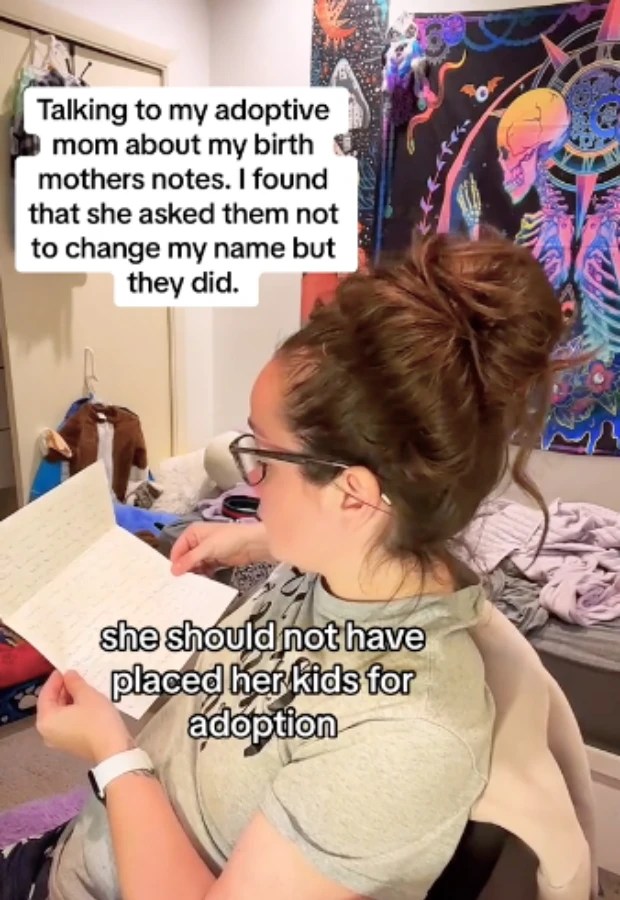
The image above comes from an essay at YourTango LINK>Woman Confronts Adoptive Mother. Thirty-six years after being adopted, the woman discovered that her birth mom had made a request to not change the name she was given at birth. The adoptive mother explained that in their religion, they name children after the people in their family they care about. The adoptive mother further stated that if her birth mom did not want her daughter’s name to be changed, she should not have placed her child up for adoption. 

An adoptee asked those who are mothers of loss (surrendered a child to adoption) in my all things adoption group – If you know about your children and what became of them, do you think of that child by the name you gave them, or the name the adoptive parents gave them ?

One of those mothers of loss shared her experiences – I am my son’s natural mother but we always had an open adoption relationship and his adoptive parents got together with me before he was born to plan his names (ie they wanted me to choose what I would name him and they were going to keep one of those names as a middle name with the name they had already planned).

I have always called him by the name they chose (except while he and I were in the hospital together and I didn’t really use a name. We just cried together a lot).

My 23 yr old niece who was adopted into my family found her mom and brother in recent years after no contact throughout her life (my brother and sister-in-law closed the adoption very early) and at that first meeting, her mother and brother struggled to call her by her current name. They asked her preference and I think hoped she would prefer her original name.

Of course, none of this can tell you how your first mother thinks but based on my and my niece’s experiences I might guess that moms who have been able to stay in regular contact probably adjust to the new name easier than moms who lose their baby and don’t see them again until adulthood. It makes sense to me that they might be more likely to think of their child by the name they originally chose.

An adoptive parent shared – I didn’t change her first name after adoption. She recently found her biological mom and extended family at age 15. They all still referred to her as that original birth name. It has made reunification and their current relationship so much better than if she had another name. I have no doubt they think and talk about you as your natural birth name. I also advocate now that no one change a kid’s name.

One adoptee shared – my mom called my brother Luke. The adoptive parents changed it to Luis (he was over a year old when they adopted him). I don’t agree with them regarding their changing it. My mom still calls him Luke – her own long time habit of thinking of him as that name.

Just Want It To End

THC Gummies look like candy.

Today’s story is from an adoptee who is also a mom (and it isn’t me) –

In February, an incident happened in my home while my ex husband was watching our kids and I was out with friends for the first time in almost half a decade. In that situation, 2 of my kids had to go to the hospital for ingesting THC gummies, from there Child Protective Services (CPS) was called and they took all 4 of my kids. I am still fighting it all to this day. Luckily, all of them are with family or close friends. My older two are with their grandma, my 3rd is with her god mom and my 4th is with her god mom.

My 4th, I didn’t parent as I should have. She was with her god mom 5 days a week, overnight too because I was made to work a god awful shift of 11am-9pm everyday, so by the time I was off, #4 was asleep and I didn’t want to disturb her.

Today my 4th baby is one.

During the CPS case, I’ve been pressured to give #4 up for adoption to her godparents. I thought I was doing the right thing since everyone around me kept saying how “selfless” I am for this choice after being talked into it. That it would be better for my baby since she loves them so much, knows their routine with her, and she “knows them as her mom and dad”.

I don’t want this.

I have thought this over and over. Judge gave them full custody already in April. They’ve paid almost 10k already into this adoption, I feel horrible for making them waste SO much money. But I do not want this and I don’t know what to do.

I guess this was more venting than anything, or if anyone has been in anything similar? I feel hopeless, and with a CPS case on me already, I don’t know if there is even a chance of my being able to get my baby back.

I’m not an awful mom. I have done absolutely everything the social worker has told me to do, I just want this all to end. I want all of my babies home and now I might only get 3 home instead of all 4.

blogger’s note – though these are unique and not necessarily likely to happen to anyone, the story is a cautionary note about what can happen. I do consume 1/2 of a 10mg edible as my “sippy hour” each evening. While it doesn’t directly “cure” my constant joint and muscle aches, it does distract my mind from them. Though I have 2 young adult sons who their father has made aware that I do this, I am very discrete and control access in a non visible location. My sons are too old now for me to worry about CPS and I have great compassion for any person who has to work such extreme hours just to get by.

One mother of loss had this to suggest – Fight it to the bitter end! Do NOT give up! At least if you fail in this regard, one day your child will know you fought for her! Also, do NOT feel guilty! You did not ask them to invest all of that $ into trying to take your child!

If anyone uses the attachment your child has to them as an excuse for them to keep her then suggest a transition period back to you – then they have no excuse for her to not go back to you! Tell whoever is in charge you are willing do whatever it takes to get your child back whether it is therapeutic visits, supervised visits, and/or parenting classes, etc., during the transition back to you.

I would then find someone else to watch her while you work after you get her back so you don’t ever risk anything like that again with them.

Please do not give up! You will regret giving up (most likely the rest of your life), but you won’t regret fighting to keep her!

Cabbage Patch Adoption

An adoptee has a request – Looking back on Cabbage Patch Kids as an out-of-the-fog adopted adult hits me different than it did when I was a kid. I’m interested to hear what your thoughts are on CPKs — then and now.

blogger’s response – I remember them but I don’t think I ever thought about the adoption part even though both of my parents were adoptees.

There were over 50 comments. I’ll only share a few –

I never really connected the dolls with adoption issues per se, even though I knew there were adoption certificates but as a child I just legit thought they were just babies grown on a little cabbage farm, so they didn’t have parents. another one replied –  I’m with you there! I still remember the day I found out they didn’t grow on a baby cabbage farm. While it’s an amusing memory now, 7/8 yr old me didn’t think so. But wait !! Actually, they do. There is a cabbage patch farm you can go visit, where they are born from the mother cabbage! It’s kinda cool.

From the website story about how LINK>“it began in a cabbage patch . . .” – The Bunnybee led the way and Xavier followed. Bunnybees were flying all around sprinkling magic dust from the crystals onto the cabbages. Rows and rows of cabbages were everywhere. But, there was something different about them. Xavier blinked his eyes and squinted at what he thought was movement among the cabbage leaves. Xavier moved closer and soon could see that there were lots of small kids and babies sleeping and playing among the cabbages.

blogger’s note – found this “Pack the ‘Kids™ up for a trip to the new BabyLand General® Hospital in Cleveland, Georgia, voted one of the Travel Channel’s Top Ten Toylands. Beautifully situated in the North Georgia Mountains, this Southern Style home filled with Cabbage Patch Kids will capture the imagination of your entire family.”

Maybe I won’t include any more adoptee perspectives because I also found this sad story related to the dolls.

The dolls were originally invented by a Kentucky artist named Martha Nelson Thomas. Martha first started making them in the early 70s, and would “adopt” them out to family and friends. The dolls eventually caught the eye of Xavier Roberts, a Georgia man who ran a gift shop. After Martha denied him permission to sell her dolls, he stole the design and began making his own versions.

Xavier’s dolls, which each had his signature printed on the ass, became wildly successful over the next few years. Their popularity reached its peak in 1983, when shortages of the dolls over the Christmas period led to mini-riots in toy stores across the country. Through all this, Martha didn’t make a single penny from her creation.

In this video, we travel to Kentucky to meet with friends and family of Martha, and hear how the Cabbage Patch craze affected her life. We also traveled to Maryland, to meet Pat and Joe Prosey, who believe they have the largest private collection of Cabbage Patch Kids on the planet.

Maybe just say NO to a Cabbage Patch Doll for your own living adoptee.

Preventing Pregnancy

If there is no pregnancy, there can be no need for adoption in response to an ill-timed birth. The LINK>Guttmacher Institute Study details the social and economic benefits that accrue when women can determine when to have children, including the impact on preventing teen pregnancy and the correlation with education outcomes. Study after study documents the positives of access to birth control. Women will go back if that access is revoked.

From that study – Historical research has linked state laws granting unmarried women early legal access to the pill (at age 17 or 18, rather than 21), to their attainment of postsecondary education and employment, increased earning power and a narrowing of the gender gap in pay, and later, more enduring marriages.

Contemporary studies indicate that teen pregnancy interferes with young women’s ability to graduate from high school and to enroll in and graduate from college. Conversely, planning, delaying and spacing births appears to help women achieve their education and career goals. Delaying a birth can also reduce the gap in pay that typically exists between working mothers and their childless peers and can reduce women’s chances of needing public assistance.

Unplanned births are tied to increased conflict and decreased satisfaction in relationships and with elevated odds that a relationship will fail. They are also connected with depression, anxiety and lower reported levels of happiness. Contraceptive access and consistent method use may also affect mental health outcomes by allowing couples to plan the number of children in their family.

People are relatively less likely to be prepared for parenthood and develop positive parent/child relationships, if they become parents as teenagers or have an unplanned birth. Close birth spacing and larger family size are also linked with parents’ decreased investment in their children. All of this, in turn, may influence children’s mental and behavioral development and educational achievement.

Because not all women have shared equally in the social and economic benefits of contraception, there is more work to be done in implementing programs and policies that advance contraceptive access and help all women achieve their life goals if and when they decide to become mothers.

LINK>Joyce Vance writes – Senate Republicans blocked a measure that would have created a federal right to contraception access. That seems like it should have been noncontroversial. It’s 2024. But it was not. It failed to pass, with Republicans saying the legislation was both unnecessary and government overreach. I suppose it’s only unnecessary if you don’t care about the right to contraception going the same way as the right to get an abortion.

In his concurrence in the Dobbs v Jackson Women’s Health Organization, in support of the decision to overturn Roe v Wade, US Supreme Court Associate Justice Clarence Thomas directly called into question the right to contraception as a logical outgrowth of the Dobbs decision.

You Won’t Be Forgotten

Today’s story (not my own) – So my kids were put in foster care. April 29th, my daughter had surgery. Thankfully, we were able to get custody of my son back, only a couple weeks before that. He was doing fine – until he saw the foster parents. The foster mom referred to her husband as his daddy but corrected herself when she realized my mom was listening. We were all there standing waiting in my daughter’s room. We are on guard to certain nothing untrue is said. So are they exceeding legitimate boundaries, when they are refer to themselves as my kid’s mommy and daddy ? They were only fostering for reunification and not adoption. Or am I just being too sensitive about it all ? My son used to say Dada all the time. Since we’ve gotten him back, he hasn’t said it once. I spoke to his developmental therapist about it and she said that they shouldn’t be doing it and that it’s confusing him. I agree. Now, I’m scared for my daughter… I had her with me until she was 4 months old. She will be 1 in July…I need some help to keep all of this in perspective, because as her mother, I am terrified she won’t remember me.

One adoptee offered this reassurance – I met my mom at 40 years old and every cell of my being remembered her. Your daughter will not forget you mama.

Often Not The Fairy Tale

Today’s story is sad but all too often true for some adoptees in reunion.

The definition of a Fairy Tale is a story in which truth prevails over lies, generosity comes to be rewarded, obstacles are overcome by hard work and love, good triumphs over evil and mercy and kindness are the greatest powers. And sometimes this simply doesn’t match the reality. Here’s the story –

My adoptive parents are dead and were amazing to me. A few years ago, I met the birth parents. I have a hard time using the word parents for them because they’ve done nothing but hurt me. I was raised to be kind forgiving and loving but these people are everything but. Several times per week, I am insulted and tore down and it makes me cry. They are married to each other and apparently a perfect fit. Both exhibit 9 out of 10 traits of narcissism. They’ve tried to get me fired at work, tried to end my marriage, tried make my friends hate me, and essentially try to cut me off from everyone because they think I should be the person they think I should be. Every time he makes me cry he laughs. They’ve held grudges and gotten mad at me for having a sick child or being sick themselves. I had a very long hard struggle with cancer (genetic I might add) that I have deficits from and they tell me to stop having excuses. When my mom died, they told me they were glad she was dead. And the list goes on and on. I’m stupid, I’m a liar (but they refuse to let me know what I supposedly lied about), and my entire life is worthless according to them. I’m struggling because society says I have to want to be with them but I don’t. They hurt me so deeply and so often I feel sick. I don’t want to be an a**hole but I had no idea how mentally abusive they are. The rest of their family minus the bio grandma is crazy. What should I do? I want to cut contact but I know I’ll get push back. Has anyone navigated anything similar? I’ve tried to make this relationship work for 3 years and it isn’t working. And all I get is people guilting me into thinking I need to maintain this toxic relationship.

One comment noted – your experience shows another side of the adoptee reunion story. Many times adoptive or foster parents get criticized for “having stolen” from the child in their care, the right to be with their birth families. Some adoptees fantasize what their birth families are / were… but sometimes, in reunion, they find those birth parents are not the fairy tale they imagined.

Unexplainable Peace

Image is not the couple in today’s story

After a medical procedure, they were very hopeful they would easily get pregnant. Years passed, nothing happened. The doctors labeled it “unexplained infertility”.

Being very religious people, they came to realize that God works wonder in the “unexplained”. After procedures, tests, a miscarriage (a clear and definite “NO” from Life) and many tears, they surrendered.

Through letting go of what they had in their own mind, they reached an “unexplainable” peace about moving forward with adoption.

Then comes the kicker – unfortunately, there is no hiding the fact that adoption is extremely expensive. Of course, they have chosen a Christian adoption agency. Even so, the total cost is $35,000-$40,000.

So, God told them to start a GoFundMe to acquire the $35,000 they needed to adopt a newborn infant ? Skeptics question that it was God telling them to do that.

It’s Hard To Feel Different

In looking for an image, I discovered this child’s book about feeling different by Doris Sanford published in 1986. The summary says – “A young boy is portrayed as he sorts out the hurt of ‘being different’ . . . at school. The boy knows he is not like other children . . . He finds true friendship with a little lamb, Fluffy. Fluffy ‘speaks’ truths to the boy about his specialness and how he is loved in spite of his differences. Ages 5 and up.”

From an adoptive parent today – We have an open adoption, more so with our son’s father and less so with his mother. Our son is 8 and has says every few months that he wishes he wasn’t adopted. He has known his birth story since birth. We visit his father’s family twice a year and he loves seeing his half sister. I’ve been struggling with the right supportive language to help him with those hard moments. I tell him that it must be hard to feel different. He says things like I’m the only adopted kid at my school.

One adoptee notes – if a person said almost every month that they were sad their mother died, would that be something to pathologize? If a person said they wished their mother never died, would you try to stop them from saying it? Losing one’s entire family, ancestors and all IS sad. As the perpetrator of the separation from his family, your comfort will ring hollow.

Someone asks – When he says he wishes he wasn’t adopted, is he saying he wants to be with his natural parents?

A mature adoptee notes – Wish I had an answer for you but sadly do not. Being the only adoptee etc. A feeling that has stayed with me my entire life and I am 72 yrs old. Not to say all times were bad but this being on the outside looking in, is always in the background.

Another adoptee asks – If his father can raise his half sister, why is he not raising him? Why is he separated from his family? I ask, because I was in the same boat. There’s nothing my adoptive family could have said and there’s not enough therapy that could have made things easier for me. He is well within his right to be angry.

One shares some personal experience – I’m an adoptee and I have fostered a child.. anyway… I always think … if kids see their parent … raising another child, it would really make them feel bad – like “why don’t they love me ?” … the child I fostered has a 1/2 brother who mostly lives his dad. The mother fought her ass off to get her daughter back from me, which is great. But has not put in the effort to get him back and he follows her on social media and is allowed to come when his dad feels like it … I just always wonder how he must feel.

An adoptee asks – Have you asked him – what part of being adopted exactly is making him sad ? Are you giving him the freedom to truly express himself or are you saying placating words like “I know, it’s hard to be different”, which actually closes down open discussion ? Is he seeing a therapist ? If not get him in to one!

From a late discovery adoptee – “it must be hard to be different” rings so hollow! I couldn’t stand it when adults said fake crap like that to me. I’d always see right through it, even as a small child!

Which caused another adoptee to write –  For me, it rings hollow because it reinforces that I AM different, and at least for me, carries the implication that “different” is less than and not as good. It doesn’t just validate my feelings, it tells me that my feelings are facts.

Another late discovery adoptee acknowledges – The past cannot be undone, but perhaps acknowledging to him that you accept that the way things happened and the way you and his natural family did things were not the best they could have been, will be a good start. Is working towards shared custody or reunification something he wants or even a possibility ?

One adoptee can relate – That’s a tough age to deal with being adopted. I had huge feelings that I couldn’t put into words and I was also the only adopted kid with my peers, as my adopted sister refused to talk about it. The kids would tease me and ask the craziest questions that make you feel so alone (ie: do your AP’s make you clean all the time? Do you call them mom and dad? Why didn’t your real mom like you enough to keep you? Was there something wrong with you when you were born?). Having another adoptee as a friend or therapist helps us to feel normal and understood. You’re seeking the right words but there are none. You are already helping him in all the ways you can – by keeping the adoption open, being supportive and his safe place. Please keep trying to find another adoptee therapist, support group, or friend. You benefited from the adoption, while he lost everything, so you aren’t able to fully understand and comfort him.

One adoptee who was adopted as an infant says – I’m 41 and HATE BEING ADOPTED. Does that ever go away?? I don’t think it does. I’m not sure there’s much you can do about his very valid feelings in the matter.

One adoptive parent made a point that was on my own mind – Can you increase the amount of visits with his sister and dad ? Twice a year isn’t a lot of time to really form that bond. Even with distance, there might be other ways to improve the contact.

One kinship adoptee suggested –  always validate his feelings, don’t internalize them & make it about you because it’s not. It’s his life that was uprooted.

One mature adoptee tells the truth – I’m 57 and still wish I wasn’t adopted. There were/are no words anyone (especially my adoptive parents) can say that will change that, ever. It also has nothing to do with feeling “different”. One of the worst things my adoptive mother did was pretend she knew how I felt, which was impossible since not only was she not adopted, but she gained from my adoption. It’s very hard for someone to come off as a sincere support when they gained from my loss.

Yet another mature adoptee – It *is* hard to feel different and to not understand why you can’t be with your biological family. I hated being adopted, I’m 40 now and *finally* coming to terms with the damage it caused me. My adoptive family doesn’t speak to me. Haven’t heard from them in over 4 years. They didn’t adopt me for life, just for when it was convenient for them. Those feelings of hurt never completely go away. Then, OMG, comes this – There’s more horror to my story, the abandonment came after I attempted suicide and they used the system to steal my oldest child from me. I feel like I was exploited to fill their void yet again and my daughter is suffering because of it. That spiraled me hard into addiction and homelessness but by the grace of God, I am still alive and coming back to living for the first time in my life. It’s a lot to unpack! My adopter was looking for the excuse to abandon me for a long time, since she flat out told me I was the worst mistake she ever made and she wished she never adopted me. We are disposable to them. It’s painful to say the least.
Contact Agreement

An adoptive mother writes – I adopted a sibling group from foster care a few years ago. At the time, there was no written agreement of contact between myself and biological parent. Bio parent never asked for anything official and because I knew I was open to contact, I really didn’t see the need in doing anything official either. Over the years, there has been contact, including in person visits, but everything was just on our own. Nothing official. Bio parent approached me recently about having something legal and official as far as contact. I am not opposed to this idea, even though I do not have to agree to it (as the adoption was finalized years ago). Anyway, here is where I need help…….

I want to make sure the kids are protected from being forced to do certain forms of contact if they ever don’t want to have contact. In a written agreement, what age would you put for when the children are able to have a say in contact? I am not going to be forcing a teenager, for example, to go to visits if they don’t want to. I really don’t want to be forcing an eight-year-old either so I’m not really sure how to word it to ensure the kids have rights in their contact. Maybe it shouldn’t be written down as a certain age?

Adoptees…..if you were in this situation, what would you want in the agreement? Anything you wouldn’t want? How can I support my adoptees the best with this agreement? Would it be better to not do one and just keep it unofficial?

Some responses – I would include the children, if they are old enough to comprehend, in the conversation. If not, then make it an amendable document with terms you set now and terms you can set as the children age and life evolves. But the decision to have visits can and should always be on the kids. Forcing visits can lead to resentment for both you and their natural family. Make a document that is continually agreed upon by all parties, mainly the children.

Another adoptee admits – it makes me uneasy that the biological parent wants a contract now. I do feel like it could cause the children to be forced into visits down the line, which obviously you should encourage contact and encourage visits, but they should never be forced if the children are old enough to have a say. If you’re already doing that and are willing to keep doing that, I don’t think you need anything legally binding at this moment. I would maybe draft up an informal agreement/schedule to help ease bio parent’s mind, but would put a clause in it saying that ultimately the children have the right to request more calls/visits/contact and to decline any calls/visits/contact.

One had questions – Is there even a legally binding way for bio parent to get visitation? I do feel that supporting the kids in having a relationship with their parent is extremely important, but I’m not even aware of how you would make it legally binding. Do the kids want contact with this parent? How often are they in contact now? I guess I’m wondering if the parent is feeling like they’re being kept from their kids or something, so they feel the need to do this? Sorry for all the questions but I feel like this is missing some context.

The obvious from another adoptee – Because adoption centers on the adoptee, I would ask your adoptees. But … they may not feel comfortable sharing what they really want. So much would depend on their birth family’s situation. I’m pretty sure I would not agree to a legal document now. No way. That said, I would do everything in my power to encourage relationships with their family. Something has shifted for the birthparent. I know my own actions would all be situationally dependent.

This adoptee goes straight and to the point – I so appreciate you centering the children’s wishes in this situation. Contact with the original parents should be child-led.

Another notes and suggests – discuss with the children and see what they would like to do. For now and discuss the possibilities for the future. I don’t know what kind of legally binding contract there could be as it would not likely hold up in court. But even a written, formal contract seems like a lot. Keeping the communication and opportunities for contact open is the most important.

The reality from another – I would not get anything in legal writing. I would just say that you are legally the parent and are uncomfortable with anything in writing forcing visitation as anything can happen down the road. I would ensure her that as long as things remain as they have been and the kids want to visit, you are open to always continuing things with all forms of contact phone etc. But you are not putting anything in writing, especially without an attorney opinion and that costs money and you cannot afford to get an attorney to do that. She has no choice but to take what you offer. Once you put your child up for adoption or your rights are terminated in foster care you cannot try to get rights back.

One person lends their opinion – You legally adopted them, they’re YOUR children now. Why consider anyone else having a say in what they do and giving them legal power ? As someone who worked in the law field, I personally would never encourage this. Don’t allow anyone else, bio parents included, to sway or bully, insinuating they have control or a say over you or your kids. If your kids and you are okay going for a visit – go for a visit ! If not, don’t. Just like any other visit to a cousin’s house or a soccer tournament. Do not sign any legal document that takes any type of decision making power out of your – their mother and guardian – hands. The fact they’re asking for a legal doc is a red flag. The adoption has gone through and is final. Now, no other person should have any legally binding document seeking control of your minor children.

And this important consideration – I would not do anything official personally, especially if drugs were involved. My 11 year old decided she no longer wants contact after mom no showed 20+ visits. It was just too hard on her to get excited for those visits and then, she began to resent her. My story is kind of similar, my dad was on drugs and while my adoptive mom didn’t force us to go, she would allow us to go anytime we wanted to (weeks for breaks, weekends, holidays, etc). I continued to go because he never made good choices due to drugs and I didn’t want my younger sister going alone when she wanted to go. I still have no contact with my father to this day. While I have a good relationship with my adoptive mother and do not resent her, I do wish she would’ve said no to him sometimes too. I know she was trying to allow us to maintain relationships with family but it was just a lot. Especially if drugs are involved, I wouldn’t do it. You never know if she will continue to be a healthy person for the kids. I’d allow a lot involvement as long as she’s showing up, healthy and they’re happy to see her, and leave it at that.

Tone Policing

Though the example uses feminism, adoptees also frequently experience similar criticisms. So, just a little PSA for anyone in an adoption or foster care related group or community – note, I have not had a problem of this sort in my efforts here.

First of all, what constitutes “tone policing” and second of all, why tone policing isn’t a healthy way to address marginalized people from the privileged position. Tone policing is telling a marginalized individual (like adoptees) that they should speak respectfully to their oppressors (for any reason).

A common form of tone policing is one person telling a justifiably angry (or even triggered) person that foster and adoptive (including hopeful) parents “learn best” when they are spoken to in a gentle tone. This is an example of foster and adoptive parents using their privilege to force submission from the marginalized person. You don’t think of it that way, but that is absolutely what you are doing.

Foster and adoptive parents become allies by learning boundaries from an adoptee or former foster care youth’s harsh tone. While it isn’t always easy, it is necessary to face the realities of these lived experiences without asking them to moderate their tone. These privileged people do not “learn best” from a gentle or more submissive tone.

Marginalized people (adoptees and former foster care youth) have spent their entire lives performing. By that, I mean they are forced to conform to the standards set by privileged people in order to appease them. If they do not, they are accused of being angry, bitter, and advised to seek professional help.

When you ask them to “code-switch” (changing aspects of conversation to fit in or gain acceptance) in order to make you, the privileged powerful person, more comfortable, you are forcing them to conform to your ideal of what the submissive, grateful adoptee or former foster youth is supposed to look like. You are forcing them to conform to your vision and version of who they are meant to be.

The best thing you can do is listen to their voices and understand that they are sharing their lived experience with you and often in spite of difficult emotions related to those experiences.