Ignorant Questions

Yesterday, at the Missouri History Museum, a couple of men that work there were relaxing. I was sitting down because when I have to stand without moving much my legs give me a lot of trouble now. Looking at my sons, taking in some exhibits along a hallway in view of these men, one asked me if they were my sons. Because I had them at an advanced age, I’ve often been asked if I was their grandmother. To one young girl at Chuck E Cheese years ago, who didn’t believe I was their mom, I could honestly tell her, she wasn’t totally wrong because I was a grandmother to two grandchildren. When my husband caught up with me yesterday, these men remarked on him being a “good dad”, which he is. I always knew he would be and so, when he admitted to me after 10 years of marriage that he actually did want to have children after all, I quickly agreed to carry his children.

While not everyone will agree with the advice I was given long ago, but I have lived by it. Never ask a question that might be overly personal, uncomfortable, intrusive or embarrassing. Even so, I do get asked and will always answer, even the most ignorant of questions.

Today’s story is about that kind of situation. A woman who is a kinship caregiver shares – Our nephew has been placed with us since he was 2 months, and is now 2 years old, so will be starting to understand soon. People in public obviously just assume I’m mom, and say stuff like “are these your kids?” Or “how old are your kids?” (I also get a lot of “dang girl, don’t you know what causes that?”) My nephew and my daughter are less than 9 months apart. I’m not sure what is best in that situation. Is it necessary to point out I’m not mom? Will that hurt is feelings and make him feel out of place? He knows his mom, and we refer to her as mom, but I don’t think he has quite grasped yet what that means. I’m not sure how to get him to develop more of a relationship with her. She can only make it to see him about once a month, and I am a stay at home mom, so we are together 24/7. He runs to me when he is hurt or scared, and cries when she first takes him out of my arms. I know it hurts her feelings. He does cuddle her and play well with her once he warms up. Should I even be pushing, or let him go at his own pace?

One suggested – You don’t owe a whole explanation to strangers but it’s easy enough to say “he’s my nephew” and change the subject.

Another shared – Regardless of whether the kids with me are being fostered, are my forever kids, bonus kids, kids friends, nieces/nephews, when asked if they’re all mine or something similar I say something along the lines of “they’re all with me” “why do you ask?” Or “Does it matter?” Depending on the tone of the asker. If someone says something like “don’t you know what causes that” or “wow you started young”, I’ll say “don’t you know when to mind your business?” Or “wow you’re too old to not know better than to ask such personal questions.” I’m not playing with people that can’t mind their business, and I’m not explaining myself to strangers. As for the bonding, it will happen.

Another admits – I typically come back with a smart ass comment when people ask if they’re my kids! Why the hell do they need to know that, it’s none of their business!! (blogger’s note – I suspect I am just too nice with strangers. LOL I probably assume they don’t know better.)

I did like this straight forward response – Just say he is your nephew. The truth.

This one made me chuckle – If they are not close enough to you to know who he is, they deserve ZERO explanation. It’s absolutely no one’s business but his and yours. I have 3 kids who are within 5 months of each other. Not twins or biological to me or each other. They aren’t even the same ethnic background as me or each other and we get the same “don’t you know what causes that?!?” Remarks. My response is “oh my god! no!! i have no idea!! please educate me!!!!” then stare at them. Makes them so uncomfortable.

Another kinship caregiver explains – I never wanted to take that title away from any child’s parent, even if I was doing the things a parent would do. I agreed to take on those responsibilities. I don’t need to have the title. To which the original woman explains – a lot of adopted people I know tell me they would have felt “othered,” if they had been discouraged from calling their “parents” mom and dad. I don’t care about the title, I just don’t want to hurt his feelings. He’s not adopted, but they have told us this will be a permanent placement. Everyone is telling me to not let him call me mom, but I can’t look at a two year old and basically say, “no, MY kids can call me that, but you can’t.” When I play the same role in all of their lives, and have since he was a newborn. A former foster care/adoptee explains –  I hate that even now I am the “other.” I hated having to explain to my peers why I didn’t call the people in my home mom or dad. Now I hate when I have to explain that the people my kids call grandma and grandpa aren’t my parents. (Or my husbands either) I struggle so much with that.

One foster parent notes – I think we all have to agree that there can’t be any one “right” way to parent, because every child/person is different. But I think there’s a common goal of putting the child’s needs first, while also preserving the relationship with his birth mother.

Someone else pretty much shares my own perspective – I think more people should mind their own business and not feel enabled to ask such personal questions as freely as they do. There have been some great cordial smackdowns in some of the other comments. I would use those liberally.

Another adds – I say he is my nephew. If they push anymore after that, I will tell people to not assume or ask. If it’s someone you’re going to see repeatedly, then it may be worth a response, but for random fly-by interactions, they aren’t owed anything. This was a good reply – When asked if all were my kids, I always smiled and said yep, its my hobby to collect ’em. Another replies – “That’s an incredibly inappropriate question to ask a stranger.” Or “Didn’t your grown ups teach you, if you didn’t have something kind to say, you shouldn’t say it?”

No Man In Sight

At least one mom in my own mom’s group decided to have a child with no man in sight. For same sex female couples who want children but want to be ethical about doing the right thing, what are the options ? One offers her experience.

I’m a queer parent to a donor-conceived child and also have adopted kids through foster care.

The topic has come up before but is always interesting to me and just inherently homophobic—that women who have conceived a child by having sex are encouraged to keep and raise the child – no matter what: mental health issues, extreme poverty, abusive partners—but then, queer people are told there’s no ethical way to have a child. So somehow sex with a man makes it ethical and idealized?? So having sex gives you a right to parent – no matter what, and if you can’t get pregnant by having sex, you have no right to have children and should go mentor kids….there’s just no way to view this stance as anything but homophobia.

The ethics of sperm donation, in my opinion, based on learning from donor conceived people and also my experience as someone abandoned by my father, is that anonymous sperm donation is not ethical. I chose to conceive with a known donor who has no interest in parenting/co-parenting but is a known and present figure in our lives. [blogger’s note – I agree that any reproductive donors ought to be known. Every person should have access to their genetic background.]

Fostering is a different story. When we went into it, we were open to adopting (if things went that way) but really tried to approach it as us supporting a family in crisis by being that safe healthy person who could watch the kid(s) until the parents got back on their feet. We fostered 8 children and have adopted 4, which statistically is in line with our state’s averages that 50% of placements reunify. Our first adoptee has 3 siblings in two different families, neither of which was willing to take her. Our second adoption is a sibling set of three, with few healthy family members, a lot of criminal involvement and in incarceration, and years of trying to find a way for parents or family to be a resource. There were only a couple of healthy family members but they were unwilling to take on 3 young children. Unlike the usual assumptions, we had zero plans to adopt them and would have gladly welcomed family for them. Yet if we didn’t adopt them, they would have been moved again to non-relatives, which would have increased their trauma, so we did the right thing for them. I don’t say this for any accolades—I say it because the reality for these kids is that at this moment in time, we’re their best option.

So yes, in my opinion, there are ways to ethically raise children, even if you can’t have sex with a man.

Society’s Unseen Realities

For some time now, I’ve been slowly reading through The Tao of Physics by Fritjof Capra. I’ve always been fascinated by the science of physics, even though I may not totally understand a lot of it. I’ve almost finished Capra’s book and the big thing I took away from it is how interconnected EVERYTHING is.

So it was that I was attracted to a Medium piece – LINK>Exploring Quantum Connections in Adoption by Shane Bouel. You may or may not be able to read it. I will excerpt some parts in case.

Shane notes – “The state of one entangled particle instantly influences the other, similar to how the separation of a mother and child through adoption can have far-reaching emotional consequences.” The separation of a mother from her child leads to complex emotions and psychological challenges for both of them. Adoptees may experience conflicting emotions as they navigate their relationships with both their birth mother and adoptive family. Birth mothers, too, may grapple with complex emotions related to the decision or lack of, to place their child for adoption. He says that “Ultimately, the goal is to create a more empathetic and compassionate environment for adoptees and their birth families.” His goal is my goal in publishing this blog as well.

An intricate web of relationships connect individuals to their environment. Quantum mechanics finds that particles are interconnected and influence each other’s states – regardless of distance. The concept of attachment has a parallel in the idea of entanglement. Particles are intrinsically linked. Adoptees navigate the uncharted territory of identity and belonging. The separation experienced by adopted individuals parallels the entangled state of particles. The emotional journey of adoptees . . . is intertwined with societal perceptions, recognition, and acknowledgment.

Dr Sue Morter delivered the message at Agape last Sunday and photons were very much a part of how she described energy acting. Shane writes – “Quantum mechanics, traditionally applied to the microscopic realm, is gradually revealing its influence on macroscopic effects, including DNA interactions and biophoton communication within the body. This bridge between the quantum and the macroscopic echoes the connection between the unseen emotional trauma of adoption and its far-reaching implications on adoptees’ lives.” And in fact, in Capra’s book, he describes the understandings being applied on a large scale to the whole cosmos.

Shane emphasizes – “The historical instances of forced adoption and exploitation highlight the need for societal acknowledgment and reconciliation.” In conclusion, he says “. . . the emotional threads of adoption connect lives in ways we may not fully perceive.”

Shane’s writing seeks to lift standards of ethics and morality related to adoption by sharing the truth he perceives and has experienced.

Deconstructing The Fantasy

Today’s question from an adoptee – How do you guys start reframing your minds and deconstructing the lies and fantasy you were told ?

I’m 27. I was lied to – until I was 13 and then, told I was adopted and to not let my adoptive mother know, I knew. I hid it, was able to find my siblings and develop a relationship with them, and then, my adoptive mom found out and forbid me from speaking to them, till I was out of her house.

It was the usual spiel. “we CHOSE You.” We took you in, when your own family didn’t want you. You’re special because we picked you. Your parents didn’t want you. Your biological family chose drugs over you. They never wanted you, but they wanted your siblings. We cared for you and took you in and loved you, and you need to be grateful about that because you could have ended up somewhere so much worse. You owe us your gratitude.

Y’know. The usual drama.

Now at 27, my adoptive father, whom I loved dearly passed. I’m no contact with my adoptive mother now for nearly 6 years. My biological mom and I have a relationship but there is nothing maternal to it. And my biological dad passed away 2 years ago from cancer.

I’m trying to deconstruct my thoughts. For the longest time I was proud of being chosen. Proud of being wanted. But then, it became manipulative with abuse tactics and the usual nonsense, when you’re raised by a narcissist. And I realized, I was nothing more than a trophy to show off how good of a person she was. Anything off about me was squashed and medicated, so I appeared functional and perfect for her little charade. I was frequently threatened with medication changes, or to be sent back to foster care. Looking back, I’m realizing how much the things drilled into me, traumatized me. How much I struggled with feeling secure. How I never felt like I belonged. I struggled with all the questions about why I wasn’t wanted, why they wanted my sisters, why I wasn’t good enough.

I’ve done therapy. I’ve tried to process it but finding a good therapist that understands adoption trauma is hard. I’m tired of slipping up. Calling her my birth mom, not calling the other one my adoptive mom. I truly view her as nothing more than someone who attempted to raise me, but failed horrifically. She isn’t “mom”. I call her by her first name. But it’s so hard and confusing in conversations to not slip up or have to explain and answer the questions that follow.

How did you deconstruct your adoption and how do you handle using the terms that make you comfortable, when it causes confusion for others.

Another adoptee replied –  I think that deconstructing anything is a life long process. Much like trauma. There will always be times when we get hit with those feelings and responses. We can just keep plugging away at the work. When those things pop up I write. Pretty much just word vomit onto the page. It keeps the thoughts from having too much power. But I rarely worry how others view the language I use to describe my experiences. I have a terrible first mother, I have a negative nickname for her that I use everywhere but this group. I don’t need other people to understand it, but just respect it. It is all so hard and you are not alone.

Another woman who has been through the mill (I won’t go into all the ways because that isn’t necessary in this context but good to know where her feelings and perspective come from), says – collect the things you were told by your adoptive parent. And next to each, write what is the truth. And regarding her biological mom – don’t chase Love that was never given to you. Keep a superficial relationship and be thankful for what you’ve got. Some adoptees don’t have a biological mother that loved them or wanted them. Cherish the small wins. You did not receive unconditional love owed it to you by not one but two women. Now you need to be a parent to your inner child and keep repeating to yourself: “You are beautiful, you are sweet, I love you so much, You are my whole world.” All of the words your mothers should have said to you. You need to become a mother to your inner child. At the same time, heal from narcissistic abuse and from having a distant biological mother.

One adoptee shares – I was told that God gave me to them. That my birth mom was on drugs and knew she couldn’t be a mom, so she wanted me to have a better life. I was abused. I met my birth mom and there was family on my dad’s side who wanted me. I’m 38. It took a long time to make peace with all of it. Just accepting that everyone involved was messed up in the head. I can only do better for my own children and stop the generational curses on both sides. I know your pain, honestly having my own children and changing the script, is what has helped me the most.

An adoptive mother admits – I am deconditioning (perhaps, that is different than deconstructing) from everything I was fed, took on, believed about adoption. I tried therapy and still partake as needed, yet this is not what I’m talking about. Rather truly getting to the energetics of loss. The real transformation within me is inner child work and neuroplasticity brain retraining. This healing is an inside job. I spent a lot of time on this path and am finally seeing and miraculously feeling some results. They are not dependent on what anyone else thinks or feels about me. (Although positive relationships expedite the process.) It is definitely improving my relationship with my son. I’m less of a head case.

Another adoptee writes – It’s a work in progress. We have similar stories. I was told endless lies by my adoptive parents. I also experienced abuse and emotional neglect. The biggest issue which led to estrangement was that they did not tell me I had a brother, who they also tried to adopt. Once I met him and was getting to know him, the reality of what they concealed from me truly hit me and I cut them off. I cannot cope with them in my life, knowing they stole the opportunity for me and my brother to be in each other’s lives during childhood. These adoptive parents who enforce sibling separation, and even lie about existence of siblings, are the most evil of evil. I have a support system – my husband and in laws. I am doing what I can to build a relationship with my brother now and trying not to let the fact that we lost so much time consume me. Therapy. I’m looking at a career change. I would like to help other adoptees cope with similar issues. I feel better with my adoptive parents out of my life, they were toxic and unapologetic and I was in denial. I lost my adoptive sister due to their actions as well (she is estranged from all of us). They caused nothing but pain for me and I finally said enough is enough. All I can do is hope I’m capable of building relationships in the future and that they haven’t destroyed my ability to do so and continue to work on that. Personal growth and no backsliding, not letting myself wallow in pain.

An adoptee shared – I finally found a therapist that’s not only adoption trained, but an adoptee herself. The difference is amazing – previous therapists just had no understanding. So make it your mission to find that. Not easy, but worth it.

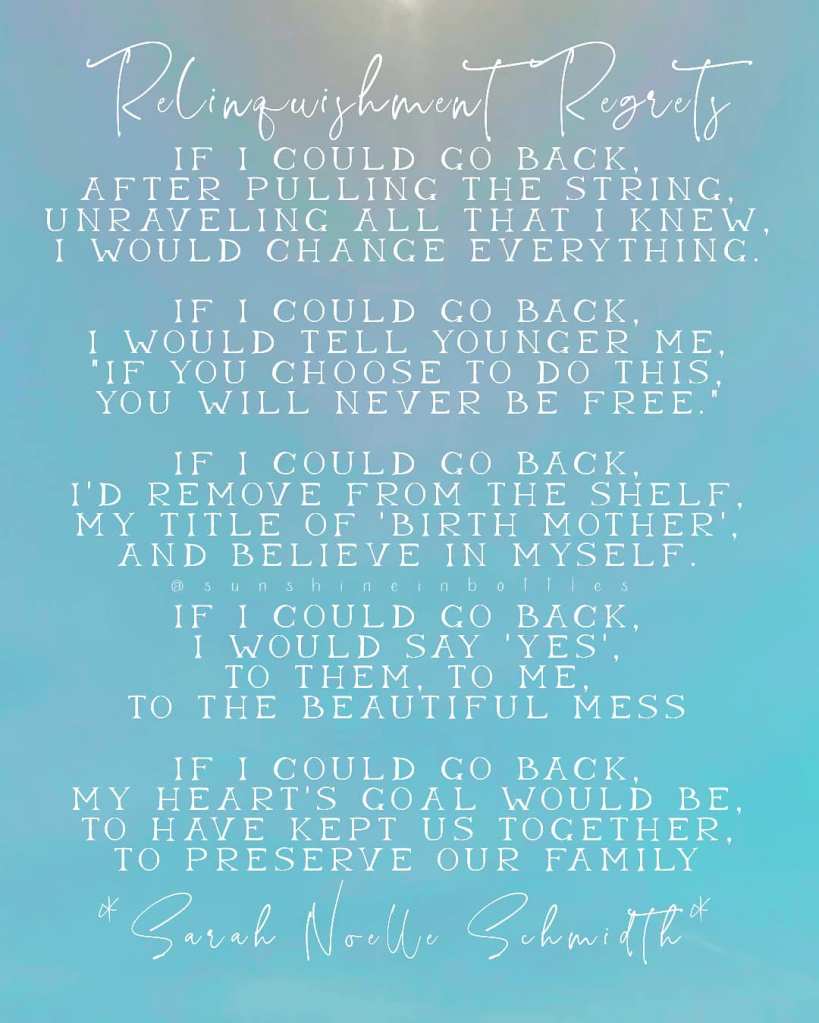
Relinquishment Regrets

Written by a mother who knows. She says of the above poem – I wrote this yesterday and thought there might be some other first/natural/birth/mothers of relinquishment moms who feel the same.

I am coming up on 22 years since my first relinquishment (I placed twice, nineteen months apart, with the same couple, who are now divorced) and the things I would change, if I could go back with all I now know about the billion dollar industry of adoption and how it uses and spits out so many mothers and adoptees, just keeps piling up and adding on with the more I learn about what I participated in, twice, all those years ago.

Another woman with the same experience writes – I feel this so SOOO hard. I’ve been struggling with being stuck with this regret for years now. My son is 20. I’ve never spent time in regrets before this one because we wouldn’t be who we are without the experiences we’ve had and choices we’ve made. And right now, I love my life – and I can literally trace the steps and KNOW that if I had parented, I would definitely not be here. But it doesn’t matter. I would give anything to change it. To not be that woman who was scared and unsupported, who didn’t know everything I should have known about adoptee trauma, and who believed there was another mother out there who was better for my own son than I was.

Releasing Belongings

I suspect what this adoptee is dealing with is not all that unusual. Today’s story –

Have any other adoptees here experienced an increased difficulty in parting with meaningful material items? I’m in my late 30s and still have my childhood blanket and stuffed animal. The area rug from our living room when I was growing up that we called my dancing rug. I was devastated when my adoptive dad got rid of it in my twenties without offering it to me first. Those items seem to make sense as being emotionally important but I guess what I’m really asking about is other objects. For example, I have a 2007 Honda Accord that I’ve had since she only had driven 11 mi. I’m close to 190,000 now. I am dreading the day we really start to discuss replacing it. It feels like I’m abandoning it after a lifetime of taking care of me.  It’s not missing it, it’s the abandoning it that I struggle with. I know that it’s only a car in my logical brain but when the day comes to leave her at the dealer, I’m going to feel like the worst person alive. I’m not talking about hoarding at all. I’m talking about specific items with a large sentimental value. This isn’t about keeping trinkets or large amounts of items, it’s about attaching an emotional connection to a less traditional personal item, like a vehicle or piece of furniture.

blogger’s note – We have a 2007 Volvo Cross-Country Stationwagon that has spent too much time at our mechanic’s. Hopefully, this last fix is more lasting. We also have a 2005 Suburban that we inherited from my deceased in-law’s. We have less trouble with that one. None of it is about attachment but rather finances.

One adoptee realizes – Oh snap, I think you may have opened a door I’ve never considered before. I have trouble getting rid of things like this as well. It’s the “took care of me part” sigh.

And another notes – I turned 30 this year and still sleep with my blankie. It’s literally falling apart but I have to have it.

One who grew up in kinship care notes – I am 31 and mine is too. I keep mine in a pillowcase to protect it. I hope, if you aren’t, then maybe it might help preserve it for you longer. Mine is just little shreds of fabric basically. It was all I had for a long time for what got to come with me.

Yet another adoptee shares – My adoptive mom threw out my blanket when I was 18, I’m still extremely sad about it (I’m 32 now). She claims “it was the size of a toonie” (slang for a two-dollar coin) but my brain remembers everything and it was still a normal size lovely blanket. I miss it so much.

Yet another adoptee says – I am the opposite, I place partial blame for this on the family that adopted me, as nearly every adult I grew up with is a hoarder. I keep next to nothing, I have a minimalist apartment, and frequently worry that because it is small, it will look cluttered. I have had conversations with my adoptive mother, where she acknowledges that she is a hoarder and she has no plans to change, so when she dies, her 4 bedroom house with a basement full of boxes of “momentos” will be left for me to clean and dig through. And how anyone can do that to their child is beyond my comprehension.

The original poster asks a question – what about big items? I actually don’t really have that many trinkets but it’s more about these big ticket items that have been with me for a long long time like my car. Do you just not form attachment to those types of items? I’m just trying to figure out how other people experience these emotions, if at all.

This is her reply –  I have never felt attached to something in a way that it would hurt me if it weren’t there. If I have the opportunity to drive a safer, newer vehicle, I will always choose that as I have had to push some of my cars off 4 lane highways. If I have the opportunity to replace furniture that I know will be more comfortable or better on my body (like a mattress) I will save to be able to do that and discard the old one as soon as possible.

A mom who lost one of her children to adoption notes –  I struggle with letting material things go – I lost one of my children to forced adoption. I have my other 3. I still see him, thankfully his adoptive mum is supportive and encourages his relationship with us. Anyway, I have kept everything I had bought him – a crib, changing mat, wardrobes of clothes etc. I gave it to his adoptive parents, so he would still get use of them but asked that they be returned to me once he had outgrown them. Thankfully, they respected my wishes. It’s all packed away in boxes under a bed in my house. I have a lot of paperwork from the forced adoption and I can’t look at it – I find it too triggering but I’m scared to part with it. What if he wants to see it when he’s older? It’s in boxes all over the house as there’s that much of it.

Yet another older adoptee admits – I’m not really a collector of things, I prefer not to have a lot of stuff but a few certain things I can’t part with. I still have things from childhood and I’m 58.

I found this one very sad – When I was a kid, if my parents got us anything (me and my 2 not-adopted siblings) I always got “the defective one”. This happened so many times that it became a joke that still happens to this day. Just a few months ago, my family ordered take out and when it arrived, there was nothing for me, because they forgot to ask me. My adoptive dad joked that I got the defective one again. It’s not the most hilarious joke, even when I tell it. It shouldn’t be a thing. My childhood Little Pony toy was shaved and given to the dog as a chew toy. My favorite pair of shoes that I bought with my own money from working after school jobs were thrown out by my adoptive mom because they were too ratty, in her opinion. I wonder if any of this has caused me to continue to be hanging onto things for so long now.

One adoptee responds to an insensitive remark with this truth – I am going to challenge you to flip that. Imagine being given away because you didn’t spark joy. Because for a lot of us… that is how we feel.

The original poster thanked one adoptee by saying – I needed help to advocate for myself with some of these responses from adoptive parents (blogger’s note – I have chosen NOT to share those here). In a post about abandonment and sentiment, I don’t really need to hear from the purchasers of the abandoned, who literally depended on our disposal (nice word choice there) and gained from it.

From a trans-racial adoptee – Not just meaningful items, but possessions in general. Although meaningful items are much harder. My issues were absolutely compounded by my adoptive mother often going through my room and giving away my things without my knowledge, much less consent. And never mind my adoptive parents giving away multiple pets without telling me either. So if an item was gifted to me, or has any sort of good memory attached to it, I have difficulty getting rid or disposing of it in any way.

Another trans-racial adoptee adds – I can never part with anything. I hate change. I get very attached to things.

Yet another has an odd combination of traits – I’m a minimalist but am very tied to items with sentimental value. It can be challenging.

If The Heavens Have Feelings

Kati Pohler with her adoptive parents

The story tells of an intense desperation to hide a pregnancy. You can read the full piece at this LINK>After Receiving a 20-Year-Old Letter, Woman Discovers the Truth About Her Birth Parents. Due to China’s one-child policy, a couple pregnant with their second child hide by moving from place to place, eventually living on a boat at the end of the mother’s pregnancy. Out of fear, they deliver their own child on the boat with the father using a pair of sterilized scissors to cut the umbilical cord himself. Next, they left the baby in the market with a note attached –

“Our daughter, Jingzhi, was born at 10am on the 24th day of the seventh month of the lunar calendar, 1995. We have been forced by poverty and affairs of the world to abandon her. Oh, pity the hearts of fathers and mothers far and near! Thank you for saving our little daughter and taking her into your care. If the heavens have feelings, if we are brought together by fate, then let us meet again on the Broken Bridge in Hangzhou on the morning of the Qixi Festival in 10 or 20 years from now.”

The Qixi Festival is a Chinese festival celebrating the annual meeting of Zhinü and Niulang (the Cowherd and the Weaver Girl) who are characters found in Chinese mythology. They appear in a Chinese folk tale about the romance between them. The festival is celebrated on the seventh day of the seventh lunisolar month on the Chinese lunisolar calendar. This story became a BBC documentary titled Meet Me on the Bridge.

I encourage you to watch the YouTube. It gives the perspectives of the birth parents, adoptive parents and the adoptee. I read that Katie returned to China to learn more about the country she was born in and is teaching English. I don’t know whether she is still there or not.

Treatment Resistant – Really ?

An adoptee writes – It amazes me how ignorant most people are about how to speak kindly to an adopted person who is advocating for adoptee rights and adoption reform activists.

That’s because everyone doesn’t see the gaping wound inside us. If they could see it, they’d fall to their knees telling us how sorry they are for our loss and apologize for insisting we feel, think, and talk only the way the adoption industry’s propaganda would like us to. Along with having numerous mental health diagnosis and labels (and they were all a lie because ”they” made the wound about behavior) and then made an incorrect diagnosis and even that incorrectly and so, treated us for the wrong thing. Yeah, that is what happens.

We got labeled “treatment resistant”, like somehow this twisted up lie we had to buy into, with everything bottled up within us, was more important than our own feelings and thoughts about our very own life experiences. Like having very normal feelings related to a very abnormal situation made us bad, or sick, or troubled children and

Why?

Because, up until adult adopted people found their voice and started using it, to educate, and get laws changed, even the mental health professionals didn’t recognize the trauma of relinquishment. The focus was always on how the child was not adjusting and the treatment consisted mostly of behavior modification. In other words, we were being groomed to be compliant adoptees.

Some of us were just too stubborn. There was no way my adoptive mom was getting the space in my heart I’d given to my first mother or the smaller space reserved for my foster parents and brother. I loved her and all but I was determined to hold onto my lived experience.

In fairy tales and children’s stories – there was a pea, and the flying monkeys were never bad, just exploited by power, and the truth really is – movies about orphans are propaganda for the adoption industry. It’s time we stop expecting children to play house. We need to start caring for and loving them through the losses they have experienced, before they landed with you, their adoptive parents. It’s time we allow a child in need of care by strangers, to continue to keep their own factual birth certificate and for courts to issue permanent guardianship papers, instead of a fictitious birth certificate. Every attempt must be made to keep the child with the family they were born into, until that effort has been completely and truthfully exhausted. Expediency is not an excuse for running roughshod over families.

So much of an adoptee’s time is spent going round and round, trying to make sense of this huge lie they are being forced to live. Many simply have not yet recognized how to blame anyone else, which is ok to do during the sorting out phase, just don’t forget to go back and clean up your campsite, once you’ve gained some clarity.

It Actually Is A Big Deal

I have seen the impact – in my mom and in my niece – both adoptees. Body image issues where the adoptive mother is determined to be thin and the adoptee has a body that is naturally larger. This can set up issues related to self-worth in an adoptee.

I belong to a mom’s group – all of our children were born within a 4 month period back in 2004 and were donor conceived. Many are going off to college now. Our family will relocate once our property sells because we have become aware and have accepted that there is a lack of social, educational and employment opportunities that match the interests and needs of our two sons. They are both egg donor conceived. They have the same genetic sources and so, are mirrors for each other. Their dad is also genetically related and I do see specific traits from him mirrored differently in one boy or the other. Because college is an issue right now among the other mothers in my group, I was attracted to this article today in Severance Magazine LINK>An Adoptee Confronts an Empty Nest by Sarah Reinhardt. Do take the time to read this well-written piece. I will only excerpt some thoughts from it.

What I had not considered until I read this story is the impact on an adoptee who finally has a genetic mirror in her own biological, genetic child and then, that child leaves to go off to study for their own higher education. My husband and I will likely experience this with our sons soon. They are ready to test their independent wings and fly off to their own separate futures. Many adoptees have deep abandonment issues and I can understand how these could be triggered when their own genetic, biological child leaves home, leaving behind an empty nest. My own parents conceived me when they were very young (it’s a miracle I didn’t end up adopted). It was always a given with them that they expected us to “leave.” With my sons, because my husband and I are older parents, I never cared if they didn’t leave but now I am facing that inevitability myself but without pushing them out the door. My heart knows the time is right for them to fly.

Sarah writes – “Sure, intellectually I’d known it was coming. In fact, I’d encouraged him to apply to out-of-state schools because he could ‘always come home,’ but I hadn’t truly emotionally prepared for the actual leaving piece of it. The unslept in bed that took my breath away the morning after I got home. Seeing the lone t-shirt that hadn’t been packed on the floor of his closet. Not hearing Spotify during his long showers or staying up until he was home from a night out with his friends, waiting to start a new show until he had a night free, or any of the myriad things that made up our routine.”

“His going had been, until this moment, just a concept—part of the plan when you have kids, or a kid, in my case. They graduate high school and they go to college—or at least that’s what I understood. And as other parents have throughout the course of history, I wanted better for my son in every area of his life—a better foundation of love and self-worth than I had, better opportunities than I had, better exposure to whatever it was he expressed interest in.” 

“So I drifted through his childhood, showing up in the way I knew how, by being available and loving him and laying the groundwork for him to live out his dreams. But I forgot about me. I forgot to plan for me.” Sarah notes. blogger’s note – they really grow up so fast !! One day they are little tikes and the next they are large, young adults.

More from this blogger – Hmmm. I know this is what my husband is worrying about now. This is going to be a radical change for him, as he has had this wild forested environment of hundreds of acres of trees to care for. It’s not just our boys going off on their own as happens in so many families – we are being uprooted with them. We do intend to buy another house, once we relocate, and think of it as a “safe harbor” that the boys could return to if they needed to. But we do know they will probably leave and find a place to live independently – probably sooner than later – but one never knows. The older one is very ready to do that as he is now 22 and looks forward to having full control of his own living space. They have made our life much richer by making us a family. Both have been educated at home and both want to experience going to a traditional kind of schooling – so both expect to attend community college when we move. Still, for my husband, the property we will be living on will be a lot smaller and he’ll lose so much of what he spends time doing. He is a doer so I’ve no doubt he will find his way into doing something with his “retirement” years.

Sarah notes that as an adoptee – “Beker was the first person in my life with whom I shared blood. And that might seem like no big deal, but for adoptees it’s a profound experience. You grow up with no mirror, no explanation for why you shot up to 5’10” and have blonde hair and green eyes, a gap in your teeth and long arms and legs, or no reference for why you twirl your hair or dislike certain foods that the family around you loves. And later, when you’re older, you wonder where your penchant for pairing vintage and new clothes, alternative music, and your pursuit of a creative life originated. And on a cellular level, never feeling ‘quite right’ with the people around you. There’s no real way to understand it—you’re just… different. And awkward. And everyone knows it but no one says it.”

She later adds – “From that point on, Beker became my focus. . . . I thought . . . the right way to parent—undivided devotion to my child.” blogger’s note – It appears that is the kind of parents my husband and I have been. It has often been about the boys – the zoo, the circus, etc. Following my oldest son around taking directions as his camera person because he showed a strong interest in telling stories through a visual medium early on. Just one example of many I could cite. My genetic, biological daughter calls my husband and I “doting parents.”

Kid Grows Up, Adopters Never Do

An adoptee writes – She said something about people adopting, then the kid grows up, but the adopters never do. How many of you felt like the “Grown up” in a house, having to care for your adoptive parents? I remember as young as 4, thinking “I’ve got to get out of here.” I think in the 60’s, they were so happy for kids to be adopted, they gave them to anyone. I was supposed to make my adoptive mom “well”. She was seeing all her friends with babies. The hope was, if she got one, she wouldn’t be so crazy.

Another adoptee replied – Most of us were forced to deal with the mental and emotional malfunctions of the infertile people who had purchased us. No big surprise that little children are totally incapable of coping with and fixing adult problems, although we continually were blamed for this failure.

An individual not involved directly in any adoption aspect still notes – parenthood is NOT therapy. Basically treating a child as an emotional support animal. That would mess with anyone, even when it’s your birth mother. To adopt a child, just to do that to them… just terrible.

Another adoptee says – I remember at age – like 5? Writing a letter to my adoptive uncle saying “can I live with you. I understand if you don’t love me, nobody does”. My adoptive parents “bought us a house and furniture” but “if you play by the rules the furniture is yours”. It’s a control game with them. Needless to say I haven’t spoken to them since Christmas, when I finally learned to stand up for myself and gave them a chance to change, sadly realizing they don’t see anything wrong with their actions or playing victim.

Yet another adoptee notes – any “help” from my adoptive dad comes with major strings attached.

And another adoptee says – Yes, parentification is a thing. (Parentification occurs when parents look to their children for emotional and/or practical support, rather than providing it.)

One who considers herself an ex-adoptee notes – I felt a crushing weight to parent them and be their in-home therapist and emotional support for everything, for 10yrs (9-19). Now at this point when I’m out, I can hardly meet my own emotional needs.

Another adoptee shares – recently, I fractured my arm. I’m out of work for 4 weeks because of this. I need both arms to work and I only have 1 at the moment. I don’t know how I’ll make ends meet, after my savings run dry, if my short term disability doesn’t get approved. Recent conversation with my adoptive mother –

Her: “How are you doing financially?”

Me: “not good, I don’t think I’ll be able to pay all my bills”

*context is my adoptive parents have a lot of money*

Her: “That’s too bad. Not my problem though, can’t help you out there.”

Then she hangs up on me. If I didn’t have my fiancé to help support me, I don’t think I’d be here, I’d have already given up.

Yet another adoptee – This is my life with my adoptive mother. If you weren’t letting her groom you, you were the problem and she used either circumstance to dump all her unprocessed shït on us. She kept me from therapy as a child because the counselors believed me over her. Just a reminder – abusers are just as good at grooming allies as they are at grooming victims – I could never understand why Child Protective Services didn’t see through all the BS. She used my anxiety, depression and PTSD against me and to shame me – in childhood and adulthood. She wants authority. Not to be a parent. And refuses to understand the difference. Even her biological son (16 years older than me) was very low contact (or outright no contact) with her when I was in grade school because of her behavior. But then of course, her having me in her grasp since I was 3months old, still left her enough room to blame my biological parents for my everything. Unless it was something good, that I actually I inherited from my biological parents, then my adoptive mother claimed it was from her and retroactively tried to claim it was her traits, that she passed on to me. (We were often forced to sit and listen to her and her biological family literally uplift and embrace their shared genetics in front of each other) When my own kids were born, who are the first biological relatives I’ve been able to know, one of the first things she conditioned my adoptive father to say to me, upon meeting them, was how much they’d be like her.

One confirms – There was emotional surrogacy in the home where I grew up. My adoptive father expected me to protect my adoptive mother’s feelings, during her wildly fluctuating emotional states, but didn’t protect me from the emotional abuse. He never expected her to seek mental help. I first felt it around age 8-9. But the stark reality of it hit home at 14, when I asked him for comfort after one of her unreasonable outbursts. He told me quite plainly to “behave” because I “know how she is.”

Even one with a “good” adoptive home notes – I love my adoptive parents, but I was always the adult in the house. ALWAYS.

Another one says, My adoptive mom likely has Dependent Personality Disorder. She’s a chronic child and it’s like she she wanted me to mother her. She struggles to do basic things that adults should be able to handle. I learned to cook at 5/6 because this was the best way to make sure I had food to eat that wasn’t rotten and wouldn’t make me sick. At 7, she starts telling me details about her sex life, like young women share with close female friends. At 10, I started cooking Thanksgiving and Christmas dinner myself – so we could have Thanksgiving without having to find a restaurant open. At 12, I was regularly being woken up past midnight on a school night because my adoptive parent’s got into a fight and my adoptive mother needed reassurance that everything was going to be ok. By 13, I started to realize this wasn’t normal.

Finally, an adoptee says, My boyfriend is adopted and his parents absolutely didn’t pay for an adult child. Just a baby. And tried to keep him that way. My adoptive parents tried with me. And it worked for a while. But I was very resistant. My brother, also adopted, same story. They treat him as a perpetual baby.