Ownership And Abuse Is Not Love

It all depends on which side you are looking at it from . . . to the fog and to those with the gift of insanity to dwell therein. So let us reverse the imaged poem, shall we ?

My life could be better
I can’t imagine how
This was God’s Plan A
I have no doubt that
My adopted mother’s love
Does not eclipse
The bond with my first mother
Which will never be part of my life
My ancestral heritage
Is a deeper part of me than
My adopted family
Adoption IS inherently traumatic
It is actually harmful to imply
I should always be grateful
Truth is
Lamenting a loss before memory
Is how I grow, not
Focusing on my blessings
I don’t need sympathy
I need to grieve
I can’t honestly claim that
Adoption is beautiful

Privatizing Foster Care

A woman in my all things adoption group encountered this business (and by that I do mean for profit) at a pop up market. I had to go looking for a definition of that. Pop-up retail, also known as pop-up store or flash retailing, is a trend of opening short-term sales spaces that last for days to weeks before closing down, often to catch onto a fad or scheduled event.

She shares her experience thus – Today I did a pop up market and after I was fully set up I walked around. One of the other vendors that were there was this one (First Home Care). They claim to be there to help children in the foster care system. Ok, cool. I asked what they did for the community as I’d love to be able to help local families… The good ends there… After talking to the lady for less than 5 mins, She starts talking about how much money you can make as a foster parent. My jaw hit the floor. I was like are you a not for profit or a for-profit company? They are for profit… Not unification… Wtf… I told her she should be ashamed of herself and walked away… Is this common? I feel like a complete noob. I had no idea that there were foster companies for profit. Like I know there’s adoption companies for profit, but foster companies…

To which someone else posted a link to an article in The Hill – “Privatization of foster care has been a disaster for children.” The article highlights an abusive system, where corporations profit from and victimize vulnerable people: foster care for children.

Twenty-eight states allow some degree of for-profit contracting of foster care services. The private companies that make money off foster children would have us believe that they are providing quality service at affordable rates — as is often the selling point of privatization made to the general public. But evidence has shown that some of these for-profit services are rife with mismanagement and abuse.

One woman, who aged out at 18, describes her last (of 3 placements) in Utah – “It was the worst of them all. I still have bad dreams. My sleep was monitored; I wound up banished to the basement, alone for days. They listened in on my phone calls, read my mail. I was told the sexual abuse I had lived through was my fault. The meds they put me on threw my moods all over the place. I wanted to kill myself. I feel lucky I made it out alive.”  She had entered foster care when her mother died after being severely abused by her father.

Privatizing the core functions of the foster care system makes it harder for the public to exercise the necessary oversight over the activities of companies that are entrusted with the safety and well-being of vulnerable children. Of course, the for-profit foster care industry argues that abuse claims are nothing but isolated cases — bad apples in an otherwise pristine crop.

Foster care contractors benefit from a steady flow of children into the foster system, just as private prison contractors rely on the persistence of steady rates of crime and incarceration. A bipartisan congressional report released in 2017 by former Sen. Orrin Hatch (R-Utah) and Sen. Ron Wyden (D-Ore.) found that, by and large, “children who are under the legal authority of their state, yet receive services from private for-profit agencies, have been abused, neglected and denied services. The very agencies charged with and paid to keep foster children safe too often failed to provide even the most basic protections, or to take the steps to prevent the occurrence of tragedies.”

Poetry For April

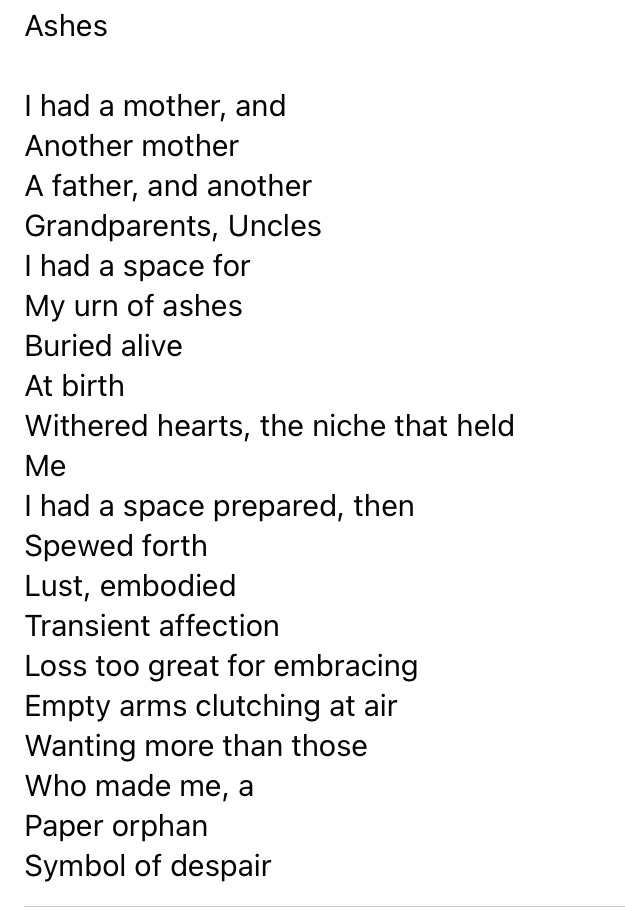
April is poetry month. My friend, Ande Stanley (a late discovery adoptee) wrote a poem for her The Adoption Files WordPress blog that I think a lot of adoptees could relate to, and so I share.

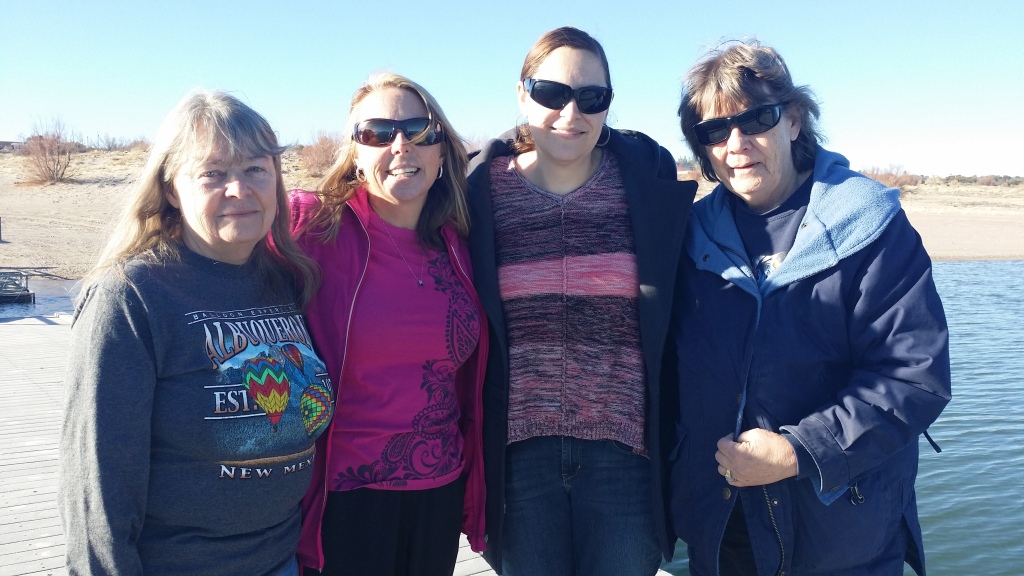
My parents (both adoptees) wanted their ashes scattered on Elephant Butte Lake in New Mexico. We had to be careful because it is not recommended. Most likely against the law. The first time, my daughter and I went out with my dad to scatter my mom’s ashes. That was a wild and crazy ride for both of us in his boat with my dad !!

When my dad died only 4 months later, my aunt (my dad’s half sister by his second adoptive father), my middle sister and her daughter, as well as me and my daughter went to scatter his ashes also on the lake, as that was his wish, but we did not take my dad’s boat out that time. We just stood on a dock near their last residence. Some official came along because we didn’t have a permit to take our car into lake property (it is a state park). My sister was hiding the cremation box under her jacket. LOL We did get the deed done. My aunt took the photo below. Maybe I should not go into the story of how the crematorium stole my parents rings . . . always make certain you get them back is all I can say.

Feb 9 2016, Ash Day

Baby Remains In Mother

No matter what happens to separate you, your baby becomes a physical part of you always. I find this knowledge beautiful.

While pregnant, the cells of the baby migrate into the mother’s bloodstream and then, circle back into the baby. It’s called “fetal-maternal microchimerism” – the presence of a small number of cells that are genetically proven to have originated in another individual. Not directly originating in the mother.

For 41 weeks during pregnancy, these cells circulate and move, backwards and forwards. After a baby is born, many of these cells will stay in the mother’s body, leaving a permanent imprint in the mother’s tissues, bones, brain, and skin. Every child a mother has will leave it’s imprint in her body.

Studies have shown, cells from a fetus could be still found in a mother’s brain, even 18 years after the baby was no longer present in her. Even if a pregnancy doesn’t go to term or the mother has an abortion, these cells are still present in her bloodstream.

A mother’s body is designed to protect her developing baby, regardless of the physical cost to her personally. This effect goes both ways, the baby’s cells help repair the mother, while the mother’s body builds the baby. If a mother’s heart is injured, fetal cells rush in and change into different types of cells to assist in mending her heart. It is known that sometimes a mother’s illness will vanish during pregnancy.

This is all part of nature’s plan that allows a baby to develop safely and survive.

And those crazy cravings you have while pregnant ? What were you nutritionally deficient in, to make your baby cause you to want to eat that ? I had gestational diabetes with my two late-life pregnancies. The fetus was craving sugar and that made it difficult to control my blood glucose. I found it surprising how the body inside my body could take over control.

So, if you have intuitively felt your child, even when they are not physically present, that is because they are still in you. Science has found this much proof that this is a reality. A mother carries remnants of her child within her for years, maybe forever, after they are no longer within the mother’s body.

Child Collectors

Jeane and Paul Briggs have 34 children – 29 of whom were adopted from other countries including Mexico, Ghana and Ukraine. 

Today, I saw the term “child collectors”. This is applies to people who adopt a lot of kids. It is not all that uncommon to see 10 adopted children in one family and sometimes it is because they are siblings. We have collected antique tractors and have met collectors who just couldn’t stop collecting. I wanted an image for that term and went looking in google images for “Large Families of Adopted Children” and found this one.

Their story was hosted by the BBC – “The family with 34 children – and counting.” There is a part of me that recoils. It seems obscene. But now that I have gotten here, I’ll look into it some more. It seems more like a group home or orphanage than a family situation to my own heart. The couple has 5 biological children in addition to the 29 they have adopted.

The Briggs family lives in West Virginia. Their odyssey began with a badly beaten, blind, 2 year old child in a Mexican orphanage. That child is now 31 years old and has thrived.  He has a girlfriend and  is a naturally talented musician who can play the piano and guitar and composes his own music. Okay so far.

In December 2014, when this story was written, the couple was anticipating the arrival of two more children that they were in the process of adopting, baby boys from Ghana. The three month old babies were abandoned in the bush.

There is only one word that comes to mind because “church” is mentioned in relation to Jeane and what motivated her to adopt the first one – saviorism. There is a missionary agenda here to convert more souls in the service of the church’s reason for existing.

Over the past 29 years, as more children have arrived, the Briggs’s house has been adapted for their expanding family. It now has nine bedrooms – two of which resemble dormitories – and at over 5,000 square feet, the building is more than twice its original size. The family’s grocery bill averages $1,000/week (back in 2014) but thanks Paul’s well-paid job and Jeane’s careful budgeting, they have been able to meet their expenses.

And no surprise, Jeane has been home-schooling the children for nearly 30 years. This is not uncommon among Evangelical Christians. My sons have been educated at home but we don’t do it for religious reasons. Every homeschooling family we’ve met regionally does it for religious reasons. Thanks to the strength of the Christian persuasion in Missouri politics, we are not troubled about the choice we made for our own sons. We have our own reasons. We are reasonably well educated and informed people who work at home, older parents, and are happy to have our children with us 24/7. This was a decided advantage for my family during the pandemic lockdowns.

Some of the Briggs children still have first families that they are encouraged to keep in contact with. Sometimes of the children speak to relatives on the phone and Jeane will send pictures to let those back home know the children are doing well. She says, “They may have our last name but if there is a relative, then we are glad that child has two families who love them. My husband and I don’t need to be the first Mom and Dad to them.”

From a young age, Jeane was concerned with the bigger issues affecting society and was particularly interested in orphans and adoption. Even then, she knew she wanted a large family – although she never expected it would be this big. She said, “Even as a child, I knew I would adopt and have a large family. Faith has been the biggest motivation… every child should have a loving family.” I rest my case about how religion drives adoption. Certainly, many of the Briggs children came from difficult backgrounds and I do agree that EVERY child should have a loving family.

Jeane and Paul Briggs

Trauma and Behavioral Responses

Psychophysiological reactions to traumatic stress have been known to occur since ancient times. Traumatized people may 1) re-experience the event through obsessive recollections, flashbacks, or nightmares; 2) exhibit avoidant reactions; and/or 3) be easily hyper-aroused and vigilant.

Children whose families and homes do not provide consistent safety, comfort, and protection may develop ways of coping that allow them to survive and function day to day. For instance, they may be overly sensitive to the moods of others, always watching to figure out what the adults around them are feeling and how they will behave. They may withhold their own emotions from others, never letting them see when they are afraid, sad, or angry. These kinds of learned adaptations make sense when physical and/or emotional threats are ever-present. As a child grows up and encounters situations and relationships that are safe, these adaptations are no longer helpful, and may in fact be counterproductive and interfere with the capacity to live, love, and be loved.

The importance of a child’s close relationship with a caregiver cannot be overestimated. Through relationships with important attachment figures, children learn to trust others, regulate their emotions, and interact with the world; they develop a sense of the world as safe or unsafe, and come to understand their own value as individuals. When those relationships are unstable or unpredictable, children learn that they cannot rely on others to help them. Children who do not have healthy attachments may have trouble controlling and expressing emotions, and may react violently or inappropriately to situations.

Children who have experienced complex trauma often internalize and/or externalize stress reactions. Their emotional responses may be unpredictable or explosive and they may react to a reminder of a traumatic event with anger. This person may have difficulty calming down when upset. Since the traumas are often of an interpersonal nature, even mildly stressful interactions with others may serve as trauma reminders and trigger intense emotional reactions. Defensive postures are protective when an individual is under attack but become problematic in situations that do not warrant such intense reactions. Adaptive responses exhibited when faced with a perceived threat may be out of proportion compared to most people’s reaction to a normal stress. These reactions are often perceived by others as overreacting or as unresponsive or detached. Often both kinds of responses can be seen in an individual who has been traumatized as a child.

After becoming highly involved in adoption communities, I have learned a lot more about the effects of adoption trauma that both of my parents may have experienced. Trauma is a constant theme in adoption related communities. The first trauma is separation from the mother who’s womb the baby grew in. When an infant is still preverbal, the body remembers what the brain did not have language to interpret. For adoptees placed with abusive adoptive parents the trauma multiplies. This happens more often than most people might believe, due to the parents’ own unresolved feelings related to infertility and their knowledge that this child is not the one who would have been in their life with their own genetics – but for.

Within the community, it is frequently suggested how necessary it is to find a trauma-informed therapist because a therapist without this specialized perspective could do more harm than good.

Many people continue to reflect on the slap known around the world. Having an understanding of the behavioral effects of trauma, really put “the slap known around the world” event into perspective for me.

In his autobiographical book, “Will,” Smith recounts that as a child he witnessed domestic violence in his home. “When I was nine years old, I watched my father punch my mother in the side of the head so hard that she collapsed. I saw her spit blood. That moment in that bedroom, probably more than any other moment in my life, has defined who I am.”

“Within everything that I have done since then — the awards and accolades, the spotlights and attention, the characters and the laughs — there has been a subtle string of apologies to my mother for my inaction that day. For failing her in the moment. For failing to stand up to my father. For being a coward.”

Seeing the look on his wife Jada’s face, after she was targeted for having a shaved head due to suffering the disease of Alopecia by the comedian Chris Rock, it is quite likely Smith re-experienced that memory in the context of current events. In effect, however wrong, he could make up for his childhood inability to protect the woman he loved. His reaction that night had more to do with that 9 year old traumatized little boy, than the man he had become since then. That man unfortunately is now subject to public reinterpretation. I admit to being a fan of Will Smith movies in general and have loved his easy going personality in most of these.

All this to highlight the extreme importance of understanding the impact of an experienced trauma and the need to seek help in the form of trauma-informed therapy. Domestic violence is a devastating problem that affects individuals all over the world. I recently saw a video of Smith listening to his wife honestly describe her extra-marital affairs. His ability to listen and to take that knowledge in impassively, may have also been a trauma induced behavior from his childhood. The fear of losing the love of a manipulative person and at the same time needing the love of that person perhaps triggered the response the world witnessed.

Endthepatriarchy’s Blog Comment

At the end of this comment, the person wrote – “I am truly astonished you have read this entire comment. You must REALLY care. Thank you for reading.” I do – REALLY CARE.

This appeared in response to the blog titled Adoption Is A Selfish Act, which I posted back on Nov 25, 2020.  I write daily so that is going pretty far back.  I am surprised to see that blog had 23 views because I am lucky to get a couple of views on any single day.  I did go back and read it again.

And I did read all of your long comment and found it sincere and thoughtful. 

Your comment went into my spam folder because of your using MY Gazing In The Mirror WordPress website address. This troubled me right away.  How you could even do that is beyond me but obviously it is possible.  BTW that blog has nothing to do with this one except they have the same author.  I attempted to email you to clarify this but it bounced.  It appears to be related to Greenbrier Schools in Greenbrier, Arkansas. My paternal grandfather’s family is deeply rooted in Arkansas.

I was inclined to approve your comment anyway but have decided, to instead address your comments in this new blog, and feel that you may see this one too.  I always try to not only be honest but respectful and considerate of anyone who comments. So that you have hidden yourself makes me sad. Maybe you do not have confidence in yourself enough to present yourself to me honestly.

I will make a few responses but because of all of the above will not show your entire comment.

Certain references to saviorism, which often does drive adoptions – especially on the Evangelical Christian side of religion, seem to have troubled you. I can understand that you feel an emotional objection to that as you state that you are a Christian.

As to overpopulation, at one time I was more worried about that but it is expected to peak at 8 billion in 2040 and then decline. Overpopulation article on Vox.

Regarding “Open Adoption”, unfortunately a lot of good intentions going into such an agreement fall apart – either sooner or later. Most do not succeed in living up to the promises.

The identity issue you dismiss is real and I don’t think it is brought on by being treated differently due to adoption (except in cases of transracial adoption where the difference in race between the adoptive parents and the adoptee stands out). Fact is, babies are born with a name given to them by the conceiving parents and in adoption, most adoptive parents change the child’s name to something different that they like better. My parents (both adoptees) used to tease one another with their birth names – once they had been able to even learn those. An adoptee lives under an “assumed” name much like a criminal on the run might.

What is interesting is that you seem so passionate about these issues – when you admit that you are not adopted and that you don’t even have children yourself nor do you want any. If you could be open with me about who you are, I’d be happy to discuss whatever in more detail with you. As it is, I have written about almost everything to do with adoption or foster care so much – that I’ve probably all said it all before and am always in danger of repeating myself. I wish you well-being and happiness.

Youth Villages

My husband called my attention to an article at NPR.org – “18 can mean an abrupt exit from foster care. For some, it’s no longer a solo journey.” I already knew somewhat about aging out of foster care and the effects of that.

What attracted my attention was this – Helping young people see that they can have a stable future is the goal of the LifeSet program. Developed in 1999 by the Memphis nonprofit Youth Villages, it is being used today in 18 states and Washington, DC. I appreciate this from their Mission and Values statements – “When at all possible, children belong with their families. We help families provide the support and structure that all children need.”

Also this – We develop innovative programs that serve children and families facing the most challenging circumstances. Our entrepreneurial spirit leads us to test the limits of existing services and create new opportunities. We provide care and treatment for children in an open, safe environment. We ensure that young people are physically and emotionally safe. We help children and families develop skills to live successfully by focusing on areas that have a long-term impact on the family.

LifeSet puts transition-age youth in the driver’s seat of their lives with a trained specialist by their side to help them identify and achieve goals. It is is an individualized, evidence-informed community-based program that is highly intensive. LifeSet specialists meet with participants face to face at least once each week. They text, email and call young people regularly throughout the week, when needed. Specialists stabilize even the toughest situations and help young people build healthy relationships, obtain safe housing, education and employment. LifeSet is one of the nation’s first — and now one of the largest — evidence-informed programs helping young people who age out of foster care. More than 20,000 young people have helped through LifeSet across the country since the program began in 1999.

I Am Right Here

On my maternal side – I was able to visit the graves of both of my maternal grandparents, one half-aunt and one set of great grandparents too (but I did not talk to the “greats” at their grave – still have some very difficult feelings towards my great-grandfather for being unwilling to take my grandmother and mother back in when my grandmother was pregnant and her husband had returned to Arkansas. Believe me, I have done my best to come up with all kinds of kinder theories about why but still . . . I will always feel in my heart that he was the cause of my mom being adopted . . . I am certain of those feelings about him.)

I Am Right Here

Looking into the darkness, I call out “where are you?”
The darkness does not call back.
Instead I hear nothing so I wait, knowing that when my words reach you there may be a reply “I am right here”
I keep walking not able to see in front of me.
Again I call out “are you there?” but nothing comes back to me.
So I continue with hands outstretched in front of me walking in darkness and feeling my way through space.
Black empty space that feels every part of my vision.
Waving my hand in front of my face I cannot see what is in front of me.
So I continue walking through the darkness.
“Is someone out there?” I say.
I can hear faint words now, it sounds like someone screaming “come this way?”
I keep walking straight ahead toward the sound.
It gets louder and I start hearing footsteps coming closer.
“Is it you?” I call loudly
“Is it Who?” I hear back
“You?” I say to the voice
I continue walking toward the sounds and keep talking to it.
“I have been lost without you,” I say.
“Who has been lost without me?” the voice asks.
“Me, I have, but where are you, I can’t see you?”
“Just keep moving forward,” it says.
“I am trying to but I keep getting lost,” I say sadly.
No more footsteps are heard.
Suddenly light begins to invade the space and standing in front of me is the one I have been looking for my whole life.
They reach their hand out to mine,
“I am right here and have been the whole time.”
~ Brandy Ford

Booth Girls

This looks interesting to me (I have not read this recently published book). My paternal grandmother gave birth as an unwed mother in a San Diego home in 1935. It was called the Door of Hope. After her release with my father some months after his birth, she tried to seek refuge with her cousin who lived nearby. I am guessing it didn’t go well. My grandmother returned to the Salvation Army home seeking employment and was accepted. She traveled by train to El Paso TX with my dad in tow to another home for unwed mothers where she became a helper. When I discovered a cousin, thanks to 23 and Me, with the same grandmother, she expressed surprise the Salvation Army “owned” my dad at the time of his adoption. The family story was a nice couple took my dad because my grandmother could not financially support him. I will always believe that the Salvation Army coerced my grandmother into relinquishing him. Thanks to breadcrumbs she left for us in her photo albums retained by her daughter, the next youngest child after my dad, I was able to identify who my paternal grandfather was.

About the book shown above –

In 1961, my mother delivered her first daughter, my half-sister, at the Salvation Army Booth Memorial Hospital in St. Paul. Booth was a home for “unwed mothers” and so, like most of the other young women in residence, my mother surrendered her baby for adoption. She kept the whole experience a secret until 1994, when my sister found my mother. After my mother died in 2009, I set out to learn more about her experiences as Booth girl in hopes of understanding my own as an adoptive mother. Based on oral history interviews, archival research, family history, and memoir, Booth Girls is a story about mothering through the losses and gains of adoption.

~ Kim Heikkila, author

There is an informative video posted, “Mother’s Day” watchable at Vimeo, available at Heikkila’s website (because of it’s privacy settings I cannot embed it her but I do recommend watching it !!).