Sad Story With Triggers

Liu Xuezhou

Trigger Warning: Content contains explicit details about suicide and suicidal thoughts.

When Liu Xuezhou‘s story first went viral last month, it brought together people from all corners of the internet — and the world. On December 6, the 17-year-old shared a video on the Chinese social media platform Weibo, where he asked the public for help in finding his biological family. Amazingly, thousands of strangers joined forces, and before long, the teen was able to connect with his birth parents. But instead of finding some closure and peace in the reunion, Liu was heartbroken when they both shunned him. Tragically, it appears the experience was so devastating that Liu took his own life over the weekend, Chinese media reported.

The teen was in the dark about his exact birth date, as his adoptive parents only knew that he was born sometime between 2004 and 2006 in Hebei, a province in northern China. He was purportedly sold by his parents as a baby. His biological mother has disputed this saying it was complicated. At some point during the adoption process, Zhang said that the “middleman” who transferred Liu to his adoptive parents insisted on giving them money for the child. The child was “sold” for $4,200 – most of which went to the middleman.

When Liu was just 4 years old, his adoptive parents both died on the same day in a freak accident. Over the years, he was passed from relative to relative, never truly calling any one place his home. To make matters even worse, he reportedly struggled financially for most of that time. After his story went viral, the teen shared that he’d taken on a part-time job to help pay for his schooling and was living in a run-down home, where he was barely scraping by.

Detectives were quickly able to track down Liu’s biological father using DNA testing, and the two were finally able to meet just weeks after the teen initially shared his story. The pair met up in Shijiazhuang, the capital of Hebei. Though the boy hoped he could go and live with his father. The man told his son that he simply couldn’t because he was already raising another family of his own.

Then, the teen found his biological mother in Inner Mongolia and arranged to meet with her in person, with the same hopes to be taken in. Her reason was also that she’d started a family of her own and simply “wanted a peaceful life.” 

At first his parents pooled some money together and sent him on a vacation to Sanya, a city on Hainan Island. But when he continued to ask them for help with finding a new place to stay, they reportedly refused. In fact, his mom even blocked his phone number and social media accounts, essentially cutting him off from all contact with her. Both parents claimed Liu asked them to buy a house for him and that they were poor when they gave him up and were still too poor to do anything of that sort. Liu claims he was merely asking for money to help cover his rent.

Having been “abandoned twice by his biological parents,” which had deeply affected him – it was the subsequent cyberbullying that made things even worse.  The 17-year-old reportedly died from an overdose of antidepressants. His aunt confirmed his death with local media outlets, sharing he was found early Monday morning and immediately rushed to a hospital in Sanya, China, before he was pronounced dead.

This story highlights the very real and dangerous nature of child trafficking, which sadly occurs all over the world but is particularly egregious in China. Under Chinese law, child trafficking can be punishable by up to 10 years in prison. But even so, the nation remains ranked as one of the world’s worst countries for human trafficking.

Adult Adoption

I read a review today of a TV reality show I will NOT be watching – Adults Adopting Adults. Yet I thought it would be an interesting topic to explore in today’s blog. I’ve come across the concept before within an all things adoption group I belong to as some adoptees in reunion with their biological family, wish to be adopted as adults by their original family. And in doing a quick google search – it really is a thing – and there are lots of law firms willing to help anyone through the process for a fee.

Beyond the adoptee in reunion with their original family, why would anyone else want to do this ? Certainly in that reality show, there are some sexually nefarious reasons and so, I really have no interest in watching it. By the way, the question has come up regarding immigration and no, adopting a foreign national does not automatically grant them citizenship.

Adult Adoption is very common in Japan and it actually goes back to business inheritance laws that no longer apply but tradition suggests they still hold a lot of sway as I learned in an article for The Economist. The country’s declining birth rate has limited the likelihood of a male heir for many business families. Many legal adoptions are coupled with a form of arranged marriage (known as omiai) to one of the family’s daughters—but the son-in-law (or mukoyoshi) then changes his name to hers. Today a host of matchmaking companies and marriage consultants recruit voluntary adoptees for Japanese companies.

To be selected as a mukoyoshi is to be awarded a high executive honor. This prompts fierce competition among managers, ensuring that the business has access to as good a talent pool as non-family companies. In fact, researchers have found that adopted heirs’ firms outperform blood heirs’ firms—although the prospect of being overlooked for an outsider can serve as motivation for sons to knuckle down, too.

In the US, the primary drivers of adult adoptions are where a step-parent wishes to secure inheritance rights for their step-child and in situations of disability requiring long-term care. I have a friend with an autistic daughter approaching legal age who has been informed to maintain support requirements, she will have to adopt her own daughter. I can also imagine this happening where a parent needs the legal guardianship of their child (though I do believe having flirted with that issue regarding my dad, adoption isn’t necessary to secure that support).

In June 2015, the Supreme Court ruled in the landmark civil rights case of Obergefell v. Hodges that the fundamental right of same-sex couples to marry on the same terms and conditions as opposite-sex couples, with all the accompanying rights and responsibilities, is guaranteed by both the Due Process Clause and the Equal Protection Clause of the Fourteenth Amendment to the United States Constitution. Before the advent of federally legalized same-sex marriage, some couples utilized adult adoption in order to pass on inheritance rights and medical decision making to their partners.

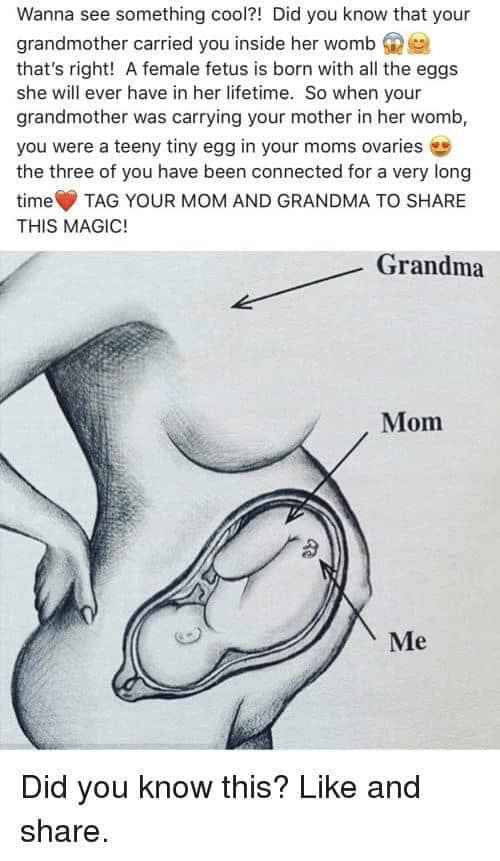
Inside Grandma’s Womb

I think I already knew that all the eggs a woman has were there in her ovaries at the time of her birth. Since we did not grow up with my maternal grandmother (due to my mom having been adopted), I feel a definite fondness for my maternal grandmother who never had another child after having lost my mom due the the schemes of Georgia Tann during her days of stealing and selling babies in Memphis TN to enhance her own wealth. In some strange way, it makes me happy to know that even though Tann could take my mom away from my grandmother, she couldn’t take my grandmother out of the core beginning of each of us.

My mom certainly yearned to know her own mother and was devastated when seeking her adoption file from Tennessee (who denied her as her father’s status of alive or dead was not ascertained) told her that her mother had died some years before.

There is a strong maternal line running down from my grandmother to my mother to me and to my daughter and then my granddaughter. My mom looked a lot like her mother at a certain age. I love feeling that mirror showing through. It is also a happy thought that when I was in my mom’s womb, my daughter’s seed was forming and when she was in my womb, my granddaughter’s seed was forming. We are all connected. Sweet.

Yet Another Story of Misattributed Parentage

Mark Overbay

Story thanks to the Right to Know people.

Every MPE (misattributed paternal event or misattributed parentage) story has a starting point. The discovery comes entirely by surprise for many, whereas it confirms others’ long-held, conscious or subconscious, suspicions. If there truly is one, the typical story involves submitting a direct-to-consumer/recreational DNA test yourself or being contacted out of the blue by someone who has. Mine has a little of each with an added twist.

One afternoon, a friend of mine called me with what he described as “interesting news.” He told me that he and his older sister had taken DNA tests and found something unexpected. He informed me that both had discovered the man they thought their father wasn’t. Their research afterward led them to believe that my father was their BF (birth father). Additionally, they had reached out and somehow convinced my father to submit a DNA test. The results confirmed their research findings. “We,” he informed me, “are half-brothers.” He sent me a screenshot of the DNA evidence to prove it. Because I was already aware of two other half-siblings from my father, this news honestly wasn’t that surprising. I remember laughing with him about the strangeness of our new situation.

What my friend didn’t know, however, is that many years ago, I had also taken a DNA test from the same direct-to-consumer company, primarily because I was ethnicity curious (as both of my own parents were adopted – this was originally my own motivation). When I told him about this, he informed me that I wasn’t on his match list and followed with the question, “You are the adopted one, right?” “Adopted? I was not adopted.” I quickly replied. Confused, he told me that my father had told his sister I was adopted. He must have misunderstood. I was 58 years old and was confident that I wasn’t adopted. My birth certificate listed my father and mother. I had seen it many times. I called his sister to see where this part of the story originated. She repeated her brother’s claim that my father had told her I was adopted. Further, she explained, he had married my mother, knowing she was pregnant with another man’s child.

When I learned the adoption news, I was more than two hours from home and my laptop. I wasn’t laughing anymore. My head was now cloudy and confused. The drive home was a blur. “Could this be possible?” I asked myself, “Was I adopted?” Once I arrived, I quickly checked my DNA matches. Neither my father nor these two new “half-siblings” were there. As I surveyed my 80,000 + matches, none matched my surname. I found that it was 100% confident regarding the connections tied to my mother. However, most of my “close” matches were surnames utterly foreign to me.

It was true then; I had been “adopted” by my BCF (birth certificate father). But, unfortunately, my mother had taken her secret to the grave. My BCF had told a stranger rather than me. I found out I was an NPE from a friend who was a completely unrelated NPE (nonpaternal event, also sometimes nonparental event). My friend was right about the adoption but wrong about the two of us. We were not related. In a nutshell, that’s how my story began.

Life does not prepare you for such moments. As abrupt and shocking as it was, this revelation explained so much. My physical appearance, personality, and temperament differed significantly from my father’s. I was athletic; he was not. We had little to nothing in common and even less to talk about. We have not spoken in many years. Those who knew both my father and me well commonly joked that I must be “the milkman’s child.” My wife has known my father for more than 30 years and never once thought we were related. I laughed these comments off, but I really couldn’t disagree. The differences were problematic to me. I knew enough about genetics to know that much of what defines our identity, the sense of who we are, is inherited. I feared that I would start to see undesirable attributes of my father revealing themselves in me one day.

The realization that I was adopted lifted an incalculable weight from my shoulders. The fear that I would someday become my father was a burden more significant than I had previously appreciated. Yet, strangely perhaps, as the reality set in, this genetic enlightenment was validating and liberating for me. The truth had freed me.

You can read the rest of his happy ending family reunion story here – Mark Overbay.

Love The Children

Short and sweet today. If we really loved our children (all of the world’s children), we would do whatever needed to be done to support the families they are born into. We would not remove children from troubled families but seek to remedy the troubling aspects.

Adoption Does NOT Make It All Better

I was reading about one of the common sticky situations that often appear in my all things adoption group. This part really got my attention – “Everyone is like ‘this is going to be so great!’ and I am just feeling like… yes and no. They will be safe, but adoption doesn’t just make it all better.”

The standard narrative in society is to celebrate and be joyful when anyone adopts. Truth is the yes and no part is probably closest to being the truth for the adoptee themselves.

Today would have been my mom’s birthday but she died back in 2015. She never was entirely comfortable with how she ended up adopted. Trying to be polite, she would say she was inappropriately adopted. Since Tennessee rejected her effort to get her adoption file (a file that I now possess in its complete form), she really couldn’t know for certain. She did know that Georgia Tann had been involved in her adoption in 1937. She knew something about the scandals surrounding Georgia Tann’s placement of children and she had a had time reconciling the fact that she was born in Virginia but adopted at less than 1 year old in Memphis Tennessee.

I will forever be disappointed that Tennessee promised my mom to do everything in their power to determine if her original parents were alive but only sent an inquiry to the Arkansas Driver’s License Bureau who could find no record of her natural father. No wonder, he had been dead for 30 years at that point and was buried in Arkansas. Could they have at least checked Social Security death records ? But they did not.

Instead, they broke my mom’s heart by telling her that her natural mother had died several years earlier. My mom had to have seen some of the many adoptee/mom reunions on TV in the early 1990s when she was seeking to obtain her adoption file. All Tennessee gave her for the $180 she paid them was a NO and heartbreak. That I cannot forgive Tennessee because having seen her adoption file, I know in my heart that how hard her mother was fighting to keep her when up against a master baby thief would have been important to her.

Even so, in her moment of accepting all that would never be, she said she was glad she was adopted. I never truly believed that she was – glad. Being adopted was not “better,” just different. However, if she had not been adopted, she would not have had me. It causes in me conflicting feelings because I am glad that I am alive and that I had my mom (and my dad) in my childhood growing up and until death did us part. I can hope that my mom and her mom had that reunion after death that many people believe in.

So It Has Come To This ?

In Crockett Texas, Rebecca Lanette Taylor was arrested after badgering a woman to sell her the woman’s baby. Wow !!

It all started in the self-checkout line. She had a baby in a car seat and her 1-year-old in the cart while waiting to use the self-checkout. Taylor “began commenting on her son’s blonde hair and blue eyes. She asked how much she could purchase him for. The mom tried to laugh this comment off, thinking Taylor was joking. Taylor told her that she had $250,000 in the car and she would pay that much for him. Then the mom told Taylor no amount of money would compel her to do such a thing.

Taylor continued to press the issue, and the mother told her to stay away. Taylor allegedly said she’d been looking forward to buying a baby for some time. Taylor was with another woman, who asked for the child’s name, though the mother didn’t answer that inquiry. However, the other woman knew the child’s name and called it out.

The mother waited for the two women to leave the store before heading to her car. In the parking lot, Taylor began screaming at the mom, saying if she wouldn’t take $250,000 for him, then she would give her $500,000 because she wanted him and she was going to take him.

The mother wisely locked her children in her car. Taylor continued to stand behind a black SUV that was next to the woman’s vehicle and continued to repeat that she wanted the child and was offering to buy him.

Eventually Taylor got into the black SUV and left. Police identified Taylor using store surveillance video and questioned the woman at her home. If found guilty of a third-degree felony, Taylor could face as many as 10 years in prison.

Maud Lewis – Tragic Birthmother

I am attracted to tragic birthmother stories. That is what I feel that both of my biological genetic grandmothers were. So last night we watched the movie Maudie. It is the story of the Nova Scotia woman, Maud Lewis, who’s folk art which sold for nominal prices during her life and has skyrocketed into value since her death. I am attracted the her famous painting of the white cat with the sad face.

In the Hollywood romanticized version of her story, her husband Everett Lewis was not a social person and is known to have been was born at the “Poor Farm” in Marshalltown, Digby County. In the movie, he frequents an orphanage. It is unclear whether his mother was a resident or an employee at the Poor Farm, and nothing is known of his father. The movie depicts Maud and Everette Lewis as two misfits who found each other and married.

When Everett wants to have sex with Maud, is ostensibly there as his housekeeper but in living with him, there is only one bed in the house – his bed. She confesses to him that she once ended up pregnant, had a severely malformed baby who died and was buried while she was asleep. Later in the movie, her Aunt Ida who had partially taken care of Maud before she went to work for Everett but didn’t want to die with regrets, confesses that the baby was perfectly normal but that Maud’s brother Charles sold her to a rich couple because he did not believe Maud was capable of caring for her.

Later, Everett tracks down Maud’s daughter and takes her to see the girl but Maud only secretly looks at her hidden next to their car, outside of her house and isn’t willing to go to the girl. One gets the sense that she may have felt the daughter would reject her for her deformities, caused by juvenile rheumatoid arthritis (which was not treatable in the time period she was growing up). And that could be the true version – which is sad and tragic enough.

There is some dispute about the movie version compared to the actual true story and that would not be surprising as movies are meant to entertain. Everett is said to have been much worse towards Maud than the movie depicts him as being. The author, Lance Woolaver, visited Maud’s famously hand-decorated with her paintings house as a child and has been fascinated by her story all his life. He wrote a heavily researched 500 page book – Maud Lewis The Heart on the Door.

The book is described as a full-length biography including detailed accounts of her disabilities, due to a childhood battle with juvenile rheumatoid arthritis that twisted her hands and joints. Despite this deepening and painful affliction, she completed and sold thousands of bright pictures and Christmas cards from her little one-room house. Throughout her marriage to the illiterate fish peddler, she suffered from poverty and loneliness, yet triumphed over all with her brilliant, colorful and happy paintings. Everett Lewis was murdered after Maud’s death in 1970, on New Year’s Day of 1979 for his lockbox filled with money from sales of Maud’s pictures.

This author’s perspective on the tragedy of Maud Lewis as a birthmother was that as a young woman in Yarmouth, Maud fell in love with Emery Allen. Woolaver believes he was the love of Maud’s life. However, after she became pregnant, Allen abandoned her. He also believes there was no reconciliation between Maud and her daughter. Whether Maud believed the lie initially told her or not, it is said that she rejected her daughter, Catherine, when she reached out to know her mother saying that her child had been a boy who was born dead. A subsequent attempt by the daughter to contact her mother by letter also failed to bring them back together.

Catherine Dowley was born August 13, 1928 in Nova Scotia. She was not aware that she had been named for her mother, Maud Catherine Dowley. Later in life she did know that Maud was her original mother and that Mamie Crosby was her adoptive mother. Catherine’s visits to connect with Maud in Marshalltown upset Mamie, who like many adoptive mothers felt that she had been a loving and good mother to Catherine.

Catherine (with glasses) with her adoptive mother, Mamie Porter.

Catherine married Paul Muise in 1949 in Yarmouth county and several years after their marriage, they moved to Ontario. They were the parents of about 4 children. Catherine died before Lance Woolaver’s book was released.

Everett was know locally as a dirty old man who would take advantage of young women for sex. Maud may have known there was that aspect to him and sought to protect her daughter from predation. Just questions without answers such as those I have in my own parents’ adoption stories. Those that know have died with the answers I will never have.

The Exploitation Problem

What could be wrong with a couple who has experienced infertility and has the financial means adopting the baby of an unwed mother ? Many people would see nothing wrong with this.

The problem is that behind this happily ever after scenario is a great deal of exploitation. In both of my parents’ adoptions, this was a definite factor, even though my mom’s parents were married. There is a great deal of money changing hands in the domestic infant adoption industry.

So, let’s consider domestic infant adoption. Only a newborn baby will do for these adoptive parents. They desire to only adopt a newborn baby. Let us judge this as selfishness. Maybe you as the hopeful adoptive parent just want to have the baby “experience.” Maybe you believe you’re getting a “blank slate” (that was what Georgia Tann who was involved in my mom’s adoption would tell her prospective parents). The truth is babies are NOT blank slates. Maybe you want the “as if born to” parenting experience (being there at the very beginning and you as parents being the only ones the child will ever know). Maybe you think this is as close as you can get to having your “own” child.

Some reality checks –

1. You are NOT needed. There are over 100 hopeful adoptive parents/singles/couples for every ONE newborn baby that is available to adopt. These babies are in high demand and sought after. They won’t age out of foster care, if you don’t adopt them. Furthermore, they have biological genetic families. Contrary to popular belief, there are very few women who just don’t want their kids. Imagine the desperation, fear and poverty you must live in to give away your own child. Adoption rates have gone down drastically over the last year. Why? Because families have received so much more financial help and resources due to COVID. With help and support, even more mothers are parenting their own children.

2. If you’re a hopeful adoptive parent glad that “support” from the government is stopping to increase your odds of getting a baby – you are not adopting because you are a good person.

3. If you’re praying for a woman to feel desperate enough to give you her baby – you are not adopting because you are a good person.

4. If you match pre-birth with a pregnant woman and coerce and manipulate her during her pregnancy – your desperation is showing and you are not adopting because you are a good person.

5. Agencies are a for profit business and often are not at all ethical. Know this, if you’re paying thousands of dollars to adopt through an agency – you are not adopting because you are a good person. You are adopting because you have the money to do so (or have raised the money through a Go Fund Me or other such platform).

6. A standard adoption practice is for the hopeful adoptive parents to be present in the delivery or hospital room. The agencies tell the birth mother that “this is just how it’s done.” Know this – it’s done to make it harder for the mom to change her mind, when she sees her child. If you’re there breathing down her neck while she is giving birth and in that moment when she first meets HER child – you are attempting rob her of the only precious moment with her baby that she may ever have. And maybe she WILL change her mind and her baby will be glad that she did.

7. If you make her feel guilty for wanting to keep her baby, the same way the agency will – you are exploiting her. If you employ an agency to call Child Protective Services on her (mind you, just standard adoption practice) when she wavers regarding giving her baby up to you, just to scare her into going forward – you are exploiting her.

8. So, the mom has changed her mind and is going to keep and parent her baby. Then, you fight against her decision by using the legal system or the agency does it on your behalf – you are exploiting her.

9. If the father is not on board with the adoption and his rights are being completely ignored – you are exploiting the father.

If any of this is true of your circumstances – you are guilty of exploiting a difficult time in someone’s life. A situation that will likely change for the better given time. You will leave a baby with lifelong trauma from sundering that child from its original family.

Shock And Confusion

Ashley John-Baptiste

I was drawn to this man’s story in The Guardian because such unexpected events are happening more often these days thanks to social media and inexpensive DNA testing.

He had entered foster care while only still a toddler. He had been in four foster homes and a residential care home, all across south-east London, by the time he aged out at 18. He had always believed he was an only child. In his mid-20s, he received a message on social media from a stranger, about 10 years older than him, who claimed to be his brother. Turned out he was a half-brother, they shared the same father. This older man had been one of his baby-sitters when he was very young. And he knew this man had at least three other siblings.

After aging out, he was rebuilding his life. He had gotten a degree and was employed as a BBC journalist. This unexpected note from a stranger on Facebook had collided with his already fractured identity, raising a wave of questions about who he was and where he came from.

At the time, the two never went on to meet in person. They messaged each other a bit for a few weeks and of course, he scoured the man’s Facebook profile, but they didn’t pursue a more intimate relationship. Years passed without any contact – until the first COVID lockdown.

His partner had given birth to his first child and they were at a hospital for a routine well-baby check. He spotted a man outside the building. They locked eyes. Weirdly, perhaps, he recognized the man instantly. He was the half-brother who had got in touch with him all those years ago. He looked exactly the same in person as he did in his profile picture.

So, he called out the man’s name and, to his relief, the man also recognized him. They stood there, outside the hospital, chatting. Time stood still. In that moment, it felt as if they had known each other their whole lives. There was a deep knowing. Nothing was awkward about it. If anything, it felt too normal.

He said at the hospital visiting his sick mother. He introduced the man to his baby. They took a photo together and even made plans to catch up properly in the near future but since that chance encounter, they haven’t met again.

For ages after that meeting, he was consumed with questions about his past. Why did social workers and foster carers tell him he was an only child? How could no one in authority not know about his siblings? Do children’s services even care about, or prioritize learning about, the family histories of looked-after children?

Sadly, he still has not had any contact with his other siblings. At this point, all he has is that photo of his half-brother who is his baby daughter’s uncle. Even so, he says this – “Although I don’t know, and may never know, these siblings on a personal level, they serve as a touch point to understanding my past and my sense of identity. Knowing they exist reassures me that I am a part of something bigger than myself. . . . knowing they are alive and well is more than enough for me.”