Rejection And Grief

Today’s story (not my own) –

I was adopted at birth, and I was told at 18. I am now about to turn 28, and really only just beginning to grapple with the emotions that accompany this information. I attribute that to getting married 3 years ago and finally being in a stable enough environment to begin processing, which college was not.

And to be frank, it’s been absolutely fucking awful. I always have and always will love my adoptive family so very much, and that makes the depth of the lie even harder to comprehend. I feel like I am burdening my husband and my friends with just, my own confusion at this stage. I am caught in a cycle of trying to justify my existence with harder and harder work and it’s not working at all lol. I know nearly everyone feels aimless around this stage in life, but woof. I am so tired. I am tired of feeling like the universe didn’t want me here. And like my entire life has been a lie. Which… it kind of was.

If you’ve made it this far, thank you, and I’d like to pose a question. For others who learned about their adoption later in life than childhood, and then began processing even later than that, what helped? Is it like grieving where you just have to let it hurt? Am I doomed to being a mopey bitch forever or will time give me grace with these feelings?

Some responses – Being late discovery adoptee (LDA) has layers to it that other adopted people don’t have to navigate. The lies and losses involved specific to life before and after discovery have massive impacts that can sometimes only be understood by those of us who have lived it. While community with other adopted people is valuable and helpful, I recommend joining specific communities for LDAs and NPEs (Not Parent Expected).

One asks – Are you in reunion at all? It can bring its own challenges but overall I feel like the truth is the only thing that can TRULY fully help us process, even if it hurts more at first. Lean into THE truth and gather as much information as feels right, so that YOU can put it together to come to terms with YOUR truth. For me, that’s the most empowering way to process the trauma.

One adoptee noted – The work you’re doing right now is some of the hardest work some of us ever have to do. Realize and accept that the people who purport/ed to love us, lied to us, or gave us away/sold us. While I can grasp all of it intellectually, I will always struggle with being invisible to them.

Another writes about the impact of the Dobbs decision – Not late discovery, but I didn’t start processing until 2 years ago when I was 40 years old. The Dobbs decision and supply of domestic infants was what triggered it. I didn’t allow myself to feel anything or care before that because while I knew as a child, it was supposed to be a secret from everyone else. There is grief. It does hurt. I don’t have any answers for the pain. I’m still feeling all the feelings two years later. Made contact in December 23 and reunion adds more feelings. It does help that my older half sister wants a relationship and we are working on building on.

From a late discovery adoptee – My experience was quite similar to yours. I discovered that I was adopted when I was 31. Now I’m 57. I think you asked a great question – asking if it’s like grieving. For me, that’s exactly what it was, and it took me a long time to forgive them. They were good parents in a lots of ways. I know they loved me very much (at least my mom) so it was hard to reconcile the fact that people who loved me and who I loved would lie to me about something as fundamental as who I was and where I came from. Like it’s hard to even comprehend. The grief, the loss. What could have been if I’d known and they got me the help I needed. Anyway, a few years after I found out, I decided to try to forgive them. I wanted my kids to have grandparents. And I just couldn’t stand the thought of losing them. Of being an orphan once again. I still go back and forth over it. Most days I don’t even think about it anymore. I’m at peace with it. But sometimes it still pisses me off. I still grieve for what could have been. It takes time. As others have said, being in a group specific to LDAs is a good idea. I think that while we have very much in common with adoptees who have always known, there’s a whole other dimension that only LDAs can understand.

Of course, this can and did go on and on but I think this is enough for today’s blog. If you are on Facebook and are a late discovery adoptee – this is the group mentioned more than once to search on for additional support – LINK>Forum for Late Discovery Adoptees. It is private and I don’t qualify.

Never Ending Grief

Today’s story from an adoptee – Today I was told my biological half brother, who has been the most communicative of my first family, has terminal lung cancer. I’ve never met him, our younger brother or either of my sisters, in person. I do not have a good relationship with first mom and first father is deceased. I had knowledge this might be a possibility and thought I was okay. But I am grief stricken. I can not stop crying and left work today. My heart is broken for a brother I never got to have and now one that will never be. Suggestions for dealing with this grief are welcome. I probably should add I lost both my adoptive parents and brother already and a son to suicide 4.5 Yrs ago. This grief feels too much and never ending.

One respondent suggested – I’m sorry for his diagnosis. I’ve found writing a grief letter to be helpful to process thoughts and feelings. Let the feelings of grief come up within your body as you write.

Another suggested – I’m so very sorry for all of your losses- the pain must be massive. My heart aches for you. Please hang in there- the world needs your light. I would encourage you to reach out to your brother and prioritize meeting him as quickly as possible. Have the relationship you’re grieving. In the meantime, I would start keeping a journal (or a note on your phone) of all the things you think of to discuss with your brother. Maybe even write him a letter (that you don’t have to send) expressing the feelings you’re experiencing right now.

Another adoptee wrote – A grief counselor and therapist really helped me deal with the loss in my life. I don’t know if this is helpful but my therapist told me I have to grieve the life I will never have. For me, I will never have a family and once I can grieve and accept that fact, it will be easier to move forward and be clear on what I really want and need for my future. I know the circumstances are different in your case. 

Another notes – I too have had so very many losses myself. It is a hard walk to travel through. I reach out when I’m feeling needy or I have feelings that are overwhelming before I am in what I call a crisis. For me it took time to learn how to do this (reaching out) and my triggers, what they are and which times I know I’m going to struggle the most – such as holidays, birthdays. I learned that it’s always up and down, and sometimes it can be easier by working on myself and embracing my journey.

Another adoptee wrote – Disenfranchised grief is real grief too. She also wrote – Virtual hug to you (cause physical hugs I can’t stand).

What I Never Experienced

Today I read this sad admission from an adoptee who was also formerly in foster care –

Ya know what breaks my heart? Is knowing that I’ve missed out on some cool things as a kid and thinking that nobody else will get it.

I hate talking to people who’ve experienced fun things as kids because they are always baffled that I had never experienced it.

I’ve never been able to go into a costume store and say “this is what I want to be for Halloween.” Never got to trick or treat either. I’ve never been to an Easter egg hunt or gotten a basket from the Easter Bunny. I’ve never had a birthday at school, where someone brought the class cupcakes and everyone sang to me. My birthday is always during the school year. I’ve never been given money by the tooth fairy. I’ve never slept over at my grandparents house with my cousin. I’ve never even had a sleep over!

I never had a gift from Santa. Just donated items from the Division of Children and Families and churches. I don’t know many kid-like Christmas songs (Frosty, Rudolf, and whoever else, I don’t know) ! I don’t know many Christmas songs period. I don’t know any bedtime stories either. I don’t have a single baby pictures or childhood item that someone has held on to.

I hated family trees in school. I hated “all about me’s.”

I’m 19 now. I feel like I’ve missed out on everything due to being in foster care and then, being adopted. Even then, not having the cool experiences.

I have a bonus family (they took me in, when my adoptive parents let me go) and they’re so awesome. They have little kids and they are so excited for the holidays. They want to trap a ghost and have it as a pet. So they’re setting up fake ghosts in sheets and pretending there’s a ghost party, so they can trick the ghost. They asked me how to trap a ghost and I honestly had never heard of that. I just said I’ve never been able to do it yet, so we better plan a good party.

I went to my room and cried. I’ve always hated the holidays because everyone could share something cool they did during break and I always had to go to another room and read or color, so I didn’t feel bad about myself.

Now I’m 19 and so, I’ll never be a kid who gets to do all the kids things.

I see why people grow up and want nothing to do with others (blogger’s note – because we have no shared foundation of memories). I get it now. I get it.

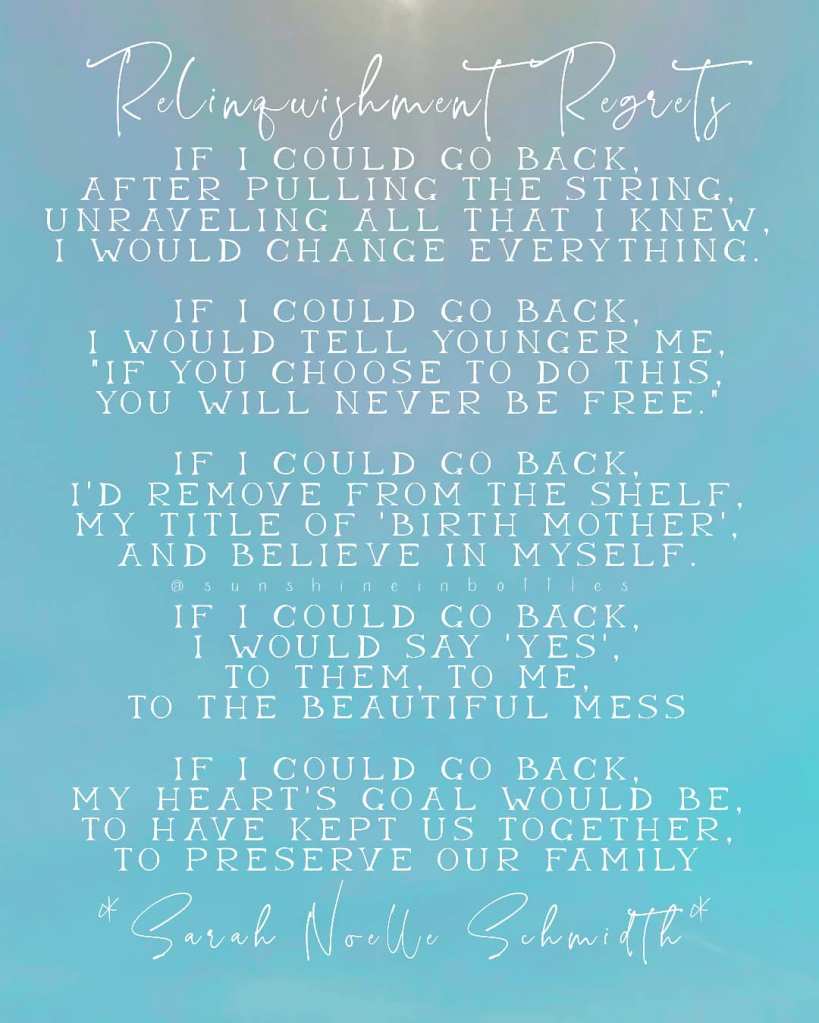
Relinquishment Regrets

Written by a mother who knows. She says of the above poem – I wrote this yesterday and thought there might be some other first/natural/birth/mothers of relinquishment moms who feel the same.

I am coming up on 22 years since my first relinquishment (I placed twice, nineteen months apart, with the same couple, who are now divorced) and the things I would change, if I could go back with all I now know about the billion dollar industry of adoption and how it uses and spits out so many mothers and adoptees, just keeps piling up and adding on with the more I learn about what I participated in, twice, all those years ago.

Another woman with the same experience writes – I feel this so SOOO hard. I’ve been struggling with being stuck with this regret for years now. My son is 20. I’ve never spent time in regrets before this one because we wouldn’t be who we are without the experiences we’ve had and choices we’ve made. And right now, I love my life – and I can literally trace the steps and KNOW that if I had parented, I would definitely not be here. But it doesn’t matter. I would give anything to change it. To not be that woman who was scared and unsupported, who didn’t know everything I should have known about adoptee trauma, and who believed there was another mother out there who was better for my own son than I was.

Suemma Coleman Home for Unwed Mothers

Stumbled on 2 stories about this place today. Had not heard of this place – Suemma Coleman – before. One was from a woman who gave birth at the age of 14, 52 years ago. It was 1971 in Indiana USA. She wrote it on the 50th year after she relinquished her baby in order to share her experiences at a Facebook page called Adoption Sucks.

She writes – I’d spent the previous 6 weeks living among hostile strangers, a captive who was caught and shamed the one time I tried to escape. The home was run by a shriveled old matriarch, religious zealots/social workers and filled with self-loathing young pregnant women. There was no privacy. There was no freedom. There was an 8 foot chain-link fence around the top of the building to prevent us from throwing ourselves from the 3 story height, as others had done in the past. There was bland, starchy food served at a single huge table and forced servitude cleaning in the kitchen. There was a single pay telephone in a hallway shared by all the dorms.

My heart goes out to the young me who was sent by ambulance alone during the night to the county hospital. There I was drugged, strapped down and delivered of my precious baby boy. During his birth I was overcome with a feeling of power and overwhelming love I never dreamed possible; I never experienced it again with my subsequent children. Then they whisked him away. I was sent to the post-delivery room where a nurse viciously kneaded my abdomen to expel the placenta, while telling me I deserved the pain.

I never expected to see him again. But the orderlies on duty that night didn’t want to bother with these pariah babies so he was brought to me to feed and change. I remembered thinking I had no idea how. They’d given me a drug to dry up my milk and another caused a splitting headache when I sat up. But all that mattered was that he was miraculously in my arms. He was perfect and beautiful. Everyone commented that his long, black eye lashes gave the impression of a baby girl but his long fingers and toes predicted the 6’3″ man he grew to be. He would briefly visit me one or two more times that night before we were separated for good.

I have a memory of watching my parents standing in the hospital corridor, far away, saying hello and goodbye to their first-born grandchild in the nursery. They were crying. I felt no sympathy for them, knowing the price we were all going to pay because of their decision. My heart had already turned to stone and against them. I spent another 10 days or so for observation and recovery in the Home. Then, I was sent home with my parents, who promptly took me to get a puppy. At 14 days of age, my baby was sent to live with strangers who would be his adoptive parents. I never saw my son again.

I found another story about this home on WordPress at this LINK>JUST SOME INTERESTING HISTORY STUFF. She writes – Today was just a rough kind of day. A fellow Coleman adoptee had emailed that she finally got in contact with her natural mother. I met this gal through one of the many Indiana adoptee groups on the internet. We have kept in touch for last two years. She knew my horror story with St. Elizabeth’s/Coleman and their confidential intermediary, Katrina Carlisle. I had advised her not to use this individual. She had gone with Omni Trace which ended up ripping her off. She emailed me about a month ago about LINK>Kinsolving Investigations. I said that this company was great as long as you can afford them. I unfortunately can’t at this time. Well they found for her. Katrina had told her not to search without her assistance. Katrina did everything she could to discourage this friend from searching period. Well she recently contacted her natural mother. Low and behold, all of the information that Katrina gave her was a lie. Not surprising really. Katrina had lied to me about the law, about who I could and could not use as a CI, and other bits and pieces of my own information. I worry daily what my own natural mother has been told by this woman. I worry whether or not she was even contacted. I worry about whether or not that she took my money and fed me a line of bullshit. I worry that she tried to get more money from my natural mother. I worry that because she could not get the information that my mother wanted about me, she assumed my mother refused contact. All of these are very real worries. I have heard them from all over the country.

This was written in 2008 and she adds –  “Indiana enacts a law that makes it the most restrictive state in the nation in regard to keeping adoption records confidential.”  She goes on to lay out a review of history re: adoption in Indiana and St. Elizabeth/Coleman specifically, and their part in it. It begins with – 1894 The Suemma Coleman Home is founded for “erring girls and women who had been living lives of shame and had no homes.” (Today, it operates as Coleman Adoption Services.) There is more there at the link.

No point in posting all this – except – yeah, it was pretty much the same everywhere. My dad’s mom gave birth to him at the Door of Hope Salvation Army Home for Unwed Mothers in Ocean Beach, California back in the mid-1930s.

Wound In The Soul

An adoptee writes – last month I reached out to my mom (biological) and how hurt I was that it went unanswered. She responded the other day, it looks like we’re going to give it another shot. I’m not really looking for anything, just sharing. I’m hopeful but really nervous. We’ll see. And if nothing else, I will know I tried.

She added, I just saw a screen shot of an adoptive parent talking about the kids being “MINE” – if you’re an adoptive parent you should know you don’t own the kid you adopt, we grow up and and into ourselves, we don’t owe adoptive parents our lives or even a connection.

There is no amount of lying, guilt tripping, manipulating, or being so great and or loving that, for some of us, could ever possibly fill the gaping wound in our souls for our actual biological family.

An adoptee suggested – Hopefully you both will try. No expectations except to be yourselves and get to know the other at this place of your lives. Maybe you can have some unanswered questions answered that will be meaningful for you. Wishing you everything you wish for yourselves.

Yet another sympathized – Wishing you good luck in your reconnection.  My messages went unanswered for awhile as well. Just know you’re not alone and there is always hope for a good outcome.

Another adoptee chimed in with this suggestion – Adopters (and foster caregivers): STOP forcing/suggesting the children in your care call you their parent/mom/dad. YOU.ARE.NOT.OUR.PARENT. You are our “caregiver”. Stop pushing your imaginary narrative on Adoptees.

Another adoptee notes – I don’t understand how people genuinely think they own other people. We own ourselves. We share ourselves with those we want to. No one else can claim us, regardless of whether they have paperwork. We aren’t cars that they just get a title to and then own. Some adoptive parents overshare about their adopted kids on public social media, when the children are too young to consent and were adopted at a young age. Their biological parents might have eventually be able to care for them again. If it’s not about ownership, why not enable the parents to keep their kids or be temporary guardians rather than adopting their children ?

Yet another notes – Some people just don’t appreciate that adults are entitled to make their own decisions. My biological family spent years guilt tripping me and demanding that I see my biological mom because she was dying from cancer. I remember being told “she gave you life,” as if I’m indebted to her for all of eternity. She wasn’t there when I was sick and scared as a child. She never acted like a mother to me but I was supposed to step up and comfort her when she was sick ? Having and raising children is the reward for parents. There are no additional requirements to apply.

This one further explains – my biological parent gave me away to someone else to raise (I was not adopted). Then, when I was forced at 13 years old to go live with my biological mom. She blamed me for loving the person who raised me, who walked me to school the first day of kindergarten, who stayed up all night with me when sick, who (although she was not able to walk herself on her own) encouraged me to take first steps, who taught me all she knew with only a second grade education, who basically treated me like her child – while my mother lived her life as if I didn’t exist. She also blamed me for having some of the same mannerisms as the person who she had left me with. In other words, my mother blamed me for her bad decision and took her resentment out on me physically.

Which brings this person to this realization – shitty people will do shitty things to the people around them. Yes, it may be easier to forgive a biological parent for their actions, than it is to forgive an adoptive parent, but in my opinion – people are people and some people do things that hurt others.  As people, we all are not perfect, and we all make mistakes, and our mistakes affect those around us, kids or adults.

To which one notes that sadly neither were some adoptive parents. So it is a matter of perspective. I was to be the cure for my adoptive mother’s “drinking problem” aka alcoholism. Guess what? It did not work.

Someone said –  pretending like having a kid makes you a mother is also a false narrative. A mother is a lot more than just birthing a kid, and it is a lot more than just supporting that kid as they grow. Adoptive parents can be terrible people, because they’re people, not because they happen to have adopted kids, just like some biological parents are terrible people too. There are as many stories of terrible relationships between biological parents and their kids as there are of adoptive parents and their adopted children.

The one who started this goes on to note – I don’t like the assumption that mom and dad can be transferred so easily and based off opinions of people who really have no idea. How adopted people view their biological parents is up to them but from the outside, to claim to know who’s who, if someone is a mom or dad, seems wrong. I know how I view my biological parents and adoptive parents.

I guess the specific question of how a biological mom views herself would be for a first mom to chime in on, they know what they live. Maybe some would agree with you. I honestly don’t know. As far as saying things like “some biological parents are terrible too” and “there are as many stories of terrible relationships between biological parents and their kids, as there are of adoptive parents and their adopted children.” I am going to argue that.

I have not just seen in my own life how differently biological parents are towards their biological child vs an adopted one, even if they are bad parents, the relationship seems to be stronger, there is a natural pull. And of course, no, not always. But I don’t think you can claim those biological vs adoptive relationships are on equal ground, as far too many are not at all.

And, going a step further, I disagree with some adoptive parents not being terrible because they’re adoptive parents. I honestly believe that some could have chosen not to adopt, not to try and fulfill their wants, and avoided the stress the adopted child came with and turned into the person they did.

I think that some adoptive parents are so incredibly naive and by the time they realize the mess they’ve made from getting someone else’s child, it’s too late. They can’t / won’t back out, give the kid back, etc. and they become resentful, they might become abusive and yes, bad people – as an outcome of choosing to be adoptive parents.

No Right To Be Sad, Still . . .

One of the complications of having been adopted in a closed process is the mess that it makes of biological genetic relationships. Today’s story.

I was adopted through a closed adoption, I’ve connected with my biological siblings, who I’m relatively close to. I’ve talked with my biological mom – maybe three times – it didn’t go well. I spoke with my biological dad once but I haven’t tried reaching out in years because of how poorly my last interaction with my biological mom went.

I just found out my biological dad died Thursday. My biological mom didn’t even try to reach out to me in order to tell me. They’ve already had the funeral. So, it is all done now.

But it hurts and I’m struggling with it. I’m in paramedic school right now and low-key, even though I was no contact with him, I wanted to make him proud and I wanted to meet him one day. I don’t know why it’s hurting so much but it is. I don’t even know how to begin processing all of this. I feel like it shouldn’t hurt this bad, I feel like I don’t even have a right to be sad about this.

The Right To Grieve

I am running short on time today (what’s new ?). This adoptee’s story (not my own) makes some important points today and so, I share.

I was adopted at birth and found out around age 5/6. My ”aunt” and my “cousins” were really my biological mom and siblings. I was the middle child. I found out at a very young age about my biological dad. We had contact a few times, without my adoptive parents unaware because they always discouraged me. When they found out, they made me block him in every sort of possible contact ever. Monitored my phone and e-mail constantly.

I found out a few years later that he passed away in a motorcycle accident.

Anyways, I have a lot of resentment towards my adoptive parents ~~ because that was taken away from me and I never get to have that now. I have a hard time processing whether I have the right to grieve a person I barely knew – but that was my dad.

It just feels messed up.

I feel like there’s this hole in me that will never be filled because it can’t.

We had a DNA test done and I’m definitely his. Which I sometimes selfishly feel like I wish that was wrong and someone else was my biological dad so I could have that chance – but it is what it is.

So much of my life, I feel like, has just been taken away from me. It feels unfair.

She Just Got Lost

Amanda Deza with daughter Veronica

A sad story today by way of The Guardian LINK>DNA used to identify California mother whose body was found 27 years ago. There is a clearer, better photo at The Guardian article. Her daughter, Veronica Tovar, contributed the DNA sample. Veronica was removed from her mother’s home at the age of three along with her other siblings. Her mother did want her children to stay together and the three were eventually placed in the same adoptive home.

Veronica says of her mother “She loved her kids even though she wasn’t here with us. That feeling never left me. She did the best she could with what she had. For me, for what I feel and the memories I have, it’s almost like she just got lost. I think she didn’t have the support she needed to thrive.” As she waited to hear back from police, she pored over details of the case and the reality of what her mother endured began to sink in. “I sat on pins and needles until I found out. I couldn’t stop thinking about it, I couldn’t stop reading about her case,” she said. “It is so unfair, so unjust, the brutality of how she was murdered.

She remembers being able to sense her mother’s struggles. “Before I was taken I do remember feeling sadness from her,” Tovar said. “I remember my mom was really sad.” Tovar is the only one of Deza’s children involved with the case. Her brother and sister are not up to taking part, she said. They were removed from her mother’s home before her and none of them know why. “We still just don’t know. On top of the not knowing we didn’t know what happened. We didn’t know why she never contacted us.” She adds, “I remember her playing with me in the sand one time. I remember her loving me. I can feel that. She did love me. She was sweet.”

Investigators believe she disappeared at the age of 29. She was last seen in 1994 with a man she had met at a rehab facility in the city of Napa, nearly 80 miles from where her remains were eventually found. Authorities said there was never a missing person report filed for Deza, who they described as experiencing “challenging times” before she died. On a spring day in 1995, a group of recyclers scavenging along a northern California canal made a grim discovery – the remains of a woman bound and gagged inside a partly submerged refrigerator. Authorities believed the body, described as being that of a woman between 29 and 41 years old with strawberry blond hair, had been underwater for several months. 

Grieving Many Times Over

Today, I share a piece by LINK>David B Bohl, who is an author, speaker and addiction & relinquishment consultant. It is titled On Grieving Many Times, And Many Times Over. I was attracted to this because yesterday was my deceased, adoptee mother’s birthday. I don’t suppose we ever get over the grief. I don’t think she ever got over the grief of never being able to communicate with her birth mother, who Tennessee told her in the early 1990s was already dead.

David writes his adoptive mother’s death was the fifth death of a parent he’d had to go through. He explains that he – hadn’t learned of the first two until much later after they’d occurred. The first one to go was my birth father, who died 32 years before I learned about it, the second one my birth mother whose death I did not learn of until 8 years after it happened (very similar to my own mom). Then there was my adoptive father 12 years ago, and now, Joan Audrey Bohl who died twice —first when the dementia robbed her of her mind and memory, subsequently rendering me a stranger when she would fail at times to remember who I was and why I was visiting. There she was another mom who had no idea I was her son. In those moments, in a most sinister coincidence, she was like my biological parents who relinquished me and existed in this world without any specific knowledge of me.

He wants us to understand “What all of this means to someone like me—a relinquishee and adoptee who now has two sets of deceased parents–is that I must face twice(?), five times(?) a yet-to-be determined amount(?) of grief and confusion. Add to that losing my adoptive mom to dementia, and there is plenty to process, a great deal of loss, and certainly much to grieve. I am, of course, not blaming any of my parents for dying or getting sick, and I’ve made peace with my biological parents for giving me up a 62 years ago. But it would be disingenuous to say that I am no longer affected by these losses and that my mother’s recent death doesn’t trigger some new layer of grief where all of those people who contributed to my existence must be acknowledged in how they shaped my life. And so, I think about mothers. The mother I knew and the mother I’ve never met. And then the mother I knew who no longer knew me. I think of fathers, the one who had never even met me, and the one who raised me and provided me with a life filled with opportunities. And I of course, as a father, I think about my children.”

When I try to talk about my own family, my youngest son says to me – you have a very complicated family. It is true. And it is true for adoptees as well. As I have learned who my original grandparents were and have made contact with that novel new experience of genetic relatives that never knew each other existed – it has actually given me a new sense of wholeness – while at the same time totally messing me up with the adoptive relatives and the feelings I have (and still have) and each of them. Very complicated indeed.

There is much more in his very worthwhile article – see the LINK.