Jealousy After Abandonment

Today’s story – I was abandoned by my birth mother at 8 weeks old and my birth father gave up his rights before I was born. I was left in a house for a week long while my birth mother went on a drug binder. Her roommate is the one that called the police and my grandma. My grandparents become my legal guardians with in the week. At 5 years old I was legally adopted by my grandparents. I do call them mom and dad and those are the terms I will be using here since they are all I know! My mom has 3 children from a previous marriage (my biological mother being one of them) and my dad has 3 children as well. I do have 3 half brothers and 1 I am super close with (we share the same biological mother) and my mom and dad also adopted him when he was 16 years old. I will not be sharing his story, just noting that there was a lot of abuse!

Growing up I never really fit in with my siblings (actually my aunts & uncles), other than my biological brother. They never wanted my parents to adopt me. My dad’s daughter literally cut him out of her life because of it. Both of my mom’s daughters never failed to make me feel out of place. Constantly reminding me that I was “adopted” and therefore, not “blood”. Which technically I am… One of my mother’s daughters would always bring it up, whenever my mom and her got in an argument, even if it was not about me. Mind you, there is over a 20 year difference between that daughter and myself. By the time I was born, she was married with 2 kids. Any time my parents did anything for me, it was “you treat her better than me and I’m your blood daughter”, even if they actually did the same things for her. Anytime I would be hospitalized and my parents would stay at the hospital with me, it would turn into “you spend all your time with her and she’s not even your real daughter”.

Then, she does admit – I had a lot of behavioral issues growing up due to my adoption trauma, so anytime I would have “out bursts” and she was around, she would yell at my mom “are you really gonna let her treat you this way, She’s not even your real daughter. You need to put her in her place”. Comments like that. Her own dad was a “dead beat” dad. So any time my dad would be a dad, she would get pissed. Even though my dad always treated her with respect and never tried to be her dad but he’s all I know. Plus both my mom and dad do so much for her. If she comes for a visit and I’m not there, she wants to know why I’m not helping. My parents are older and have health issues and so, I do my best to take care of them because I only live 10 minutes away.

My mom recently had major back surgery. I went to the hospital and then, cooked for 2 weeks straight – so my dad could focus on my mom and they both could eat good. Well she ended up coming down and my mom asked her to make dinner. She said “ I don’t know how to cook” even though she was a cook for 10 years at a restaurant…. She did end up cooking dinner and I went over there to eat with them. At the dinner table, she made the statement “I don’t cook as much as she does, so it probably won’t be good”… but it was good and everyone said that. It was nice to have someone cook for me as well but she complained that I didn’t help.

The happy news – I got married on October 3rd and so, she will no longer be in my life because I’m tired of putting up with her trying to make me feel small and saying that I do not belong. That is because there were conflicts on the day of her marriage that she was directly responsible for and issues related to her birth mother who is in jail but knows information about her and her brother that appear to have come from this sister/aunt, even though she knows about the abuse and trauma that both of them have endured. Anyway, she says that she is really hurt, heartbroken in fact, and can’t help but think it hurts even more because she is adopted. She notes – That I never felt “at home” or whatever but I always tried to be nice, respectful, and loving and even when I felt like she thought I was not deserving of love.

Another adoptee shares – I’m so sorry! Yes in my experience it has been other family members making adoption feel less than. I feel like I don’t have a family unless I am impervious to being offended and a major people pleaser.

The Fear Never Goes Away

Not the source of today’s story.

(Not my own story either) I just really need to put this weight down somewhere where those who read it will understand. I also hope expectant moms who are considering relinquishing their child might see this and consider yet another way their choice can impact their child.

I was adopted as an infant. My mother willingly and intentionally relinquished me. My adoptive family was overall loving and kind. I am (finally) in reunion with my first family. I have never had Div of Children’s and Family Services involved in my personal life, though I’ve witnessed it firsthand with friends. I say all of this to show that there is no “logical” reason for how I feel, and that it is directly related to adoption trauma —

I am always, every single day, on edge and terrified of anything that could separate my son from me. My son is safe and healthy and loved, I am in my mid 30s and safe and secure, and yet… there is always the fear of having him taken from me and given to someone else nagging in the back of my brain. All day every day. I carried that fear through my pregnancy, and now still carry it at almost 18 months postpartum. The idea of him being taken from me makes me feel panic and sick inside. It’s its own kind of terror.

This is adoption trauma, 35+ years down the road. Even in a “happy” adoption story.

Blogger’s note – I was always worried that some do-gooder would misinterpret my family dynamics and my children would be taken away. It is not an unreasonable fear these days. Fortunately, my sons are now old enough that it is no longer a fear. Anyone who has witnessed the system in action has reason to be afraid. Even those of us without such a history worry about it. Adoptees carry such fears because they were separated from their birth family (regardless of the circumstances) and that is totally understandable.

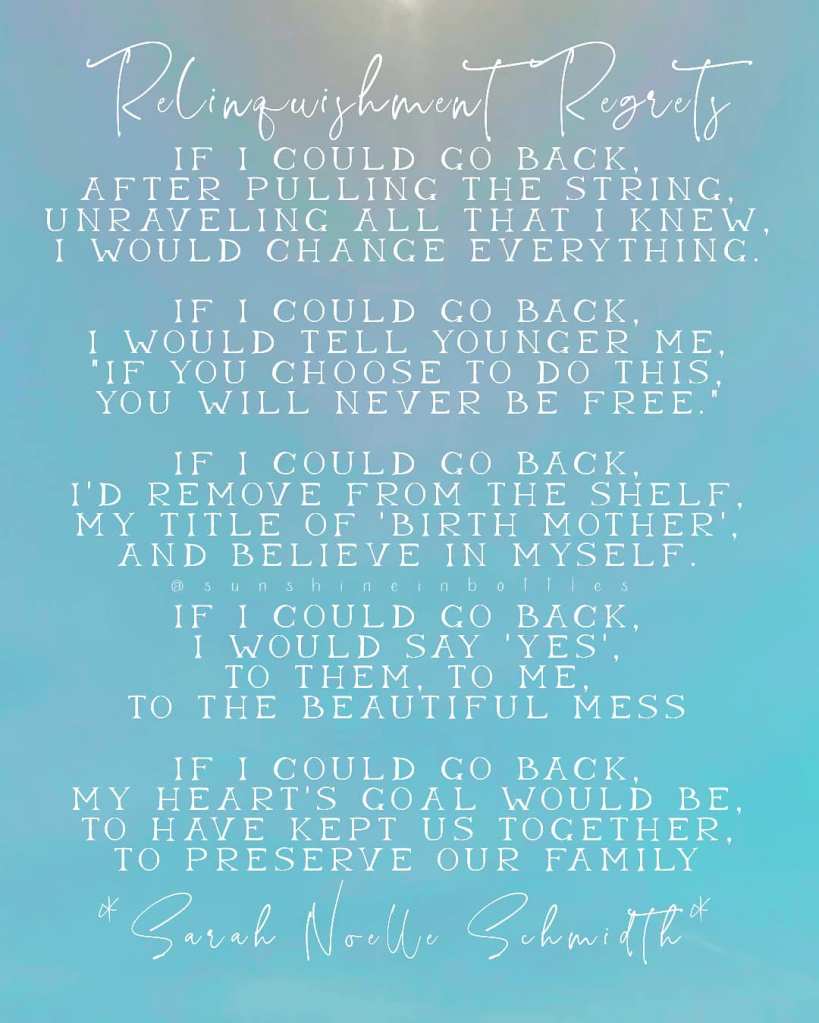
Relinquishment Regrets

Written by a mother who knows. She says of the above poem – I wrote this yesterday and thought there might be some other first/natural/birth/mothers of relinquishment moms who feel the same.

I am coming up on 22 years since my first relinquishment (I placed twice, nineteen months apart, with the same couple, who are now divorced) and the things I would change, if I could go back with all I now know about the billion dollar industry of adoption and how it uses and spits out so many mothers and adoptees, just keeps piling up and adding on with the more I learn about what I participated in, twice, all those years ago.

Another woman with the same experience writes – I feel this so SOOO hard. I’ve been struggling with being stuck with this regret for years now. My son is 20. I’ve never spent time in regrets before this one because we wouldn’t be who we are without the experiences we’ve had and choices we’ve made. And right now, I love my life – and I can literally trace the steps and KNOW that if I had parented, I would definitely not be here. But it doesn’t matter. I would give anything to change it. To not be that woman who was scared and unsupported, who didn’t know everything I should have known about adoptee trauma, and who believed there was another mother out there who was better for my own son than I was.

An Inconvenient Truth

Most IVF efforts fail.

Sharing some thoughts from an article in The Guardian – LINK>Not being able to have a baby was devastating – then I found people who embraced a childfree life by Helen Pidd. Adoptees in my all things adoption community often suggest that couples struggling with infertility accept remaining childless rather than adopting someone else’s baby and inflicting trauma on that child.

The author writes that her three rounds of IVF produced 24 eggs and six decent embryos, none of which resulted in a baby. Therefore, they decided to stop trying. Not everyone seemed to respect their decision. Imagining they were being helpful, they would share stories about their friends who had succeeded on the seventh try or had gone down the egg-donation route. 

She tells the story of Mia and Laura, who are married but had decided early on not to have children – they just didn’t feel that children were the key to a meaningful and worthwhile existence and didn’t fancy the day-to-day drudgery of parenting. There’s a freedom that comes from opting out of motherhood before you hit your 30s. She notes – “Having children is a good way of not having to think about what you really want from your life. Without children, you are responsible for your own destiny.”

She describes why she started to seek out others without children. For one, she preferred the optimism of the childfree-by-choice community over the grief of those suffering from their infertility. Sometimes, there is a distinction defined, between the childfree and people coping with infertility, referring to them to as “childless”. Adding “less” to most words makes them negative: hopeless, meaningless, useless. She came to understand that she personally preferred “childfree”, because she did not want to be defined by what she didn’t have.

There is actually a community for such people – LINK>”We Are Childfree.” They are a community-supported storytelling project that celebrates childfree people, explores their experiences, and dispels the myths the world holds about childfree people. They offer a global community for anyone embracing a childfree life, whether by choice, by circumstance, or for those who are just curious. Through their efforts, they are committed to fighting stereotypes and strict gender roles; creating a world in which everyone enjoys equality, bodily autonomy, and is empowered to make their own choices, to live authentically. We Are Childfree began in 2017 as a photographic project to celebrate women who had chosen not to be mothers.

It is really medicine for the soul to know it’s OK. To accept that one’s life is supposed to go this different way. They celebrate with the first names of four childfree legends: “Jen & Betty & Dolly & Oprah” – Jennifer Aniston, Betty White, Dolly Parton and Oprah Winfrey. It is true that only those who have tried IVF and still failed to have children can honestly understand how those who have feel or think. 

Even so, all the evidence suggests that as women become better educated and financially independent, they choose to have fewer children. What feels new is that women are now talking about this decision and refusing to apologize or be pitied for it. One comedian famously is very deliberate. Chelsea Handler rejects the idea that if you don’t have children you have to use all of your extra free time productively.

Ruby Warrington, author of Women Without Kids, wonders, “What if more women having more time, energy and other resources at our disposal means more women leaders in business, politics, and the arts?” It could potentially lead to a more restorative, collaborative way of running the world. On this Earth Day, 2023, it is worth considering.

It Will Take A Lot

I often wonder if I will ever run out of things related to adoption to write about here but everyday I seem to find something and so, until I can’t seem to do that anymore, I suppose I’ll persist. Today’s inspiration comes from this admission from an adoptive mother –

After adopting our daughter and experiencing some pretty clear effects of her being separated from her mom, I have changed my mindset on adoption. While I know realistically that there will always be a need of some sort for a program to care for relinquished children, I don’t believe in the current system and think it needs a complete overhaul.

She admits – I did not do enough research before we went through the process and relied too heavily on the agency to provide me information. Now I realize their bias, pursuit of financial gain, etc. I did everything wrong – did a gender reveal, had a baby shower, did a GoFundMe, ick ick ick. After placement, I could just FEEL that my baby needed more than I was giving.

I also know that a woman who is struggling with fertility issues that desperately wants to start a family is going to be mighty difficult to dissuade – the flood of savior stories and toxic positivity that is shoved in hopeful adoptive parents’ faces is overwhelming. And despite all of the very valid points that have been made by those who know repeatedly, it will take a lot of education and dedication to overcome the propaganda and the emotional response a woman experiences in order to make a decision that is best for the child and not for her own desires.

So what to share with a woman who is struggling with fertility issues, who desperately wants to start a family ? I often see the very first suggestion is therapy to reconcile her infertility issues and realize that adoption is never a replacement for a natural born child.

Read The Primal Wound by Nancy Newton Verrier. I have read it myself and I still see it turn up recommended as the very best possible perspective into adoption trauma from a woman who is both an adoptive and a biological mother as well as a therapist to adoptees and their families. She has tons of insight about all of it.

It is very important to listen to adoptee voices. Here is an analogy – We would never do open heart surgery without an expert surgeon who performs that surgery every day. While a patient (adoptive parent) is part of that process, they are not the ones (adoptees) who know what it feels like to walk in those shoes. A hopeful adoptive parent is inherently biased against hearing any truth about the pitfalls of adoption. They often only listen to the voices of other adoptive parents who have benefitted from adopting. You will rarely hear these discussing the risks, only the positive aspects of adopting a child into their life.

It is important to explain what a for profit enterprise adoption is. The coercion of birth mothers, our society’s lack of focus on family preservation, the option of being a foster parent who strives for family reunification over fostering simply to adopt, explain the guardianship option, share the loss of identity and anything else that a mature adoptee knows about it all.

Remaining connected to those genetic mirrors that the child’s original family is of vital importance. There is occasionally a need for long term care, when the parents could not or would not parent their child(ren), and the extended family members were unwilling or unable to be a placement resource for those children. Adoption is much more nuanced than most people realize and many adoptees feel negatively about their adoptions. Many who choose to be foster parents are actually trying to help and actively trying to support families in crisis to reunify. That said, the training and support is abysmal. 

Passing On One’s Genes

I distinctly remember when my husband first told me he wanted children. I came by today’s blog in a round-about way looking at infertility and narcissism (and see one of my own blogs showing up in a google search, oh my). Yet then I found this – I believe there is no good reason – other than vanity and narcissism – that an infertile couple should opt for IVF over adoption. Please CMV. (Change my view) by LINK> Javier Mosquera at Penn State.

This got my attention as both the choice to pursue IVF and issues of adoption matter to me. We briefly considered adoption and quickly ruled it out. Over 20 years ago, I didn’t know everything about adoption that I know today. I am very glad we didn’t go that route. But for the grace . . .

So Javier writes, “Today’s topic for my Passion Blog post comes from the subreddit LINK>‘changemyview.’ The complete prompt can be found there” at the link. Javier notes that “I will be following the subreddit’s Submission Rules for comments, to keep order and structure to my posts.”

[1] We live in a world where there are orphans in need of adoption to loving homes, and where loving couples cannot naturally conceive.

While this is true, it makes the assumption that the couples unable to conceive would provide the same love and support that parents of a functional home (whose first choice was adoption) could provide. Why risk letting a couple who obviously wanted their own offspring in the first place (and pursued adoption only after being unable to conceive) adopt a child who already may feel unwanted, only to continue the cycle? Such a child may grow up to harbor serious emotional problems, and live an unhappy life. Adoption should be left for those who genuinely want it, rather than for those who feel discouraged due to infertility.

[2] IVF is insanely expensive. And why force nature’s hand when there are simpler alternatives? And from what I understand, it’s not a 100% guarantee it would even work on top of that.

[3] Studies have shown that couples love their adopted child the same as their own “flesh-and-blood” child. Adoption even exists in the animal kingdom among some species. So I don’t buy the “but some people want to have ‘their own flesh and blood child’” argument, because all I hear from that is that you’re incredibly vain.

Here I will challenge two of your points, and while l concede with you, you must remember that it is our biological desire to put our DNA back into the gene pool. This is a product of evolution, with the purpose of keeping the human population alive. People want their own offspring, and furthermore, by doing so it is the best guarantee of leaving a contribution to mankind. Releasing one’s genes back into the playing field directly affects future generations. Indirectly, you may have gifted the world with the next Thomas Jefferson or Socrates. Your argument regarding expense would be valid for low-income families, but if one has the money, I don’t see any problem with someone attempting to pursue fostering children that has their own genetic code.

My young sons, maybe about the same age as Javier, are fans of Reddit (I don’t go there). My oldest who is now 21 claims he is never going to have children. I’m certainly not going to argue that with him. Though recently we did point out that my husband was 35 before he decided that he did want to have children after all. This is because my son is encouraging us to get rid of all this “kid stuff” that we have been saving for the day when our sons have children of their own. This son has always known from a very young age, his own mind, and has not been wrong any time he as asserted anything so important. I have to take him at his word.

I’m Okay But

“I still think if I was given the choice to be aborted or grow up adopted, I’d choose abortion.” Those are the words of one adoptee.

The pain of having to live under the lies of adoption was just so great that never being born still seems like the better option. I loved my parents. I am forever grateful for the care and love they gave me with the best of intention. I knew they loved me but I knew they were also lying to me and that confused me. I’m grateful to be alive today but it’s not always been that way.

Now I know the TRUTH and I’m free to be me. And I think it’s marvelous. I just might be a superhero and neurodiversity is my superpower. Level up????

Many adoptees, but not all of course, feel the same way . . . Don’t believe it. Overturning Roe v Wade and creating more babies for hopeful adoptive parents will shatter the lives of those adoptees by the trauma they experience in the process.

Reversal

Sadie & Jarvis, with Godparents, Kennedy & Brandon and kids

I have written before about the special challenges that adoptees of a different race face when placed with a different race of adoptive parents. In the past, this has usually meant Black and Asian children placed with white adoptive parents. In a somewhat recent development, Black couples are adopting white children as shown in my photo above. I was made aware of this couple today.

For most of my life, I really did not have much of a racial identity. True, my skin was unmistakably white. I grew up on the border with Mexico and so my environmental was predominantly Hispanic. My parents were both adoptees with no more than a minimal knowledge of who they might have been before adoption. I used to say I was an Albino African because really I couldn’t prove otherwise and neither could anyone else. I honestly suspected 25% Black, 25% Hispanic and the rest White for much of my adulthood. Now that I know something that my parents never knew – something about the people who conceived my parents and gave their genetic heritage to us all – I know that I have 25% Danish, a lot of Scottish and Irish, quite a bit English. These are the real realities and it is a gift I never expected for over 60 years of my life to receive. Yeah, it matters.

This story has an interesting twist. After agreeing to foster a newborn, actually premature, baby boy they named Ezra. After agreeing to foster, the birth parents deciding to surrender their son to this couple for adoption. Next, the Sampsons chose a new and somewhat surprising path that I am also familiar with – embryo donation. This allowed Sadie to experience pregnancy. Their twin daughters were named Journee and Destinee and they are also white. Their family motto has become, “Families don’t have to match.” 

Because I am familiar with reproductive medicine, I know the difficult next stage – what to do with leftover embryos ? We allowed ours to be adopted. It was all arranged online independently but the couple did hire a lawyer. I never questioned their race nor did the thought cross my mind. Clearly, it was not a predominant concern of my own at the time. Sadly for that couple, the process did not result in a pregnancy and live birth.

White supremacists worry a lot about the dilution of the white race. It is a fact of modern life that the races are mixing. Interracial marriage, the children born to such unions and adoption are all – let us hope – leading to a better understanding that human beings are more alike than different. That peace and harmony on this planet may be the eventual result. The only real question remaining is the issue of adoptee trauma and that many donor conceived persons also have issues with how they were conceived. It is a tricky path to walk but some brave souls are stepping out ahead of the rest of society. With a better understanding of psychological impacts, it may be possible to avoid some of the worst of the worst outcomes. I do hope over time that proves true.

Finding Empathy

Gabrielle Union, daughter Kaavia
and husband Dwayne Wade

I will admit that I have become generally against surrogacy as part of my own journey to understand adoption as it has manifested in my own family. However, in reading Gabrielle Union’s beautifully written essay in Time magazine – Hard Truths – I ended up feeling a definite empathy for her situation and believe the outcome to have been perfect for the situation.

Within my spiritual philosophy it is believed, as also is stated in Hindu Scripture, that “Mind, being impelled by a desire to create, performs the work of creation by giving form to Itself.” Some of my ability to empathize may have also arisen from experiencing secondary infertility in attempting to conceive my oldest son. I believe that Assisted Reproduction is a knowledge granted to man by Mind and so, many children are today being created using these medical techniques. This is a fact of modern life.

Gabrielle suffers from adenomyosis in which endometrial tissue exists within and grows into the uterine wall. Adenomyosis occurs most often late in the childbearing years. So in reading the Time magazine article I found poignant her experience of multiple miscarriages and various medical interventions in her many attempts to conceive. Many women then turn to adoption and it is often noted that the infertility itself must be dealt with in therapy before even considering adoption because an adopted child will never be that child you would have conceived and carried through a pregnancy to birth.

My objection to surrogacy is my awareness of how the developing fetus begins bonding with the gestational mother during pregnancy. Gabrielle writes of her awareness of this disconnect with clarity – “the question lingers in my mind: I will always wonder if Kaav would love me more if I had carried her. Would our bond be even tighter? I will never know . . .” She goes on to admit that when she met her daughter, they met “as strangers, the sound of my voice and my heartbeat foreign to her. It’s a pain that has dimmed but remains present in my fears that I was not, and never will be, enough.” She ends her essay with “If I am telling the fullness of our stories, of our three lives together, I must tell the truths I live with.” It seems healthy and realistic to my own understandings.

As the mother of donor conceived sons, I can understand the complex feelings. I can remember distinctly feeling less entitlement to my sons than my husband since it was his sperm that created them. I am also aware of adoptee trauma from that separation from their natural mother. Both of my parents were with their natural mothers for some months before they were surrendered for adoption. I think I see this issue in a couple of photos I have managed to obtain from their early years.

My mom held by a nurse from the orphanage she had been left in for “temporary care,” while my grandmother tried to get on her feet. My mom appears to be looking at
her mother in this photo.
I notice this expression on my baby dad’s face.
I wonder if my grandmother was there and was
he puzzling about her presence ? I can’t know
but it has caused me to ponder.

I will add that Union’s surrogate was of a different race. Another issue with surrogates is that they often become emotionally attached to the baby growing in them. Gabrielle describes her surrogate and the surrogate’s husband as “free spirit” people. She says at the time she met her surrogate in person, “The first thing I noticed was a nose ring. Oh, I thought, she’s a cool-ass white girl.” The surrogate wasn’t bothered at all – there was an excitement to her voice when she said, “This is such a trip. I have your book on hold at four different libraries.” She must have been referring to Gabrielle’s first collection of essays, We’re Going to Need More Wine, which sparked powerful conversations by examining topics such as power, color, gender, feminism, and fame through her stories.

Carrie Thornton, Dey Street’s (the publisher) VP and Editorial Director says of the new book, You Got Anything Stronger?, that it is “a book that tugs at the heart, feels relatable, and . . . you see her for exactly who she is. . . ” I would agree having read this story.

I Admit I Am Old School

This not the first time it has come up. I am doing my best to recognize changing norms and find a good level of acceptance within my self. For one thing, among those changing norms is a recognition of the trauma that every adoptee experiences. Another is same sex couples and the frequent desire of these couples to go beyond marriage to parenting. There I do struggle with having grown up with a certain kind of mindset that believes optimal for children growing up is having both a male and female role model. I am also realistic enough to know that isn’t always possible. We have several single mothers in my mom’s group. Some chose to enter into pregnancy without a male partner and some became widows after their children were born. In both cases the children do seem to be thriving and I am a witness to that fact.

Today the question was asked in my all things adoption group – What are your thoughts about the Buttigieg’s impending adoption? I didn’t know about it until I saw that. So I went looking and see that this male same sex couple is at least enlightened enough to have been seeking “a baby who had been abandoned or surrendered at short notice”. Yet, we are talking about an infant it would appear. I once had a discussion with a friend who was good friends with a male same sex couple who was raising a little girl who they had via a surrogate. I expressed my reservations about that situation honestly. I have less concern about a female same sex couple where one contributes the egg and the other carries the pregnancy. There is still the issue of the child being donor conceived and how some sperm donors have fathered a multitude of genetically related children.

I am glad my boys have their father as a male role model. I am glad they have me as a female role model. There are a lot of gender issues in our modern society. There is toxic male culture but my boys are home schooled so they aren’t exposed to very much of that in their daily life. It’s enough that they have witnessed me have to push back on some of that at home. Thankfully, my husband is for the most part respectful, appreciative and considerate of me. With over 30 years of marriage completed, there are bound to be moments that aren’t sterling.

In these days of gender equality, marriage equality and equal employment opportunities, it might seem odd to even contemplate discussing the topic of a male parent versus a female parent. Undoubtedly many well-adjusted children are raised in single gender families making the equality of parenting question seem out-dated and narrow-minded. I do understand this.

However, there are a number of ‘experts’ who agree that the influence of both a female and a male are vital for proper child development. This diversity give the child a broader, richer experience of interactions. I found an article that shares the perspectives of Dr Kyle Pruett of Yale Medical School who notes that females and males parent very differently.

If you are at all interested, you can read about his perspectives in this article – Do Children Need a Male and Female Parent? “Need” is probably too strong a concept given the realities. I would say in a perfect world . . . but this isn’t . . . is it ? So adoptions still continue to happen today. They probably always will but reforms in the practice are still possible and adoptees are leading the charge to make reforms possible – keeping genetic and identity information intact – even after an adoption.

Strong male/female influences can be created through other family members such as an aunt or uncle, grandfather or grandmother. In an imperfect world this is a reasonable alternative method of supplying male or female role models in single sex households.