It Happens

It is surprising how often this happens and it is never intended but . . .

First the question, then the answers –

So a couple adopts a child because they believe they will never be able to have a biological, genetic child. Then, surprise – the adoptive parents actually discover they have conceived. What effects do their having an adopted and then a biological child have on that first child who was adopted ? Question for adoptees, is there anything that your adoptive parents could have done to make it better for you ? Is there anything they did specifically that was harmful to you in relation to the new sibling ?

Responses –

[1] The short one – I have two brothers that are biological to my adoptive parents. This effects me everyday. I ask birth mom, why me ? I wonder what might have changed her so that she could have been a better mother to me ?

[2] The longer, more detailed perspective – Stop pretending biological and non-biological children are the same. Educate yourselves and take the burden off the child. I was adopted as an infant. My adoptive mother became pregnant 5 months after my adoption was finalized. My “sister” was always the much preferred, longed-for first choice. With her birth, I was superseded. I will admit that I was “a difficult child” (due to an un-recognized infant trauma. My “sister” was easy (with her natural parent/child connection). I grew up with a front row seat view of what a healthy, biological connection looks like. The way human evolution intended it to be.

What my adoptive parents did do right was treat us outwardly and monetarily the same. We both had the same opportunities and resources. What was chronically neglected were my unseen needs, which were instead passed off as troublesome personality traits. So, although my adoptive parents KNEW I had “problems,” they did nothing to address those. What I wish they had done is what they would have done if their biological daughter was chronically ill: move heaven and earth to help her and thoroughly educate themselves on her issues.

I wish they had understood the different needs of a non-biological child and not burden themselves with the expectation I would ‘heal’ simply through therapy, while they themselves did nothing. Instead I wish they would have proactively learned how to be effective, gentle, therapeutic caregivers to a child living with early grief and loss among genetic strangers. I wish they would have gone the extra mile for me that my “sister” did not need from them.

I Am Now My Own Parent

My Dad and Mom

I’ve told some version of this story before and can’t promise I won’t again, though with evolving perspectives, these likely do change over time. My dad died only 4 months after my mom. She died first in September 2015 and he followed in February 2016. It was a profound event in my own life as I am certain it is in many lives. After my dad died, my youngest sister said, “We are now orphans.” I remain estranged from her. The cruelty she expresses towards me when we are in contact with one another causes me not to want to be involved with her. Not long ago, the state of Missouri informed me that they held some abandoned asset of my mom’s and I jumped through hoops and ended up with a whopping check for $20. Because I needed to provide my sisters names and addresses, so they could receive their own shares, I contacted my youngest sister’s conservator, who had been appointed to manage her funds. Turns out, he has been free of her for 2-1/2 years and no longer has that responsibility. The judge turned him loose and I understand. My sister is difficult and uncooperative and so, she is on her own now. So be it. I never wanted to take her freedom away from her. It was her own lawyers and the need for a family member to ask the court to look at her circumstances that forced my own involvement.

The topic today was inspired by a Daily Guide for Sunday, July 10 2022 in the Science of Mind magazine written by Rev Dr Jim Lockard. That phrase that is my title today comes from an affirmation he put at the end of his essay. He mentions that some people have never known their family of origin. That was certainly true for BOTH of my parents – as each of them was adopted and they died knowing next to nothing about their origins. I was conceived out of wedlock by a teenage mom. I could have so easily been given up for adoption but thankfully, I was not. It seems that one of my purposes in this life was to reconnect the threads of my parents own origins and I have now made it as far as is necessary for my own peace of mind. I know who all 4 genetic grandparents were, something of their stories and am aware of quite a few living, genetic relatives now that I am in contact with.

After my mom died, I came into contact again with an aunt. She is the widowed wife of my dad’s brother (my uncle was also adopted). A profound experience for me in high school was witnessing my uncle’s slow decline from Lou Gehrig’s disease. She is a nurse who met him when he was a Marine and hospitalized due to an auto accident. I had been thinking about this aunt for several days. It seems we do have a “spiritual heart connection” and so, she had been thinking about me and called me recently. It has been true since my mom died that she still calls me to check in from time to time – mostly to hear the latest for me and adds a few insights into her own life. Mostly, she just listens. I find her easy to talk to, honestly, though she is much more conventionally religious than I am. She usually asks about my sisters and how are they doing. She used to tell me she was praying for my estranged sister and I but she no longer tries to reach me that way. She had only one child with my uncle and he died a few years ago, too young and somewhat unexpectedly. She lives with an elderly sibling and that sibling’s spouse. My aunt is now 90 years old and I never know how much longer she will be in my life but she is totally lucid and I am always happy to hear from her.

Mine is a strange reality to live. Learning who my genetic relatives were and are, has to some extent, distanced me from the ones I grew up with. Even so, I remain fond of the adoptive grandparents I grew up with (now deceased) and with the aunt just mentioned and one other (my dad’s step-sister, who he acquired when his adoptive mother remarried after a divorce). My mom also had a brother who was adopted through the Tennessee Children’s Home before her. I am not all that close to him but did see him at my mom’s memorial service. It was his daughter’s receipt of his adoption file that had her call to tell me – I could get my mom’s. That opened the door for me to become genetically whole again and fulfill an intended life purpose.

Basic Human Rights

I bought a t-shirt today that reads “Girls Just Want To Have Fun-damental Human Rights.” In fact, if Roe v Wade is overturned, a lot of the basic moral, just, ethical and fair “rights” we take for granted in human society today that actually at NOT codified in the Constitution will also come under threat by the same logic the conservative justices on the Supreme Court are using in this very polarizing issue.

It caused me to think about how adoptees are treated – no right to know who the parents that conceived them were, no right to their original birth name or original birth certificate, no right to the records associated with the decision to allow them to be adopted and which they never consented to. No right to their personal medical history information. Adoptees are treated like second class citizens.

The rights of Black people, the rights of women generally, the rights of those who identify as LGBTQ – all is under threat now . . . My husband recommended an article to me in The Guardian today. I will read it as soon as I have a few minutes. It is by Laurence Tribe. The subtitle reads – If the high court adopts Alito’s draft opinion, it will be a legal tidal wave that sweeps away a swath of rights unlike anything America has ever seen.

Comparing Animals to Human Adoption

Today’s personal (not me) story –

I saw a post recently about rescue animals and wanted to get more clarification on it. I am an adoptee. I “rescued” my dog. I also work in vet med. I want to know why we are comparing animals to people? Yes it is very triggering when adoption land treats former foster care youths and adoptees like animals. Humans should NOT be treated like animals. Human babies should NEVER be part of or used for profit from our government or private agencies. Human adoption is WRONG. Comparing animals to the human adoption industry is weird. We can acknowledge that the similarity is someone profits off it. My personal experience with breeders many times has been horrifying, because those animals are viewed as money, not real living beings. Here is a pic of my boy Gus. He was literally starving on the streets covered in urine and fleas when he was picked up.

Gus

I have also seen that today is National Rescue Dog Day.

Who Even Am I Anymore

A journal for processing various experiences for adoptees including late discovery, to donor conceived, and for those who discover a non-parental event and misattributed paternal event.

Between 6 and 10 percent of people who order mail-in DNA kits are shocked to discover Misattributed Parentage. Others may learn the truth without saliva; their lives are turned upside down by unexpected phone calls, social media messages, or files left behind by an older generation.

The effects of a DNA-Discovery can be life altering and identity shattering. Without a precedent for this brand new global phenomenon, the world is scrambling to catch up, finding itself short on resources to address this kind of trauma.

Who Even Am I Anymore is the first process journal of its kind, specifically designed for a community of people that grows larger each year. Eve Sturges used her experience as an NPE, a licensed psychotherapist, and host of the podcast Everything’s Relative to craft thoughtful questions for this uniquely existential journey. Designed to be used by individuals or in groups, with a therapist or without, this resource offers itself as a compass to those who find themselves unexpectedly lost at sea.

One reviewer writes –
I am a Late Discovery Adoptee and experienced years later via DNA test that my biological dad was not my biological dad. Eve asks just the right questions. I loved these writing prompts. They give me the opportunity to reflect, write it all out and heal from the act of writing.

Another one writes –
As an NPE (non-parental event) it truly helped me to get through and process the feelings from the trauma of finding out my dad isn’t my dad.

You can learn more about Eve Sturges at her website.

To Stop Transgenerational Trauma?

Another adoptee shared – a former therapist of mine was adopted (her and a twin brother went to the same family in a domestic infant adoption). She’s also a pastor’s wife. She threw ALL my adoption trauma out the window and basically gave me both this same speech about me getting to skip generational trauma from my biological dad’s family and also that it was all God’s plan. I saw her twice and ghosted her. She also told me I didn’t have Bi-Polar Disorder after I was diagnosed in an actual hospital setting, and after only speaking to me twice for about 40 minutes each time. I swear Christian therapists are insane.

Another one admitted about the therapist that she just said the quiet part out loud inappropriately. The kids that are removed for abuse and similar are adopted out because they’re trying to save the kid and stop the cycle. Honestly a lot of kids DO end up better off, BUT of course there’s the trauma. I feel like an orphan no matter my adoptive or biological connections in adulthood. But that pain had me vowing to give my son a better life. And while I wouldn’t say I’ve succeeded at that (married an abuser, we also had to escape) the hope is because I’ve tried to stop and break the generational cycle that he’ll do better than I ever was or could be able to.

Another one said – Separation trauma from adoption IS generational. We can pass to our kids and screw them up and all they did was have a parent that got adopted. So adoption continues generational trauma. Tell that idiot therapist to research epigenetics and then find a new one.

I do believe it IS passed down. Both of my parents were adopted. Myself and my sisters certainly had issues within our own parenting that I do believe is directly related. Thankfully, our children do seem to be breaking those trauma cycles in their own lives.

Poetry For April

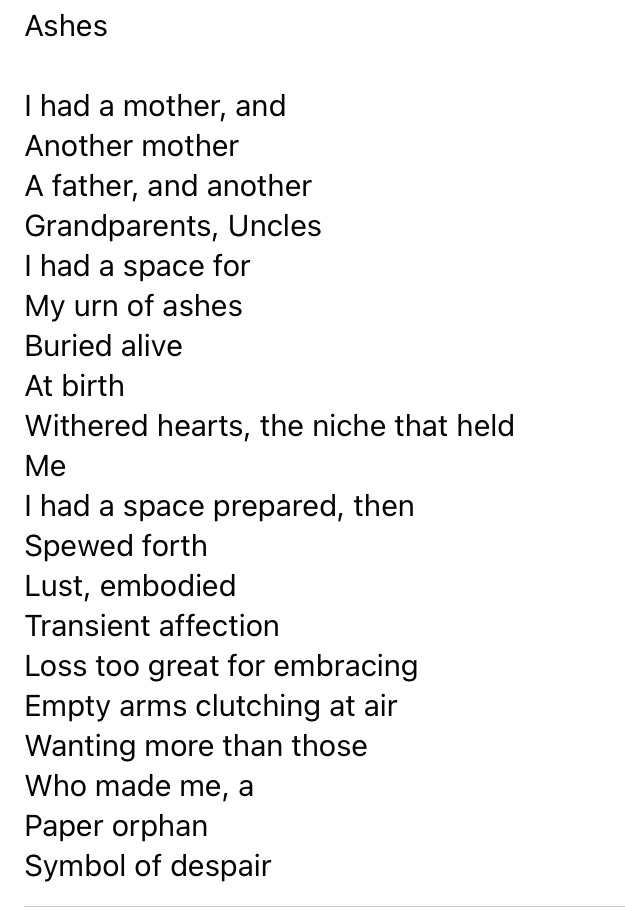
April is poetry month. My friend, Ande Stanley (a late discovery adoptee) wrote a poem for her The Adoption Files WordPress blog that I think a lot of adoptees could relate to, and so I share.

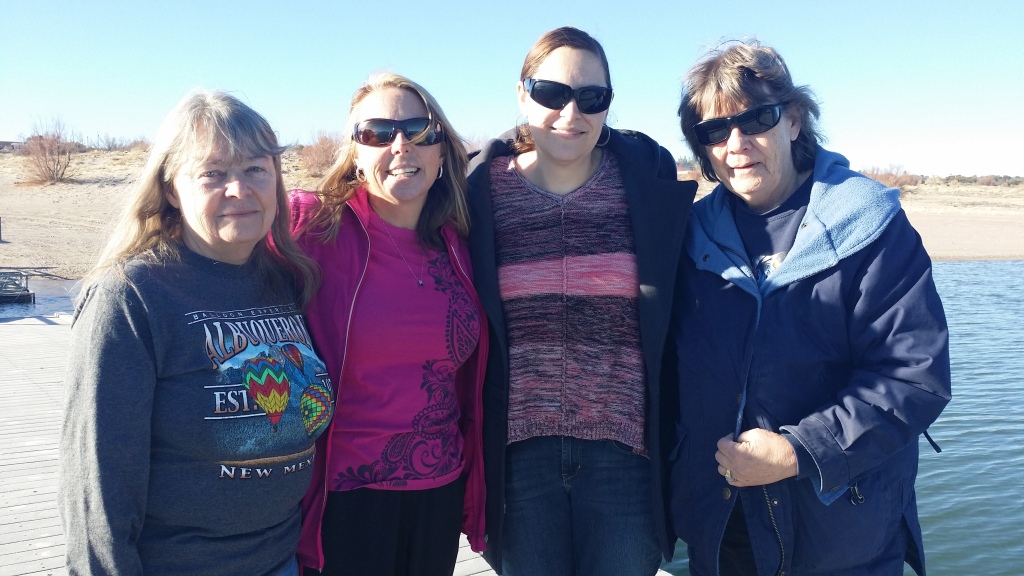
My parents (both adoptees) wanted their ashes scattered on Elephant Butte Lake in New Mexico. We had to be careful because it is not recommended. Most likely against the law. The first time, my daughter and I went out with my dad to scatter my mom’s ashes. That was a wild and crazy ride for both of us in his boat with my dad !!

When my dad died only 4 months later, my aunt (my dad’s half sister by his second adoptive father), my middle sister and her daughter, as well as me and my daughter went to scatter his ashes also on the lake, as that was his wish, but we did not take my dad’s boat out that time. We just stood on a dock near their last residence. Some official came along because we didn’t have a permit to take our car into lake property (it is a state park). My sister was hiding the cremation box under her jacket. LOL We did get the deed done. My aunt took the photo below. Maybe I should not go into the story of how the crematorium stole my parents rings . . . always make certain you get them back is all I can say.

Feb 9 2016, Ash Day

Erasing The Mother’s Name

I was reading an article this morning in Time Magazine (the March 14/March 21 2022 issue) by Aubrey Hirsch titled “Why my children have their mom’s last name.” She describes all of the complications this has raised in their family’s lives. When I conceived my oldest son, my husband strongly wanted my name added to our son’s names and so both of my son’s have my maiden name as their middle names (which in this patrilineal society causes us not the confusion this woman and her husband’s choice has caused). What is a bit strange in our case is that both of my parent’s were adopted and so my maiden name links us not at all in genealogical terms to my family. Even trying to concoct an honest family tree at Ancestry is going to be a challenge (one that I only started but still need to complete).

My dad was given his mother’s maiden name as a surname because she was unwed at the time she gave birth and even though she knew full well who his father was (as I have since discovered in my own adoption story journey and am grateful for the breadcrumbs to my paternal grandfather’s identity that she left me) she did not name him on my dad’s original birth certificate and of course, because he was adopted, his birth certificate has the names of his adoptive parents. And because his adoptive mother later divorced the first adoptive father and remarried, my dad was adopted twice and his birth certificate as well as his first name was changed twice. It was all very patrilineal because his “new” (one could say he spent his entire life as many adoptees do living under an assumed identity) first name was the name of the adoptive father each time as well as the surname for each of these adoptive fathers. I can imagine what this might have felt like to his 8 year old self when the second one occurred.

The woman who wrote that personal essay for Time magazine laments how she has been pushing back against her children having her last name and not the father’s since they were born. Is it true that babies must take their father’s last name ? Well only if the mother identifies who the father was, I suppose, in most circumstances. Studies have shown that 95% of the time, heterosexual married couples give the baby the father’s name.

Ms Hirsch makes a good argument for her choice, she says – women do the hard work of pregnancy and childbirth. They also do the vast majority of the actual parenting (generally about twice as much). And she also points to the circumstances caused by the coronavirus pandemic 80% of US adults who were not working were women who were caring for children not in formal school or day care.

I agree also that our society simply does not support mothers and their children enough. Note that any attempt to pass more social supports for working parents, like paid family and medical leave, subsidized day care, and universal preschool, have stalled. It is mothers who will be shouldering the bulk of these burdens, forced to give up their jobs along with their names. And it is the male dominated society we live in that is mostly to blame. In general, women are not valued as highly as men, only make about 75% as much in the same jobs in most cases.

The issue of names shown on birth certificates is one that most adoptees are very sensitive to for understandable reasons. Even so, this woman bucked the tradition. She is proud of her family heritage and it is true that marriage erases the family connection for women 95% of the time (though some women today do keep their maiden names in marriage or hyphenate them). For this woman, her family name will be part of her genealogy and not erased as most women’s connections to the family of their birth are.

Being Understood

When faced with complex feelings related to complicated situations, people with no experience with that reality will try to throw in a feel good positive but that does not indicate that they really understood how this experience has affected you.

A woman in my all things adoption group received this response from a friend and she acknowledges – My friend means well but they really don’t grasp how adoption IS trauma. This is my main support person. The only person who is there when no one else is and to have such a huge disconnect cuts deep. They are very accepting that everything is just the way it is and not allowing trauma to define your life. Which at times is super helpful – yet right now I’m hurting and on this subject it doesn’t actually work.

She goes on to explain – Saying that it “Wasn’t that bad” or complimenting me by saying “as amazing as you are” does not help. Was adoption not that bad because it shaped me into who I am ? Or is it that who I am is that resilient that I make being adopted seem like adoption isn’t that bad ? See I can’t have one thing without the other. I’m not allowed my identity without adoption being brought into it. I can’t be truly separated from my trauma, so that it wouldn’t define my life, which in turn makes me feel like a living breathing trauma in a skin suit. I’m like 2 people in one body that feels one story 2 different ways.

A birth mother can struggle in similar ways. One said – I am not an adoptee, but a birth mother and I relate so much to this situation. My dad and I are very close and any time I try to talk to him about my feelings regarding my birth daughter, he says things like “it could be so much worse than it is”. It would be so nice to have friends that genuinely understood.

One of my own reasons for writing this blog every day and sharing a diversity of situations and experiences is so that people without any adoption or foster care in their personal experience might understand these situations better and find a greater degree of empathy for an adoptee or birth mother, than these people usually encounter in their own everyday life.

Maud Lewis – Tragic Birthmother

I am attracted to tragic birthmother stories. That is what I feel that both of my biological genetic grandmothers were. So last night we watched the movie Maudie. It is the story of the Nova Scotia woman, Maud Lewis, who’s folk art which sold for nominal prices during her life and has skyrocketed into value since her death. I am attracted the her famous painting of the white cat with the sad face.

In the Hollywood romanticized version of her story, her husband Everett Lewis was not a social person and is known to have been was born at the “Poor Farm” in Marshalltown, Digby County. In the movie, he frequents an orphanage. It is unclear whether his mother was a resident or an employee at the Poor Farm, and nothing is known of his father. The movie depicts Maud and Everette Lewis as two misfits who found each other and married.

When Everett wants to have sex with Maud, is ostensibly there as his housekeeper but in living with him, there is only one bed in the house – his bed. She confesses to him that she once ended up pregnant, had a severely malformed baby who died and was buried while she was asleep. Later in the movie, her Aunt Ida who had partially taken care of Maud before she went to work for Everett but didn’t want to die with regrets, confesses that the baby was perfectly normal but that Maud’s brother Charles sold her to a rich couple because he did not believe Maud was capable of caring for her.

Later, Everett tracks down Maud’s daughter and takes her to see the girl but Maud only secretly looks at her hidden next to their car, outside of her house and isn’t willing to go to the girl. One gets the sense that she may have felt the daughter would reject her for her deformities, caused by juvenile rheumatoid arthritis (which was not treatable in the time period she was growing up). And that could be the true version – which is sad and tragic enough.

There is some dispute about the movie version compared to the actual true story and that would not be surprising as movies are meant to entertain. Everett is said to have been much worse towards Maud than the movie depicts him as being. The author, Lance Woolaver, visited Maud’s famously hand-decorated with her paintings house as a child and has been fascinated by her story all his life. He wrote a heavily researched 500 page book – Maud Lewis The Heart on the Door.

The book is described as a full-length biography including detailed accounts of her disabilities, due to a childhood battle with juvenile rheumatoid arthritis that twisted her hands and joints. Despite this deepening and painful affliction, she completed and sold thousands of bright pictures and Christmas cards from her little one-room house. Throughout her marriage to the illiterate fish peddler, she suffered from poverty and loneliness, yet triumphed over all with her brilliant, colorful and happy paintings. Everett Lewis was murdered after Maud’s death in 1970, on New Year’s Day of 1979 for his lockbox filled with money from sales of Maud’s pictures.

This author’s perspective on the tragedy of Maud Lewis as a birthmother was that as a young woman in Yarmouth, Maud fell in love with Emery Allen. Woolaver believes he was the love of Maud’s life. However, after she became pregnant, Allen abandoned her. He also believes there was no reconciliation between Maud and her daughter. Whether Maud believed the lie initially told her or not, it is said that she rejected her daughter, Catherine, when she reached out to know her mother saying that her child had been a boy who was born dead. A subsequent attempt by the daughter to contact her mother by letter also failed to bring them back together.

Catherine Dowley was born August 13, 1928 in Nova Scotia. She was not aware that she had been named for her mother, Maud Catherine Dowley. Later in life she did know that Maud was her original mother and that Mamie Crosby was her adoptive mother. Catherine’s visits to connect with Maud in Marshalltown upset Mamie, who like many adoptive mothers felt that she had been a loving and good mother to Catherine.

Catherine (with glasses) with her adoptive mother, Mamie Porter.

Catherine married Paul Muise in 1949 in Yarmouth county and several years after their marriage, they moved to Ontario. They were the parents of about 4 children. Catherine died before Lance Woolaver’s book was released.

Everett was know locally as a dirty old man who would take advantage of young women for sex. Maud may have known there was that aspect to him and sought to protect her daughter from predation. Just questions without answers such as those I have in my own parents’ adoption stories. Those that know have died with the answers I will never have.