A Need To Know

Today, I read this from an adoptive mother – my adoptive daughter wants to research her background with a DNA test. She wants to know her origins and research whatever comes up. We homeschool and she wants to do this as part of her schooling. She just turned 14, so the questions I have are:

(1) Which DNA company is best ?

(2) How do we handle the info she gets ? No one knows who her natural father is, including her natural mother.

I don’t know if it would name a dad. How would we handle that, since her natural mother doesn’t even know who he is ? The father certainly has no clue he created a child.

The adoption is closed. She doesn’t have contact with her natural mother but I do. Honestly, I’d let there be contact but my husband is against it.

This is something I’ve had experience with. Both of my parents were adoptees. Neither really knew anything about their origins. My mom tried to find out with Ancestry but other than some ethnicity information, it didn’t get her where I think her heart wanted to go. I didn’t even know that she had done this, until I did Ancestry simply because I never knew my ancestry. I used to joke I was an albino African because no one, including myself, could say otherwise. I thought my dad was at least half Hispanic. My mom did have a bit of Mali, probably because her ancestral line included slave owners. My dad was half Danish. Who knew their complexion could be so dark ?

I did make progress with both Ancestry and 23 and Me. It helped that I had some names to go by. I rarely pay much attention to either these days. 3rd and 4th cousins don’t mean much. Ancestry was helpful in putting together my ancestor’s family trees and looking at human migrations as well as employment history where noted. 23 and Me brought me into contact with my paternal grandmother’s family. My dad’s father doesn’t seem to have ever known about his son. There is still extensive family in Denmark. My DNA has helped me prove my legitimacy as a family member.

Today, I read this – “Your DNA matches are probably your relatives. But a DNA test only suggests a relationship exists.” That is as truthful as it gets and as informative. Without names, it is only a mystery to solve.

From another child of adoptees I read this (it also proved useful for my nephew in his own search and connected him with his true father – information my sister tried to hide from ALL of us) – We used Ancestry, 23&Me as well as Search Angels to find my grandparents. Ancestry was the best in terms of ethnicity and finding my grandmother’s side of the family. Search Angels used the Ancestry information to find grandfather’s information.

I highly recommend this tool for getting answers, but you also need to be prepared for a lot of information that will generate more questions, as well as open the door to biologically related family. This is a GOOD thing for your 14 year old but she also needs support at home while processing this information. If your husband is going to cause issues, I would bring her therapist in to be part of this journey. I’d also add some extra sessions where you can join and create a plan for how to support her.

This is such an important thing for her to do and you owe it to her to support her. Remove any barriers that will cause guilt, shame, frustration at home. It will bring you all closer. If your husband gets in the way, be ready for her to resent him (and possibly you) over time.

More Common Than Believed

I am often surprised to discover an adoption connection in someone I have known but did not know that about them. In discussing the weather, a friend casually commented – I was born in Virginia, my uncle arranged my adoption 2 months before my birth, my adoptive parents raised me in Chicago.

I replied – oh my !! I did not know this about you. Every day I write a blog about all things related to family separations – primarily adoptions. My parents were BOTH adoptees. My maternal grandmother was sent away to Virginia to give birth to my mom, when my maternal grandfather for whatever reason (and I have many ideas about it that can never be confirmed) left her in Memphis 4 months pregnant. She didn’t give my mom up in Virginia but brought her back with her to Memphis Tennessee. She tried to reach my grandfather who was in Arkansas (they were actually married) – there was a big flood going on in the Mississippi River at the time and I suspect that was part of whatever obstacles. I have met my cousin in my maternal grandfather’s line who does not feel he was the kind of man to not respond. Regardless, Georgia Tann (the baby stealing and selling woman) got ahold of my mom and she was transported by her adoptive mother to Nogales Arizona.

Adoption touches more lives than many people suspect.

PS – If you don’t know about LINK>Georgia Tann, there is a Wikipedia article that covers her generally and more than one book has centered on her.

Do Different Surnames Matter ?

Illustration by Barry Falls

Today’s quandary – I’m an adoptee, and my partner is also. I have reunited with my natural family and have a close healthy relationship with our adoptive parents. I have a seven year old son, who my boyfriend is looking to adopt, once we marry. My son has no relationship with his genetic dad (we had domestic violence issues in past and he legally has no visitation, haven’t seen him in 4 years) but I worry how my son would feel. I would never force this on him. We are pregnant and due in February. I worry deeply about my son feeling “left out” or “other” as he would have a different last name than the rest of us. I want it to be his decision on adoption, name, etc. He is very familiar with adoption as he has met our natural family, but again he is only seven. Legally on paper it would be much easier to have him under my partner, for health insurance and decision making reasons (recently he had an ICU stay due to breathing issues due to smoke from wildfires, also issues of getting him a passport, school meetings and involvement, etc) but I don’t plan on making that decision for him, as he hopes his father can get himself together to be able to be involved in his life again (as do I – knowing how it feels to be separated from biological parents, this has always been a goal of mine but the restrictions are purely for my son’s safety). Their reunification has always been a goal. Are there any other options for my boyfriend to assume legal guardianship or some kind of custody without severing the biological tie of my son with his father? His father is completely uninvolved by choice, as our protective order allows phone calls and such, and he just chooses to not engage. My son adores my boyfriend and they are very close. I just don’t want to put the weight of a decision like that on him, and I don’t want to choose it for him. I’m hoping there’s another answer.

In response, someone comments – My kids have different last names and I have a different last name than my husband. Everyone’s names are on the mailbox. I promise you that nobody actually cares, it’s your own insecurity about the situation. My husband is not my son’s father. You can easily get him on all the paperwork for your son’s school and doctors. If you are legally married, he can still be on your husband’s insurance without an adoption.

Another one adds – my oldest has my last name and my children with my husband have his. It’s a non issue. She never felt “left out” and why would she? From the age of 6 till adulthood, she’s only seen her biological father twice. My husband never “adopted” her, as it was unnecessary to care for and about her. She still has my last name (I hyphenated it when I married) and her sisters have their husband’s. Names don’t make a family.

More in this New York Times piece by Lisa Belkin LINK>Biological Siblings, Different Last Names.

We Were Once A Family

You probably remember the horrific story – In March of 2018, an SUV carrying two adults and six children drove off a cliff along Pacific Coast Highway. It was deemed a murder-suicide at the hands of Jennifer and Sarah Hart, a white lesbian couple who adopted the Black children from two families in Texas children on board.

The above and what follows are thanks to a story online by LINK>WBUR about Roxanna Asgarian, author of the book who’s cover is above. When the Houston reporter sought out the birth families of those children, she discovered a flawed and over-burdened child welfare system that routinely mistreats Black families. What started as a newspaper assignment turned into Asgarian’s new book.

The birth mother of three of the six children was battling drug addiction. Her children were cared for by their aunt and a father figure, who was not related to them. They were removed by Child Protective Services when the aunt asked their birth mother to babysit one day because she could not find any other childcare. The other three were removed from their birth family for reasons of supposed medical neglect. Actually, one of the children was bitten by ants at a birthday party. Their birth mother had not been able to find a ride for them to the hospital.

The adoptive mothers, the Harts, had been investigated multiple times for abuse and mistreatment. Even so, the children were never removed from their care, even when they displayed bruises and malnourishment. Asgarian says, “I knew immediately when I was let into the homes of the birth family of three of the kids that this was a child welfare story. It seemed increasingly clear as time went on that the systemic part of the story was being totally overlooked.”

You can read an excerpt of her book at the link above.

A Sad Reality

Though the date has past, it is still worth making a point about this because with inexpensive DNA testing and matching, it is happening more often now. An NPE, not parent expected, also sometimes MPE, misattributed parental experience, are terms applied to people who have learned that they are adopted after entering adulthood. It can also apply to people who learned that they are the product of donor conception, affairs, and/or rape.

One woman notes – Found my biological family. Unwanted by all…. I’m a product of date rape. The dirty secret…

From that comment, I learned today about LINK>RAINN (Rape, Abuse & Incest National Network) a national nonprofit support organization that can give people with these kinds of experience the resources they might need as a child conceived as a result of sexual assault. RAINN also carries out programs to prevent sexual violence, help survivors, and ensure that perpetrators are brought to justice.

Why Is It Different Here ?

How come infant adoption doesn’t exist in countries with social safety nets??

Because women don’t willingly give up babies without coercion and desperate circumstances.

The point above is that many countries outside the US have less than 200 adoptions annually…some only a handful. WHY?

  • Because they don’t allow it to be a multi billion dollar industry
  • It is NOT privatized
  • It is illegal to adopt on your own – no internet/friend matches
  • They have a social support system to help families stay together.

Some additional comments –

The social nets in the US need serious overhaul. I work in a hospital and some of the situations I’ve seen people in are heartbreaking, infuriating, sickening. It makes sense that countries with ACTUAL support see fewer broken families all around.

It was sad to see this one – I wish it was like this everywhere. I’m from Ukraine and it’s a sh*tshow – lots of kids abandoned, horrific dysfunction, zero support. It’s terrible.

Safety nets include but are not limited to: proper science based sex ed, access to birth control of the patients choice, access to medical care, plus abortion accessibility. Access to housing and therapy. I have found a lot of people assume support is $$$ and while that is true to a degree, it is not the whole picture. Building community is the best thing we can do. To which someone else noted – but realistically money solves a ton of issues.

From an adoptee – Safety nets and social resources are so important. It is deeply disturbing that we pay so much lip service to “children are our greatest resource” and pretending that we are all about “family values,” but when push comes to shove, it’s really about greed and selfishness. We need to elect politicians who are more interested in people than money and power.

A transracial adoptee notes – I hate it when they try to make it seem like there are soooo many abandoned babies. Even if there is an expectant mom who wants to give birth (which how many pregnant people are truly willing to give birth, especially in a country with a high mortality rate, to just relinquish the baby) but does not want to parent (as in they have the ability/support/the means to parent but truly do not want to & wouldn’t/couldn’t abort), then what about the father? And if he really absolutely does not want to parent, do they really not have a single family member or honestly even close family friend who would take in the baby? Like the leap to having absolute strangers adopt the baby is just too much for me honestly. I frankly find it a bit hard to believe that there are so many situations where there are 2 capable expectant parents who simply don’t want parent and for not a single family member be capable/willing to take care of the child.

Another explains –  it’s the private adoption industry taking the foster care statistic of approximately 100,000 post-Termination of Parental Rights youth in this country, and just conveniently not mentioning that almost none of them are babies or toddlers. And then, if challenged, they will say ‘but this prevents them from ending up in foster care, aging out without a family,’ although I imagine that would not be relevant to the majority of parents who relinquish privately.

Which brought this recognition – I’ve actually found it incredibly bizarre how some very educated and intelligent people in my life, people who understand systems of oppression in regards to other demographics, a) don’t seem to get that no one gets pregnant to happily turn around and relinquish and b) refuse to understand that different age groups in the foster care system likely have different needs and require different approaches.

And this story from an expectant mother – I’m 42, expecting my 4th. My 1st, I was a single mother when her father left when she was 15 months old. I was a single mother for 10 years when I met my husband. But I thrived. I had a career, bought my own house, could afford a comfortable life. When I married, we had 2 boys over 8 years of marriage. My husband comes from a long line of mental illnesses, which he inherited. Both our boys are special needs, ASD among others. I’m in the middle of a long divorce as my husband is dragging it out and controlling it all as long as he can. I’m now a single mother for a second time. Eventually started casually seeing someone and got pregnant the second time we were together. He immediately jumped ship and was adamant he doesn’t want anything to do with it. Doesn’t want to be on the birth certificate. Nothing. This pregnancy will make me a single mother for essentially a 3rd time, at the age of 43. I am over being a single mother. I don’t want to do this for 40 years straight. I am older. I have no family that would take a baby. I had zero interest in abortion, I live in a state where it’s still legal, but that’s not something I agree with and I couldn’t live with myself. So, yes, I’m the mom that would carry to term just so I wasn’t killing the baby. I also couldn’t live with the what if’s with adoption. So I’m simply left with parenting. Do I want to? No. It’s simply the only option that doesn’t leave me with what ifs for the rest of my life. I fit everything you said is a far stretch. Father does not want, I would not abort, I have already been a single mother most of my entire adult life, so I know I CAN do it, but I don’t want to anymore. I’ve lived that phase of my life. I’m currently reliving that phase of my life with 2 challenging kiddos. And now, my awful luck has me starting all over again a 3rd time. And being in this position, I’ve come to realize there are lots of older women in my position for different reasons. Thought they went through menopause, Birth Control failed, whatever. Married, divorced, there are lots of us. So many people think this is a “young mom” issue, but there is an older crowd no one considers because we aren’t the norm.

Another agreed – the majority from the statistics I’ve seen who are getting abortions are married or divorced older women. I don’t see many choosing adoption at that age.

And a perspective from the United Kingdom – The UK has plenty of adoption, largely because our social services and safety net are so full of holes, struggling families don’t get help and their kids get taken away. What we don’t have is abandoned babies or people voluntarily giving up their infants. Because we have free, readily available abortion for people who really don’t want a kid, free healthcare (even if the government is currently running the service into the ground) and enough of a basic safety net (however fraying) that is usually sufficient that people who choose to give birth don’t feel they have to then give away their children due to poverty. I have a mountain of criticism for the ways our society is failing families, and letting them fall apart, but I still look at the United States in horror at how much worse it is.

The Life You Never Lived

Though not an adoptee myself, but as the child of two adoptees who never knew anything about their biological, genetic families, this applies to me as well. Even with my genetic relatives that I have met or gotten to know virtually, there are still those family lives I’ve never been a part of. There is no making up or compensating for that. There is only going forward from here.

And even though, I do know who my genetic relatives are now, I’ve banged my head against the sealed adoption records issue both in Virginia (where my mom was born) and California (where my dad was born). So even lacking both of those, thanks to inexpensive DNA testing and matching companies and then some fortuitous connections from there, I know as much as I can ever hope to now.

Googling on the life you never lived, I found this – Our Ghost Lives: Why We Obsess Over Lives We Could Have Lived at LINK>unpublishedzine.com. Even before I read this, I think – this could apply to many forks in our life’s path. What might it have been if we had done this or that. So, really lives we could have lived can apply to many people, not just adoptees. It’s only that adoptees have good reason to wonder “what might my life have been like if I had remained with my first parents?” All of the “what ifs…” that we daydream about. Woulda, shoulda, couldas are never reality. There is only what we have lived.

Excerpts from the linked article – Ghost lives earn their namesake because they haunt, they linger, and are the phantoms of what could have been. Wishing for our ghost lives to be a reality is common when our current lives are hard. Ghost lives should never detract from our regular lives because it becomes unhealthy.

Instead evaluate the choices you have made and how they have brought you happiness. This is a lot like what I heard the Rev Michael Bernard Beckwith suggest in his Sunday message at Agape – Do a testimonial trek through your awareness. Notice all of the places in your life where your own might and power did not get you out of trouble. Your back was against the wall. Through some kind of grace or expanded awareness, everything turned out okay. Curate the feeling of that grace or miracle.

It is a trust that goes beyond your personality construct, your human skills, beyond what you think you can do. You walk with a radical trust in life Itself by looking back over your life and seeing all of the places where you did not make something happen but something dawned upon your awareness, something pulled you to another level of experience – let that become a baseline of confidence and trust. You have confidence in yourself and you walk with that dynamic. Life has a tendency to support its continuance.

Back to the article – choosing real life over what could have been radiates a lot more positive energy, mindfulness, and an ability to be in the present. Being in the moment requires conscious effort. Appreciating the choices that we did make, shows us the good that is there, that we may sometimes fail to see. Be grateful that this big, messy, joyous real life isn’t a ghost life (which can only ever be an illusion) but your true lived experience.

Without Secrecy or Shame

The mom’s group related to my youngest son once divided ourselves into tell/don’t tell. After that, we could no longer discuss, within the whole group, the medical technology that had brought all of us together. Our children were all born within a 4 month window of time. We’ve only gotten together once (and not all of us made it to the event) when our children were 2 years old. One woman who gave birth to twins developed a rapid breast cancer and is no longer with us. As to the others, I often wonder how the ones who were “don’t tell” will manage the reality of inexpensive DNA testing and matching services that are ubiquitous today. Though I never ask . . .

My family was always open about the truth but also did not make a big issue of it. Locally, I really didn’t think it was anyone else’s business. After our egg donor did 23 and Me, I got my husband a kit. Then we got both of our sons kits. That gave us an opportunity to talk over one Sunday night dinner about the whole circumstance of how we came to have them. They seem to understand that they would not exist any other way. As their biological mother (though they don’t have my genes – at least not from the egg that became them – who knows what all goes on in the womb ?), I don’t detect any difference in our relationships with one another – thankfully.

So, yesterday, I read this story that, of course, spoke to me in very personal ways. I suppose part of my own reasons for honest transparency had to do with the fact that I am a child of 2 adoptees and until after they had both died, I knew next to nothing about our origins. My only regret is that I didn’t uncover those details while they were still alive.

The story was part of LINK>Huffpost Personal and was submitted by Julee Newberger titled – My Parents Hid The Truth Of My Birth From Me. I Almost Did The Same To My Own Daughter. It is subtitled – “The longer we waited, the more anxious I became. If we didn’t tell her soon, I feared it could do lasting damage to our family.”

She explains – “When I was my daughter’s age, I believed I was the biological daughter of my doting mom and dad, who said they tried to have children for more than 10 years until, at last, I arrived. But I always sensed that something was amiss. There were no pictures of my mother pregnant or stories about my birth. Nobody in the family had my crooked smile or blue-green eyes. I’d overheard some whispered conversations about adoption, but whenever I asked my parents, they shut it down.”

“By the time an older cousin confirmed that I was adopted, I was in my early 40s and both my parents had passed away. This midlife discovery left me with tangled emotions and no way to work through it with the two people I’d loved and trusted most. It’s possible that my parents thought they were saving me from stigma or that they feared I’d abandon them in lieu of my biological family.”

Regarding the conception of her daughter, she notes – “I also experienced something I hadn’t anticipated ― a sense of shame, as if I had cheated nature. At 44, maybe I wasn’t supposed to be a new mother, and by extension, this beautiful baby wasn’t truly mine. . . . feeling like an imposter, somehow less ‘legit’ than the other moms.” Up until her daughter’s questions about ethnicity, she had told herself that it was too soon to explain donor conception to a child who was too young to understand how a baby was made.

So, this is how it proceeded – “As soon as she started asking about her ancestry, I bought a book called ‘You Began as a Wish’ by Kim Bergman, which talks about all the different ways kids are conceived. My husband and I planned for all of us to read it together, but my daughter preempted that by pulling the book out of a box of Amazon purchases after school.” The author continues, “My whole body tensed as she began reading aloud and asking questions: ‘So all kids are made up of sperm, an egg, a womb’ … ” So, Julee came out with it – “Remember we told you that Mommy had trouble getting pregnant at first?” I said matter-of-factly. “Well, an anonymous donor gave us an egg so that we could have you.”

“After a while, I could see recognition in her warm brown eyes, different in color and shape than my own. “So, I’m related to somebody else,” she said. The author notes – “A recent study on third-party reproduction. Results showed families have better outcomes when parents tell kids about their conception early on, ideally by the time they’re 7 years old. The longer we waited, the more anxious I became. If we didn’t do it soon, I feared it could do lasting damage to our family.”

blogger’s note – I don’t regret any of our choices. The situation is simply my family’s reality and we are far from alone in our circumstances. It is a whole new world thanks to medical progress.

The Legacy Of Family Separation

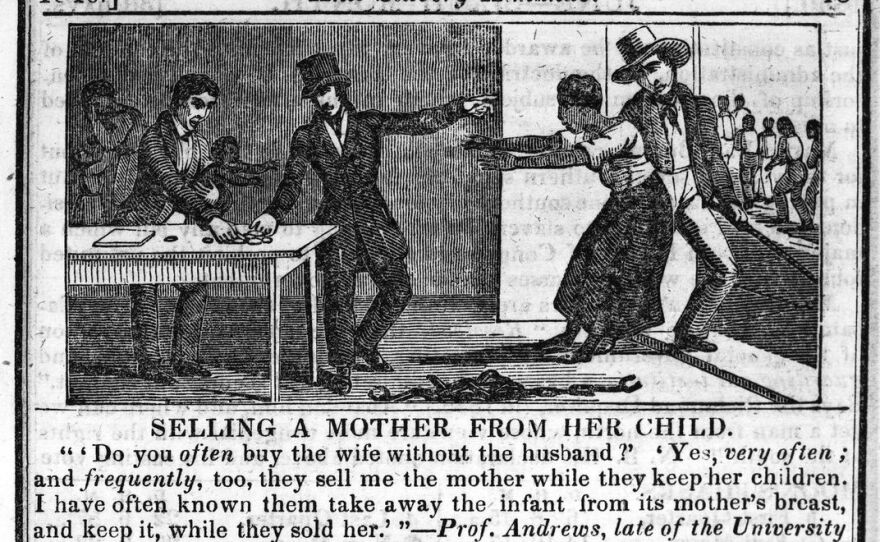
Since today is Juneteenth, a federal holiday that recognizes the date when the last enslaved persons were finally informed of their freedom, I thought about all of the children that were taken away from their parents, primarily from their mothers, during the period when slavery of Black people was common in these United States.

Black Perspectives is the award-winning blog of the African American Intellectual History Society (AAIHS). They are deeply committed to producing and disseminating cutting-edge research that is accessible to the public and is oriented towards advancing the lives of people of African descent and humanity. From the Black Perspectives website, LINK>Slavery and America’s Legacy of Family Separation by Vanessa M. Holden. Forced family separation was always a fixture of the lives of enslaved people. Enslaved children were a lucrative business. The expansion, maintenance, and future of slavery as an economic system depended on these children, particularly after the close of the American trans-Atlantic trade in 1808. 

One such story comes from Harriet Mason, who remembered her mistress forcing her to leave her home and family in Bryantsville, Kentucky, to work in Lexington as a servant at the age of seven. She remembered, “when we got to Lexington I tried to run off and go back to Bryantsville to see my [mother].” The grief of a childhood spent away from her family at the whim of her owner led her to suicidal thoughts, “I used to say I wish I’d died when I was little.” Even in her old age she was firm that, “I never liked to go to Lexington since.”

Slaveholders borrowed against their human property. They gifted enslaved children to their white sons and daughters as children, upon their marriages, or as they struck out to begin their slaveholding legacy. And of course, slave children could be sold down the road and down the river. Children knew that at any moment this could happen to them.

Blogger’s Note – Last night, my oldest son wanted to know if anyone in our family had benefitted from the labor of slaves. Eventually, it was suggested that every American has. I know that among my mother’s own genetic, biological family there were slave owners (I saw one will that was stipulating slaves by first name and who they were to be given to). I also know that side of my family also fought on the side of Confederates in the US Civil War. I’m not proud of being the descendent of these realities.

From the linked article – To profit from slavery and participate in slaveholding, Lexington’s white residents did not even need to own, buy, or sell a single slave. Someone made the shackles. Someone ran slave jails. Someone generated the official documents needed to transfer property. Someone hired enslaved children to work in their homes and businesses. Adults running with children from officials who would separate them was a feature of fugitivity during American slavery. To produce the “fugitive” category, a range of institutions sprang up. Local money paid sheriffs, courts, and officials to uphold the law that protected slaveholders’ rights to their human property. Someone printed runaway ads. Someone made money on enslaved peoples’ bodies at every juncture.

Along with physical labor, children deemed by the state to have unfit parents and placed into adoptive homes, perform emotional labor. Adoptees not only lose their birth families in the process, but they also lose ties to culture, language, country, history, and identity, and must contend with societal expectations that they be grateful for a “better life” in the face of it all. Children of color adopted by white parents also face racism in their new homes and communities. There is emotional labor too in being the physical body that allows white families to appear more liberal or multicultural, even if the opposite is true. In the United States, adoption is an industry and, as adoptee advocates continue to warn, it is poised to profit from family separation. There is already precedent for keeping children in the United States after a parent has been deported and awarding custody to American adoptive parents over immigrant parents caught up in immigration proceedings or because they were detained or incarcerated.

Black families are separated by the bond and bail system, incarceration, the child welfare system, and the criminalization of poverty. All can lead to family separation and the loss of one’s children. Child welfare advocates also recognize the link between the disproportionate number of Black children in the foster care system and the pipeline from foster care to prison.  All of these contemporary systems of power are echoes of legal and social structures that devalued enslaved parents and profited from enslaved children during American slavery.

We need to acknowledge these links to the history of American slavery and the ways that African Americans continue to endure discrimination. Following the money exposes the truth.

When Dad Is A ?

My dad never knew his genetic father which is a shame because they would have been great fishing buddies. There is an adoptee who’s writings I follow, Tony Corsentino. He wrote a piece for this day. He titled his LINK>D.N.A. You can read the entire piece there. I’ll just excerpt it a bit here.

He mentions that he had received a copy of his original birth certificate two months before he received an email from his birth mother. He learned his biological father’s name in that email. On his original birth certificate nothing appears in the blank labeled “father.” blogger’s note – my father’s birth certificate had no name for a father either.

Yet, Tony had a name. He found his father’s Facebook page. He didn’t do anything else with the information for 8 years. He had built relationships with his birth mother and her siblings. He feared upending his new and (what he feared was a) fragile relationship with his birth mother. She and his father had ended contact when she discovered she was pregnant. 

Yet, he did want to learn more about his father and so he went the Ancestry route. blogger’s note – It certainly proved very useful in my own roots journey quest. His father had not submitted a DNA sample, although he had joined the site and created a rudimentary tree. At Ancestry, Tony was able to reconstruct an extensive family tree. He messaged a few DNA matches on his father’s side. It took 4 months before he got a reply from any of them. One of them was not kind.

Yet, he knew that to send that message out was to signal to his biological relatives that he was not going to hide who he is from anyone: not his biological relationships from his adoptive family, and not one half of his biological tree from the other half.

His father’s first cousin, (his second cousin once removed) conferred with her sister. They welcomed him as family. They were in contact with his father and agreed to serve as intermediaries for an eventual contact. He notes that a few weeks later, he spoke with his father for the first time. Here is how it went –

“He was most eager to share family history and lore—about his uncles who had perished in World War II, about his career, about his two sons, my half-brothers. And with evident discomfort he explained that his wife, who had known that he had possibly fathered a child, was opposed to my making contact with people in her family. He said he was “working on” this. That was the last I’ve heard about it. In the months since we have exchanged a handful of text messages on holidays and birthdays. His two cousins are Facebook friends. I am planning to meet them this summer. It might be the only branch of my father’s family—my family—that will accept me.”

This Father’s Day, he has questions – “Does it make sense to wish my biological father a happy Father’s Day? Did he feel my absence from his life in anything like the way my birth mother did, who carried me and gave birth and watched as they took me out of the room on the understanding that the absence would be forever? . . . Father’s Day gives me nothing to say to him. Not, anyway, as long as my existence remains a problem—a threat just outside the walls of the family stockade.”

blogger’s note – I like his ending – “Let this be a note pinned to the stockade door. Dad, you know where to find me.”