The Trauma Isn’t The Same

An adoptee was troubled by her birth mother’s awkward attempts to communicate and find some kind of common ground. As a mother who didn’t raise my own daughter after the age of 3 after a divorce, I understand how difficult it can be for an absent mother. I remember really have trouble finding a commercial birthday card that reflected my relationship with my daughter. Now, I just make my own with a software program.

So this original mother made a really poor choice by sharing a poem that really didn’t reflect the adoptee’s or this mother’s life experience and the adoptee felt angry and I can honestly understand why.

The fate of a mother is to wait for her children. You wait for them when you’re pregnant.
You wait on them when they get out of school. You wait on for them to get home after a night out.

You wait on them when they start their own lives.
You wait for them when they get home from work to come home to a nice dinner.
You wait for them with love, with anxiety and sometimes with anger that passes immediately when you see them and you can hug them.

Make sure your old mom doesn’t have to wait any longer.
Visit her, love her, hug the one who loved you like no one else ever will.
Don’t make her wait, she’s expecting this from you.
Because the membranes get old but the heart of a mother never gets old.
Love her as you can.
No person will love you like your mother will.

I think it was a cry for love and more connection but it fails given the circumstances.

Someone tried to translate this – Some people express themselves wrong as well, because they don’t know how. This poem says “I’m struggling to say this but I waited and waited for years to have a relationship, I’ve always loved you and I want to be able to have that relationship” the part at the end doesn’t strike me as the message. Again, this is how I see it.

I can easily understand that many women who surrender a child to adoption do wait a long time for the child to grow up so that they can have some hope of resuming a relationship. Sometimes it doesn’t happen in time – as it was with my mom, who’s own original mother was dead before she could connect. Now that I have the adoption file and have visited my grandmother’s grave, I believe she was always waiting. The name on the grave is the more childish name “Lizzie Lou” that was on my mom’s original birth certificate, rather than the more mature name “Elizabeth” I saw on a letter after the surrender and on the divorce papers when my mom’s original father legally ended his relationship with that wife.

An adoptee says it clearly – I disagree that first moms (unless they were adoptees also) suffer “just as much” trauma as adoptees. Most first moms don’t start life with sheer torture and live life in fight or flight mode. They don’t spend their childhoods lost in a fog of confusion getting gaslighted and tricked by their families. I have very much sympathy for first moms and the terrible trauma they endure but I would never equate that to what adoptees suffer as infants and children. Adoption shapes our entire lives. First mom trauma happens later in life. They are different.

Infants experience pre-cognitive trauma. Babies have no previous identity or knowledge of their self before the trauma. The memory is stored in the hippocampus without narrative as pure emotion, which is terror and powerlessness. This can get triggered and manifest as emotional flashbacks. And those might plague a person for a long time, if not adequately addressed in therapy.

Infants grow 75% of their brain mass between age zero to age 3. Trauma during rapid brain growth can be more impactful. Trauma “in the first two years followed by ten years of bliss is more damaging than ten years of adversity after 2 years of baby bliss” ~ Dr Bruce Perry, who co-authored a book with Oprah Winfrey – What Happened to You?: Conversations on Trauma, Resilience, and Healing.

Oprah writes – although I experienced abuse and trauma as a child, my brain found ways to adapt. This is where hope lives for all of us—in the unique adaptability of our miraculous brains. I hope that with our book #WhatHappenedToYou, you begin to find the tools to build a renewed sense of personal self-worth and ultimately recalibrate your responses to circumstances, situations, and relationships.

Losing My ?

As the child of both parents being adoptees and as the sister to my only two sisters, who both gave up babies to adoption – I’ve said “adoption” was the most natural thing in the world for me. But that isn’t quite right – it’s not natural – and all of the kids I grew up going to school with didn’t have adoptee parents (though thankfully, my parents were NOT my adoptive parents) and adoptive grandparents and adoptee uncles. So, I can’t really say it was commonplace to have adoption be so primary in our lives.

The closest I can come is that it was the reality. Not having a medical history for my parents when asked about that in doctor’s offices was just the reality.

Not knowing our racial heritage was just the reality. In fact, it may seem a bit odd but until I knew better (in 2017, when I was already 63 years old and both of my parents deceased), I honestly thought my mom was half African American and my dad was half Mexican – not kidding about that – that is how I was able to explain to myself that my parents had been given up for adoption – they must have been mixed race, which made me at least 50% mixed race along with 50% white (because I was definitely light skinned, blond haired and blue eyed). The truth was far from my creative imaginings. My mom had a lot of Scottish along with some English and thanks to slavery a smidgeon of Mali. My dad is half Danish.

My 4 adoptive grandparents were all wonderful people. My mom’s original parents were highly thought of and loved by their relations. My dad’s mother was loved and his dad, well he was a lot like my dad. Never knew he had even one child, let alone a son. More’s the pity – I think they would have made great fishing buddies.

Yet for about 5 years now, I’ve been reading the thoughts of adoptees wherever I find them and my perspective has entirely changed. I do not think adoption is a good thing in most cases. I actually thought my parents were orphans for the longest time – like until I was grown and heard from my mom that she was trying to get the state of Tennessee to release her adoption file to her because she was CONVINCED her adoption had been inappropriate (to a great extent because Georgia Tann had been involved) and she wanted to contact her original mother. Then, the state of Tennessee broke her heart because they told her that her mom had already died a few years earlier. She knew her dad was likely (and even that was not certain) older than her mom, so probably dead too. About 2 years after my mom died, I was able to do what she never could – get her entire adoption file from the state of Tennessee.

I do have Ancestry as well as 23 and Me to thank for most of my progress on my dad’s side. I now know who all 4 of my original grandparents were (something my own parents died never knowing). I have contact with some genetic, biological relations who are still living. I feel whole in a way I never even knew I did not feel before I learned all of that.

Somehow this song speaks to my feelings about all of this . . .

Different Not Better

Valid response from a former foster kid –

Stop saying better. Start saying different. When the adoptee is rehomed, abused or killed then it’s not our problem. We can’t guarantee better. Right now adoption is based on what people want. It was based on this way ever since the government and agencies took over. It’s not about helping kids but helping yourself to kids. People don’t adopt to help kids. They adopt to become parents. To be mommy and daddy – not play mommy and daddy.

It also upsets me – the kids who aren’t seen as worthy, don’t get adopted. So again, who is adoption for ? People are waiting for a non-existent baby to be created or a baby to lose their family in foster care, so they can grow their family.

What was this in response to ?

I am a social worker by education, been out of the field for about 6 years, I worked for about 1 year in foster care/adoptions. I left the field because I felt it was difficult to make a difference/help due to all red tape and bureaucracy.

Anyway, one thing I took from my experience, was that I want to adopt. I just thought I would be loving a child, adding to the family, teaching them, helping them grow, etc.

I did believe/was taught (or something) that adopting children from foster care, etc was… making a difference, that it was in a way, giving them another chance. A chance to give them a good home, better opportunity and away from abuse, neglect, exploitation etc. Or that parents who give up their children for adoption are brave, because it’s really hard to give up a child, but they do it out of love, because at that moment they can’t provide a good life for them, etc.

Pluses and Minuses

A Former Foster Care Youth, then Adoptee writing her thoughts… contemplates – Am I the only one that struggles with going back and forth with being – glad my parents gave me up and then, at the same time sad that my extended family didn’t keep me ? I can’t imagine the person I would be, if I was raised by my biological parents… if I were to guess, I probably wouldn’t have finished high school and would be living off welfare. But being given up also caused additional trauma including feeling unworthy, unloved and abandoned. I was sexually abused in the first foster family I was placed with. Then, the second family had so many foster kids, I never got attention. The family that adopted me did so because their biological daughter passed away at 20 years old, so they took me in. I always felt like I had to be who she was… Then again, my adoptive mother did teach me to be a strong, independent woman who doesn’t need to depend on anyone including the government, financially. So I think, there are pluses and minuses in being given up and adopted. However, I also think, if my biological mother had received the help she needed, mentally and financially, maybe I would not have had to go through any of my imagined or my real outcomes.

I am not an adoptee myself but I have thought about such things. Both of my original grandmothers could have raised my parents had they had the proper support and assistance. I have no doubt about that. My mom may have grown up in more poverty because her adoptive parents were financially very well off. This did allow some benefits and privileges for my mom and for me and my sisters. I’m less certain about how my dad may have turned out.

His original mother was unwed and had an affair with a married man. I doubt he ever knew he had a son as his extended family here in the United States and still living in Denmark did not know he existed. DNA proved my relationship to them. My paternal grandmother did go on to have other children but also a rather difficult life as I have been told. No doubt he would have been loved. He was very important to his adoptive mother as well who had a huge influence on the outcome of my own life. She was a strong woman in her own ways.

I grew up with good adoptive grandparents, aunts and cousins and I am grateful for all of them. Learning about my original family has had a bittersweet effect on me. It has left me more lonely in odd ways – not part of the adoptive or the genetic families – in reality. More alone than I was before I knew . . .

Ray Liotta and Adoption

I don’t remember him actually making any kind of strong impression on me but I did see the movie “GoodFellas” back in 2020 (thanks to Netflix keeping track of these things for me).

It is interesting how ideas for this blog come to me. This one was from a short acknowledgement in Time magazine about the man’s recent passing. Something about his adoptive mother dying during the filming.

I thought, so another adoption story. It never ceases to amaze me how many people in our society are somehow touched by adoption more broadly (meaning not necessarily adopted themselves but in their extended family). I went looking to learn more about this aspect of the man’s life.

The story I read was about how he found peace with his adoption. He said, “At first, I didn’t understand how a parent could give up a child. So, I had that kind of energy of just being like, that’s just f***** up.” His perspective changed after the birth of his own daughter in 1998, at which point he felt he had to trace and locate his birth mother.

Ray was born in 1954, the same year I was, in Newark New Jersey. He was adopted at the age of six months. He was in an orphanage at the time. His adoptive parents were Alfred and Mary. Liotta knew he wasn’t his adoptive parents biological child growing up. He also had an adopted sister, Linda.

His drama teacher in high school asked him if he wanted to appear in a play during his senior year. Liotta didn’t take it seriously at the time (he was into sports) but it led to him eventually studying acting at the University of Miami. After graduation, he got his first big break on the soap opera Another World.

In his 40s, he hired a private detective to locate his birth mother and younger siblings. He subsequently learned from her that he is mostly of Scottish descent (like I learned regarding my maternal grandmother’s family). He then met his birth mother and siblings – a half brother, five half sisters and a full sister. She explained to him that she had given him up for adoption because she was too young and couldn’t contend with the responsibility.

He said that then, “I realized that she did it for very valid reasons from her perspective and for 99% of the kids put up for adoption, the birth parent believes that it’s for the betterment of the kid… Often, the household, the situation, the age just dictate that’s the best thing to do for the child.” After the meeting her, Liotta honestly said that he was “disappointed” by his mother’s story. He reminds me of my own mom in saying that he was “really grateful that [he] was adopted.” When Larry King mentions there is a book for adoptees called “You Were Chosen,” Liotta admits that his was “I was given up.” Most adoptees hate the “chosen” narrative.

Liotta died in his sleep while filming Dangerous Waters in the Dominican Republic. Foul play is not suspected in his death. At the time of his death, he was engaged to fiancée, Jacy Nittolo. That had made him a happy man. He wrote, “Christmas wishes do come true. I asked the love of my life to marry me, and thank God she said yes!!!” Liotta is also survived by his 23-year-old daughter, Karsen, who he shares with ex-wife Michelle Grace.

Adoptee Jodie Sweetin

I will admit that I didn’t know who this woman was nor did I ever watch Full House. That said, today I learned that she was adopted and has now spoken out about her adoptive family. I read that Full House portrayed the perfect life, the perfect kids, as well as the most perfect parents one could hope for. Jodie Sweetin played the adorably sarcastic Stephanie Tanner on the much-beloved family sitcom. She also starred in some Hallmark movies. Years later, after Jodie was all grown up, she reprised her role on the Netflix revival series Fuller House.

At the time of Jodie’s birth, both of her biological parents were incarcerated. Her original mother was a struggling addict. Her father was killed in a prison riot before Jodie ever had the chance to meet him. Recently, she made an appearance on Olivia Jade’s ‘Conversations’ podcast and opened up a lot about her life. “My dad, Sam, my adopted dad, his ex-wife who he had three adult kids with when they adopted me, she was my biological father’s aunt,” Jodie explained.

Janice was his second wife and they were hoping to start a family but were having troubles with conception. Because of her original parents’ circumstances, Jodie was in dire need of a family and Sam and Janice wanted a child of their own and so, fates aligned and roughly one year later, the adoption was finalized.

The adoption began fostering feelings of hurt and rejection. In her younger years, she used to think “‘Oh, something was wrong with me.’ There’s this point in your life where you finally kind of realize what happened,” Sweetin said. “That it no longer becomes something about you, that it’s like, ‘Oh, I wasn’t wanted.’ ”

Intrafamily adoptions are incredibly common and even preferred. An intrafamily adoption is a specific type of adoption that allows a family member to adopt a child. This is a streamlined kind of adoption. “People don’t really talk about it, because I think there’s this weird sense of shame, if there’s an interfamily adoption,” Jodie said.

Having resolved some of her emotions around adoption, currently Sweetin says, “They actually made the healthiest decision for me by allowing me to be adopted by another family that could provide better.”

A Product Of A Product

I read an interesting thread this morning that I thought reveals some really important perspectives and so, I share this.

Things I find odd: in the decades following discovery, none of my adoptive family asked about or acknowledged the existence of my half-siblings.

Nor did they either ask how I felt about being lied to for over thirty years; lies they participated in telling. I don’t say this to shame them. I am not even naming them here. As children, they were emotionally abused in that they were told to lie to a family member, every single day. They should not have been asked to do that. I don’t fault them for remaining silent prior to my accidental discovery of my adoption. What I find completely baffling is the continued silence.

What does that say about the nature of love, respect, compassion and connection that adoption supposedly creates? You may say; most adoptees know, so your experience is an anomaly. If so, there are thousands and thousands of anomalies running around these days. There are STILL adoptive parents posting on social media who say they haven’t told the adoptee, don’t know when or if they will. In transracial adoptions, adoptive parents can’t avoid the truth of adoption, but many make a practice of dodging questions, fabricating stories, joking about the adoptee’s pain. And I add, knowing a good number in the donor conception contingent of family creating, there were many who did not ever intend to tell their children. Of course, that was in the days before inexpensive DNA testing. Oops.

I guess odd is not a strong enough word. Cruel, maybe?

There were 4 children in my family; two of those were adopted. First a biological, genetic daughter, then the adoptee girl – me – and an adoptee boy, then a biological, genetic son. My adoptee brother died when I was 13. He was 12. The oldest daughter always knew. The youngest son learnt in high school. Yep; both of those were told to lie. Apparently it was important for them to tell other friends and acquaintances that I was not their “real” sister. I, however, was never told.

What a way to set family relationships up to fail. The refusal to engage with me now “post-discovery” reveals how deep that failure goes and it does increase the pain that I felt as an adoptee to an almost unendurable level.

In their defense, I don’t think they ever learned, nor knew how to learn, how to engage emotionally in a healthy way, not just with me but with others. Some of this was the result of being raised by adult children of alcoholics and a great deal of death and dysfunction occurred in the course of our upbringing. How much of that dysfunction can be attributed to being taught to lie ? It could not have helped the circumstances.

This brings on additional sharings of a similar nature.

Thanks to a friend recognizing my now ex husband was a functional alcoholic, I got into Al-Anon. I was also fortunate to find a couple adoptee support groups at that same time and found that there is a lot of overlap!! Dysfunction doesn’t discriminate. The ex was the son of a violent alcoholic. I dated men who had drug or alcohol issues. My adoptive parents were the youngest in their pre-Depression era families and we’re definitely not what we would refer to as “healthy” today. Add adoption to the mix…

My adoptive mom’s dad was a violent alcoholic. My adoptive dad’s dad was more of a gentle alcoholic, I think. They came out of hard times. Add the pressures of infertility during a time when women’s primary role was parenthood ? So much pain and suffering.

You are right about silence being cruel. Speaking as a first mom… losing my baby to adoption at 17 years old … I was told I would go on with my life, as if nothing had happened. My family never spoke to me about it. It’s traumatizing and cruel to pretend it never happened. I’m sorry that any of us are here having this discussion but we must talk about it, if we are to heal. I was in the adoptee fog for 43 years… & now 12+ years in reunion… I won’t be silenced any longer.

And by sharing such personal thoughts about personal situations, maybe some who encounter people living with such pain will be a little kinder. Until you walk a mile in my shoes . . . seems to fit. Always give the benefit of the doubt and consider the kindest possible explanation for whatever seems “off” is also good advice.

Concerns About Illegal Adoptions

Ukraine’s foreign ministry has appealed to the United Nations to facilitate the return of Ukrainian children who have been “illegally deported” to Russia.

In a statement, the ministry said Russia had engaged in the “illegal and forced displacement” of Ukrainian children, “among them orphans, children deprived of parental care, as well as children whose parents died as a result of Russia’s military aggression” across Ukraine’s borders to Russia.

The statement reads:

In violation of international humanitarian law and basic standards of humanness, Russia is engaged in state-organized kidnapping of children and destruction of the future of the Ukrainian nation.

Such actions of the Russian occupiers can be qualified as kidnapping and require a decisive reaction from the international community, primarily from the relevant international organizations.

Ukraine has repeatedly accused Russian forces of forcibly deporting thousands of children from the Donetsk and Luhansk regions of eastern Ukraine since the war began.

Earlier this month, two individuals said they and other women and children were forcibly transported to Russian territory from the besieged city of Mariupol in March. The Kremlin spokesperson, Dmitry Peskov, has denied these accusations, claiming “such reports are lies”.

~ source The Guardian reporting

Because I am generally against adoption in most cases, and even though I know that the US has no high moral ground, as I am aware that children arriving unaccompanied at the US border were taken in and most likely, too many adopted by families that were total strangers to them, I am still concerned that this same unfortunate situation is also happening to Ukrainian children. I know the circumstances are not equal but the outcomes are equally concerning.

Poetry For April

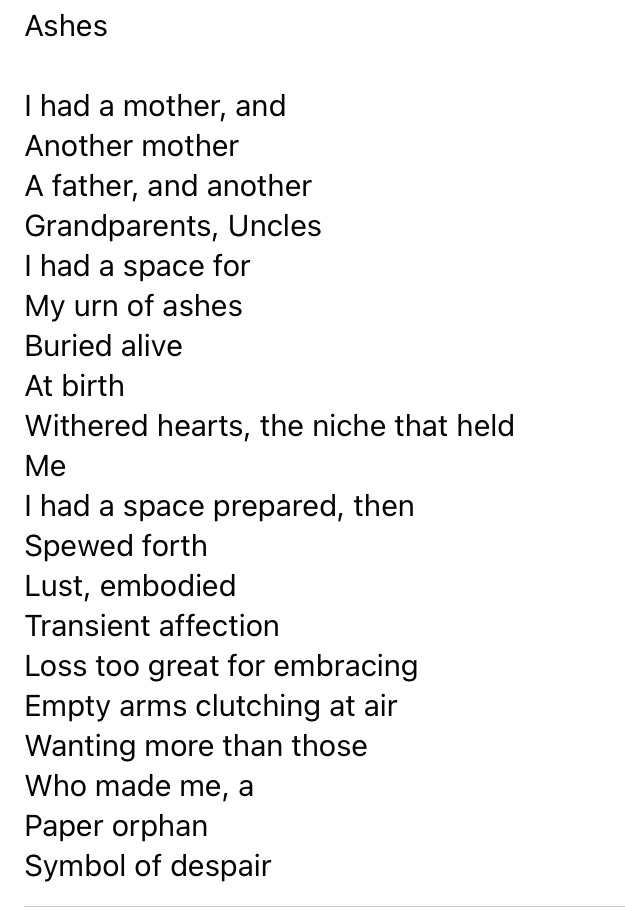
April is poetry month. My friend, Ande Stanley (a late discovery adoptee) wrote a poem for her The Adoption Files WordPress blog that I think a lot of adoptees could relate to, and so I share.

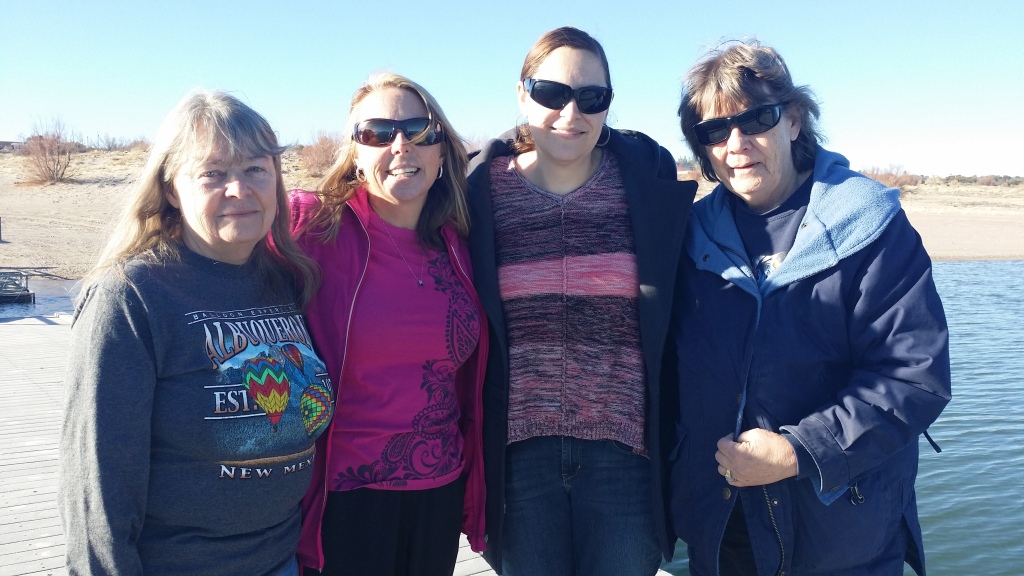
My parents (both adoptees) wanted their ashes scattered on Elephant Butte Lake in New Mexico. We had to be careful because it is not recommended. Most likely against the law. The first time, my daughter and I went out with my dad to scatter my mom’s ashes. That was a wild and crazy ride for both of us in his boat with my dad !!

When my dad died only 4 months later, my aunt (my dad’s half sister by his second adoptive father), my middle sister and her daughter, as well as me and my daughter went to scatter his ashes also on the lake, as that was his wish, but we did not take my dad’s boat out that time. We just stood on a dock near their last residence. Some official came along because we didn’t have a permit to take our car into lake property (it is a state park). My sister was hiding the cremation box under her jacket. LOL We did get the deed done. My aunt took the photo below. Maybe I should not go into the story of how the crematorium stole my parents rings . . . always make certain you get them back is all I can say.

Feb 9 2016, Ash Day

I Am Right Here

On my maternal side – I was able to visit the graves of both of my maternal grandparents, one half-aunt and one set of great grandparents too (but I did not talk to the “greats” at their grave – still have some very difficult feelings towards my great-grandfather for being unwilling to take my grandmother and mother back in when my grandmother was pregnant and her husband had returned to Arkansas. Believe me, I have done my best to come up with all kinds of kinder theories about why but still . . . I will always feel in my heart that he was the cause of my mom being adopted . . . I am certain of those feelings about him.)

I Am Right Here

Looking into the darkness, I call out “where are you?”
The darkness does not call back.
Instead I hear nothing so I wait, knowing that when my words reach you there may be a reply “I am right here”
I keep walking not able to see in front of me.
Again I call out “are you there?” but nothing comes back to me.
So I continue with hands outstretched in front of me walking in darkness and feeling my way through space.
Black empty space that feels every part of my vision.
Waving my hand in front of my face I cannot see what is in front of me.
So I continue walking through the darkness.
“Is someone out there?” I say.
I can hear faint words now, it sounds like someone screaming “come this way?”
I keep walking straight ahead toward the sound.
It gets louder and I start hearing footsteps coming closer.
“Is it you?” I call loudly
“Is it Who?” I hear back
“You?” I say to the voice
I continue walking toward the sounds and keep talking to it.
“I have been lost without you,” I say.
“Who has been lost without me?” the voice asks.
“Me, I have, but where are you, I can’t see you?”
“Just keep moving forward,” it says.
“I am trying to but I keep getting lost,” I say sadly.
No more footsteps are heard.
Suddenly light begins to invade the space and standing in front of me is the one I have been looking for my whole life.
They reach their hand out to mine,
“I am right here and have been the whole time.”
~ Brandy Ford