A Strong Urge to Parent and Infertility

Like I believe all Coen Brothers films, this one is quirky. Holly Hunter is excellent as a fierce mom. Her infertility coincides with the birth of quintuplets to a local business owner. Like many infertile women, the fact that some people have many children (including her husband Hi’s supervisor at work) while some are denied the joys of parenthood seems very unfair. She concludes that the Arizona (their last name and the state where this takes place) family has more children than they can handle (due to fertility drugs) and she hatches a plan to take one of the quintuplets as the child they want in their life.

Not only is Hunter’s character, Ed, infertile but they cannot adopt due to Hi’s criminal record. And actually, that is a bright spot as far as anyone who would like to see less adoptions is concerned. The kidnapping scene is hilarious as the babies go every which way and Hi tries to corral them, sometimes carrying one under each arm. Quite a few of the characters are exaggerated and not meant to be taken seriously – from Hi, to 2 escaped former convicts who force their way into the couple’s lives to the crazed bounty hunter like something from a Mad Max or similar movie. Also funny also is his supervisor’s large and unruly family who visit the couple causing chaos everywhere.

In the end, Hunter’s character only wants to make things right again and returns the baby as well as turning down the $25,000 reward. But I did fall in love with the fierceness of her mothering instinct to protect the baby against all threats. That was beautiful to behold.

Holly Hunter w Nathan Jr

Fear of Abandonment is Real

Stephanie Drenka and genetic family

I went looking for a topic for today’s blog and found this story by Stephanie Drenka. She writes that – “I was struck by the pervasiveness of adoptive parent-focused stories. Where were the adoptee perspectives ?” The photo is from when when she was reunited with her biological mother, two sisters, and a brother.

She notes that “abandonment issues do not end in adulthood. Though I haven’t experienced divorce, I can imagine it might be similar. If a woman’s husband leaves her, even after remarries the perfect guy, she may always deal with a persistent fear that he will leave her as well. Fear of abandonment is real, and has to be acknowledged in order to resolve it.”

I have personally witnessed this issue playing out in a loved one and it had not been resolved previously. It came out at a very inopportune time but never-the-less had to be dealt with in its extremity.

Stephanie notes – Even the most well-adapted adoptee still faces moments where the trauma resurfaces. For me, that meant small things like every time a doctor would ask me for my family medical history or now, post-reunification, not knowing when I will be able to meet my biological sister’s new baby boy. And adds – I won’t go into the trauma experienced by birth mothers and families, because that is not my story to tell. Suffice it to say, from my personal reunification experience, adoptees are not the only ones who struggle with the aftermath of adoption.

She says – I love my (adoptive) mom and dad to the moon and back. They are my role models, biggest supporters, and best friends. I feel blessed to have them in my life– but please don’t presume to tell me that I was “lucky” to be adopted. Like many adoptees, my parents told me that I was special. While meant with good intention, being chosen is a burden. It puts pressure on us to be perfect and grateful. It can be incredibly emotionally taxing and negatively effects your self esteem in the moments where you can’t live up to that perfect picture. These expectations can prolong mental illness without treatment, because it may seem like asking for help is being ungrateful.

Choosing to adopt is an expensive proposition and as Stephanie notes – one mostly related to white privilege. I agree with her stated perspective – Can you imagine if the money people spent on adoption services went instead to supporting single mothers or low-income parents? Or what if adoption profits were used to benefit adoptees themselves in the form of post-adoption services like counseling, genetic testing, mental health treatment, or birth family search costs?

She ends her own essay with this – The truth about adoption is that there is no Truth. Adoption is many different things for many different people. It is love, loss, grief, abuse, hope, despair. It can sometimes be celebrated, but should always be examined through a critical and compassionate lens.

A Complicated Relationship with Love

“No one has a more complicated relationship with love than a child who was adopted.” from an article in Psychology Today titled The Complicated Calibration of Love by Carrie Goldman. Children are the only ones who simultaneously crave, reject, embrace, need, challenge, inhale, absorb, return, share, fight, accept, and question your love on a daily basis.

How does the world convince an adoptee they are loved and valued ? The same world that thrust a great injustice upon this child by separating them from their first mother and possibly siblings, the world that passed them along to a doting foster mom to whom they became attached and then separated them again, the world that dropped this child into the outstretched, naïve, and eager arms of adoptive parents, their greatest joy intricately tied to the child’s greatest sadness, the world that views this child’s story as a happily-ever-after and now expects them to be grateful, happy, well adjusted, and perfect at all times—how does such a child learn to trust the love of that world?

Carrie notes – To match the giving of love with the exact need of any recipient is a moving calibration. There is no reliable unit of measurement for something so imprecise as human affection. We try. We offer up our love in words and actions, hoping to meet the ever-changing needs of our lovers, our children, our friends, and our families – every relationship that matters takes some work.

When one person in the relationship inhales the sour breath of the beast that is insecurity, a beast whose presence twists the very air between two humans and makes greater the flaws that beckoned it in the door. Insecurity, also known as fear, feeds on the dark and scary parts of the mind, growing in strength and power as it distorts what is real and what is imagined.

Sometimes insecurity grows too large until there is almost no space left for the relationship. But the antidote to such despair is hope, and hope, fortunately, needs less fuel to stay alive. These dynamics occur in any relationship, and the intensity can be magnified by a thousand when one of the partners is an adoptee.

The choice to be an adoptive parent is built on mountains of hope, oceans of hope, forests filled with the hope that a thousand seeds planted might one day yield a mighty tree. What combination of internal resilience, good parenting, genetics, access to birth history, love, acceptance of grief, and endless empathy is needed to raise an adoptee to wholeness ?

An adoptee did not choose to be adopted at a very young age; it was foisted upon them and packaged as “you’re so lucky” by the world. An adoptive parent must allow and validate all the feelings and viewpoints, even the ones that don’t fit the happily-ever-after narrative. 

An adoptee is unlucky. They are not growing up with their first family. If biological children for their adoptive parents are also in the picture, they cannot help but wonder if the adoptive parents love their biological children more. Many adoptees worry they will never be good enough. Most adoptee do battle with legitimate fears of abandonment in every relationship they enter into throughout life. Often an adoptee rages against the unfairness of being adopted and basically hates being adopted.

~ Carrie Goldman writes a parenting blog called Portrait of an Adoption.

Shame

We feel shame when we violate the social norms we believe in. At such moments we feel humiliated, exposed and small and are unable to look another person straight in the eye. We want to sink into the ground and disappear. Shame makes us direct our focus inward and view our entire self in a negative light.

I came upon the powerful graphic above yesterday and felt there was more that I could personally say about it. On my Facebook profile page yesterday, I shared – I have owned up to this before. I had an abortion at the age of 23 or so – mid 1970s. I am glad it was safe and legal. I was not being reckless. I was driving an 18-wheeler with a partner. Our dispatcher didn’t get us home to where my pharmacy was in time and I ended up pregnant. Neither he nor his family were the kind of people I would be glad to have been tied to through a child today. At the time, I had breakthrough bleeding. My ex-SIL and ex-BIL had a child with serious birth defects. I just felt the pregnancy was not progressing normally. Also, to be honest – I didn’t want to commit my life to 7 more months of going it alone with no financial support. I’ve never regretted it but pro-Life propaganda has definitely haunted me. In writing this, I searched my memory for all of the reasons why I chose that course of action.

The mothers and women in my family, and to whom I am genetically related, chose other courses of action. Back in the 1930s, the mothers of both of my own parents, chose to carry their pregnancies, spent the first few precious months with their babies, and one way or another lost that first child to adoption. I wrote, and it was true, “I didn’t want to commit my life to 7 more months of going it alone with no financial support.” In some people’s minds I was simply being selfish and I will accept that judgment, though in truth I have no regrets about doing what I did and for the reasons I did it at the time.

Yet, I felt enough shame for having chosen a different path (both of my sisters carried unplanned pregnancies to term but also gave their babies up for adoption) that it was a long time before I admitted to anyone what I did earlier in life. It was my private decision which no one but the circumstances influenced. Maybe influenced in no small measure by the legality and safety of the choice at the time. Only as Roe v Wade has come under increasing opposition have I started sharing my own story of what it was like to have made that choice and my gratitude that I had it available to my own self when I felt I needed that.

The father of my own conception made it clear he would not stand by me if I chose otherwise but I don’t think that was my major motivation. In reflecting on my statement that I would have had to “go it alone” above, I also know my parents supported one of my sisters throughout the pregnancy and then, remarkable to me now that I know more about adoption in general, my own adoptee mom coerced my sister into giving up the baby she wanted to keep and then, encouraged a lie to me that the baby had died. Intuitively, I knew it had not and concocted fantastical stories about what had actually happened to the baby believing it had been stolen and taken into Mexico (my sister had delivered at a hospital in El Paso TX very near the national border). Because of this, my mom finally admitted her truth regarding the whole situation to me.

Many women bear a cross – maybe they suffer their whole lives knowing their child is out there somewhere out of their own reach. Many of these original mothers suffer a secondary infertility and never have another child. Many struggle as single mothers to keep and raise their child. Our society does nothing to help them. My sister actually sought financial support during her pregnancy but was denied it based upon our parents financial condition. It was not my parents seeking financial support but my sister and not in increase my parents financial condition either.

After I divorced the father of my first child, I had to go to work and that meant child care. When one “family style” child care that she loved at first became a tearful battle, I left work to check on her and discovered through the window of a half door, an older child bullying her and no adults in sight. I pulled her out that day. I often had to go to my mother to beg $20 to make it through to payday. She never denied me but financially it was always difficult. At the time I divorced her father, he told me he would never pay me one cent of child support because I would just party with the money. Such a horrible perception he had of my own integrity and ethics. I didn’t want to spend my life in court fighting him for it even though the judge insisted in awarding me $25/mo “in case” I changed my mind and wanted to seek an increase. I never did. Instead, I left my daughter with her paternal grandmother while I tried to build a financial nest egg for the two of us by seeing if I was capable of driving an 18 wheel truck cross-country.

I always intended to return for her and would have never given her to her father to raise but his mother did that. He remarried a woman with a child and then they had a child together. Unintended consequences of financial desperation. And now, in a sense my story has come full circle, my shame – not even listed above – is that I gave up raising my child for financial reasons. Back when she was in day care, I couldn’t hardly answer the pediatrician’s questions, because she was away from me all day. After her father and step-mother raised her, I struggled to find birthday cards for her that reflected the lack of a daily, physical relationship I had with her. There were no role models for an absentee mother back in the mid-1970s, even though the absentee father was a standard reality.

Shame. Oh yes, I am well acquainted with it. As my daughter knows, I have struggled to find peace with not having “stuck it out,” as my own mother said to me that she would have done, to do the right thing by my daughter. It is a work in process. Recently, I reflected on all the things I did right by her in the brief early years she was physically under my care. I told her, I realize that when I was mother to you, I was a good one. And the abortion ? I atoned for it, by giving up my own genetic connection to have two egg donor conceived sons (same donor both times), that my husband might be able to have the children he desired, even as we both realized I had gotten too old to conceive naturally. Even so, they are now almost 18 and 21 years old. They have proven to me that I can “mother” children 24/7 throughout their own childhoods. At least I have no shame in that. I even breastfed both until they were just over 1 year old. I also have the knowledge that I didn’t put adoption trauma onto the fetus I aborted early in that pregnancy.

A God Given Right To Parent

Sharing the words of one adoptee, Mary Constance Mansfield, for today’s blog –

It’s exhausting. People just refuse to connect the dots. Adoption agencies and private adoption attorneys make no money if they don’t encourage and often time coerce a young woman to place their infant for adoption.

There’s a whole group of women who struggle with infertility and are praying a newborn experience the trauma of being abandoned by their mother, because they deserve to be a parent.

They are quite sure that their almighty, always right, god, chose this other woman’s child to actually be their child and they are sure their love will heal whatever trauma the infant might experience. And they will address it when and if the child brings it up. Because they believe they have a god given right to be a parent.

I would disagree….

Well many of us don’t actually come out from the innate Stockholm syndrome that the adoption industry thrives on until our last adoptive parent dies and that ghost kingdom we kept hidden for so long begins to scream at us.

The American Academy of Pediatrician’s official statement about an adopted child is “It should be assumed, ALL adopted children have suffered an irreversible trauma” and they recommend early recognition and appropriate treatment. They know that the child doesn’t have the vocabulary to bring it up. The earlier the recognition the better the chance for recovery.

With the influx of the “domestic supply of infants” that’s expected from the overturning of Roe vs Wade, it’s imperative that those who end up adopting do their due diligence and actually help the child talk about what they feel.

Yes it will hurt when you hear they think about their bio mother and wonder if they have siblings, among other things any child would ask if they knew they were living with strangers but had a history before they were adopted. But that pain you feel is for you to deal with. It’s not so you can convince a child they don’t need to know anything truthful about life before adoption. The reality is you should’ve already grieved the biological child you can’t have and done your homework in regards to the trauma of never seeing your mother this side of the womb causes, so you can be aware of the symptoms when you see them.

And for the sake of keeping it real. Most private adoption agencies are affiliated with a church or a denomination. And private adoption attorneys? Well they are just that…. they get paid only if they find a womb wet infant for the 30 to 50 people in line for one. They have absolutely no monetary reason to give natural mother’s the info regarding resources available if she should want to parent.

Adoption TikTok

I will admit to being a bit of a Luddite (sometimes defined as a person opposed to new technology or ways of working – which certainly applies to me LOL). I’d still be back in Microsoft 3.0, if it wasn’t for my husband pushing me forward. I don’t do TikTok or Instagram or any of the many other platforms available today. I hate apps. I view them as multiplying clutter that I don’t need. However, I did come across notification in my all things adoption about an article in Teen Vogue (which as I am almost 68 would probably have not come to my attention otherwise). The title is Adoption TikTok: Building Community and Critiquing the U.S. Adoption System.”

The young woman wrote – “Myself and an another adoptee were featured in this TEEN VOGUE article! Such an exciting opportunity to be heard and I think the journalist did a wonderful job.”

One woman describes meeting her birth mother in Brazil (she was adopted as an infant by a New Jersey couple). “My mother pulled me into her house and pulled me onto her couch and into her lap, even though I was probably almost twice her size. She looked at my fingers and looked at my toes and, like, it was just so primal to me. Like how you would look at your baby.”

Her adoption, the country she had to leave behind, the shape of her life: All of it could be traced back to poverty. “We are all indoctrinated into this overly positive narrative about adoption, right? We see it in movies and kids’ movies, this trope of adoption being a beautiful thing,” she said. But her story didn’t feel beautiful. Her birth mother’s pain had transformed her already shifting understanding of adoption. While some women choose adoption because they don’t want to be a mother, others lack the emotional support or financial resources to raise children, even though they very much want to. 

TikTok hosts a growing community of adoptees who use the social media platform to shed light on the trauma and economic pressures that have shaped their adoption experience. The hashtag #adopteesoftiktok has garnered tens of millions of views.

You can read the rest of this article at the Teen Vogue link above.

One reader in my group commented – “Research also suggests that open adoption can reduce the grief that many birth mothers experience after giving up a child for adoption.” My only feedback is where it says that research supports that open adoption reduces grief, that doesn’t sit well with me. The study only went to 20 years post placement – yet time and again I am finding in natural mother’s groups – it’s at 20 plus years that things start to unravel, as their relinquished child starts to form and share their own views surrounding their adoption, outside of the influence of their adoptive parents. ~Natural mother 26 years into an open adoption

Ownership And Abuse Is Not Love

It all depends on which side you are looking at it from . . . to the fog and to those with the gift of insanity to dwell therein. So let us reverse the imaged poem, shall we ?

My life could be better
I can’t imagine how
This was God’s Plan A
I have no doubt that
My adopted mother’s love
Does not eclipse
The bond with my first mother
Which will never be part of my life
My ancestral heritage
Is a deeper part of me than
My adopted family
Adoption IS inherently traumatic
It is actually harmful to imply
I should always be grateful
Truth is
Lamenting a loss before memory
Is how I grow, not
Focusing on my blessings
I don’t need sympathy
I need to grieve
I can’t honestly claim that
Adoption is beautiful

Poetry For April

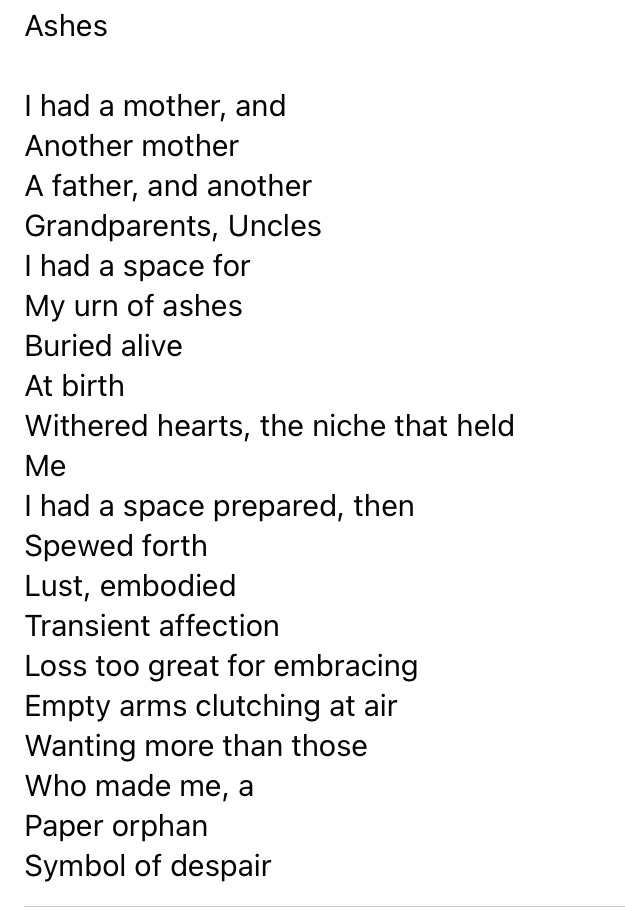
April is poetry month. My friend, Ande Stanley (a late discovery adoptee) wrote a poem for her The Adoption Files WordPress blog that I think a lot of adoptees could relate to, and so I share.

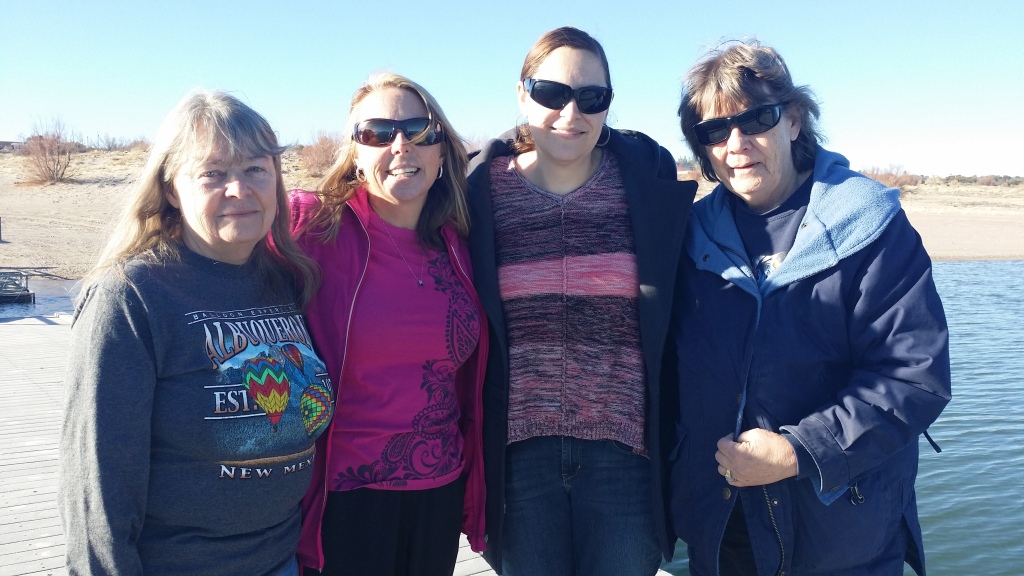
My parents (both adoptees) wanted their ashes scattered on Elephant Butte Lake in New Mexico. We had to be careful because it is not recommended. Most likely against the law. The first time, my daughter and I went out with my dad to scatter my mom’s ashes. That was a wild and crazy ride for both of us in his boat with my dad !!

When my dad died only 4 months later, my aunt (my dad’s half sister by his second adoptive father), my middle sister and her daughter, as well as me and my daughter went to scatter his ashes also on the lake, as that was his wish, but we did not take my dad’s boat out that time. We just stood on a dock near their last residence. Some official came along because we didn’t have a permit to take our car into lake property (it is a state park). My sister was hiding the cremation box under her jacket. LOL We did get the deed done. My aunt took the photo below. Maybe I should not go into the story of how the crematorium stole my parents rings . . . always make certain you get them back is all I can say.

Feb 9 2016, Ash Day

I Am Right Here

On my maternal side – I was able to visit the graves of both of my maternal grandparents, one half-aunt and one set of great grandparents too (but I did not talk to the “greats” at their grave – still have some very difficult feelings towards my great-grandfather for being unwilling to take my grandmother and mother back in when my grandmother was pregnant and her husband had returned to Arkansas. Believe me, I have done my best to come up with all kinds of kinder theories about why but still . . . I will always feel in my heart that he was the cause of my mom being adopted . . . I am certain of those feelings about him.)

I Am Right Here

Looking into the darkness, I call out “where are you?”
The darkness does not call back.
Instead I hear nothing so I wait, knowing that when my words reach you there may be a reply “I am right here”
I keep walking not able to see in front of me.
Again I call out “are you there?” but nothing comes back to me.
So I continue with hands outstretched in front of me walking in darkness and feeling my way through space.
Black empty space that feels every part of my vision.
Waving my hand in front of my face I cannot see what is in front of me.
So I continue walking through the darkness.
“Is someone out there?” I say.
I can hear faint words now, it sounds like someone screaming “come this way?”
I keep walking straight ahead toward the sound.
It gets louder and I start hearing footsteps coming closer.
“Is it you?” I call loudly
“Is it Who?” I hear back
“You?” I say to the voice
I continue walking toward the sounds and keep talking to it.
“I have been lost without you,” I say.
“Who has been lost without me?” the voice asks.
“Me, I have, but where are you, I can’t see you?”
“Just keep moving forward,” it says.
“I am trying to but I keep getting lost,” I say sadly.
No more footsteps are heard.
Suddenly light begins to invade the space and standing in front of me is the one I have been looking for my whole life.
They reach their hand out to mine,
“I am right here and have been the whole time.”
~ Brandy Ford