A Basic Human Right to Know

Most U.S. citizens raised by their biological parents never question whether the information on their birth certificates is accurate. With the evolution of adoption and alternate means of conceiving a child, “accurate” is an increasingly subjective term.

Is the purpose of a birth certificate to portray a biological account of a person’s birth parents, or is it an account of one’s “legal” parents — the ones responsible for raising them?

The US Census Bureau created Birth Certificates in the beginning of the 20th Century as a means of tracking the effects of disease and urban environments on mortality rates. The task of issuing birth certificates was transferred to the Bureau of Vital Statistics, a division of the Department of Health and Human Services. In 1946, the recording births was decentralized into today’s varied state systems (and in reality, based on my parents births in the 1930s, this existed well before the 1940s). This has caused there to be 50 different sets of regulations concerning how, when, why and if access to original birth certificate information can be obtained.

The document has become an important (if not our sole) means of identification when we obtain anything from a driver’s license to a passport. It is an indispensable tool for genealogical researchers.

For adoptees as well as donor-conceived persons, there is oftentimes a clear distinction between one’s genetic parents, those with whom you share DNA, and one’s legal parents, the ones who have rights and responsibilities attached to their parenthood, and most-times, the ones who are raising them.

Our birth certificate practices concerning non-biological parents began with adoption. In the mid-20th Century, there was rising concern that adopted children’s birth certificates read “illegitimate.” In response, states began to issue adoptees amended birth certificates, listing the adoptive parents as if they were the genetic parents, thus hiding the shame of the child’s illegitimacy and the adoptive parents’ infertility. The originals containing the biological parents’ names were sealed and not available to anyone (including the adoptee) except by court order. The new birth certificates showed no indication that they had been amended, which gave adoptive parents an easy way to not tell their children of their adoption. In about half of the US states (including large population ones like California and Virginia as I personally found with my two parents adoptions), adoptees original birth certificates remain sealed.

Women who use donor eggs to become pregnant are listed as mothers on birth certificates. When our donor informed me she had her DNA tested at 23 and Me, I made the decision to provide my children with the information and private access to her (with her consent) that DNA testing and that site’s design make possible. It is unsettling to see someone else listed as my two sons “mother” even though they grew in my womb, nursed at my breast and have been cared for and nurtured by me 24/7 for almost every day of their entire lives. Yet, I knew this was the proper path to establish for my own children their personal reality.

There are a whole host of concerns raised by adoptees and the donor-conceived, including the right to identity, ongoing medical history, biological heritage, and the right to know their genetic parents and I for one believe these issues are valid and should receive transparent answers.

The US Surgeon General reports 96% of Americans believe that knowing their family history is important. It certainly has made a world of difference for me as the offspring of two adoptees. I suppose this has given me a broader perspective on the importance of a person knowing from where their genes originated. The United Nations has acknowledged the right of the child to preserve his or her identity, including nationality, name and family relations.

I believe that all people have a moral right to know the truth about their personal history. Where the state has custody of relevant information it has a duty not to collude in deceiving or depriving individuals of such information. Growth, responsibility, and respect for self and others develop best in lives that are rooted in truth.

There has been a recommendation made that the Standard US Birth Certificate be revised to expand upon the “two parent only” format to include categories for Legal Parents, Genetic Parents and Surrogates. In the case of adoptees, the child’s birth name and parentage should be recorded along with his or her legal/adoptive name.

The time for birth certificate reform is now. Unfortunately for many, it should have happened decades ago.

You Don’t Have To Age Out to Qualify

Today’s Story –

I was in foster care from the age of 5 until 9. I was adopted at 9. But I moved back in with my biological family and mom when I was about 10 or 11. Then, I was back in foster care from age 16 to18. Even if I had only been in foster care that once from 5-9, I would consider myself to be a former foster care youth. I remember my social worker clearly. I remember being moved from house to house because my older siblings fought to keep us all together, even though my brothers were “trouble makers”.

I remember one home making us shower outside with the water house instead of using the bathrooms inside to shower. Then, eventually being separated from my brothers, while my older sister and I stayed together, until they found another placement that would take all of us.

All of that happened to me in the first year of foster care.

Then, when they found the placement that would eventually adopt me. But one of my brothers was molested by a grown up, the family had adopted as a child. That led me to want to move back in with my biological family – after the adoption was finalized.

I don’t think it takes aging out to be considered a former foster care youth. I get how being adopted as an infant doesn’t really give you the voice to speak as a former foster care youth, mainly because while it involves trauma, these aren’t experiences you can describe first hand because you don’t actually remember them.

I’m not going to tell someone how to identify themselves. If foster care was some part of your own story, it’s just a part of it. I’m not going to say you are wrong for identifying however you identify.

It Is Wrong To Hide The Truth

A person should not have to live to the age of 19 before knowing they were adopted. A person should not go through life being they come from a culture they did not. However, that is what happened to Melissa Guida-Richards. That was the point in her life when she learned she was not Italian at all bur a Columbian mestiza or mixed race. Melissa shares her story in a Huffington Post op-ed – My Half Siblings Found Me On 23andMe. I may never have learned the identity of my own dad’s father but for 23andMe hooking me up with cousins with the same grandmother (who I lived over 6 decades knowing nothing about).

That same 2017 year that I began to learn who my parents original parents were (both of them were adopted but at least they grew up knowing they were adopted all along), Melissa did 23andMe and learned about her cultural genetic make-up (Latina with Indigenous, Eastern Asian and some African roots with less than half of her genetic makeup from Italian or even European sources). She finally knew why she felt different from her entirely European adoptive family who came into the US straight off the boat from Italy and Portugal.

Before she knew she was adopted, she had grown up hearing stories of her adoptive father tending goats in Italy and her adoptive mother washing clothes in a stream in Portugal. She was taught to have pride in those cultures … but these were not her own birth culture. She experienced a sense of frustration over the way she had been raised. This built up inside of her until she made the decision to go into therapy when she was in college. Eventually, therapy allowed her to come to terms with some of these things, yet she was still pushing some of the others aside, finding that easier than confronting them. It takes time to grow through an evolution like this.

Like many adoptees, it took having biological children genetically related to her to give her that connection to kinship that was missing all of her life. Then, very much like what happened in my circumstances, two years after having her DNA tested by 23andMe, she received this message – “Hi, this may be weird and I don’t mean to bother you but I’m your half-sibling.” In a matter of seconds, she went from having no biological ancestors, and yet now children who were related to her, to having a sibling only a few years older than her. And she shares, what many adoptees feel when they discover biological, genetic relatives – Finally, there was someone else out there like me. After years of feeling like the broken, weird, outsider in my adoptive family, there was someone else.

Her feelings at that point, echo the anger many adoptees feel as they become mature – while her initial emotion was feeling overwhelmed with joy, she soon felt the grief. She says, How was it fair that I had no idea of this? That we, two siblings, were separated and yet adopted to the same country? Why did the world think that that was okay? Why did my adoptive parents act threatened when they found out about my sibling?

As she became acquainted with her half-sibling, she felt the novelty of experiencing actual similarities with a relative. All of her life, she had very little in common with her cousins by adoption and not surprisingly, her brother who was also an adoptee. Now this all made more sense, it had taken learning she was adopted.

She also experienced her adoptive mother withdrawing, becoming very quiet. Then, she received another message that she had yet another half-sibling who had the same original mother. It turned out that both of these half-siblings had been adopted but had been raised by the same adoptive family. Her adoptive parents lying about her adoption hurt even more. What also hurt for her was that these two half-siblings had not conveyed to her the full truth from the beginning of their making contact. They had both known about her for months, had looked at her blog, and on social media. They had decided together that it would be easier to go slow with the revelations and while the first one was open to creating a relationship with her, the other older one was not.

This whole situation felt like a betrayal to her. She says, “As adoptees I would have thought they would understand how any information about my birth family was vital to me. That hiding any part of our family would hurt me . . . since they had grown up together and knew about their adoptions since they were small, it didn’t really process for them why it felt like such a betrayal to me.” Eventually, she realized what hurt. It was one sibling protecting the other because that one wasn’t ready for a relationship with her. Their bond, from growing up together, and being biologically related, was something she could never have.

She shares some truth about adoptee reunions that I have seen more than once myself – they are often not like the movies. There’s heartbreak, anger, numbness and general confusion. People often expect an instant connection with their biological relatives because they share blood, but that can take some time or often never fully develops. I have certainly found that with my own newfound relations. They have histories together that I didn’t have with them. That gap of living different lives totally unaware of one another is very hard to fill – in fact, I have come to believe it is impossible. I am grateful for whatever relationship I can develop with each but I must keep my expectations in that regard very low.

The author arrives at this realization – My biological siblings and I may have come from the same mother, but we don’t share the same experiences. Society has pressured us to immediately connect upon meeting one another, when we barely could pick the other out from a crowd of strangers. It’s okay for reunions to be imperfect and painful because not all things in life are meant to be the way the movies portray. Having a relationship with both siblings during this (pandemic) time has filled some of the holes in my heart that adoption left. I’m beyond glad to have them in my life, and only hope that one day soon the world is a little less dangerous so we can all meet in person.

She ends with “we are still family ― flaws and all.” Yes, I totally get that sentiment.

Adoption Is NOT Needed

Today’s story –

I’m tired of having to explain this to prospective adopters. Adoption is NOT needed to give a child a “good” life.

I am Latina, and in my culture, aunts and uncles as well as grandparents step up to help raise each other’s children. Even in cases where there is no poverty nor struggle. My parents were middle-class average Joe’s, yet my aunt and grandma still raised me. I wouldn’t want it any other way.

I am not an adoptee nor mother but I am a foster parent. My job is to help reunite infants, toddlers, and grade schoolers with their natural families. I get a lot of hate from other foster parents and adoptive parents for saying this, but adoption simply isn’t necessary.

I became a close family friend to some of the families that I have helped to be reunited, and they are all doing so well. All they needed was a little bit of help. I will go as far as to hire a lawyer to fight family separation. I love these kids, and what’s best for them is to be with their own families. Imagine if we had a mentorship-type program where women helped struggling mothers parent their own child, instead of taking their child away from them. Friends don’t let friends give away their babies.

Also, that $30,000-60,0000 that is spent to adopt an infant would go a long way to helping these parents to keep and raise their own children. I have yet to see a mother who genuinely did not want her child, just a mother who is struggling or has low self-esteem. If that is the case, then build her up. No excuses why you cannot do this. In lots of cultures, like mine, everyone helps to raise each other’s kids without anyone taking them away their own parents and erasing their identity.

Don’t Erase Identity

Today’s story –

I work with this guy who’s sister lost her 4 kids. Of those 4, he and his mom have 3 of them. When the children went into Child Protective Services care, the baby was not given to the grandma but to a foster family, a lesbian couple.

I was talking with my coworker yesterday and he said they just went to the baby’s second birthday party. Apparently, they have a good relationship with the couple. He told me they’re about to adopt his nephew and change the baby’s whole name. He said one of the wives comes from a similar situation and her adoptive family changed her name and she was glad they did because she hated her original name. So they’re changing his name, so that he doesn’t grow up hating his name like she did.

I told my coworker, the little boy will likely grow up hating his name because they changed it. I also told him that changing the little boy’s name means his original birth certificate will be closed and sealed. Doing this is destroying a part of that little boy.

My coworker said he doesn’t like it either but understands why they want to do it.

Just ick though, ugh.

Believing in Colorblindness is a Privilege

Colin Kaepernick with his parents, Teresa Kaepernick, Rick Kaepernick and girlfriend, Nessa Diab

Read the link to Colin’s story at the end of this blog to understand more completely why his photo is here.

Articles that mention adoption always catch my attention. Today, I saw one in the Huffington Post – Like Colin Kaepernick, I Wish My Adoptive Family Had Talked About Race by Melissa Guida-Richards. She was adopted from Colombia in 1993 and her adoptive parents were one of many that believed in the colorblind ideology. Her adoptive parents believed that giving a child a loving home was all that was necessary. 

For most of her life, the family didn’t talk about her race and ethnicity. Actually, she was not aware of her true racial identity until she was 19 and found her adoption paperwork. Her parents had believed that if they raised her as Latina, she would be treated differently than the rest of the family. However, people often questioned her about where she was from ― particularly when her adoptive family wasn’t around. When she was out in public with her white parents, she found that she was included under their umbrella of privilege. But the moment she was out on her own, people treated her differently.

Many BIPOC adoptees eventually learn that the world is divided into how they are perceived with their adoptive families versus when they are alone. And this is especially true in today’s climate where an Asian adoptee shopping for groceries can be attacked, a Black adoptee pulled over by police is potentially in danger, or a Latina adoptee walking in their town is told to go back to their own country. Adoptive families can think that it will never happen to their child, but for most transracial adoptees, it does. It’s just part of the reality of being a person of color.

Transracial adoptees do not have the privilege of believing in colorblindness. It can be fatal for a Black adoptee to “forget” that they are Black. If that adoptee approaches a police officer the same way their white parents do, they could find themselves in danger. When adoptive parents do not properly prepare their transracial adoptee for a racialized world, they are left playing a game of catch-up that they hopefully can win before it costs them their very life.

Current policies disallow considering race when placing children in adoptive homes. This is due to laws like the Multiethnic Placement Act (MEPA), which prevents child welfare agencies that receive federal funding from denying or delaying a child’s placement based on race. MEPA was amended in 1996 to establish that states could be fined for using race in placement decisions. While MEPA also requires agencies to “diligently recruit families that reflect the racial diversity of the children in need of homes,” it does not fine states that fail to do so.

Currently over 70% of adoptive parents are white and over half of adopted children are of a different race than their adoptive parents. One key issue with MEPA was that, while it made it significantly easier for white middle-class adoptive parents to adopt children of other races, it neglected to require anti-racism and transracial adoption education before or after placement.

The adoption industry perpetuates the idea that adoption ends in a beautiful happily ever after. When we think of adoption as an ending, we forget that it has a lasting, constant impact throughout the adopted person’s life, not just their childhood. Race should not be an afterthought in adoption. Adoptees are often pressured to be grateful and simply be happy that they have a family, to forget all of the challenges and trauma they experience.

When you are a person of color, you know how the world sees and treats you, and when your family refuses to be open to simple conversations about ethnicity and race, you start to wonder what’s so negative about acknowledging your identity. It impacts how you see yourself and how you believe your family sees you.

The author found that her adoptive family avoiding conversations of racial differences led to her having feelings of rejection and shame. She struggled to understand how her parents and relatives could love all of her, when they refused to acknowledge a big piece of her identity. Adoptive parents need to get comfortable having uncomfortable conversations about race. Race may be a construct but its ramifications are very real.

At the beginning of her essay, the author also mentions Kaepernick’s interview in Ebony magazine. Worth the quick read.

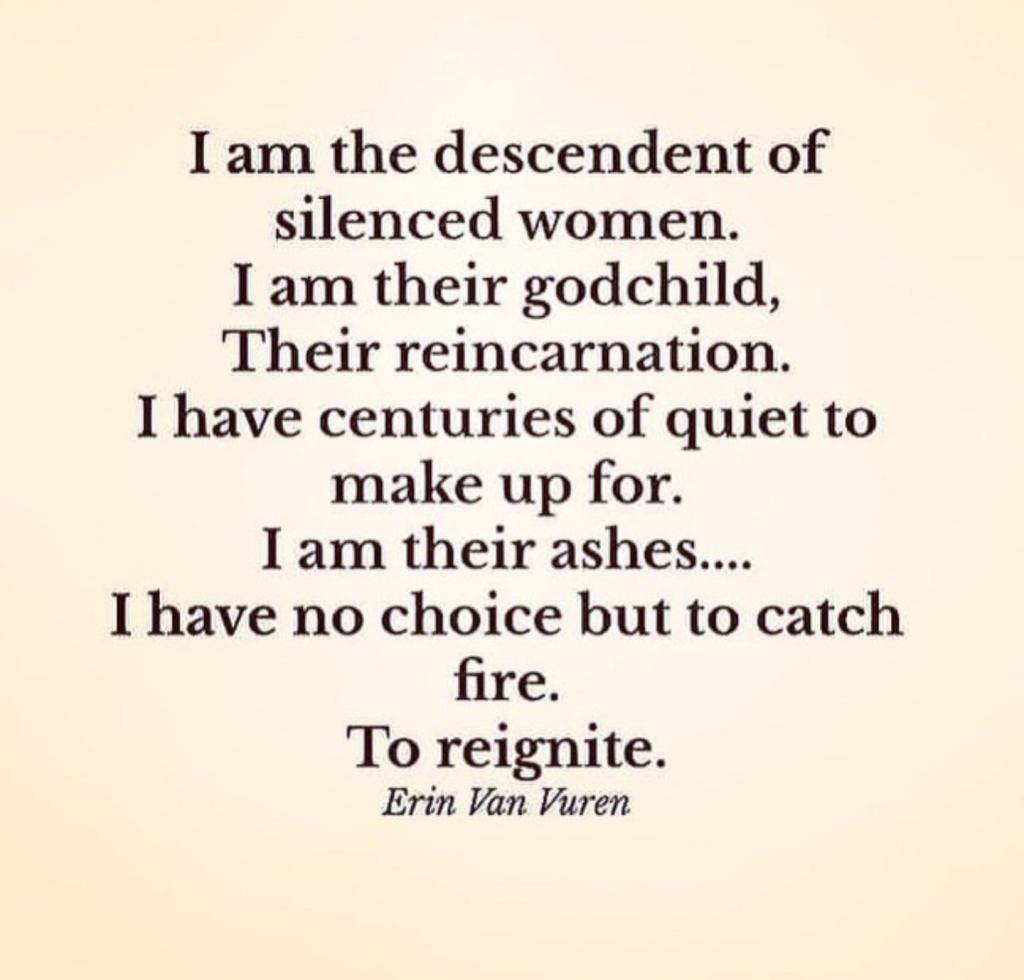
Silenced Women

When I saw this graphic, it went straight to my heart like an arrow. My grandmothers, forced by circumstances to give up their first born, and in two cases only child (which includes a grandfather who never was given the benefit to know he had a son), to go on with their lives as though nothing happened.

I don’t think I’ll ever truly 100% get over it and I probably should not because adoption is still a thing that drives mothers and their babies apart. I now have an unflinching awareness of what it means to be adopted.

At almost 70 years old now, having to live through a full 6 decades before I knew the truths of my origins, I do fell as though I was born to re-connect the broken threads of my family’s beginnings, that I have somehow managed to fulfill my destiny in having been born at all.

In learning about my family’s ancestors, I also discovered what a miracle it was that in the mid-1950s, I was not given up for adoption, with my parents forced to suffer the same fate their own parents encountered. My teenage mother and my father only having just started on his university studies – both interrupted when I decided to take up residence in my mother’s womb.

My grandparents could not tell their own stories of loss that hurts for a lifetime because no one would have been sympathetic regarding their plight but for adult adoptees today, there is a growing awareness of the trauma and pain of being cut off from one’s roots and some are even choosing to attempt parenting when they had thought to give up their child and they are finding a lot of support in society all around them.

May the reform of attitudes continue to take over the dominant narrative that adoption saves babies and children from a worse fate.

Identity

From an article in Severance magazine.

Growing up as an adoptee, I frequently fielded questions from friends and strangers alike. “Do you know who your real mother is?” “Do you think you look like your parents?” “What [ethnicity] are you?” The first two questions were easy to answer: My mother is my real mother.  No, I don’t look like either of them. But the third question hounded me my whole life. It speaks to a universal quest to identify with a group. And it speaks to the need of others to figure out who we are. For an adoptee, another question swirls around in the mix: Are we valid?

On one hand, our identity is who we believe we are, and on the other it’s who others believe us to be. In essence, the identity question is two-part: ‘Who am I?’ and ‘Who do you think I am?’ Adopted or not, we work to reconcile our personal vision of who we are versus who others believe we are. Yet when you’re adopted, there’s an added layer. For me, and I imagine for many adoptees, there’s a struggle to answer the question ‘Who are you?’ When others challenge our identity because of our adoption status, it’s difficult enough; but it’s further complicated by the fact that we have incomplete information about our genetic roots and, therefore, we can’t answer. And even when we get that information, we’re still left wondering how others view us.

Now my story –

I’ve been going through 30-40 years of saved clutter, old letters to and from family members, etc. Yesterday I found my OMNI Berkeley Personality Test results. One does this for their own self and asks some people close to them to do it regarding that person’s perspectives on one’s personality. I had my husband, my daughter, my two sisters, my parents and my in-laws all do this for me back in the early 1990s. Then one compares how one sees one’s self with how other see them. It does give great insights.

I knew that both of my parents were adopted. Since finally learning who all 4 of my grandparents were so late in life (after the age of 60), I’ve also been reading and learning as much as I can about the effects of adoption on adoptees as well as on their descendants. Much of that learning I’ve been sharing in this blog.

No doubt, adoptees have all sorts of reasons for discovering their birth or genetic backgrounds. My mom felt compelled to try to connect with her birth mother but by the time she made the effort, it was too late. Her mother had already been dead for several years leaving my mom devastated. The state of Tennessee wouldn’t release her adoption file to her at that time because they could not determine the status of her birth father who had actually been dead for 30 years (they really didn’t try very hard). It’s a pity because in her adoption file that I now possess was a picture of her mother holding her for the last time before she was taken to be adopted.

In the Severance article, she writes – “I projected her need to know about the baby she’d given up, basing that assumption only on my own feelings toward my children—trying to imagine how a woman could part with her child. I thought perhaps she might want to know that I’d had a good life.” This is so much like my mom’s own explanation of her need to know. My own reason to do the search was to learn the truth about my own ethnic identity. Simply being “American” as my mom once told me because due to adoption they didn’t know, didn’t cut it for me. It is surprising how important in our melting pot of a country, there is still so much emphasis on our ethnic heritage. It was my public school girl days friends making a big deal about theirs that made me feel like something important was missing in my own life. Even the Census forces you to record some ethnicity other than American.

I am so glad to know today about my Danish paternal grandfather, my Scottish maternal grandmother and all of the English and Irish parts of me. I’m less fond of the strong streak of Confederates in my maternal line but grateful my Yankee paternal grandmother and that Danish paternal grandfather balance my karma out in that respect. I’ve certainly had fun exploring the traditions and places where my DNA originated. It is amazing how often Denmark turns up in my life before I even knew I had that culture in my background.

Blue Bayou

At the Cannes Film Festival in July, a journalist from the Netherlands thanked the director and star Justin Chon for his movie, which centers on a Korean American adoptee. Chon isn’t actually adopted like his subject, Louisiana bayou-bred Anthony LeBlanc, whom he plays in the movie. The film premieres Sept 17th.

LeBlanc is a tattoo artist with a criminal record. Like many adoptees in the real world, LeBlanc was never naturalized and risks being sent to a country he barely knows, prompting questions around citizenship, belonging, family — and who gets to be considered American. 

Chon said his Korean heritage and the experiences of friends in his immediate community in part compelled him to examine the issues surrounding international adoption. The practice began during wartime “babylifts” after World War II and subsequent conflicts when the U.S. asserted its power in part by “rescuing” orphans from communism to demonstrate its goodwill.

In 1955, the practice was further formalized when an evangelical couple, Henry and Bertha Holt, successfully advocated for the right to adopt Korean “war orphans” through an act of Congress. The couple later launched Holt International Children’s Services, the first large-scale international adoption organization. Foreign born babies those adopted by US parents before 2000 weren’t automatically granted citizenship. 

Chon said that to bring the sort of tenderness and care the subject deserved, he first pored over research and news articles about similar cases. One of the most publicized was the deportation of Adam Crapser, who was adopted from South Korea. He endured abuse and later abandonment by two sets of adoptive parents, none of whom filed for his citizenship. Crapser, who had several arrests on his record, was deported in 2016. 

Variety wrote in a review that “Justin Chon’s Blunt-Force Melodrama Takes on the Injustices of America’s Immigration System.” The system is the system, and its rules and loopholes exist to punish more than they protect. The movie holds little back as it rails against the cruelties and hypocrisies of American immigration law to stirring effect. 

At the film’s outset, it’s clear LeBlanc has turned his life around from rough beginnings. Having spent his childhood passed from one adoptive and foster family to another, and having endured a stint in prison for motorcycle theft, he has finally found emotional stability in the home he shares with Kathy and Jessie, her daughter from a previous relationship, who regards him adoringly as her true dad. 

“Where are you really from?” It’s an invasive question that’s awfully familiar to people of color, one that intrudes its way into our everyday lives. Though it can have innocent intentions, it’s often hostile and only works to invalidate your livelihood. You don’t really belong here, is the true meaning that lurks under that query. As the closing titles inform us, tens of thousands of adoptees have been deported from the United States, thanks to an exploited loophole in a law that only protects children born after 1983. 

What Blue Bayou does wonderfully in quiet moments is illustrate that being Asian is not a one-size-fits-all identity but a vast tapestry of different cultures. I’ve not seen this movie yet, of course, but I think I would like to. New Orleans holds a special place in my heart. My maternal grandmother went there to try to convince Georgia Tann to give her baby girl back to her but it failed and my mom was taken to Nogales Arizona by her adoptive mother.