The Chatter Is About Deportation

Someone asked for help to explain to an 11 yr old (who is only at the 3rd grade academically) about his biological father having been deported and this book was recommended, although the circumstances in the book’s story are not the same, it could be a conversation starter for this foster mother. A lot of noise this week about Mass Deportations if the election in November goes in a certain direction.

She mentions that he’s in therapy and his therapist is aware. The therapist suggested was that they tell him together, but that she should explain what the term deportation means ahead of time. She says, “I was able to do that by having a discussion about traveling and living in other countries.”

About this book – In this realistic and empowering tale, Carmen learns that through community and love, she can find strength in herself and maintain her connection with her Papi, who has been detained because of his immigration status. Carmen loves doing magic with her Papi. He can make sarapes fly. He can make rabbits vanish! But one day, her Papi vanishes. She is sad and scared when she learns he has been detained because he is an undocumented immigrant from Mexico. At first, Carmen’s family keeps Papi’s detention a secret, fearing that they might be judged negatively. As Carmen’s community becomes aware of their situation, they rally around her family with love. Carmen learns she can find strength in herself and maintain her connection with Papi, no matter what happens.

A note about the other “Something Happened” books, which present and explain sensitive and important events happening in communities across the United States and around the world. Told in clear, compelling stories, the books come with the authority of psychological expertise from the American Psychological Association. They include Something Happened in Our Town: A Child’s Story of Racial Injustice, which is a New York Times and #1 Indie Bound bestseller, and one of the American Library Association’s most banned books; Something Happened in Our Park: Standing Together After Gun Violence, which was nominated for The Goddard Riverside CBC Youth Book Prize for Social Justice.

Like Dominos Tumbling

Yesterday, as I was considering how the pieces of my own roots journey unfolded, I had this image of Dominos – one leading to the next. I had been in the dark about my own genetic, biological roots for more than 60 years. My mom had tried to discover her own but was denied and rejected when she made her attempts. My dad never seemed to want to know or maybe he was just afraid of what he might discover.

Never the less, one amazing revelation after another and in only 1 year’s time, I knew most of it. Some additional pieces have come my way since then but nothing as absorbing and amazing as that year since. Was I just lucky or was it just the appropriate time for everything that had been hidden and sealed off to reveal it self ? It was like there was an energy of disclosure that would no longer be denied.

From my mom’s biological, genetic mother and father to my dad’s biological, genetic mother and father, one after the other, doors opened and the truth was revealed. It feels very solid now – I know from whom and where I came from. Not that dark place of knowing nothing that I lived with for over 60 years.

I’m grateful for my success. I could have just as easily failed – or could I have ? Somehow, it was just finally the time for the truth to out itself. All I did was follow the bread crumbs, from one piece of information to the next, until there were not a lot more to follow – though some turn up from time to time – a relative in Denmark, where my dad’s father immigrated from. More recently from that same family line via Ancestry, the wife of another one who is highly interested in genealogy.

I will follow any that come but mostly I’ve arrived at wholeness and that has meant everything I could have ever hoped for. I believe I fulfilled the reason I wasn’t given up for adoption by my young, unmarried parents who were both adoptees (they did manage to get married before I was born). Thanking all that is good in this world.

The Legacy Of Family Separation

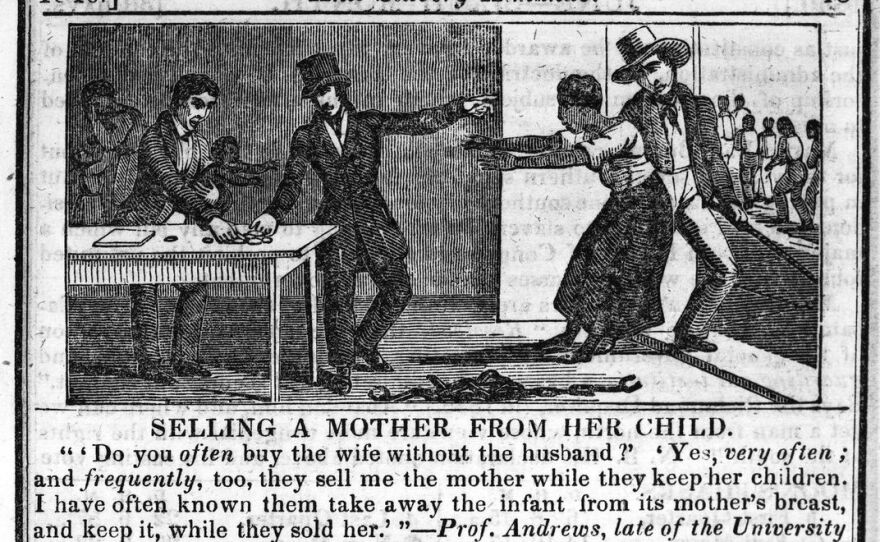
Since today is Juneteenth, a federal holiday that recognizes the date when the last enslaved persons were finally informed of their freedom, I thought about all of the children that were taken away from their parents, primarily from their mothers, during the period when slavery of Black people was common in these United States.

Black Perspectives is the award-winning blog of the African American Intellectual History Society (AAIHS). They are deeply committed to producing and disseminating cutting-edge research that is accessible to the public and is oriented towards advancing the lives of people of African descent and humanity. From the Black Perspectives website, LINK>Slavery and America’s Legacy of Family Separation by Vanessa M. Holden. Forced family separation was always a fixture of the lives of enslaved people. Enslaved children were a lucrative business. The expansion, maintenance, and future of slavery as an economic system depended on these children, particularly after the close of the American trans-Atlantic trade in 1808. 

One such story comes from Harriet Mason, who remembered her mistress forcing her to leave her home and family in Bryantsville, Kentucky, to work in Lexington as a servant at the age of seven. She remembered, “when we got to Lexington I tried to run off and go back to Bryantsville to see my [mother].” The grief of a childhood spent away from her family at the whim of her owner led her to suicidal thoughts, “I used to say I wish I’d died when I was little.” Even in her old age she was firm that, “I never liked to go to Lexington since.”

Slaveholders borrowed against their human property. They gifted enslaved children to their white sons and daughters as children, upon their marriages, or as they struck out to begin their slaveholding legacy. And of course, slave children could be sold down the road and down the river. Children knew that at any moment this could happen to them.

Blogger’s Note – Last night, my oldest son wanted to know if anyone in our family had benefitted from the labor of slaves. Eventually, it was suggested that every American has. I know that among my mother’s own genetic, biological family there were slave owners (I saw one will that was stipulating slaves by first name and who they were to be given to). I also know that side of my family also fought on the side of Confederates in the US Civil War. I’m not proud of being the descendent of these realities.

From the linked article – To profit from slavery and participate in slaveholding, Lexington’s white residents did not even need to own, buy, or sell a single slave. Someone made the shackles. Someone ran slave jails. Someone generated the official documents needed to transfer property. Someone hired enslaved children to work in their homes and businesses. Adults running with children from officials who would separate them was a feature of fugitivity during American slavery. To produce the “fugitive” category, a range of institutions sprang up. Local money paid sheriffs, courts, and officials to uphold the law that protected slaveholders’ rights to their human property. Someone printed runaway ads. Someone made money on enslaved peoples’ bodies at every juncture.

Along with physical labor, children deemed by the state to have unfit parents and placed into adoptive homes, perform emotional labor. Adoptees not only lose their birth families in the process, but they also lose ties to culture, language, country, history, and identity, and must contend with societal expectations that they be grateful for a “better life” in the face of it all. Children of color adopted by white parents also face racism in their new homes and communities. There is emotional labor too in being the physical body that allows white families to appear more liberal or multicultural, even if the opposite is true. In the United States, adoption is an industry and, as adoptee advocates continue to warn, it is poised to profit from family separation. There is already precedent for keeping children in the United States after a parent has been deported and awarding custody to American adoptive parents over immigrant parents caught up in immigration proceedings or because they were detained or incarcerated.

Black families are separated by the bond and bail system, incarceration, the child welfare system, and the criminalization of poverty. All can lead to family separation and the loss of one’s children. Child welfare advocates also recognize the link between the disproportionate number of Black children in the foster care system and the pipeline from foster care to prison.  All of these contemporary systems of power are echoes of legal and social structures that devalued enslaved parents and profited from enslaved children during American slavery.

We need to acknowledge these links to the history of American slavery and the ways that African Americans continue to endure discrimination. Following the money exposes the truth.

Still Separated

The good news is that just under 3,000 of the 4,000 children separated from their families by ex-President Trump’s “zero tolerance” immigration policy at the southern U.S. border have been reunited. That policy was lambasted as cruel and inhumane by critics. It has taken years for government officials to reconnect relatives with their young children.

Nearly 1,000 children still need to be reunited with their relatives. It is the second anniversary of the task force created to help with the reunifications. Many of those kids are Central American migrants who were separated from their parents at the border and placed in detention centers. That method was part of the Trump administration’s hardline approach to immigration and was meant to deter millions of migrants from seeking asylum in the US during his term in the White House.

“We understand that our critical work is not finished,” DHS Secretary Alejandro Mayorkas said in a statement. “We remain steadfast in our commitment to fulfill President Biden’s pledge to reunify all children who were separated from their families under the ‘zero-tolerance’ policy to the greatest extent possible, and we continue to work diligently to incorporate the foundational principle of family unity in our policies and operations.”

“We have made significant progress toward reunifying families and providing them with necessary services and support,” the Dept of Homeland Security said. “This critical work will continue until all separated families that can be found have been provided the opportunity to reunify.”

Reproductive Justice

And Reproductive Justice MUST include adoptee voices because adoptees are intimately familiar with the same systems of white supremacist violence that make reproductive justice necessary. Today’s blog is thanks to an op-ed by Tina Vasquez in LINK>Prism. The goal of this series about reproductive justice and adoption was simple – disrupt the adoption storytelling that has become the norm in mainstream media. These feel-good stories from the perspective of adoptive parents rarely include the voices of adoptees or question the preponderance of “cheap, easy, and fast” transracial and international adoptions by evangelicals that amount to little more than child trafficking.

No more salvation narratives. No more narratives of gratitude. No more framing adoption as a “win-win.” No more white saviors. We will question adoption as a system—its power dynamics, its economics, and its privileging of certain “reproductive destinies.” “Out of the Fog” is a phrase adoptees often use to describe facing the reality of their adoptions.

LINK>Operation Stop Child Protective Services (CPS) was founded by Amanda Wallace. She spent 10 years as a child abuse investigator before realizing that “she had become the silent enforcer for an oppressive system.” She now lends her insider knowledge to families navigating the system and trying to regain custody of their children.

About 27% of adoptions are transracial, according to a recent survey from the Department of Health and Human Services: birth mothers are disproportionately women of color, and adoptive parents are overwhelmingly white. Low-income Black and Native American children are the most likely to be separated from their families. Poverty is often interpreted as neglect when applied to these people.

When Roe v. Wade was overturned in June, white evangelicals wasted no time communicating their desire to take the babies that result from forced pregnancies. Never mind that most people denied abortion care simply become parents and that there is little evidence linking abortion bans to increases in adoption.

Time and time again, the solution offered to state violence is adoption, yet we fail to center adoptees whose lived experiences and areas of expertise touch every injustice and systemic problem our movements battle against. This is especially true when it comes to reproductive justice. While efforts are being made to explicitly discuss adoption as a reproductive justice issue, adoptees’ voices are still not being uplifted in these conversations. Adoptees are building their own movements—including Facebook groups like LINK>Adoptees for Choice—but will movements for sexual and reproductive health, rights, and justice invite them into the fold?

Reproductive Justice

Yesterday, this blog was about the rights of fathers, today it is about the Reproductive Justice Movement. Reproductive justice includes the right to abort a pregnancy but also the right to raise a child in a safe and supportive community.

Why Reproductive Justice ? The experiences of Black, brown and Indigenous women who have been sterilized, abused, or punished for bearing children. Welfare laws based on misleading impressions of so-called welfare queens – Black women who allegedly had babies to collect welfare checks but wasted the money. These stereotypes have led to welfare policies that discourage welfare recipients from having more children by reducing their benefits.

The white-dominated reproductive rights movement’s “choice” framework privileges the most socially advantaged people in society. Those who have the ability to make choices. It doesn’t take into account social structures, power arrangements of race, class, gender, heterosexism, immigration status, religion – all of which shape one’s ability to have reproductive autonomy.

High Black maternal mortality is a matter of reproductive justice. States that have passed or will soon pass abortion bans have the worst healthcare systems, the highest maternal mortality, especially Black maternal mortality, and the highest infant mortality. As a result of [the supreme court decision] Dobbs, we’ll see increases in maternal mortality – deaths of pregnant people who intended to carry to term – because their health will be compromised.

It includes ending police violence, abolishing prisons, and all the inhumane carceral approaches to meeting human needs that have a profound impact on one’s reproductive life. Prisons are a major impediment in the United States to reproductive freedom. People who have had their children taken away by a discriminatory child welfare system that targets Black neighborhoods for family separation do not have reproductive freedom. To me, reproductive justice is inextricably linked to the fight against the prison industrial complex and the family policing system.

The reproductive justice framework is more effective than the reproductive choice approach. the movement for reproductive justice must be aligned with movements for housing, abolishing the prison industrial complex, environmental justice, and economic justice, because all of those movements are essential to supporting freedom, including reproductive freedom.

Movements seeking to limit or abolish the power of the criminal legal system and the prison industrial complex are relevant to opposing Dobbs’ assault on reproductive freedom. People are already being arrested and imprisoned for stillbirths and miscarriages; that standard will be applied to abortions as well. Recognizing the interconnected nature of these challenges is essential.

Today’s blog leans heavily on an interview in LINK> The Guardian of Dorothy Roberts. She is an internationally renowned scholar of race, gender, and the law at the University of Pennsylvania, who has dedicated her career to exposing attacks on Black women’s reproductive rights dating back to slavery and persisting to the present. 

You can learn more about Reproductive Justice at this LINK> SisterSong. Reproductive Justice combines reproductive rights and social justice.

Family Separations

My husband told me about this story several days ago. Of course, I do care. It is abominable what the US border policies have done in separating children from their natural parents. You can read the transcript at this LINK> NPR Investigation reveals how government bureaucracy failed to stop family separations with Ari Shapiro talking to The Atlantic immigration reporter Caitlin Dickerson. The Atlantic also has the story, though I am not a subscriber and have used up all of my “free” article allowance. You can access that at this LINK> The Secret History of Family Separation or under this headline – “We Need To Take Away Children: The Secret History Of The U.S. Government’s Family Separation Policy.”

The Trump administration was known for immigration policies that were chaotic and extreme, yet even by that standard, family separation was in its own category. Kids as young as infants were removed from their parents at the border, more than 5,500 children total. Hundreds are still not reunited. Caitlin Dickerson chronicled those policies in real time, first for The New York Times and now for The Atlantic. And her latest cover story for The Atlantic is an exhaustive investigation into how the family separation policy came about.

Caitlin Dickerson says, “The Trump administration . . . was very focused on trying to curtail immigration, both illegal immigration, as well as asylum seeking. The reason this exhaustive an account was necessary was because it’s the most extreme implementation of consequences. And some families, hundreds of them, still have not been reunited today.” She goes on to say, “. . . hawks, like Stephen Miller, were going to push for these really aggressive policies. But it’s actually the bureaucrats, the career experts who went along with zero tolerance and family separations who are really important. They told me they were very concerned about separating families, but they stayed quiet. And when I asked why, they said, well, it wasn’t strategic to speak up in these meetings or, you know, I couldn’t alienate myself before Stephen Miller, given how much power he had in the administration. They figured someone else would intervene, and because of that, this policy was put into place.”

Dickerson goes on to say that Homeland Security Secretary Kirstjen Nielsen  wishes she had not signed the memo authorizing family separations. She didn’t have good information when she made this decision. Career immigration officials said we have systems and processes in place to ensure it’s going to be implemented smoothly. And that wasn’t true. Based on their advice, she made that decision.

Sadly, there is still the desire by some former Trump administration officials to see this policy implemented again in the future. The separation trauma is immensely destructive for the kids who were in the very early stages of development and this is going to be a lifelong story for them.

I did some research and found two other articles – LINK> PolitiFact noted in February 2021 that the Biden administration had rescinded the Trump-era policy that led to systematic family separations and that he had established a task force to reunite families that were separated under the Trump administration.

However, a LINK> Vera.org piece noted – Children Are Still Being Separated from Their Families at the Border. This one is dated June 23, 2022 written by Erica Bryant. She makes the point that – “A better system would place Office of Refugee Resettlement (ORR) officials at the border to immediately evaluate family relationships. This should be done in trauma-informed and developmentally appropriate settings, rather than in jail-like holding centers. Medical and mental health services that children might need should also be available on site. If ORR confirms the family relationship and rules out risks of trafficking and other immediate dangers to the child, children should be released with their relatives immediately.”

Adult Adoption

I read a review today of a TV reality show I will NOT be watching – Adults Adopting Adults. Yet I thought it would be an interesting topic to explore in today’s blog. I’ve come across the concept before within an all things adoption group I belong to as some adoptees in reunion with their biological family, wish to be adopted as adults by their original family. And in doing a quick google search – it really is a thing – and there are lots of law firms willing to help anyone through the process for a fee.

Beyond the adoptee in reunion with their original family, why would anyone else want to do this ? Certainly in that reality show, there are some sexually nefarious reasons and so, I really have no interest in watching it. By the way, the question has come up regarding immigration and no, adopting a foreign national does not automatically grant them citizenship.

Adult Adoption is very common in Japan and it actually goes back to business inheritance laws that no longer apply but tradition suggests they still hold a lot of sway as I learned in an article for The Economist. The country’s declining birth rate has limited the likelihood of a male heir for many business families. Many legal adoptions are coupled with a form of arranged marriage (known as omiai) to one of the family’s daughters—but the son-in-law (or mukoyoshi) then changes his name to hers. Today a host of matchmaking companies and marriage consultants recruit voluntary adoptees for Japanese companies.

To be selected as a mukoyoshi is to be awarded a high executive honor. This prompts fierce competition among managers, ensuring that the business has access to as good a talent pool as non-family companies. In fact, researchers have found that adopted heirs’ firms outperform blood heirs’ firms—although the prospect of being overlooked for an outsider can serve as motivation for sons to knuckle down, too.

In the US, the primary drivers of adult adoptions are where a step-parent wishes to secure inheritance rights for their step-child and in situations of disability requiring long-term care. I have a friend with an autistic daughter approaching legal age who has been informed to maintain support requirements, she will have to adopt her own daughter. I can also imagine this happening where a parent needs the legal guardianship of their child (though I do believe having flirted with that issue regarding my dad, adoption isn’t necessary to secure that support).

In June 2015, the Supreme Court ruled in the landmark civil rights case of Obergefell v. Hodges that the fundamental right of same-sex couples to marry on the same terms and conditions as opposite-sex couples, with all the accompanying rights and responsibilities, is guaranteed by both the Due Process Clause and the Equal Protection Clause of the Fourteenth Amendment to the United States Constitution. Before the advent of federally legalized same-sex marriage, some couples utilized adult adoption in order to pass on inheritance rights and medical decision making to their partners.

Family Separations and the Judge

No child should be separated from their Mother, rather we should work on means to keep them together!! No matter what. There are very few children who wind up truly unwanted. Most of the issues their parents face are temporary and, with proper support, the family can be preserved.

Republicans have suggested that one of the reasons she should be given a lifetime appointment on the highest court of the land is that she has seven kids. Constantly bringing up how many kids she has is part of an attempt on Republicans’ part to (1) draw a distinction between Barrett and what they view as childless heathen Democrats, (2) claim that any opposition to her confirmation is anti-mom, and (3) suggest that since she’s a mother, she must be a good person who couldn’t possibly issue rulings that would hurt millions of people.

One of the problems with Coney Barrett is her own worldview – according to her own opening statement in the Judiciary Committee hearing, her own biological children are super intelligent but the black children she adopted were damaged, ie she “saved” them. This is known as white saviorism.

In one of the only discussions of immigration to arise during the confirmation hearings, Barrett declined to say whether she thought it was wrong to separate migrant children from their parents to deter immigration to the United States. “That’s a matter of hot political debate in which I can’t express a view or be drawn into as a judge,” Barrett said in response to a question from Sen. Cory Booker (D-N.J.). Booker said he respected her position but asked again: “Do you think it’s wrong to separate a child from their parent, not for the safety of the child or parent but to send a message. As a human being, do you believe that that’s wrong?”

Barrett told Booker she felt as if he was trying to engage her on the Trump administration’s border separation policy. Under the policy, immigration officials applied a “zero-tolerance” approach to undocumented immigration and separated families crossing the border through Mexico. “I can’t express a view on that,” Barrett said. “I’m not expressing assent or dissent with the morality of that position—I just can’t be drawn into a debate about the administration’s immigration policy.”

Booker responded that, actually, he was simply asking “basic questions of human rights, human decency, and human dignity,” which one might think a staunchly pro-life individual and mother of seven might be able to answer.

Jill Filipovic described Barrett as “Pro-life until birth” which is the real problem with a lot of Pro-Lifers. Filipovic goes on to say about the Judge – “Booker wasn’t asking about the family separation policy as a legal matter. Like her views on abortion, she could presumably separate her personal feelings from her legal ones. She’s been happy to put her views on abortion forward. Why so quiet on family separations?”

Reproductive Justice

I believe in this concept – the human right to maintain personal bodily autonomy, have children, not have children, and parent the children we have in safe and sustainable communities.

The truth is – most women do not want to give up the children they birth.  Most women do not lose the children they have because they are wantonly abusive.  If the support, encouragement and financial resources were there – most children would be raised by the people who gave birth to them.

Access to reproductive health is affected by many other factors – race, religion or sexual orientation.  Also the financial, immigration or disability status as well as environmental conditions.

I have heard that families waiting in the squalor of make-shift refugee camps on the Mexican border, sleeping on the ground in flimsy tents meant for weekend camping in mild weather, are sending their children ALONE across the border in the hope of their being granted asylum.  In most cases, the parents could see no other way to get their children the medical help they need or safety from being preyed upon by gangs.

In the United States, every new wave of immigrants (from the Chinese to the Irish and Italians) has faced hatred and difficulty before being accepted as yet another kind of American.  We would do well to remember that always has it been that the resident population has feared the impacts of the arriving masses.