Levels of Necessity

A woman asks – Is there ever an instance where adoption is ok?

A good example comes from an adoptive parent – I don’t know. I thought no, but then a friend reached out yesterday about being contacted to adopt a friend’s child that was born 3 months early. The baby is still in the hospital (born in November). Both parents recently passed away, and the extended family is either unwilling or unable (because of incarceration) to adopt. The other siblings have been adopted by other families that are not related. If all this proves to be true, it’s the first time I’ve felt like maybe this is a time when a child does need a home and does need to be adopted. The baby is literally alone in NICU and is truly an orphan. With that being said, as an adoptive parent, I’ve come to realize that most adoptions don’t have those levels of necessity attached to them.

I also thought this was a good answer – There will never be a blanket statement of “adoption is okay in xyz case.” The answer is that adoption should be a last resort. Instead, support the parents in keeping their kids. But if you are adopting no matter what, look for kids (usually teens) who have already experienced a termination of parental rights.

Another writes – Living in a country (New Zealand) where adoption is almost obsolete – fallen 98% in the last 30 years and considered a relic of the past, I think we have proven it is not needed anymore – there are better options that do not erase a persons identity.

Here is another perspective from an adoptee related to an International adoption – I was adopted from China as a baby during their one child policy – families were often stuck in the position of giving their daughters to other family members, hiding them from authorities, or giving them up for fostering or adoption. I don’t think it was my American parent’s job to fix this through adoption, when there were other ways they could care for children domestically, but should this be considered a slight “exception”? I do empathize with my parents desire to help a dire situation, but I’m sure I’d feel different had I not had a loving, safe childhood in America. Thousands of Chinese girls were adopted by American families during this time, and I know others feel they have had opportunities here in America that they know they wouldn’t have had, had they stayed with their birth parents.

I also liked this answer – With the consent of the person being adopted, and then ONLY if the person being adopted is of an age to consent to the adoption. Adoption is never necessary. Therefore, it should only be done with consent.

I definitely agree with this perspective – Until they stop erasing the child’s ancestry and issuing fake birth records, no. Adoption, as it is practiced today, is never OK. You can provide permanency, love, and support to a child without adoption. Adoption is a lie.

These last two are backed up with this personal experience – If they are old enough to fully understand what is going on, so I would say 12 and up (just my opinion) and if there was no other family. In my case there was no one, but I didn’t get adopted until I was an adult (had 7 unsuccessful adoptions while in foster care) but adoption should only happen of the child is fully aware of everything and 100% without a doubt wants to be adopted.

And lastly this – I am an adoptive parent – I adopted my nephew when my sister was dying and his dad was not available. I would have done things differently and possibly left it as a kinship placement with permanent guardianship – had I known then, what I know now. Talking about his first parents is common in my home, we have his mom’s pictures hanging up, I have his original birth certificate and several other documents of importance. And he’s in therapy at the age of 6 from trauma directly from being adopted. It’s not sunshine and roses, even when it’s family.

Kinship Caregivers

On December 29, 2020 – Ohio Governor Mike DeWine signed Senate Bill 310 which authorizes payments from the Ohio Dept of Job and Family Services to pay kinship caregivers. This is a big deal and hopefully other states will now follow suit. The governor noted that in Ohio alone, there are 2,600 kinship caregivers providing safe and loving homes to nearly 4,000 children registered in a children services agency.

The governor ordered the development of a system to pay kinship cargivers by June 1, 2021 and that payments to caregivers should be caught up retroactively to the date the bill was signed – December 29, 2020.

Across the United States, 4% of all children (more than 2.65 million) are in kinship care. In this arrangement, relatives raise kids when their parents cannot care for them. This is an effort to keep families together.

There are three general and sometimes overlapping categories of kinship care. These categories are: 1) private or informal care, where families make arrangements with or without legal recognition of a caregiver’s status; 2) diversion kinship care, where children who have come to the attention of child welfare agencies end up living with a relative or close friend of the family. and 3) licensed or unlicensed kinship care, where kids live with relatives but remain in legal custody of the state.

There are many reasons that a parent may be unwilling or unable to care for their child, including death, incarceration, illness, substance abuse and financial instability.

Kinship caregivers may be grandparents, great-grandparents, siblings, aunts, uncles, or family friends of the children in their care. Caregivers often feel responsible for extended family members and prefer to care personally for relative children who may otherwise end up in non-relative foster care. In many cases, grandparents and other relatives have not planned for the addition of children to the home, and may have problems accessing social and educational services that have changed drastically since they raised their own children. Some caregivers experience feelings of guilt and social isolation resulting from fear of the perception that one failed in raising one’s own child. Caregivers may be hesitant to pursue legal custody of children in their care if they want to maintain relationships with the child’s biological parent, or if they view the arrangement as temporary.

Grandfamilies face obstacles not encountered by biological parents such as obtaining medical and educational services for the children in their care and securing affordable housing in which they can live with the children. Many of the public assistance benefits available to birth parents and foster families are not available to kinship caregivers even if the child was receiving assistance in the parent’s home. Some states offer “subsidized guardianship” payments for kinship families with children placed through children services agencies or foster care agencies, although these payments are substantially less than payments that non-relative foster families receive.

Financial issues are common for many older grandparents and great-grandparents who are living on fixed incomes, Social Security or disability payments, who did not plan to raise children late in life, or who are raising children with demanding educational or medical needs. The prevalence of these financial issues has led to a high rate of food insecurity, job loss and home foreclosure in families who support additional children without adequate financial and service assistance. The obstacles can be even greater in “informal” care arrangements, where the relative caregiver lacks a legal relationship (such as legal custody or guardianship) with the child.

Appearances Matter

A woman has guardianship of 6 year old twin girls.  Their mother is incarcerated but they have some contact.  The father is dead.  Recently, one of the girls said –  “I don’t look like you (taking about her hair). I want my hair to look like yours, and my eyes are different than yours.”  All are Caucasian.  The little girl is fair with blue eyes.  The Guardian has olive skin and dark hair.  She wanted to know the best ways to address this concern.

One adoptee that responded was harsh but truthful.  “None of what you said was validating. You even called your phrases platitudes! All you did was list the reasons she’s not allowed to feel as she does. Regardless of what emotion they express regarding their losses, your response should be, ‘You’re right’.”

“I would have wanted to hear that I had every right to be sad that I don’t look like my caregiver. Then I would have wanted my caregiver to grieve with me.  Many of us adoptees began processing our grief and are STILL processing our grief in our 40s 50s 60s and beyond. What a difference it would have made if the adults in our lives could have put words to that grief, acknowledged our losses, and helped us process those feelings in a healthy way.”

Another said – Here’s the thing: Kids are smart. They know when you’re offering them platitudes, when you’re repeating the things you’re “supposed” to say. Worst of all, they know when those things you’re “supposed” to say don’t resonate with them because you received them from other people who are like you.

Tell them the truth: We look like the people whose genetic material we inherited. Therefore, we look like our biological (and not our adoptive) families. One day, when they have children (if they have children), their children will look like them because that’s how nature designed people to work.

Like all organic things, we take our appearance and our genetic composition from the people who formed us organically. Adoption is not organic, and therefore these children will not look like the people caring for them.  Because love doesn’t make you a parent. Genetics do.

My image of the book cover came from an adoptive mother’s suggestion, though she added – It didn’t seem to impress my daughter, but some kids might like it. We talked about it a lot. She really wanted us to look alike. She is Asian, I am Caucasian with blond hair, so we are very different. We had some matching outfits that she loved, but finally she straight up asked if we could have the same color hair, so I had it dyed a dark brown for quite a while. That seemed to do the trick for her. I’m not sure if she grew out of it or if it met her needs, but she’s a teen now and it doesn’t come up anymore. She’s fairly open about her needs and concerns, so if it was still a thing for her, I think she would tell me.

Many adoptive parents are quick to brush their own discomfort aside and attempt to distract the adoptee from it. Adoptive parents, please develop the courage to face the depth of loss adoptees experience and sit with them in it awhile. Doing so will bring healing and healthy relationships so much sooner.

Adverse Childhood Experiences

For several months now our entire country and most of the world has been living with toxic stress.  It’s the kind of stress that puts you on edge and keeps you there, day after day after day.  If you have felt stressed, imagine what it would be like to experience adversity and/or abuse — not having enough to eat or being exposed to violence – then think, what if the one experiencing this is still a child.

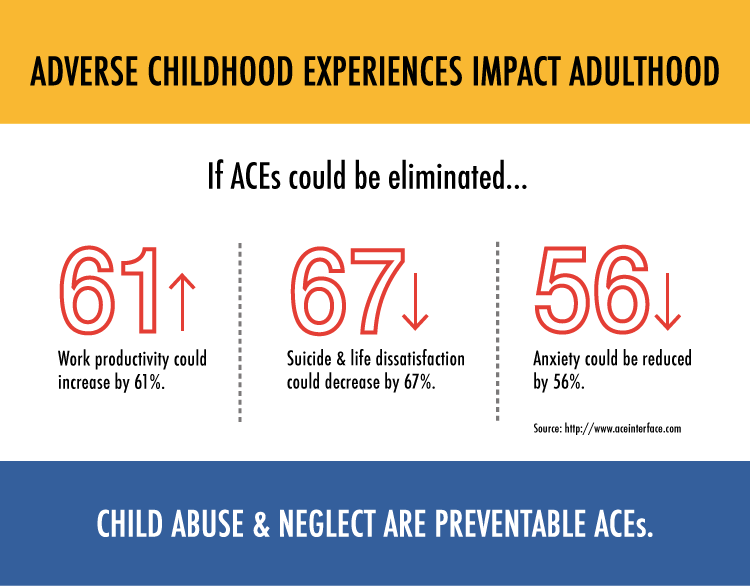
Factors such as divorce, domestic violence or having an incarcerated parent are called adverse childhood experiences (ACEs). Four or more ACEs can result in chronic health conditions such as heart disease or diabetes. In the long term, living with ACEs or other negative factors, such as poverty, can literally change your brain chemistry.

What does it look like for a young person to live with several ACEs and no supports ?  What does a foster parent experience when bringing a middle school or teenage foster youth into their home ?

It might be not being able to sleep without a light on. Or it could be eating even when one is full or not hungry. Some children become “runners” — they leave school whenever they become upset.

And the symptoms can become even worse.  The child may become a cutter; may be suicidal. Such children can have trouble forming appropriate friendships. Maybe they trash their room; in one fight-or-flight moment, climb out of their window and tumble to the ground. Even jump out of a moving car.

A foster parent could find themselves restraining the child physically by wrapping their arms around the child’s shoulders or waist, using all their strength to keep the child from leaving or hurting their self. Maybe you raised your hand only to motion toward something and the child flinched or even ducked.

And your heart breaks for this young person.  You had hoped they knew you would never hit them.  You are a foster parent.  You signed up for this because you thought you had something to give — time and care and love — to kids who desperately need that.

You might become the person the county calls when a child is removed from a home and has nowhere else to go, or when a foster family needs a break. This is known as emergency respite.

Most foster kids want to be happy.  After a lifetime of abuse and neglect, they may not know how.  A foster parent is also there to be a support for reunification with the biological family.

The best foster parents build a fortress of protective factors around their foster children. Protective factors are those things that most of us take for granted — a friend to call when we need advice; someone to help whenever we aren’t enough on our own.

Some of us are born privileged to have built-in protective factors (a supportive family, enough money).  Most foster kids will need to collect them from somewhere else (perhaps a chosen family made up of friends). At school, they require trauma-informed teachers and staff who understand how ACEs can be reflected in behavior.

National data shows that more than 20 percent of children up to age 17 have experienced two or more ACEs.  Beyond abuse (physical, emotional, sexual) and general neglect these include the loss of a parent to death, divorce and abandonment.  A family member addicted to drugs or alcohol.  A family member that is incarcerated. Being exposed to domestic violence and mental health issues among the family’s members.

Brain toxicity exists. A child can have post-traumatic stress disorder. ACEs are not limited to low-income neighborhoods, domestic violence and substance abuse take place in higher income homes and are every bit as toxic. Learn to look at all people through a trauma-informed lens. Ask, if you suspect this, “What happened to you?” and then listen without adding your own opinions.

Every domestic-violence shelter worker or child-care provider, anyone who works for child-protective services, anyone associated with family court, law enforcement personnel and physicians – ALL need to be trained appropriately to deal with trauma related behavior

Trauma is not the fault of any child.  Understanding ACE impacts allows adults to see the reason behind the behaviors.  Baby steps in a positive direction are progress.


Foster Girl

Foster care is a cause that affects you whether you realize it or not. Your tax dollars fund the care of these throwaway children in your community, and you pay for their outcomes as adults who experience homelessness, incarceration and another generational cycle of welfare.  The majority of outcomes are tragic for kinless, abused, or neglected teens that age out of the system and transition into the real world inadequately prepared.

Georgette Todd has written a book that chronicles her difficult childhood that included sexual abuse and drug use.  It could not have been easy to dig deep into all of her experiences.  Due to her effort to educate herself and make it into college, she has learned to write well.  After earning BA and MA degrees, she worked at an adoption agency.  She eventually ended up providing the youth perspective for the Alameda County Child Welfare Dept in a program called the Youth Advocacy Program. She was in charge of presenting the emancipated foster youth perspective and recommendations about department policies and practices.

Todd outlines the basic premises of the foster care system approach.  The US foster care system is far from perfect. There needs to be a systematic way to save children from abusive and neglectful homes.  The purpose of the system is to place an abused or neglected child with a safe, loving relative that lives in the child’s original community.  If proximity is not available, then the foster child will live wherever the biological relative resides. Until then, children are placed into receiving homes, emergency foster homes, or whatever facility is available.  If the social worker cannot find a biological relative to care for the child, then efforts to secure a more permanent placement take priority. Permanence can mean adoption or long-term foster care in a group home or house setting.

These are the key goals of foster care but these plans don’t always pan out. Bureaucracies don’t always work.  Unfortunately, many foster children end up in understaffed group homes and inadequate facilities. They also go into crowded juvenile halls or wind up going out on the street hustling for survival.

I selected Todd’s book because I belong to a private Facebook group called Adoption: Facing Realities.  The members are adoptees, former foster youth, expectant mothers, original parents who permanently lost custody of their child and adoptive (including those who hope to) parents.  Some find the perspectives in this group difficult.  The mission of this group is to help expectant mothers believe in their ability to raise their own children, and not to chose a permanent solution to a temporary problem.

Though adoption figures prominently in my reason for joining this Facebook group, I’ve become more aware of foster care because of this group.  And I realized I really had no real life background experience with which to understand foster care.  Though Georgette Todd’s book is only one experience among thousands, I did gain the perspective on the system by reading her full childhood experience of it that I was seeking.  The book may not be a good choice for victims of sexual abuse and former foster youth may not need to read it for the reasons I have.  If a former foster youth wishes to compare experiences, then that may be a reason.

Some related links –

Georgette has a website – www.georgettetodd.com.  She was a participant in a 30 minute documentary about the foster care experience which you can watch on youtube here – https://youtu.be/hS5JVSTf4LA.

I am not inclined to do Facebook birthday fundraisers but for this year only, I am doing one to support the work of Connect Our Kids, which I learned about at the end of Georgette Todd’s book.  They are applying technology to help social workers located extended family for displaced children that may be able to care for them.  Kinship is often, but not always, a better option for many children.  Modern families are far flung and often lose track of one another.  I set a modest fundraising goal of $200 and donated the first $25 myself.  Here’s the link, if you would like to help the cause – https://www.facebook.com/donate/310497696609444/


One Way The System Is Broken

I read a heartbreaking story today and I want to share it because not only does it illustrate something that is really not just but also that love is real and true and people can and do change.

So this woman was adopted at age 5. Her mother’s rights were terminated voluntarily because she had failed to complete her “plan”.  The woman was placed into foster care – twice.

At the time, her father was incarcerated on assault charges. Other than the fact that he had lost his temper and gotten violent, she doesn’t know anything more about the circumstances.  What she does know is that he did not get violent with her mother or any of his children.  I too understand inheriting a temper, I got my father’s much to my own surprise when I discovered that well into my 50s.

Back to my story.  The father did NOT want to give up his rights. He wanted to parent the child himself, when he was released. He wasn’t serving a particularly long sentence.  However, his rights were forcefully terminated because he was in jail.  Sadly, he was released a few months after she was adopted.

At some point, the father spoke to a caseworker.  He learned there was a prospective couple planning to adopt his child.  It is said he made threats to harm the couple planning on adopting his child.  He threatened to forcefully take his child back if he had to.

So it is said that for this reason, the adoptive parents chose a closed adoption.

Sadly, her dad maintains to this day that she was “kidnapped”.  This is an understandable perspective.

Turns out, her dad lived close by her entire childhood even though she did not know him. He remarried a few years after his release.  He went on to have 4 more children who he successfully parented. A portrait of her hung in their bedroom all the years of her childhood.  They even had a small cake to celebrate her existence on her birthday each year.

This just feels so very sad . . .