The Legacy Of Family Separation

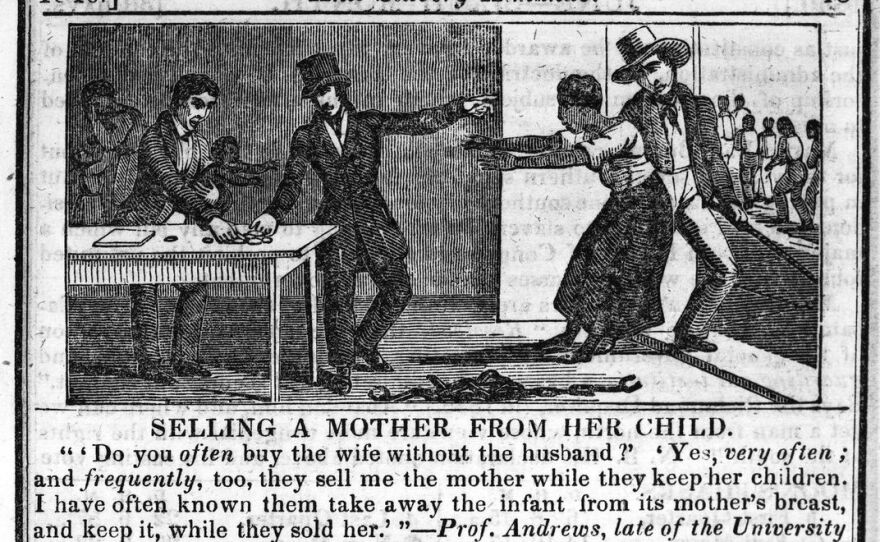
Since today is Juneteenth, a federal holiday that recognizes the date when the last enslaved persons were finally informed of their freedom, I thought about all of the children that were taken away from their parents, primarily from their mothers, during the period when slavery of Black people was common in these United States.

Black Perspectives is the award-winning blog of the African American Intellectual History Society (AAIHS). They are deeply committed to producing and disseminating cutting-edge research that is accessible to the public and is oriented towards advancing the lives of people of African descent and humanity. From the Black Perspectives website, LINK>Slavery and America’s Legacy of Family Separation by Vanessa M. Holden. Forced family separation was always a fixture of the lives of enslaved people. Enslaved children were a lucrative business. The expansion, maintenance, and future of slavery as an economic system depended on these children, particularly after the close of the American trans-Atlantic trade in 1808. 

One such story comes from Harriet Mason, who remembered her mistress forcing her to leave her home and family in Bryantsville, Kentucky, to work in Lexington as a servant at the age of seven. She remembered, “when we got to Lexington I tried to run off and go back to Bryantsville to see my [mother].” The grief of a childhood spent away from her family at the whim of her owner led her to suicidal thoughts, “I used to say I wish I’d died when I was little.” Even in her old age she was firm that, “I never liked to go to Lexington since.”

Slaveholders borrowed against their human property. They gifted enslaved children to their white sons and daughters as children, upon their marriages, or as they struck out to begin their slaveholding legacy. And of course, slave children could be sold down the road and down the river. Children knew that at any moment this could happen to them.

Blogger’s Note – Last night, my oldest son wanted to know if anyone in our family had benefitted from the labor of slaves. Eventually, it was suggested that every American has. I know that among my mother’s own genetic, biological family there were slave owners (I saw one will that was stipulating slaves by first name and who they were to be given to). I also know that side of my family also fought on the side of Confederates in the US Civil War. I’m not proud of being the descendent of these realities.

From the linked article – To profit from slavery and participate in slaveholding, Lexington’s white residents did not even need to own, buy, or sell a single slave. Someone made the shackles. Someone ran slave jails. Someone generated the official documents needed to transfer property. Someone hired enslaved children to work in their homes and businesses. Adults running with children from officials who would separate them was a feature of fugitivity during American slavery. To produce the “fugitive” category, a range of institutions sprang up. Local money paid sheriffs, courts, and officials to uphold the law that protected slaveholders’ rights to their human property. Someone printed runaway ads. Someone made money on enslaved peoples’ bodies at every juncture.

Along with physical labor, children deemed by the state to have unfit parents and placed into adoptive homes, perform emotional labor. Adoptees not only lose their birth families in the process, but they also lose ties to culture, language, country, history, and identity, and must contend with societal expectations that they be grateful for a “better life” in the face of it all. Children of color adopted by white parents also face racism in their new homes and communities. There is emotional labor too in being the physical body that allows white families to appear more liberal or multicultural, even if the opposite is true. In the United States, adoption is an industry and, as adoptee advocates continue to warn, it is poised to profit from family separation. There is already precedent for keeping children in the United States after a parent has been deported and awarding custody to American adoptive parents over immigrant parents caught up in immigration proceedings or because they were detained or incarcerated.

Black families are separated by the bond and bail system, incarceration, the child welfare system, and the criminalization of poverty. All can lead to family separation and the loss of one’s children. Child welfare advocates also recognize the link between the disproportionate number of Black children in the foster care system and the pipeline from foster care to prison.  All of these contemporary systems of power are echoes of legal and social structures that devalued enslaved parents and profited from enslaved children during American slavery.

We need to acknowledge these links to the history of American slavery and the ways that African Americans continue to endure discrimination. Following the money exposes the truth.

Field Notes from an Adoptee

This guy, Brad Ewell, now has a monthly column at lavenderluz LINK>Field Notes from an Adoptee. He also has that “mini-series” at this LINK>Empowered To Connect Podcast. There is read, “A Texas Police Officer minding his own business, Brad got a Facebook message at age 48 that completely changed his life. As he pulled the threads of his own life story, even he couldn’t have predicted the twists and turns that emerged.”

From Lori Holden’s website – Lavender Luz – Introducing Field Notes with Brad Ewell. He is a Late Discovery Adoptee. He didn’t learn he was adopted until 2019 at the age of 48. He writes – “In the four years since my discovery, I’ve reunited with much of my birth family, lost my adoptive father, hugged my biological father as he walked out of prison, lost members of my birth family, and met a lot of adoptees. I’ve also taken a hard look at adoption and how growing up adopted, and with my true story unacknowledged, may have impacted the man I grew up to be.”

It is his desire, to expand the connections he has made since then, to reach further out of the adoptee echo chamber because he doesn’t believe growth and change occur when we only talk to people who are similarly situated to us. His aim is to speak openly and honestly about adoption’s good parts as well as it’s challenging parts. He hopes to improve adoption for those we love and everyone else involved.

He invites you to email him at mpebrad@gmail.com or connect with him on Instagram: @a_late_discovery.

National Former Foster Youth Month

Cindy Olsen McQuay

I didn’t even know but my all things adoption community appreciates the voices of former foster care youth as much as it does adoptees. So I saw the graphic and then read – May is National Former Foster Youth Month. A month when former foster youth use our voices. As a demographic of the population expected to be grateful for being “saved”, it high time we spoke up and corrected the perception that society has about our situations.

When I googled it though, that was not the focus even though it should be. I saw focus on foster parents and adoptions. One year, wanting to learn more about foster care as I have no experience with the system (I only see stories about it), anyway I found a book – LINK>Foster Girl, A Memoir by Georgette Todd. That certainly expanded my awareness by seeing things through one person’s experiences as told in the written word.

In California the counties with the highest median incomes have the lowest number of children in foster care, and vice versa. The poorest counties have the highest number of children in foster care. If the stipends that are used to employ other people to care for the children of poor families were used to help create families with less generational trauma, while minimizing the stigma throughout society of being on government assistance, we as society would be wholly better off.

Please take the time this month to amplify the voices of former foster youth, listen to what we have had to endure, and consider ways in which our suffering does not have to be carried into the future.

From Chris Chmielewski, LINK>Foster Focus – I love May. I love learning what foster care groups are passionate about this year. Then June 1st will appear and we disappear from your consciousness. We go back to being the first or last story on the newscast. We become the story on your newsfeed you pass by. We fade back into the background. That isn’t the case for me. I run the nation’s only monthly foster care magazine, Foster Focus. I am a former foster kid. I care about the kids in care and the kids who age out, get too old for the state to care for, every single day. Every month is foster care month for me because it deserves to be.

He goes on to note – Kids will still enter foster care at age 9, on average, and stay in care for more than two years. Traumatized kids will still be misdiagnosed and given psychotropic medications they don’t need. There will still be kids who will attend 10 schools and move to a dozen homes while in care. Kids in care will still fuel the pipeline that is Human Trafficking. 

When they leave care, they will populate your prisons, somewhere in the neighborhood of 40-70 percent of all prisoners spent time in foster care, depending on the source. They will fill your streets. Former foster kids account for nearly 50 percent of the homeless population in this country. They aren’t going to go away just because the calendar says it is summer. The road ahead is long and filled with the obstacles that thwart progress. 

None of This is OK

And yet, there seems to be no other choice in today’s story. Everything this person tried to do – failed. The kids are now 3 and 1. Mom was incarcerated, but has since been released. She contacted this woman 7 months ago and asked her to adopt the children. She tried to convince her that her kids need her. She went into social worker mode and asked her what her barriers to parenting were. She talked to the mom about substance abuse treatment options, housing support, financial support, etc. She told her that the best place for her kids is with her. She repeatedly reassured the mom that she on her team and wanted to help her. She told the mom that she has rights and that this case is not over yet – don’t give up. She tried everything she could think of to convince the mom to come back (she’s left the state). The mom called her from an unlisted number and wasn’t in an emotional space to hear all she tried to say. She was asked to call me back in a week (this woman was hoping maybe they could then continue the conversation) but the mom has gone no contact.

The permanency hearing is now coming up in 2 weeks. Because mom hasn’t been in contact with the Div of Child and Family Services (DCFS) now for 8 months, the Guardian Ad Litem is asking for reunification efforts to cease and the goal changed to adoption. This woman has woken up to the problems in the system and previously said she was unwilling to adopt them because she didn’t want to add further trauma to their lives – she sincerely wanted them to go back with their mom or be placed with relatives but a search for family on the mom’s side has been unsuccessful.

Now she is conflicted because she loves these kids but to be honest her feeling is that adopting just isn’t ethical at this point. She even decided to close her foster care license because she no longer wants to be involved in a system that tears families apart. She told herself that she’d just see this last case through. The problem is that these kids are going to be placed for adoption, no matter what she does. If she says no, then DCFS is going to start calling other foster homes in the region and find someone who will adopt them. Another home would be strangers, as she once was. But they also may not be the same ethnicity (the kids are Mexican and so is she). The 3 year old is established in her preschool and she has formed a relationship with her therapist. More to the point – this woman does love these children, cares deeply about their needs and tries her best to be trauma-informed and listen to adoptive voices. Realistically, she knows that she can never take their mom’s place. She knows that they will likely always have a gaping wound.

She knows that simply loving them is never going to be enough. That going will be hard, lifelong work on her part. She is honestly conflicted because she doesn’t want to be a further part of a system that is actively hurting them. But not adopting them feels like a cop-out. And the very idea of passing them onto a stranger feels devastating. None of this is okay. However, she got herself into this and she is going to do whatever she has to do on their behalf.

Some Origins Aren’t Happy

Being a domestic infant adoptee is hard enough but image that you met your biological mother but were told that you were a product of rape and that she wouldn’t go into any more detail about your biological father. This adoptee would rather know the truth than always wonder. Therefore, she asks what other adoptees have done when faced with a similar situation. Did they just let it go or bet a DNA test ? She admits that her biggest fear is that 50% of my DNA is monster and that now she has passed that on to her own children.

Some responses –

I wouldn’t condemn yourself for the crimes of your origin. There’s been several studies on the impact of nurture vs nature. The best way to deal with some things in life beyond our control is to just acknowledge them. You don’t need to accept it, you don’t need to approve it. Just know it and understand what that information means to you and what you will do with it essentially.

Another shared – A very dear friend was always told she was the product of incest. She did DNA testing for other reasons and has found a whole other family that never knew she existed. It’s been difficult for her to navigate but she is glad to be in reunification. The stories we hear about us form our ideas about the world and as the stories evolve sometimes our identities and the world we see changes too.

Then there was this – I’m an admin of a large adoptee only group, and this narrative is sadly not uncommon. Now, your mother may well have been abused, however many women are so heavily shamed that they were left with invent a story that makes what they did (have sex!!) appear more socially acceptable, to them and their (judgmental) family. It’s actually more common than imagined. That said, I’d highly recommend having a trusted therapist in place before exploring – to guard your mental health no matter the outcome. Personally, my mother won’t even say my father’s name. He was a major player. AND I have a relationship with his side of the family, which I value. Take your time.

Another adoptee admitted – My biological mom told me I am the result of rape also. And I’m inclined to believe her, because that’s a heavy burden to carry and I want to believe she wouldn’t lie about it. She did, however, give me his name and I found and spoke to him, and naturally his side of the story was very different than hers. I don’t know where in the middle of both of their stories the truth is, and that will probably eat at me for my entire life.

Then this one – While my mom didn’t say she was raped, she did tell me that my father was a pretty shitty human. They started dating when she was 15 and he was 21. Two years later she got pregnant, thought they were headed to get married, but instead got blind sided by him telling her that he was already married with an infant and a pregnant wife, and that he was also heading to prison for armed robbery. I did do DNA tests and found his side. He passed about a year before I found him. I’m still back and forth on whether I wish I’d had the opportunity to meet him or if I’m relieved I don’t have to make that decision. I did find both of those siblings, along with another younger brother (yet another mom) and a bunch of nieces and nephews. As big of a surprise I was to them, they have all been wonderful and welcoming. I don’t know if this helps but I don’t regret finding all the answers.

Some more encouragement – It’s okay to feel like you deserve answers, because you do – even if the answers are uncomfortable or hard to hear her give you. DNA testing helped me find family and get a few more sides to my adoption story than the one I had initially. Your mother may absolutely be telling you the truth, and I’m absolutely not saying to doubt that. I’m also very much a “believe all women” type. But if you feel a nagging that there’s more to the story than you’re aware of, it’s okay to seek answers. Good luck.

More about the potential realities – My biological mom will not tell me any details, although I do believe her that it was rape now. It’s frustrating not to know details of who this person was, but it’s painful for her to talk about it and she said she will never tell me. I’ve done a DNA test, not specifically to find him, but I didn’t get any additional information by doing so. At the moment, I’m just letting it go.

The Cost Of Hidden Stress

The trauma that afflicts many adoptees occurred pre-language and so the source of it’s effects can seem mysterious but the impacts are very real. Today, I learned about this man – LINK>Dr Gabor Mate. It seemed to fit what I am posting so often in this blog that I thought I would make today’s about him.

For example, one of his books is titled When The Body Says No – “disease can be the body’s way of saying no to what the mind cannot or will not acknowledge.” Dr Mate also believes that “The essential condition for healthy development is the child’s relationship with nurturing adults.” And yet, time and again, I read from adoptees that their adoptive parents were really not prepared to be the kind of parents this subset of our population needed. Under Topics, he has many articles related to LINK>Trauma.

During the pandemic, in April 2021, Dr Mate hosted an online event with Zara Phillips. She is the author of LINK>Somebody’s Daughter, subtitled A Moving Journey of Discovery, Recovery and Adoption. The event information noted that adoptees and children who are fostered are over-represented in the prison system, addiction clinics and are 4 times more likely than their peers to attempt suicide. This talk considered why that would be and what, if anything adoptees and their caregivers can do about it. For many, when we talk about adoption, we talk about placing children in need, into loving homes to parents that want them. The assumption behind these conversations is that love will overcome all challenges and obstacles. What we don’t talk about, or rarely, is that the adoption in the new home comes about because another home has ended, or perhaps not even begun. We forget that all adoption is formed from loss. Love is essential but it is not enough. They discussed what it means to carry the trauma of being relinquished. How adoption is not a one-time event but has a lifelong impact. They considered how unresolved trauma can lead to addiction and suicidal thinking. Also what, if anything, an adoptee (and those that support them) can do to heal and recover.

Often adoptive parents think that their love will be enough but time and again that is proven wrong when it comes to adopted children. Dr Mate brings up the myth of the blank slate baby which Georgia Tann used to highlight in selling babies.

There is a LOT at Dr Mate’s website. I believe much that is there could prove helpful to the people who read and follow my blog. Absolutely, he is about how to heal.

Big Rage

When I was 4 and my brother was 10, our mother was sentenced to two years in prison for drugs. She was the eldest of 5 siblings (my natural father was not in picture or listed on the birth certificate). At first we bounced around to various family members. Eventually my brother went to live with our uncle and I went to live with a friend of the family. My natural mother signed the custody papers, then later the voluntary termination of parental rights, from prison with her sister (a Notary Public) signing as witness. Suddenly, at 4 years old, I had a different family. We moved to another state when I was 7 where I proceeded to live a brand new, vastly different life.

I won’t go into the rest – the court trial for custody when my natural mother was released from prison (she lost); the old money, don’t-air-dirty-laundry, only blood relatives matter mindset of my “new” extended family; the shock of moving from a major city in one state to rural farmland in another (on top of everything else); having my name legally changed as a teenager, when the adoption papers were finalized; everyone in my small town knowing my story because I had a different last name than my “parents”; reconnecting with my natural mother, natural brother, and her family as an adult and discovering they’ve always felt I was “stolen” from them.

I fucking hate it.

I hate being adopted; I hate my natural family for splitting up siblings; I hate them for giving me away to outsiders; I hate my extended adopted family for hating me, belittling my experience, telling me to be fucking grateful I was taken in by someone; I hate that I am reminded of my adoption Every. Single. Day. in large and small ways; I hate that I’m fucked in the head with no concept of normal; I hate feeling like a piece of luggage; I hate having two birth certificates; I hate people thinking I’m “playing the victim” when I try to talk about it; I hate not knowing my genetic history or where I’m from; I hate my natural mother for signing the termination of parental rights; I hate my natural brother for getting to grow up with our cousins; I hate feeling like I don’t belong anywhere, with anyone; and I HATE that I cried while writing this because after 40 years it still hurts so much.

So much hate inside me. Big Rage. But I am more than that, I have just as much love. A bundle of strong emotions. I’ve always said I feel like I was born without skin – just raw nerve endings exposed to the world.

Adoptee Jodie Sweetin

I will admit that I didn’t know who this woman was nor did I ever watch Full House. That said, today I learned that she was adopted and has now spoken out about her adoptive family. I read that Full House portrayed the perfect life, the perfect kids, as well as the most perfect parents one could hope for. Jodie Sweetin played the adorably sarcastic Stephanie Tanner on the much-beloved family sitcom. She also starred in some Hallmark movies. Years later, after Jodie was all grown up, she reprised her role on the Netflix revival series Fuller House.

At the time of Jodie’s birth, both of her biological parents were incarcerated. Her original mother was a struggling addict. Her father was killed in a prison riot before Jodie ever had the chance to meet him. Recently, she made an appearance on Olivia Jade’s ‘Conversations’ podcast and opened up a lot about her life. “My dad, Sam, my adopted dad, his ex-wife who he had three adult kids with when they adopted me, she was my biological father’s aunt,” Jodie explained.

Janice was his second wife and they were hoping to start a family but were having troubles with conception. Because of her original parents’ circumstances, Jodie was in dire need of a family and Sam and Janice wanted a child of their own and so, fates aligned and roughly one year later, the adoption was finalized.

The adoption began fostering feelings of hurt and rejection. In her younger years, she used to think “‘Oh, something was wrong with me.’ There’s this point in your life where you finally kind of realize what happened,” Sweetin said. “That it no longer becomes something about you, that it’s like, ‘Oh, I wasn’t wanted.’ ”

Intrafamily adoptions are incredibly common and even preferred. An intrafamily adoption is a specific type of adoption that allows a family member to adopt a child. This is a streamlined kind of adoption. “People don’t really talk about it, because I think there’s this weird sense of shame, if there’s an interfamily adoption,” Jodie said.

Having resolved some of her emotions around adoption, currently Sweetin says, “They actually made the healthiest decision for me by allowing me to be adopted by another family that could provide better.”

Jennifer Teege’s Horrifying Discovery

Jennifer Teege (B&W photo of Amon Goeth)

When Jennifer Teege, a German-Nigerian woman, randomly picked up a library book off a shelf, her life changed forever. Recognizing images of her mother and grandmother in the book, she discovered a horrifying fact that no one had ever shared with her: Her grandfather was Amon Goeth, the vicious Nazi commandant depicted by Ralph Fiennes in Schindler’s List, a man known and despised the world over.

Although raised in an orphanage and eventually adopted, Teege had some contact with her biological mother and grandmother as a child. Yet neither revealed that Teege’s grandfather was the Nazi “butcher of Plaszów,” executed for crimes against humanity in 1946. The more Teege reads about Amon Goeth, the more certain she becomes: If her grandfather had met her—a black woman—he would have killed her.

Teege’s discovery sends her, at age 38, into a severe depression. My Grandfather Would Have Shot Me: A Black Woman Discovers Her Family’s Nazi Past details her quest to unearth and fully comprehend her family’s haunted history. Her research takes her to Krakow—to the sites of the Jewish ghetto her grandfather “cleared” in 1943 and the Plaszów concentration camp he then commanded—and back to Israel, where she herself once attended college, learned fluent Hebrew and formed lasting friendships. Teege struggles to reconnect with her estranged mother, and to accept that her beloved grandmother once lived in luxury as Goeth’s mistress at Plaszów.

Ultimately, Teege’s resolute search for the truth leads her, step by step, to the possibility of her own liberation. The chronicle of her struggle with her haunted past unfolds in her memoir My Grandfather Would Have Shot Me, co-written with journalist Nikola Sellmair and newly translated from German.

Teege visits her grandparents’ house in the Płaszów neighborhood of Krakow, Poland. It is the only dilapidated house on quiet Heltmana Street. And she writes – there is a coldness that creeps into your bones. And a stench. 

Over a year has gone by since I first found the book about my mother in the library. Since then I have read everything I could find about my grandfather and the Nazi era. I am haunted by the thought of him, I think about him constantly. Do I see him as a grandfather or as a historical character? He is both to me: Płaszów commandant Amon Goeth and my grandfather.

When I was young I was very interested in the Holocaust. I went on a school trip from Munich to the Dachau concentration camp, and I devoured one book about the Nazi era after another, such as When Hitler Stole Pink RabbitA Square of Sky and Anne Frank’s Diary of a Young Girl. I saw the world through Anne Frank’s eyes; I felt her fear but also her optimism and her hope.

You can read the entire piece my blog came from in – my Jewish Detroit. I have a smidgeon of Ashkenazi Jew in my DNA and have always felt drawn to Jewish culture. I would like to read her book sometime. Also because I am interested in learning more about the experience of Black people. In the USA, we have much to learn and white supremacy is a threat, slavery still exists only now the plantations have been replaced by prisons.

Kinship Adoption

Jamie Foxx with Grandmother Talley

Jamie Foxx was born Eric Marlon Bishop (1967) in Terrell, Texas, to Louise Annette Talley and Darrell Bishop, who worked as a stockbroker and had later changed his name to Shahid Abdula. His mother was an adopted child. At just 7 months old, he was is abandoned by both his parents, leaving him to be raised and officially adopted by his maternal grandparents, Mark and Esther Talley. His grandmother had a profound impact on her adopted son and Foxx credits her as being inspirational.

“My grandmother was 60 years old when she adopted me. She ran a nursery school and had a library in the house. She saw me reading early, saw I was smart and believed I was born to achieve truly special things,” Foxx said of his grandmother. He has said that he had a very rigid upbringing that placed him in the Boy Scouts and the church choir and started piano lessons at the age of three at his grandmother’s insistence. Although strict, Estelle undeniably provided Jamie with a loving and nurturing home and was an incredible support to him. He was appreciative that his grandmother was there to give him the care and support he needed to become successful in life but, that never stopped him from wondering about his biological parents and why they left him. It was a constant struggle to comprehend that they never reached out to him. Jamie was only seventeen when his grandfather, Mark Talley, died. Estelle Talley died in October 2004 at the age of ninety-five.

Foxx had difficulty forgiving his birth father, seemingly unable to put his grievances with the man to rest, despite attempts at reconciliation. Foxx did successfully reconcile with his biological mother and also developed a bond with her husband, George Dixon, the stepfather who Foxx refers to as his “pops”. It was interesting to find our that Foxx’s grandparents had also adopted his birthmother. I have long noted that adoption tends to run in families. That is certainly true in my family.

His relationship with his birth mother has progressed quite far since the days when she was unable to care for him. She has been living together with Foxx in the same house for quite a while along with his stepfather. His relationship with his stepfather was an inspiration for the character of Walter McMillian in the movie Just Mercy. His father was incarcerated unjustly for 7 years. It was this that sparked the beginning of their living arrangement. He sent his father a letter while he was in prison promising to rescue him from the situation he was in when he was finally released from prison. That is a promise he has kept even though his mother, Louise and Georg had divorced. They both continue to live with him today.