The Worst Racism

Jenni White, columnist at The Federalist

I learned about Jenni White while reading White Tears/Brown Scars by Ruby Hamad. White has caused a bit of a stir with her column – “The Worst Racism My Children Have Experienced Came from Black Peers.” So I went looking because I also read that she had adopted 2 daughters from Zambia.

Hamad wrote – White claimed to be raising her daughters in a house that does not see color and wrote, “Why would I raise them to identify with a specific race as if being members of the human race weren’t enough?” Hamad says, It is as if she believes that racism will disappear, if only Black people stop calling themselves Black ?

What White defined as hideous racism included their Black pastor asking her whether she was educating the girls about their culture. While she claims to be a staunch believer in Martin Luther King, her perspective is that once her daughters were brought to America, “they became Americans. Not African-Americans, not black girls.” Hamad judges that assimilation and absorption into the default that is whiteness continues to be the frame from which many white women view women of other races.

So, now I will read Jenni White’s column and share with you what I think about it. She begins with the story of McKenzie Adams, a fourth grader from US Jones Elementary School in Demopolis, Alabama, who was despondent after relentless taunting by other black children for her relationship with a white child. McKenzie hanged herself in her family’s home. White acknowledges that suicides which are the result of school bullying have risen steadily over the years, it was McKenzie’s death that spoke to her on a very personal level.

She goes on to share how she ended up adopting her daughters. “In the summer of 2005, while visiting my grandparents in the northeast, my husband and I met up with my cousin, an international teacher, and his new wife, whom he’d met while teaching in Zambia, Africa. In recounting her history, Justina told us of the very recent death of her sister and how her 21-year-old nephew was struggling to feed and care for five siblings as young as 2.”

She admits that “We knew that adopting two little girls (4 and 9) from the other side of the world into a family of two boys (4 and 2) wouldn’t be easy in terms of bonding and re-assimilating the family birth order structure, but it was the stuff like what little McKenzie Adams experienced that we didn’t see coming, and it quickly blindsided me.”

So, the Black pastor incident occurred in a grocery store. The pastor is a Black woman. The pastor talked about how important it was for White to get the girls subscriptions to “black” magazines and to make sure and watch “black” movies and TV shows so they could see and relate to people of their color. She felt that, Jenni, as a white woman, couldn’t be expected to understand the “black experience” in America. That she needed to be sure and make appropriate and relevant material accessible so the girls could better assimilate with black culture.

White responded about raising all of her kids as Americans. The pastor believed White’s thought process was unfortunate. Her “whiteness” would be unable to process the facts that her girls’ fate would always balance at the pinnacle of someone else’s prejudicial small-mindedness. The pastor felt strongly that it was up to White to make the girls aware of the discrimination that was sure to come their way.

White brings her story up to date by writing – Today, my daughters are 21 and 16. She writes that it continually shocks her that any real racism her children have encountered has come from their black contemporaries. She also admits that the 21-year-old had enough of an emotional struggle that she returned to Africa to live with her brother and finish high school. Then, the girl did come back to Oklahoma after graduation, joined the National Guard, and began college with the intention of becoming a nurse.

She goes on to describe the other girl as innately conservative and that she struggled with the constant racial politics in her college English class. The girl had been assigned to write a paper regarding disproportionate brutality by police toward black Americans. White says that her daughter is frustrated that so many black contemporaries have razzed her because her last name is White and she was adopted by a white family. When Jenni asked her how she dealt with that kind of thing, she just shrugged her shoulders and said, “What are you going to do?”

She shares a story about when a Black boy called her older daughter the n word. She told him she was in no way an “n-word.” He answered, “Hey, we’re both from Africa.” Her response to that was “I’m from Africa. You’re from Oklahoma, and I’m no ‘n-word.’” Her daughter also said that this same kid has mocked her about hanging around white kids, including her white boyfriend, who is also on the football team, as well as acting and speaking like she is “white.”

Jenni White says that she follows the Blexit movement. I had never heard of it. They are clearly against CRT (Critical Race Theory) since they indicate that on their home page and I have included their link to that document. I am not going to read all 24 pages. The document seeks to explain CRT this way – Critical Race Theorists … believe that people of color experience racism daily … that the majority of American society, or more specifically white people, have no interest in stopping this so-called oppression because it benefits white Americans. The Blexit movement claims their intention is to uplift and empower minorities to realize the American Dream. In truth, it is only that so far – a dream unrealized for most.

I’m white. I do not raise any black children and I do have strong feelings about the adoption of children of color by white adoptive parents. I really can’t judge anyone else, including Jenni White, regarding how parents decide to raise their children. It is a complex world. I grew up with no racial bias, even though I am white, because both of my parents were adoptees with no knowledge of their genetic origins. We were raised only knowing we were Americans. I used to joke that I was an Albino African because back then, even I didn’t actually know for certain. My mom did discover she had a smidgeon of genes from Mali when she had a DNA analysis done. I can agree with Jenni White’s hope – that someday differences are celebrated within the context of the whole, and not parsed out as weapons of contention and conflict.

Colorblind Idealism

There seems to have been an evolution among some citizens in the United States to realize that racially colorblindness isn’t really the answer to racism. In the evolution of adoption and in an attempt to get some children in foster care placed in stable homes, transracial adoption was seen as the answer. As some of these adoptees have reached adulthood, they are increasingly speaking out about why growing up black in a predominantly white community and school has proven challenging, even difficult for them.

Recently The Washington Post had an article by Rachel Hatzipanagos that focuses on transracial adoptees – I know my parents love me, but they don’t love my people. A few years ago, there was a Medium piece – The Myth of Colorblindness by Rosa Perez-Isiah.

For adoptees, their adoptive parents couldn’t see and rarely talked about the racism they experienced. Classmates’ racist comments about their hair and eyes were dismissed as harmless curiosity. America’s racial dynamics were explained in the language of “colorblind” idealism. 

In her Medium piece, Perez-Isiah says – Colorblindness is the belief that we don’t see color or race, that we see people and that we are all the same. These beliefs are widely held by well intentioned people, including educators and school leaders. These are idealistic beliefs and there are a number of issues with this ideology. Colorblindness negates our diversity, race and culture because we all see color and we all have biases. When we identify as colorblind, we are suppressing our authentic views and in the process, perpetuating systemic racism. Race matters and it has impacts on opportunities, education and actual income (as well as its future potential). Colorblindness oppresses people of color. When you fail to see color, you fail to acknowledge the current narrative, a system of injustice for many non-white people.

Cross-cultural adoptions have been debated for decades. In 1972, the National Association of Black Social Workers took a strong stand against the adoption of Black children by White parents. Several years later, the federal Indian Child Welfare Act was passed to address the wave of Native American children being separated from their tribes and placed with White families.

The growth in transracial adoptions from foster care in recent years has far outpaced the growth in same-race adoptions and transracial adoption is now 28% of all domestic adoptions in the United States. More recently, the national conversation about systemic racism (driven by George Floyd’s death in 2020) has cast a new light on interracial adoption and prompted transracial families to confront the unspoken cultural divides in their own homes.

For adoptees, there is a transracial adoption paradox. Growing up, they experience many of the privileges that come with Whiteness because of their adoptive parents. When they then enter the school system or move out of the family home to live independently as adults later in life, they’re confronted with the reality of being perceived and treated as a racial minority. Not so subtle is the experience of white students putting their pencils in the hair of a Black student and marveling at the way the texture makes them stay in place.

When adoption agencies take on a color-evasive approach with hopeful prospective adoptive parents, they signal to these white parents that race does not need to be a significant factor in their decision-making. Then, by extension, it is no surprise that these adoptive parents might not think that the race of their adoptees is a significant factor in raising their child. Often these parents naively hope their support will make up for racial difference, even when they acknowledge there are challenges in raising a child of a different race.

From a transracial adoptee – “I believe that a lot of people think that adoption is this beautiful, magical, straightforward process. And also when they think of adoption, that they are centering around this “White savior” image and focusing on adoptive parents more than adoptees. And/or birth, biological parents — those two seem to get left out of the narrative a lot. I also believe that adoption from a birth mother, birth parent perspective can be very intense, very complex, very emotional. And I believe that we need to lean in and listen to adoptees and birth parents more.”

Today, many adoptees have their DNA tested, either at Ancestry or 23 and Me. For an adoptee that was raised white, it can be an amazing experience to discover their father is Black and see somebody that looks like them, finally a true racial mirror. One mixed race adoptee notes – “I think a lot of White people think that they have a good handle on race … and have what they would call a ‘colorblind’ kind of mentality. But I don’t think they understand that when you say the word ‘colorblind,’ what I hear is ‘I see you as White’.”

Another transracial adoptee suggests – “I think first acknowledging that your child is not White is, like, a huge step for a lot of White adoptive parents is to, like, see outside. Because a lot of parents see their child as, this is just your kid. They don’t see them in racialized terms. But in seeing them in that colorblind way, you are not protecting them. You are not preparing them to grow up and be an adult.”

Adoption is a trauma. Every adoptee has a different response to their trauma. Often it takes therapy to understand what was experienced as a pre-verbal infant and more importantly, how it continues affecting the adult adoptee. Therapy can help an adoptee get over feeling defective simply because they were given up for adoption. It can require learning that babies are placed for adoption for a number of reasons and that none of those reasons have to do with the baby or the value of that baby regardless of their skin color. The adoptee, not the adoptive parents, needs to be the center of their own life and story. Much of the narrative around adoption centers on the adoptive parents and frames their actions as selflessness and saving a child.

One Black adoptee admits –  I longed, and continue to long, to understand why I needed to be adopted, why I needed to be shipped across the country, why I couldn’t stay in the South, why I couldn’t stay with Black families, why I couldn’t have stayed with at least my biological extended family.” And though I am white and my mother was white too, this is a universal need in adoptees. My mom’s genetic, biological family was in the rural South and she was taken by train from Memphis to Nogales Arizona by her adoptive mother. For a long time, my mother believed she had been born in Memphis, a belief her adoptive mother was also led to believe by Georgia Tann, until birth certificate alterations made clear my mom had been born in Virginia which just made my mom believe she must have been stolen from her mother because things like that happened with Georgia Tann’s adoption practices.

Sadly, the saviorism of white adoptive parents is just so prevalent. Unfortunately, there is a deep-seated belief that white people can take care of Black people better. I have been learning a lot about this in overall society by reading White Tears/Brown Scars by Ruby Hamad.

I end today’s blog back where I started with the issue of colorblindness – Why is the colorblind narrative popular? The Medium piece notes – it is easier to identify as colorblind than acknowledge differences that make us uncomfortable. This is easier for people to handle, especially in schools where we may lack the information and guidance to have difficult conversations about race. Another reason is simply not knowing…you don’t know what you don’t know. Many people also repeat what they’ve been taught and fail to reflect or question those beliefs. In the end, we don’t realize how harmful the myth of colorblindness can be.

Adoption is a challenging situation regardless – add in racial differences and it becomes doubly so. It takes courage and practice to shift from a colorblind to a color BRAVE ideology.

Like Many, Learning As I Go

Clearly, I did not for see all of the criticism that I was getting myself into but I did note that it was “a difficult topic to discuss in a politically correct manner”, so I did have an inkling. Five women expressed a problem with yesterday’s blog. There were literally hundreds of comments posted on the question thread. My blog yesterday attempted to acknowledge I am the product of a different time than the one I am living in now. I also posted a link to that blog in my all things adoption group. This caused my blog to have 10 times more views than any I have ever written here but no comments were left on the blog itself that I know of today.

Without apologizing for viewing the culture I was raised in positively, and I do continue to raise my own children within the same kind of family structure, I was shocked by the accusations of homophobia made against me within my all things adoption group simply for believing in the value of that culture as applied to child-rearing, a culture that includes both male and female role models. Please note – this does not exclude same sex couples but those do need to include extended family to provide examples of each gender, for a child growing up within that culture.

Needless to say, the increase in young people who refuse to embrace a gender identity (non-binary) is a trend for humanity that I don’t expect to end. It is a good response. Making a significant point about how gender is actually a meaningless distinction except in actual procreation. I completely agree with that stance. I have enough life experience to know that sex is sex, regardless of the forms it takes, though rape is something else entirely and about power over another human being. I am also aware that many young people do not intend to parent or have children. Many of my friends, who are in my same age group, lament not expecting to enjoy having grandchildren. Just as with abortion and now the pandemic, these are circumstances that have pushed back concerns about over-population.

Certainly, my family and my dearest friends include people who identify as gay and they are all loved by me just as any other family member or friend is. I see their humanity and accept them as they present themselves to be. For that, I was told to STOP tokenizing my gay family and friends. You sound like the obviously racist people who say “I can’t be racist, I have a black friend.” That was not my intent but I know, life is like this now. Sometimes we can’t undo perceptions, regardless of where our heart actually is. I accept the impossibility of doing so. Social media is a difficult place to even attempt that.

It was also said of this blog that on the whole the writing was disjointed and convoluted making it difficult to discern its intentions.

So I will make clear – my intention regarding the adoption related values most important to me – that were raised by this question that was asked – What are your thoughts about the Buttigieg’s impending adoption?

Adoption causes trauma by separating a baby from its gestational mother. Surrogacy does the same thing.

I support family preservation. This includes financial and emotional support, so that mothers can raise their own children. If a child does need the care of people who they are not born of, for all of the reasons usually given including abuse or neglect, this can be provided without changing their name and parentage from that shown on their original birth certificate. Birth identity matters.

In the case of the Buttigiegs their intention is to remain anonymous. I doubt that is going to succeed in the long run, though actual results will be the proof. The press will turn over every stone they try to set in order to reveal the child’s origins.

In a Washington Post article it was written – “The couple, who have been married for three years, had been trying to adopt for a year, taking part in parenting workshops. They were on lists that would allow them to receive a baby who had been abandoned or surrendered at short notice and also were seeking to be matched with a prospective mother.”

So to be clear, I like the former mayor, now cabinet member, Pete Buttigieg well enough, what little I actually know about him. But the language used in the couple’s announcement included lots of red flags for anyone interested in adoption reform. And the fact that they’re pursuing domestic infant adoption is precisely what I object to the most.

Research indicates that children with same sex parents have strengths and unique challenges. I found this article in an attempt to add some reality to my own thinking – “Same Sex Parents and Their Children“. It notes that between 1 and 9 million children in the United States have at least one parent who is lesbian or gay. There are approximately 594,000 same-sex partner households, according to the 2000 Census, and there are children living in approximately 27 percent of those households.

Adoptees definitely have unique traumas and I do have concerns about this particular couple’s ability create a totally positive outcome, from the trauma they will cause by the adoption of a baby. I would have the same concerns regardless of the sexual orientation of an adoptee’s parents.

Always An Adoptee

Advice from an adoptee – If/when your adopted child says anything that you deem “negative” about their adoption, instead of just throwing around frequently used adoption phrases – please please please consider the long term affect of hearing some of these phrases

1. “Would you have rather stayed in the orphanage/on the streets, been aborted, would you rather have died?”

Yes, sometimes. Adoption is complex and complicated. Sometimes I wish I wasn’t here instead of enduring nights of sadness, depression, suicidal ideation, intrusive questions, all the unknowns, the mental health problems .. I will never stop being an adoptee. It affects EVERYTHING in my life

2. “God/We saved you from your biological family.”

Let us decide that. What was I saved from? I do not know. There are many things adoption has NOT protected me from. So please let me decide in what ways I was saved. It may shift and change. Also, please don’t say negative things about our biological families. Give us the FACTS that you know and allow us to decide where to place them in our hearts and lives. Y’all don’t get to decide if our biological families are good or bad. Many things I was told about my biological family ended up being racist, unkind, untrue, and problematic.

3. “You were chosen”

Maybe. Kinda. But often, not exactly. My adoptive parents chose me between 2 babies. I was laying beside another baby and they chose me. But if they had decided “no, she’s not for us” they would have found another baby – easily. Adoptees often feel like replacements. We know a lot of our parents wanted A BABY – not necessarily “us” specifically. We have to process that – please allow us the space and time to do so

4. “They loved you so much they decided to give you up.”

No. What about desperation? Survival? Poverty? Lack of resources? Addiction? Death? Would you give up your child because you loved them? I was not given up out of love but I was raised to believe so. It made me feel awful about myself and my biological sister (she was not “given up”). Does loving someone mean sending them away forever? Would my adoptive parents do the same because they loved me?

5. “Be grateful for what you have. Be grateful you are not dead/alone/orphaned/poor/etc. You are so lucky to have a loving, stable family.”

STOP telling us how to feel and what aspects of our lives to feel good about. Especially in response to something we have said, please don’t.

Please Imagine losing your mom at a young age and when you tell someone, they say “Wow but you should be so grateful that you still have…” or “You are so lucky that you have a family that loves you!”

How about “I am sorry for your losses and pain. How can I help without overstepping?”

There are days I would rather be dead than adopted. Days when I miss my biological family. Days that I want to return to a place I barely remember. Those are not the times to dismiss an adoptee’s feelings. Imagine how you’d feel hearing these responses.

All You Can Ever Know

Nicole Chung

With Asians on my mind this morning, I stumbled on this book when an essay in Time magazine titled “My adoption didn’t make me less Korean” got my attention. I can not locate a digital link for this (I will share some excerpts – her own words about being Asian at this fraught time – later in this blog). In my all things adoption group, there have been a number of Korean adoptees. The international adoption of Korean children by Americans was the result of a large number of orphaned mixed children from the Korean War after 1953. That is not Nicole’s story.

In looking for her book, I found a New Yorker review by Katy Waldman – Nicole Chung’s Adoption Memoir, “All You Can Ever Know,” Is an Ode to Sisterly Love. Like many adoptees, her parents believed she was a gift from God. Like many transracial adoptees, growing up among white, Catholic Oregonians in the eighties and nineties, students teased her for being adopted and for looking “different.” 

Her adoptive mother couldn’t tell her much about her original parents. They “had just moved here from Korea” and “thought they wouldn’t be able to give you the life you deserved.” This brief story, one of love and sadness and altruism, “may be all you can ever know,” her mother told her.

After a protracted and unglamorous process of filing paperwork and wrangling lawyers, she finally uncovered the reality of her original genetic family, the Chungs. She discovered an older sister, Cindy. Sadly, her sister had been physically abused by their natural mother. She learned that her parents are divorced and not speaking to one another. Her birth father had told Cindy that Nicole had died. 

Nicole explains why having a baby mattered to her so much, “I wouldn’t be alone anymore. There would be someone who was connected to me in a way no one else had ever been.” For her memoir, Chung wanted to explore “the quiet drama of the everyday adopted experience.” 

Remembering the fiction she scribbled down as a kid, Chung writes that she “found a measure of previously unknown power” in envisioning “places where someone like me could be happy, accepted, normal.” 

From Chung’s Time essay – What her adoptive parents struggled with was to fully and consistently see and understand her as a Korean American woman. She doesn’t blame them for this, she notes – “Acknowledging it flew in the face of everything ‘experts’ had told them when they adopted me in the early 1980s – the adoption agency, the social worker, the judge had all maintained that it wouldn’t, shouldn’t matter.” She shares the things they would say to be color-blind with her.

She also notes – “Often, people who’ve read my memoir will note my white family’s ‘color-blind’ approach and ask whether this led to me thinking of myself as white. My answer is always swift, unequivocal: no, I never thought I was white.” However, she goes on to say her adoptive parents did “assume that I’d be protected from racism because the world would see me as they did – their child, no more, no less – and as my race was irrelevant to them, they could not imagine anyone else caring about it either.”

She says, “While my adoptive family saw me as almost raceless and therefore safe from racists, I lived every day from the age of 7, when I heard my first slur from a classmate, understanding that my Korean face made me hypervisible where we lived – and that it could also make me a target.”

This startled me. I cannot imagine children that age knowing racial slurs. Then, I remember reading once that children learn racism in the family. I thought about WWII, the Korean War and more recently the Vietnam War. I could believe that some returning veterans, having done battle with Asians, might have brought bias home with them.

Chung describes how from the start of the pandemic and racial scapegoating, she has thought of other Asian American kids growing up in white families and white spaces, even as she knows their experiences are not interchangeable. She says, “I know it can feel like a unique burden when you witness or experience racism in a kind of isolation, unable to retreat and process your rage or sorrow with people who also know what it’s like to live in an Asian body.”

She speaks of the experiences of transracial adoptees – “asking, sometimes begging our adoptive relatives to acknowledge our experiences; to stand with us; to challenge the racism endemic in our society as well as our own families and communities.”

Her adoptive parents have died. She says, “I’ve had to accept that there are questions I’ll never get answers to, things we’ll never be able to settle. That my parents didn’t entirely understand or accept my racial reality will always be with me, part of my adoption story.”

In her final thoughts she says, “I know the last thing either of my parents would have wanted was for me to despair, or live my life in fear. And so, for their sake and my own, I won’t.”

White Fragility

This is a very personal post about me and my daughter. We got into a huge fight last night over the n-word.

We were driving in the city listening to her songs. I personally found the songs disgusting and demeaning to women. Every other word was p—-y, Ho, b—ch and especially nig-er. Not nig—a. But nig-er.

To me there’s a huge difference. And I told her that NO ONE, black or white, should ever use that word. I also told her that I think it’s disgraceful to hear singers use it in their songs.

My daughter told me that I was acting like a racist. She said white people can’t use the word. But that black people can because they are taking back the word. They are taking ownership of the word.

I have no clue what that means. And if I’m wrong I’ll be the first to admit it. But I think using that word under ANY circumstances is wrong. And that includes rap stars.

I’ll be blunt. I think the way these rap stars talk about women is despicable and demeaning. They are NOT ho’s, bitc—s, and nig-rs.

They are beautiful women who deserve our respect.

So, wonderful that he cares about this young woman and wants her treated well. But it appears that he’s trying to tell her she can’t use words from the culture she’s scrambling to belong to because she’s been raised outside of it ? If you are the Caucasian parent of a Person of Color, it matters not what way, shape or form, it is NOT your place to tell your children about their own culture or what is racist to them. As a parent, it is ESPECIALLY your job to listen.

Forced Sterilization

In China –

A teacher coerced into giving classes in Xinjiang internment camps has described her forced sterilization at the age of 50, under a government campaign to suppress birth rates of women from Muslim minorities. Qelbinur Sidik said the crackdown swept up not just women likely to fall pregnant, but those well beyond normal childbearing ages. Messages she got from local authorities said women aged 19 to 59 were expected to have intrauterine devices (IUDs) fitted or undergo sterilization.

In 2017, Sidik was 47 and her only daughter was at university when local officials insisted she must have an IUD inserted to prevent the unlikely prospect of another pregnancy. Just over two years later, at 50, she was forced to undergo sterilization. When the first order came, the Chinese language teacher was already giving classes at one of the now notorious internment camps appearing across China’s western Xinjiang region.

She knew what happened to people from Muslim minorities who resisted the government. In a Uighur-language text message that she shared, local authorities made the threat explicit. “If anything happens, who will take responsibility for you? Do not gamble with your life, don’t even try. These things are not just about you. You have to think about your family members and your relatives around you,” the message said. “If you fight with us at your door and refuse to collaborate with us, you will go to the police station and sit on the metal chair!”

In the US –

Dawn Wooten, a nurse working at an ICE detention center in Georgia, made startling allegations about the treatment of the women detained there. Wooten filed a whistleblower complaint against the agency last Monday.

Natalia Molina has written about the history of forced sterilization. There’s a shameful legacy of US officials ordering operations on people without their consent — often disproportionately targeting people of color — with laws driven by racism and cloaked in terms about mental health and fitness. There’s a long history affecting many different racial and ethnic groups, across many institutions — mental health hospitals, public hospitals and prisons.

The ICE allegations can be seen as a recent episode in a much longer trajectory of sterilization abuse and reproductive injustice.

Back in 1907, Indiana passed the world’s first eugenics sterilization law. 31 other US states followed suit. Women and people of color increasingly became the target, as eugenics amplified sexism and racism. The laws, which led to officials ordering sterilizations of people they deemed “feeble-minded” or “mentally defective,” later became models for Nazi Germany.

Under those laws, about 60,000 people were sterilized in procedures that we would qualify today as being compulsory, forced, involuntary, and under the justifications that the people who were being sterilized were unfit to reproduce. In California, people of Mexican descent were disproportionately sterilized. And in North Carolina, Black women were disproportionately targeted. Most of the state laws were repealed by the 1970s. But their history is something states are still reckoning with.

Could progressives become the next target upheld by a very conservative Supreme Court ? One hopes not but with the craziness that is overtaking the US, one can no longer predict how outrageous an unethical policy might be and still be upheld in the coming future. What has been done, cannot be undone, but we should never be silent about injustice and abuse. We can stop turning our heads away because it is someone else’s problem.

Never forget, social ideas can be twisted in order to promote dehumanization. Like the Muslim ban Trump ordered shortly after his inauguration.

The Story of Haitian Adoptions

God’s Littlest Angels, an orphanage in Pétionville, Haiti

Since the subject has come up, I thought I would look into this.  The January 12 2010 earthquake that devastated Haiti’s capitol set off an international adoption bonanza in which some safeguards meant to protect children were ignored.

The current Supreme Court nominee Amy Coney Barrett adopted John Peter, now age 13, was adopted by her in 2010 when he was 3 years old, after the devastating earthquake in Haiti.  Ibram X. Kendi tweeted, “Some White colonizers ‘adopted’ Black children. They ‘civilized’ these ‘savage’ children in the ‘superior’ ways of White people, while using them as props in their lifelong pictures of denial, while cutting the biological parents of these children out of the picture of humanity. And whether this is Barrett or not is not the point. It is a belief too many White people have: if they have or adopt a child of color, then they can’t be racist.”

John Lee Brougher from the NextGen America PAC tweeted, “As an adoptee, I need to know more about the circumstances of how Amy Coney Barrett came to adopt her children, and the treatment of them since. Transracial adoption is fraught with trauma and potential for harm.”  And I really hoped that Trump would have picked the judge from Florida that was on the short list for diversity reasons but I knew he didn’t care one whit about diversity.  He does care about the Evangelicals (many of whom promote international adoptions) and their desire for ultra-conservative judges.  From that perspective, of course Coney Barrett was a given and that has proven out.  A group of Evangelicals were reported in the Oval office the morning before the official announcement.

The Obama administration responded to BOTH the crisis and to the pleas of prospective adoptive parents and the lawmakers assisting them, by lifting visa requirements for children in the process of being adopted by Americans.

Although initially planned as a short-term, small-scale evacuation, the rescue effort quickly evolved into a baby lift unlike anything since the Vietnam War. It went on for months; fell briefly under the cloud of scandal involving 10 Baptist missionaries who improperly took custody of 33 children; ignited tensions between the United States and child protection organizations; and swept up about 1,150 Haitian children, more than were adopted by American families in the previous three years, according to interviews with government officials, adoption agencies and child advocacy groups.

Under humanitarian parole, adoptions were expedited regardless of whether children were in peril, and without the screening required to make sure they had not been improperly separated from their relatives or placed in homes that could not adequately care for them.

Some Haitian orphanages were nearly emptied, even though they had not been affected by the quake or licensed to handle adoptions. Children were released without legal documents showing they were orphans and without regard for evidence suggesting fraud. In at least one case, two siblings were evacuated even though American authorities had determined through DNA tests that the man who had given them to an orphanage was not a relative.

I’m sure there will be more about these circumstances in the coming days.  To inform yourself about the matter, you can read about the free for all Haitian adoptions after the 2010 earthquake in the New York Times – “After Haiti Quake, the Chaos of U.S. Adoptions“.

Why Would She Say This ?

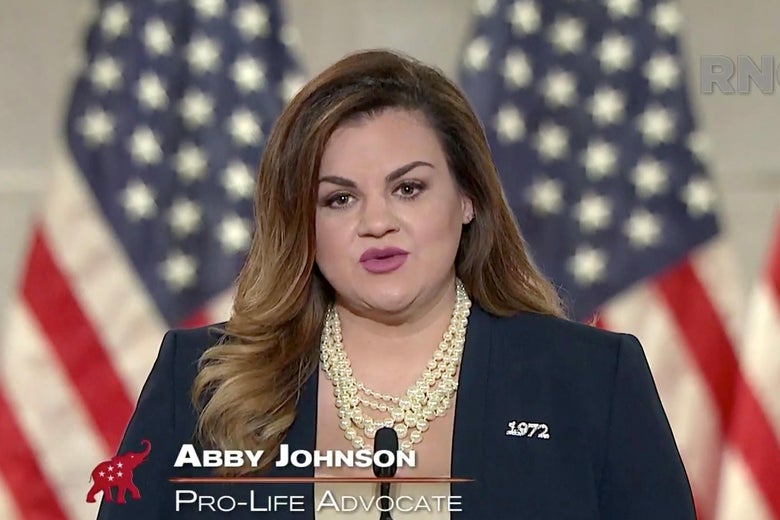
Though Abby Johnson is best known for her anti-abortion activism, I am mystified by what I learned.  How could she say this ?  Not entirely leaving aside the problematic situation of this white woman raising a Black son born to a Black mother or father (however that came to pass).  So okay, he isn’t 100% Black, he’s biracial but a lot of white people lump them together equally.

The speaker at the current RNC convention said that the police are “smart” to target her ADOPTED Black son because he is “statistically” more likely to commit a violent offense.No wonder Black people are more likely to die during encounters with law enforcement, if this is the prevailing point of   view.

Admittedly, Abby Johnson is a controversial figure. She has a long history of making racist remarks on Twitter and in video blogs. How can it be the most beneficial placement for this Black young man ?

Johnson once said in a video posted as recently as last June (after the killing of George Floyd) that, “I recognize that I’m gonna have to have a different conversation with Jude than I do with my brown-haired little Irish, very, very pale-skinned, white sons, as they grow up.” She certainly has no problem viewing “her” boys from different racially based perspectives. What is in this woman’s heart ?

Her husband blogged in 2015 about the couple adopting the boy at birth. She is quoted as saying, ““Right now, Jude is an adorable, perpetually tan-looking little brown boy. But one day, he’s going to grow up and he’s going to be a tall, probably sort of large, intimidating-looking-maybe brown man — and my other boys are probably gonna look like nerdy white guys.”

So let me get this straight, she is projecting this boy into becoming an “intimidating” man ? Why do they have him at all ? I don’t understand this.

In explaining her comment about police profiling her son, she adds, “Statistically, I look at our prison population and I see that there is a disproportionately high number of African-American males in our prison population for crimes, particularly for violent crimes. When a police officer sees a brown man like my Jude walking down the road — as opposed to my white nerdy kids, my white nerdy men walking down the road — because of the statistics that he knows in his head, that these police officers know in their head, they’re going to know that statistically my brown son is more likely to commit a violent offense over my white sons.”

I can’t help but call racial bias on this woman and I am sad that sweet little boy is being raised by her.  She had had some ignorant and factually incorrect things to say about Black fathers.  She says that Black fathers have not taken their place in the home. According to her, 70% of Black homes do not have a father present.

I don’t know, it is not something I have researched; but of course, if more Black men are incarcerated than their percentage of the population would represent, that may be true. She makes a statement about activists in the Black community trying to redefine what Black fatherhood is.  I was also aware of such initiatives but from a more positive perspective than she goes on to assert. She claims that Black fatherhood looks like a Black man coming in and out of the home. I am white also and I would never attempt as a white person to define anything about the Black community and I believe that is where she also oversteps her bounds.

And wow, she really steps into it saying that “culturally, it is accepted for Black men to be with multiple women.” I had to stop listening to her youtube rant at that point. There are just as many white and men of other races out there messing around with multiple women – our current president included.  We would not even have a MeToo movement if men had not gotten lost in their sexual values along the way. And of course, not all men, but just saying what is obvious to me. So I am done with Abby Johnson.

I remember my family watching If Beale Street Could Talk. I believe this gives an honest portrayal of the close knit nature of Black families, even when the father is incarcerated. The movie was adapted from a James Baldwin novel about 1970s Harlem. I trust Baldwin’s perspectives on Black issues more than I trust this woman’s perspective.  In the movie, the young man is arrested for a crime he did not commit. The social indictment of our institutionally racist justice system is a thread in the plot.

I could go on and on but I do recommend this movie to anyone who believes Abby Johnson is justified in her opinion of Black families and especially Black fathers.  It may just change your opinion enough to open your mind a little bit.

Jesus Loves The Little Children

As a young girl, growing up in an Episcopal Sunday School, we would sing “Jesus Loves The Little Children”.  It is firmly ingrained in my mind –

Jesus loves the little children
All the children of the world
Red, brown, yellow
Black and white
They are precious in His sight
Jesus loves the little children
Of the world

And I innocently believed this completely.  However, we are now in a time of serious civil unrest and it is not without good reason.  The parents of children of color worry reasonably about the safety of their young and give them “the talk” at a young age.  Yesterday, a business associate of ours located in Kansas City admitted to my husband that he still worries about his 21 year old son who naturally has a black skin color.

I wonder if white transracial adoptive parents are able to understand the danger.  I have listened to some grown adoptees who are black but were raised in white households lament that they don’t feel comfortable in the neighborhoods and among the people of color that they are genetically related to.  This ability to fully relate has been robbed from them by adoption.  Yet, as adults, at some level they realize they are beset by risks the white people who raised them do not fully comprehend.

Why is it that good people who are religious fail to understand the confusion and pain of adopting black children into white families ?

Asher D Isaacs writes in his article “Interracial Adoption: Permanent Placement and Racial Identity – An Adoptee’s Perspective” for the UCLA National Black Law Journal this –

I am the product of an interracial adoption. My birth father is Black and my birth mother is white. At the age of eighteen months, I was adopted by a white Jewish family which lived in a predominately white suburb of Buffalo, New York. My adoptive parents believed that the world should be color blind, so they raised me in the same way as they did their three biological children. My family never addressed the fact that my skin was brown or my hair curly. Nor did they discuss with me social and political issues relating to the African-African community. My parents did not see a need to expose me to Black culture, history, or role models.

However, despite my achievements, I was still exposed to racism. Strangers occasionally hurled racial insults at me, and white parents attempted to prevent their daughters from dating me. Thus, although I was outwardly successful, this period in my life was difficult and confusing. I could not understand how I could be popular at school, an excellent student, live in the same neighborhoods as my classmates, and yet be subject to insults and rejection because of my race. “What was wrong with me?” I wondered.

For a greater understanding of the potential harms, before you go and adopt a child who looks nothing like you and your biological children, you should read his entire paper at the linked article title above.