Silenced Women

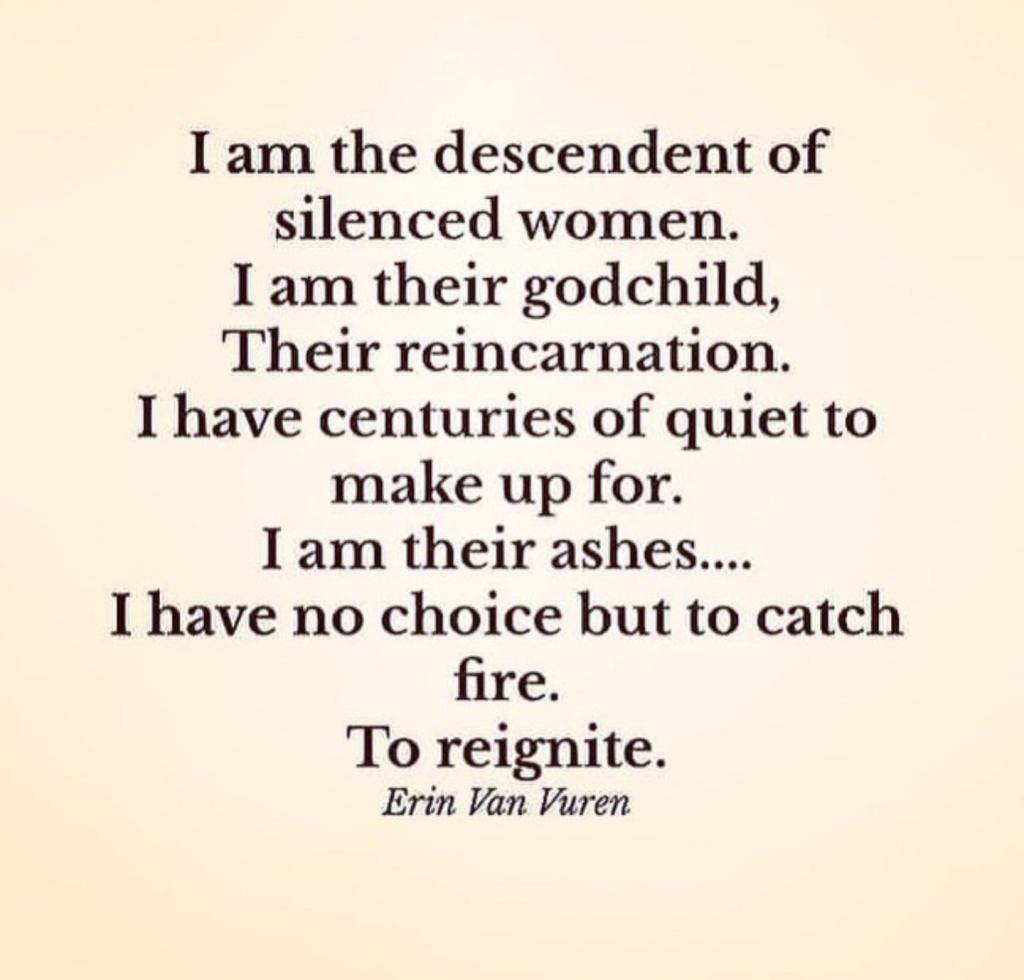
When I saw this graphic, it went straight to my heart like an arrow. My grandmothers, forced by circumstances to give up their first born, and in two cases only child (which includes a grandfather who never was given the benefit to know he had a son), to go on with their lives as though nothing happened.

I don’t think I’ll ever truly 100% get over it and I probably should not because adoption is still a thing that drives mothers and their babies apart. I now have an unflinching awareness of what it means to be adopted.

At almost 70 years old now, having to live through a full 6 decades before I knew the truths of my origins, I do fell as though I was born to re-connect the broken threads of my family’s beginnings, that I have somehow managed to fulfill my destiny in having been born at all.

In learning about my family’s ancestors, I also discovered what a miracle it was that in the mid-1950s, I was not given up for adoption, with my parents forced to suffer the same fate their own parents encountered. My teenage mother and my father only having just started on his university studies – both interrupted when I decided to take up residence in my mother’s womb.

My grandparents could not tell their own stories of loss that hurts for a lifetime because no one would have been sympathetic regarding their plight but for adult adoptees today, there is a growing awareness of the trauma and pain of being cut off from one’s roots and some are even choosing to attempt parenting when they had thought to give up their child and they are finding a lot of support in society all around them.

May the reform of attitudes continue to take over the dominant narrative that adoption saves babies and children from a worse fate.

Placating Adoptive Mother Emotions

It is just a difficult path to trod. Today’s story –

My son’s birthday is coming up soon. The last time I posted publicly about my kids was the anniversary of the final visit, and their adoptive mother got upset that I said anything. She enlisted my younger child for her defense. They asked me to not post anything ever again, because the adoptive mother doesn’t want to see it. Yet she continues to stalk me to see what I’m posting. I suspect that if I let a birthday slide by without saying anything, she’d use it as evidence that I’d completely forgotten about my kids. I’m not sure what the adoptive mother wants me to feel – am I supposed to regret having kids at all? Am I supposed to blame myself for surviving abuse? I know that, of course, I wish I’d taken the kids and gotten away from him before Child Protective Services got involved. Acknowledging that at this point is not going to make the adoptive mother any happier. I suspect that she wants from me is to admit that I’m just a horrible person and be grateful to her for saving my kids from me. I want to do what’s right for my kids long-term, and if the adoptive mother needs to control what I feel and say about the adoption, how much freedom is she giving them? Is there anything I could post that might get the adoptive mother to react like a reasonable human and not like some an obsessed control freak? PS it’s the older child’s 19th birthday. The younger one who is 16 has basically taken responsibility for handling the adoptive mother’s emotional state, because the adoptive mother throws temper tantrums to get her way and must be appeased.

The first responder said – I would acknowledge his birthday. He’s 18 – so old enough to tell you himself if he doesn’t want you to post anything. He’s also old enough to no longer be her property. Just as a side note have you tried reaching out to him to see if he would like contact directly with you now that he’s old enough?

I can relate to the difficulties. My daughter went to live with her dad when she was 3 years old. He remarried, so there was a step-mother, a step-sister and a half-sister in her family. I gave her a calling card, so that when it was safe (meaning it wouldn’t cause an upset) for her to call me, she could choose when. Sometimes, I had to wait a long time for those calls but at least she knew I wanted to hear from her. In an adoption situation, I don’t know if something like that would be possible but there is always reversing charges. What I cared about the most, was my daughter’s comfort and quality of life – not my own.

Social media didn’t exist when my daughter was young. I can easily understand the next responder’s comment – This is one reason why I keep my profile completely locked down with no public posts. Nobody gets to tell me how to feel about MY kids.

Someone else noted this obvious truth – you did give birth to your children and have every right to acknowledge their birthday. A birthday not only celebrates the day a child became an independent person but also the mother who gestated that child to birth. Many times, when I am celebrating one of my children’s birthdays on my Facebook page, friends will also acknowledge it is my celebration of an event as well.

Sadly, this perspective contains a frequent truth – some adoptive parents are control freaks. They would like to erase the fact that the adopted children are not biologically related to them, the children are possessed like property that the adoptive parents bought to furnish their life. The natural mother should post whatever she wants… one day her children may see it and realize they were loved all along! It will mean so much to them to know that. I know that understanding would have meant a lot to my own adoptee parents (both were).

And when all else fails – There are features that allow you to block specific people from posts. It’s strategic avoidance of the real problem, but sometimes that’s the best you can do. Anyway, as long is the posts aren’t abusive or causing damage to anyone, then she really should have zero say about what you post to your wall. Her discomfort is her own. You don’t need to carry that for her.

And the perspective from an adoptive parent – I’m so sorry that not only did she express unhappiness with you saying something, but that she enlisted the children into her unhappiness with you. That’s just, WRONG. It sounds like she is very insecure in her position as parent, and wanting you to remove yourself from yours to give her more room. You don’t have to do that. I believe that what is right for your children long term, is for them to KNOW that they were always on your mind and in your heart. I personally think that it is fine for you to make a post in regards to your children’s birthdays. Growing and birthing a human being is a MAJOR thing that happens to us as the person doing it, not just to the baby. I’m guessing that there are other people who follow you on Facebook who know about your children, maybe were even a part of their lives… Just because someone else is legally their parent now, does not change the fact that there were people in the children’s lives BEFORE. People who’s hearts and memories and emotions did not just disappear because of a court order. If possible, tighten up your security. If you’re friends with her on Facebook, exclude her from your posts if you feel the need. But please feel free to acknowledge your children, your love, and your loss however you feel you need to.

Not Of My Blood

This topic comes up repeatedly in my all things adoption group. It seems that the incidence of varying degrees of abuse is more prevalent on the part of adoptive parents. Adoptees often wonder and theorize why.

It started with this insight – So many adopted people I know have stories of child abuse by both of their adoptive parents. What is the mentality behind this, what is the psychological mechanism that results in so many adoptive parents getting a child just to abuse them? I don’t think every single case is where adults actively seek out children so they can have someone to abuse, but it’s way too common to just be a case of easy hunting grounds. Is there something that happens inside of the brains of adoptive parents that turns so many of them into child abusers?

Although, anything conceivable probably exists, I do not believe most couples go into adoption with the intent of mistreating their adopted child. There is something else going on.

One thought was this – Humans developed over millennia to raise their own biological/genetic offspring. Our biology knows whether the child is our own or not. Adoptive parents are preconditioned by social workers and adoption agencies to have expectations that “nurture” will adjust the child to be the same “as if” they had given birth to the child but it does not work that way.

Until very recently, and to some extent this remains true, adoption in the modern western version is predicated on treating adoptive parents like they are the original natural parents. Birth certificates are falsified to support that perspective. Often, in the past, adoptive parents lied to the child about their origins. Thanks to more accessible, inexpensive DNA testing and well reported adoptee reunions with their biological families, this fantasy can no longer hold dominance in adoptionland.

Raising kids is hard! They test and exhaust us. This is especially true when there isn’t shared blood and genetics. The frustration isn’t tempered by biology and deep parental bonds. My oldest son was very challenging at the age of 6, when his younger brother had had the lion’s share of my attention throughout infancy and his first 2 years. I actually would say to him, it is lucky for you that I love you. If you challenge other people the way you have challenged me, you could end up hurt very badly or dead. It was my maternal bond with him that stayed me from actually hurting him, though my anger could surprise me.

One adoptee shares – I can only speak for my adoptive parents but I was property to them. I was meant to fulfill a role and anything out of line with that expectation was punished. I recognize that they knew what the social worker looked for and how the system worked, therefore they were very good at hiding it. No one would ever believe me. It was clearly easier for them to take their emotions out on me (an adopted child) than on their own biological children.

Another adoptee shares – When I started calling my narcissistic adoptive mother out on her shit, it caused a huge fight with my whole family against me. And one of my aunts basically said it didn’t matter how they treated me, I just had to suck it up, take it, and thank them, because they “took me in” out of the “goodness” of their hearts when they didn’t have to. This implied they received a free pass regarding how they treated me. Which is obviously wrong. I think that is the mentality that a lot people have, when it comes to adoption, especially among the older generations. Like you could have/would have had it worse if they hadn’t come along, so you should feel “lucky.” It doesn’t feel “lucky.”

What happens when adoptive parents finally achieve the birth of a biological, genetic child ? One adoptee shares – we were all adopted and it was a loving safe environment until I turned 8. Then they had their only biological child and the rest of us had to scramble and grab for pieces of affection. I don’t know if it was regret for adopting, the satisfaction of finally having what they wanted, something else or a mix of it all but whatever the case, we went from cherished to easily replaceable.

Another woman adds – I think can be twofold. Either one, or a combination of, the psychological effects of infertility grief and the impact on an adopted child of emotional neglect as a result of the adoptive parent being unable to meet the needs of a traumatized, adopted child. (Note all adopted children suffer adoption related trauma, ie a belief they were rejected by their natural parents.) Chronic emotional neglect (causes more trauma) and has profound effects on an adopted child. It is worse when the caregiver doesn’t recognize or acknowledge that they don’t feel the love and acceptance for their adopted child that they expected to feel. It’s all too common then to blame the child for not meeting the adoptive parents needs, rather than looking at the emotional content in the adoptive parent. Throw in a societal saviorism belief related to adoption and there are the frustrated feelings of believing they are entitled to a child they didn’t receive.

Another adoptee shares – My adoptive parents were very physically abusive. I don’t know any science behind it but my honest thought was always that because I wasn’t flesh and blood, they couldn’t love me the same. There was no genetic connection… I don’t really know …. but that is how it has felt. I don’t think they adopted me with the intention of being abusive, but they couldn’t control themselves. It’s like if my daughter has a play date and that child is being awful, I’m like their parent needs to do something before I do…I just don’t have a motherly connection to anyone else but my own children…and it might sound super messed up but its literally how I rationalized all the physical and mental abuse I suffered … They didn’t even care if they hurt my feelings. Just like I wouldn’t care if I hurt someone else’s kid’s feelings, if they were little assholes. Of course, I know there are people who abuse their biological children…but I always think that’s generational and based on some mental health issues. The reason anyone abuses a child is complicated.

Someone else shares their perspective – I believe most adoptive parents adopt as a solution to their infertility and to “save a poor baby in need”. They are fed rainbows and unicorn stories that convince them that they are wonderful people doing a wonderful thing and that the adopted child it will be just the same as their own baby. So they treat a traumatized child just the same as they would their own. Except it’s not the same. If they don’t allow the child to have feelings, go to therapy, etc as soon as the child acts out, they won’t understand why the child is behaving that way. Most adoptive parents signed up for the “cute baby and matching sweater” they see on Instagram. Instead they get a screaming demon !! The more frustrated the parents become, the more they refuse to acknowledge their adopted child has trauma. That inability to empathize becomes more triggering for the adopted child. The parents eventually snap under the pressure and enter a cycle of abuse because “we tried love and it didn’t work”. When all they actually tried was to force the child to bond with them and pretend the child is the same as a their own biological child. It messes with the brains on both sides and often leads to the point of violence.

And finally, this perspective – every adopted child has a job. It might be to fix infertility or it might be to take the place of a dead child. Whatever it is, as adoptees we are given a job with no description and unfortunately, we don’t know when we miss the mark until we trip over it. That accounts for a lot of disappointed adoptive parents. Just as the adopted child does not recognize any genetic markers in regard to physical appearance and personality – neither do the adoptive parents. So on top of the heartbreak of infertility comes the heartbreak, disappointment and anger in having to continue living with why you adopted the child in the first place.

A Deep Evolutionary, Hormonal Need

A couple of questions were asked of adoptive parents in an all things adoption group I belong to –

Does being an adoptive parent feel the way you thought it would before you adopted ?

Does it fulfill your needs ?

In fairness, the question could be asked of biological/genetic parents as well. So it was that this thoughtful woman attracted my attention with her response –

She says directly that she is not an adoptive parent. She is a grandmother and the mother of 3 adult biological children with some post-divorce estrangement issues. She is the child of narcissistic parents from whom she picked up narcissistic habits that she’s now trying to recognize and eradicate within herself.

She describes herself as “a middle-aged woman coming to terms with my own flaws, strengths, and failures of both commission and omission. The questions shown above are phrased like arrows —bound to pierce anyone who truly is open to them.” She goes on to admit that these are great questions— and horrible questions, too. For sure, necessary— probably for ANY parent, but especially for adoptive parents.

She says honestly, “At each and every stage of motherhood I could have answered Yes and No to the first question. PARENTHOOD overall does not always feel AT ALL the way we think it will, before we experience it. And parenthood itself has plenty of rosy myths associated with it— but obviously NOT the sanctity and saviorism that gilds our culture’s concept of adoption and adoptive parenthood.”

She notes that – “The second question is intended to be an unsettling question— even for biological parents. We’ve got a huge biological imperative to bear children, as a species, so there’s a deep evolutionary, hormonal sense of “need” to procreate for which I don’t think we should be shamed. Many humans get pregnant by accident, or without much thought given to the repercussions of sex.”

Once a living, breathing child exists, that person is NOT AT ALL here to fulfill the parent’s needs. And it doesn’t take very long for that one to be recognized. Even so, we do not always realize that. During the toughest years of parenting, most parents barely have time to breathe, much less analyze the psychological, ethical, and moral framework that their parenting rests upon— and there is always a framework, whether the parent knows it or not.

These penetrating questions are relevant to ALL parents, at any stage of parenting. We all live as the protagonists of our own lives, and thus are prone to centering our stories upon ourselves. Sometimes it’s okay to center yourself in a story. Yet, that is NOT true in terms of your children or perhaps more accurately, they are going to center their own stories on their own lives. This is the great web of interpersonal interconnectivity that binds us all.

So okay, maybe there is no huge profound wisdom in this blog today. Even so, these are really deep questions that are WORTH sitting with, even if they cause some discomfort when thinking about our own answers to them. It is not surprising if they feel hugely uncomfortable when you read them. You may even feel that you have somehow failed as a parent. We are all too self-centered, even when we think we are being self-sacrificing for our children.

Mormon Adoption of Native American Children

The Mormons – yet again. Taking other people’s children to advance their religious cause. A white middle-aged man, Michael Kay Bennion writes in his lengthy dissertation titled Captivity, Adoption, Marriage and Identity: Native American Children in Mormon Homes, 1847-1900 – “I remembered that my third great-grandfather once traded
a horse for ‘an Indian boy, two or three years old.’ Or so his journal said.”

Some Mormons saw the purchase of a Native American as the adoption of a child when they were unable to have children of their own. Jacob Hamblin (a ranch by that name, Hamblin, figured prominently in the Mountain Meadows
Massacre) traded the Utes “a gun, a blanket and some ammunition” for a six-year-old boy “stolen from a small tribe.” Many Mormons view Jacob Hamblin as a type of nineteenth-century social worker, others would assert he was a slave trader. The fact is that Jacob acquired many children and parceled them out, sometimes in exchange for trade goods, making “slave trader” a distinct possibility. Jacob Hamblin, according to his own words, believed that his work saved lives and indicated he felt grief over separating the families.

From north to south, Native American children were entering Utah Mormon families in increasing numbers in the 1850s, even as the New Mexican slave trade slowly decreased. Not all Native American children traded to Mormons easily or happily identified with their captors. There are many stories of runaways and those persons who never adjusted to the Mormon culture. The Utah slave trade caused grief and pain for the children’s parents and also for children who were stolen and placed in Mormon families. Imagine these trembling, frightened captives thrust into a culture very different from their own, who then had new identities imposed upon them.

Native Americans captured, traded, given away, or sold into Mormon homes experienced a difficult cultural shift from growing up Native American to growing up Mormon. Many Latter-day Saint families acquired these children out of a sense of religious duty. They then embraced the difficult task of fostering these children into a new culture, often with mixed results. Most of these adoptive parents felt little or no need to preserve Indigenous customs within the lives of these children. While retaining the external physical characteristics that Mormons and other Euro-Americans used to identify them as “Indians,” they were taught to respond socially as members of Mormon society.

These children had the difficult task of reconciling their past and the newly imposed white identity and their success often was a reflection of the kindness or malicious actions of those white persons involved with them.  This resulted in various behaviors from within uniquely constructed internal identities. Some of these children learned to live in the seams between cultures, some accepted the new culture, and others resisted it.

During the American Civil War, several children were adopted by Mormon families after surviving two horrific massacres which were perpetrated by a Californian Union volunteer regiment of the US Army. At the Bear River Massacre and at a subsequent battle, these volunteers killed hundreds of Shoshones and Bannocks. There were 5 surviving children, left homeless and wounded by the attacks, that required medical attention, food and clothing.  The Mormons in southern Idaho and northern Utah provided these. One of those five died but the remaining four were adopted into Mormon homes.

Against a backdrop of conflict and tribal upheaval, Native American children in Mormon homes would sometimes reach maturity and assert their own identities. Mormon foster parents or indenture holders (a common practice in those times)  attempted to teach the Native American children the white way of life, even as these Mormons tried to reconcile their own deeply held cultural prejudices with a sense of mission – against the actual reality.

An example of this trade in children is illustrated in a story of a Native American who is said to have told a white
Mormon man – “I’ve got too many children, and my wife’s got another new baby and I’ve got to get rid of this one.” To which the Mormon replied, “[G]ive it to me. I’ll take it and feed it and save it. But I don’t want you to take it back, when it gets a little bigger, when it could kind of help the family…We don’t want to raise a baby and then [you] come and take it away [from] us again. So…I’ll pay ya for the little girl.” Turns out the little girl’s mother was not pleased and made a fuss. The Mormon insisted to the Native American man, “Now make up your mind right now and never change it, because you can’t have this baby back if you take the horse.”

This negotiation sounds more like purchasing a pet than adopting a child. The mother of the child, who was understandably distraught over the loss of her child is described as “squawking” like an animal, rather than weeping for
her child. The source of this narrative trivialized a highly emotional parting of mother and child.  Such was the perspectives of white people during that time.

Marginal food and clothing resources among Native American family clusters in the 1850s Great Basin region worsened as Mormon settlers appropriated the best fields and river bottoms for their own use. As previous narratives indicate, sometimes the Native American families simply gave away a child, when resources became so scarce that the child represented more of a burden than an asset.  I call it desperation for their children to survive.

As Mormons encountered Native Americans, they found that the ideal in their scriptures of the chosen Lamanites of the House of Israel rising up to claim their blessings (an interesting tenet of the Mormon religion that believed the dark skinned “fallen” could be made white again) often clashed with the predominant Euro-American image that Indians were perpetually dirty and permanently degraded. In coping with this paradox, Mormons tried to find ways to bring the Native American image up to the standards of their own ideal.

Washing and clothing Native American children is reported in many literary and direct experience accounts of bringing Native American children into Mormon homes. This process of cleaning up natives was not unique to the Mormons. It is frequently found in stories of captivity and adoption narratives, beyond those of the Mormons, and cannot be classified as a unilateral phenomenon, limited to Euro-American captors and Native American captives.

One can feel the deadening sense of deprivation and the unwelcome new smells, textures and tastes that lye soap, water and cotton or linsey woolsey presented to a Native American child leaving their culture unwillingly and entering another. The abrupt changes in sight, sound, odor and taste that Native American children experienced upon entering a totally alien environment would have been severely disruptive.  Their appearance, demeanor, and smell were often disagreeable to Mormon women. It is true that both Native Americans and Whites altered the appearance of their captives. One reason was to bring their outward appearance into culturally accepted norms.  The other reason was an attempt to remove the “other” in them while inducting them into the captor’s culture. Additionally, washing and clothing are known to have had religious overtones in Mormon culture and so, Mormon pioneer women were expressing this in scrubbing newly adopted Native American family members.

It was not only the physical dirt, but spiritual filth that needed to be exorcised, as demanded by their salvational way of thinking. Mormon mothers and fathers understood physical cleanliness as a prerequisite for repentance. In this way, they believed they could participate in redeeming the Lamanites. Some Mormon mothers may have hoped that their Lamanite child would put off their old culture, so that their labor would not be in vain as they presented a clean child, dressed in Euro-American style, to the other family members. With some others, it may have simply been that they could not tolerate unfamiliar odors wafting from the Native American.

The imposition of external markers of the white culture divided the adopted Native American children from their birth culture and delineated the expectations of the Mormon family for their future behavior. Some Native American children seized upon the cues in their new environment and built upon them, some would forever resist assimilation and others would use ethnic behaviors from each culture as the situation demanded. But each child forced into a new way of living had to construct an identity they could survive with.

Regarding all of these children, given the times and environmental conditions caused by white settlement, any one of them might have starved or have been traded to the Utes and taken to New Mexico given the thriving slave trade of that time. However, such a child might have lived a long life, had a family of his own even though, as many did, he had to struggle through all that Native Americans dealt with in the late nineteenth century. That child remaining in his culture realistically would have loved his tribal life and experienced a sense of wholeness, that being separated from it was never going to embody.

Thank you for bearing with me leaning into my history loving heart. Learning that the Mormons had taken 40,000 Native American children out of their culture, adopting them into their religious and family lives, caused me to visit this related story. Back to more usual topics, I’m certain, tomorrow.
Dialectical Behavior Therapy

I came across the letters DBT in an adoption discussion group and as I had no idea what it stood for, I do what I often do in such cases, google it. It started with this comment by an adoptive parent –

“I just had it click in a deeper way yesterday that I put a lot of thought and effort and will into trying to heal my kids. As if I’m a savior. As if I can. But in DBT, it talks about creating a change ready environment for your kids. By the way, if you can find a child DBT therapist, do it! Its expensive and it involves individual and parent and group sessions, and its work and learning, but its SUPER effective. All kinds of stuff prove its effective. Back to my point, if I’m trying to create a change ready environment, a calm and consistent environment where mean words can roll off my back, and I’m working on me setting the example that self care is important and I’m working on me so that I can hold all the pain they send my way, that’s where I make the most beneficial impact for all of the family and that’s where I love my kids the best.”

DBT stands for Dialectical Behavior Therapy. Dialectical behavior therapy is an evidence-based psychotherapy that began with efforts to treat borderline personality disorder. There is evidence that DBT can be useful in treating mood disorders, suicidal ideation, and for change in behavioral patterns such as self-harm and substance abuse. Many of these issues are aspects experienced by adoptees due to the trauma of separation from their original mothers.

One woman commented – “DBT absolutely SAVED MY LIFE. The skills helped me stop with SI and I then went on to lose 140 pounds.” I had to google SI too. Introverted sensing (or Si for short) is one of the most misunderstood cognitive functions in the personality community. Introverted sensing is a perceiving (information-gathering) function. It focuses on the subjective, internal world of personal experience and compares and contrasts new experiences to past experiences and memories. Si-users tend to notice patterns repeating themselves and are quick to spot changes or inconsistencies in their environment. They trust personal experience and subjectively explore the impact of current events, choices, and consequences.

So back to DBT . . . .

Its main goals are to teach people how to live in the moment, develop healthy ways to cope with stress, regulate their emotions, and improve their relationships with others. DBT can help people who have difficulty with emotional regulation or are exhibiting self-destructive behaviors (eating disorders and substance use disorders). DBT is sometimes used to treat post-traumatic stress disorder (PTSD).

DBT incorporates a philosophical process called dialectics. Dialectics is based on the concept that everything is composed of opposites and that change occurs when there is a “dialogue” between opposing forces. The process makes three basic assumptions:

All things are interconnected.
Change is constant and inevitable.
Opposites can be integrated to form a closer approximation.

Mindfulness skills help you slow down and focus on using healthy coping skills when you are in the midst of emotional pain. The strategy can also help you stay calm and avoid engaging in automatic negative thought patterns and impulsive behavior. BTW, I am a BIG believer in mindfulness.

Distress tolerance techniques help prepare you for intense emotions and empower you to cope with them with a more positive long-term outlook. There are 4 techniques – distraction, improving the moment, self-soothing and thinking of the pros and cons of not tolerating distress.

Emotion regulation lets you navigate powerful feelings in a more effective way. The skills you learn will help you to identify, name, and change your emotions. When you are able to recognize and cope with intense negative emotions (for example, anger), it reduces your emotional vulnerability and helps you have more positive emotional experiences.

Interpersonal effectiveness helps you to become more assertive in a relationship (for example, expressing your needs and be able to say “no”) while still keeping a relationship positive and healthy. You will learn to listen and communicate more effectively, deal with challenging people, and respect yourself and others.

They Always DO Grow Up

A question was asked – when adopting a child, particularly a baby, do the adoptive parents ever think about what will happen when that child is an adult ? And by that I mean after the parents are dead. Will that child have a legacy or a family or a tribe (other than their friends if they are lucky enough to have friends) or partners to last a lifetime ?

The person posing the question goes on to wonder – did you ever think, will your child when they are an adult, get what they need or deserve from family property ? Do you really think that your adult will hold onto a claim to your family ? When everyone is sitting around talking about Aunt Jenny, how will that make your adult child feel ?

One response was this –  you adopted a child to love, that does not automatically extend to other people, who may not feel the same way as you, the adoptive parent, when it comes to sharing an inheritance or even in how they actually feel about the adopted kid. Lots of families and other people “play along” with the game of pretending the adopted child is the same as if you had given birth to them for the adoptive parents sake. Sadly, there have been cases of adoptees who have been denied family keepsakes, etc after the adoptive parents’ death specifically because of the adoption. Adoptees told they are not worthy because the charade is over.

Adoption in most cases is very much about the baby. The savior/hero thought process of most adoptive parents focuses on the baby/child. It’s such a short term view of a real person and their entire life.

I found this story very interesting – So I’m adopted: my grandfather left me a trust fund and none of the biological grandchildren have one. They all contested his will. They didn’t understand why I received a trust fund. However, they did all receive some money from his estate. I was the one who saw my grandfather weekly and never asked for money or anything. He would take me out for dinner and always slip me a $20.00 for gas. I was always grateful. I loved my grandfather best because he was like me – his parents died and he was abandoned with his brother. So we both had that hole in our souls. When he was dying, I made sure I was there with him. I was the product of a forced adoption and I have an adopted son (from foster care). He will receive a portion of the trust from my grandfather and the trust will be split with my husband. I made certain to set it up for everyone five ways. My adoptive parents are still alive and the will they have created is so stupid that I just cannot. However, I will get some amount monthly until I die, then my remaining money goes to their own blood relatives and is divided up among them. My kids will receive nothing. When I’ve shared the will with a few close friends, they are all like WTF ! The way my adoptive parents hold money over my head, even at this stage and age, is so annoying and uncalled for ! I wish people realized you cannot be buried with your money.

This really spoke to me on more than one level. I don’t know what the laws are now but when my mom’s adoptive parents created a generation skipping trust, my mom told me that it was against the law for adoptive parents to disinherit adopted children. So, my mom and her also adopted brother, received income from the trust but cannot cash it out. However, my mom also struggled with the way her wealthy adoptive mother held money over her head. I also experienced that when I went to England with my adoptive grandmother. I had very little in the way of spending money. She was like – I paid for this trip, be grateful (as I watched her spend freely on her self). It’s not like she had to directly earn that money with hard work. My grandparents got in on the ground floor of Circle K when it first started. It made them wealthy as the stock appreciated. My grandfather retired as a vice president of a bank. He died at a relatively young age – in his 60s. My grandmother lived 3 decades longer on those funds and traveled the world and was always giving money away in philanthropy. I think she did it to earn respect. She actually grew up poor.

One more story and I have to end this for today – my son was placed at 4 days with his adoptive family. He is now 33. Typical closed domestic infant adoption. He lived with and cared for his maternal adoptive grandparents for the last five years. They both passed on either side of Christmas. His grandmother’s literal last words were “don’t kick him to the curb”. She must have sensed what was coming. The family gave him to the end of March (about 3 months) to move out. Once he was out of his grandparents house, he will continue to get paid $500/month but only for a year. They want to basically be done with him. That’s how his adoption ended. Thankfully, he has moved “home” with me and I am happy to have all of my kids back. We’re planting fruit trees now. I changed my own final documents years ago to provide for all four of my children equally.

Why Did You ?

Some adoptive parents say they never intended to adopt. Unless you’re kin, why did you have your name in the ring so to speak ?

One answer – people become foster parents with no intention of adopting. Then kids get placed with them. They do everything they can to help reunification and rights are still terminated. Social workers give them the option to adopt or kids will be moved. Foster parent didn’t get into fostering to adopt but think moving the kid(s) would add more trauma. So people shouldn’t become foster parents at all if they don’t want to adopt.

From a foster parent – We only ever planned to foster… we didn’t even seek out fostering, we were contacted to take a previous family member and started taking other kids once we were already licensed. We ended up with a 15 year old and didn’t even know she was free for adoption until after she was living with us. She wanted to stay and we wanted her to stay as well. We didn’t officially adopt because that’s what she wanted but she chose to legally change her name to ours at 18. We have been fostering 13 years and she has been the only permanent additions to our family. For us, we would only consider adoption for instances like this where the kiddo had no one else.

Another way it can happen – We were not pursuing adoption at all but a family friend knew I was adopted, thought I might be open to it, and then was asked to adopt her baby. I was totally in the fog at that time. (The Fog – is the state of believing all the positive narratives about adoption – the truth is much more challenging and difficult. One adoptee writes this – I just want people to see our trauma and our pain and stop rubbing ‘happy adoption’ in my fucking face all the time.)

Another perspective – We fostered for five years mainly teenagers and adopted a sibling group of three teenagers. They have always had contact with their family but no one was able to support them. They asked us to adopt them and it felt wrong to say no. I didn’t know guardianship was an option. My mom is adopted but has never shared the isolation and pain she felt with me in her adoptive home, so I had no idea adoption wasn’t the “right thing to do.” There’s a such a strong campaign to adopt in our society.

Then, there is this true saga –

This is in no way an attempt to justify as I still fight with myself over adopting. But I’ll explain how we ended up here.

When I decided to foster, that was all I wanted to do, I did not at all want to adopt. Fast forward a few years, and I had 3 foster kids who would be going up for adoption. I was not adopting, and so they were moved to a pre-adoptive home. They kicked the oldest girl out after 2 weeks and she came back to me. The goal was to give her more time to get to know them before moving her back in. That home removed the other 2 just a few weeks later.

At that point the Department of Human Services (DHS) decided to keep the other 2 kids together and leave the oldest girl with me and work on getting her into the same home as her siblings. Over the next 6 months the other 2 kids were removed from several potential adoptive homes due to behavior. Brother ended up in a home to be adopted. Little sister was there and we tried to move the oldest girl. After 2 days, they didn’t want the oldest girl back in their home, and a week later the youngest girl was removed from that home due to her behavior and at that point, DHS allowed her to come back to me. So then I had both girls.

After so much heartbreak for them, and so much rejection, I decided to pursue legal guardianship of the girls. It was a fight, but the judge was in agreement, until their mom died and then, I was told I had to legally adopt. They didn’t want to be adopted, they wanted to be with their mom, but they also didn’t want to move anymore. So, it’s not like they had much of a fucking choice. Stay in foster care and keep being passed around and rejected or be adopted and stay in the one home you’ve been loved in since being taken from your parents.

PS – My desire to foster was definitely fueled by selfish, savioristic motives. I wanted to help families, and I did, but I also wanted all the ass pats and recognition I could get. So even though I didn’t intend to adopt any foster kids, I did insert myself into the system as a whole out of partly selfish motives.

Infant Saviors

My oldest son at age 4. There are probably baby pictures somewhere but didn’t find them easily on my hard drive. The point here is that I have often referred to him as “my savior”. That is because trying to conceive him alerted me to a danger I didn’t know was lurking in my body – hepatitis C. Had I not gone down that road and been subjected to numerous lab tests, I would have continued drinking alcohol – sometimes to excess. The genotype I have is unlikely to progress and so I have chosen not to embark upon the treatment which is expensive and would disable me for months in attempting the cure. He is now 20 years old and I am healthier than ever, though my almost 67 year old body is showing me signs of wear and tear – especially my knees.

Today, I learned about Megan Culhane Galbraith’s new book The Guild of the Infant Saviour: An Adopted Child’s Memory Book, which will be published on May 21 and can be pre-ordered now at bookshop.org. An excerpt appears in Severance magazine. As I turn to reading the article myself, I will acknowledge that some people adopt infants to save their marriage and outcomes would indicate that is more often than not – unsuccessful. Others adopt infants thinking THEY are the saviors and that without them the child would fare badly in life and that is generally NEVER true as well.

Galbraith’s book is identified as creative nonfiction. The book is described as experimental in form and structure. It is a memoir but much more. A striking visual art project, an intellectual inquiry into the nature of memory, and a frightful window on the failures and brutalities of the American system of adoption. The book is the origin story of a girl who had three mothers before she was half a year old and the experience of the woman she grew to be, who, only during her own pregnancy, was overwhelmed by the need to know her history and learn about her first mother. The author’s meditations on the nature of identity, her compulsion toward self-erasure, and her fear of abandonment likely will resonate with adoptees.

Snippets from the excerpt that you can read more fully at the Severance link above –

“It is incredible how few concrete details I needed to feel connected across time.” . . . “I began to think about who I was at nineteen—a virgin for starters—and how incomprehensible it would have been to become a mother when my own future felt like it was just beginning.” . . . “What struck me most was that my birth mother had cared enough to update my file.” “within the last ten years” to alert her that she was a DES granddaughter.

Diethylstilbestrol (DES) was a drug given to women during their pregnancy. DES was a synthetic form of estrogen given to women between 1940 and 1971 to prevent miscarriage. The daughters of women who used DES were forty times more likely to develop cancers of the cervix and vagina. Galbraith goes on to note – “The drug’s side effects were known to skip a generation, meaning, they may have affected me—or worse my unborn child. Late-onset and irregular periods were one side effect for DES granddaughters like me. I didn’t get my period until I was sixteen: my biological mother got hers at around eleven. Other risks included infertility, cancer, congenital disabilities, and fewer live births.”

Always Connected

Birth moms never lose their connection, even when the baby has been adopted.

The perspective of many adoptive moms is that they have paid tens of thousands of dollars to have their own baby – the birth mom never mattered in their own calculations.

Inside their savior minds, the baby is now theirs. Adoptive moms tend to make everything about themselves including the adoption. When this graphic appeared in an adoption group, the adoptive moms criticized it as being disrespectful of them. It is also the truth – about every baby ever born of a mother (which all of them are at this time in our civilization – thankfully, we are not Aldous Huxley’s Brave New World – yet.

In Aldous Huxley’s Brave New World written in 1932 there is a scene at the Central London Hatchery and Conditioning Centre’s Embryo Store, where embryos gestate ectogenetically under dim, red light: “The sultry darkness . . . was visible and crimson, like the darkness of closed eyes on a summer’s afternoon. The bulging flanks of row on receding row and tier above tier of bottles glinted with innumerable rubies, and among the rubies moved the dim red spectres of men and women with purple eyes and all the symptoms of lupus. The hum and rattle of machinery faintly stirred the air.”

Embryos need to develop, a process that for each is best carried on under dim light. But the representations of embryo culture in Brave New World extend the comparison, for they reveal a heavy dependence on a variety of visualization technologies, from microscopy to cinematography. Thus the tour of the Central London Hatchery and Conditioning Centre features “the yellow barrels of the microscopes” lit by the winter sun; the Director’s description of how fertilized ova are transferred, in their embryonic culture solution, “onto the specially warmed slides of the microscopes,” where they are “inspected for abnormalities”; and a description of how x-rays are then used to trigger the process of embryo budding, or “bokanovskification,” which produces up to 96 identical embryos.

Thankfully, we continue to develop inside our mother’s wombs. One can only wonder what human beings devoid of that human connection during development as a fetus would be like but one thing is certain – in such a “brave new world” no mother would have to relinquish her infant to a stranger and any couple who wanted to adopt would have a ready supply but I for one am not willing to go to that world. I hope we never do.

One adoptive mom (bless her clear sighted heart for knowing this much) wrote – I just don’t understand what is so difficult of a concept for adoptive parents to grasp that a human being can love more than one person. Why is it such a big threat for a child to know and love their freaking parents! And how in the hell could this saying be disrespectful? It is TRUE. And just because they(we) are now raising the child does not deem them(us) worthy of more love or any kind of additional respect!