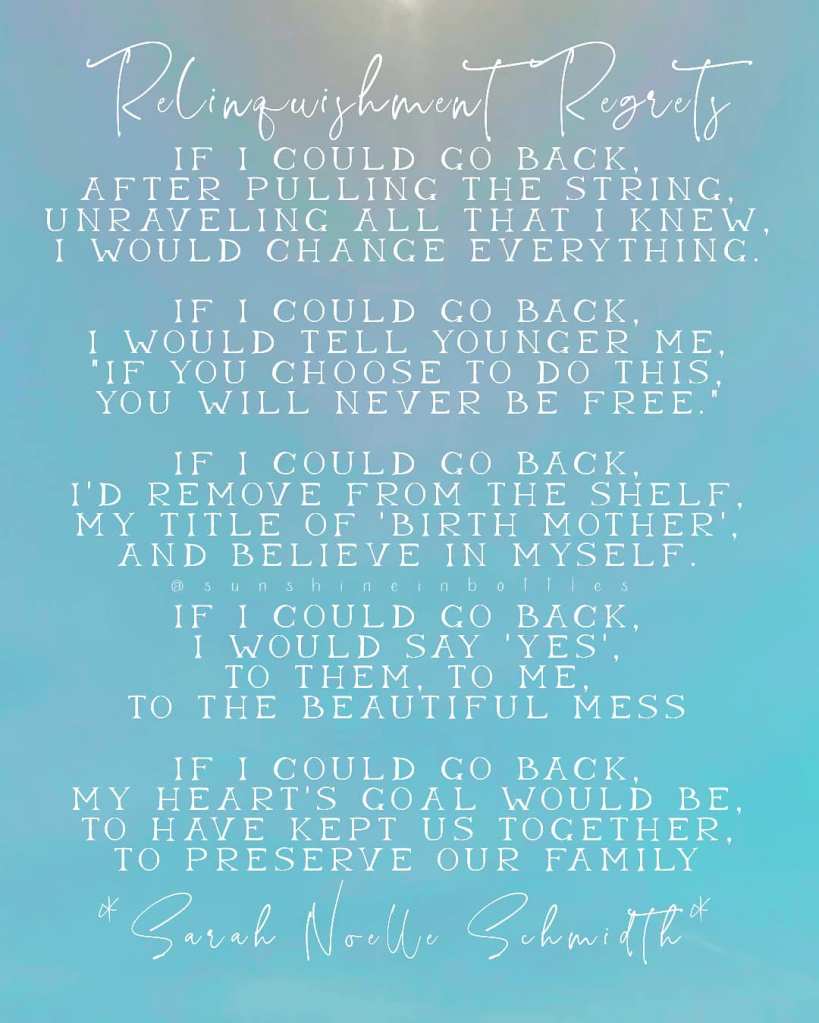
Relinquishment Regrets

Written by a mother who knows. She says of the above poem – I wrote this yesterday and thought there might be some other first/natural/birth/mothers of relinquishment moms who feel the same.

I am coming up on 22 years since my first relinquishment (I placed twice, nineteen months apart, with the same couple, who are now divorced) and the things I would change, if I could go back with all I now know about the billion dollar industry of adoption and how it uses and spits out so many mothers and adoptees, just keeps piling up and adding on with the more I learn about what I participated in, twice, all those years ago.

Another woman with the same experience writes – I feel this so SOOO hard. I’ve been struggling with being stuck with this regret for years now. My son is 20. I’ve never spent time in regrets before this one because we wouldn’t be who we are without the experiences we’ve had and choices we’ve made. And right now, I love my life – and I can literally trace the steps and KNOW that if I had parented, I would definitely not be here. But it doesn’t matter. I would give anything to change it. To not be that woman who was scared and unsupported, who didn’t know everything I should have known about adoptee trauma, and who believed there was another mother out there who was better for my own son than I was.

Doing What She Can

Without wading into the complex and fraught issues involved in transracial adoptions (been there, done that, probably one of my most commented on blogs to date), there has long been an issue of white adoptive parents not knowing how to manage their Black child’s hair.

The source of my own blog for today comes from Blavity.com.  Blavity News is a community and website platform for Black voices, stories, creators and thought.

“I saw that this might be something where I can empower them,” Tamekia Swint of Styles4Kidz said.  She had noticed more white parents choosing to adopt Black children.  “They’re not familiar with the [black] hair.”  She started the company in 2010 with three clients. Since then, she’s served more than 500 families. Swint offers several styles ranging from $40 to $150. She also hosts workshops for parents who want to learn how to do their children’s hair.

And running counter to criticisms of transracial adoption, Swint says, “A big misconception a lot of Blacks have about whites adopting Black children is that they don’t care about these kids and that’s just not true.”

One white mother of Black twins living outside the United States is thankful for Styles 4 Kidz because Black hair resources are scarce in her country.  She says, “Adopting these two has been a positive experience for my family. We adopted them when they were five days old.”  The organization also allows her to socialize with other parents.

“I know soon it will be time to send them to school and that is something my husband and I are discussing now,” she continued. “I know there are things I won’t be able to relate to when it comes to Blacks and that’s why I am learning as much as I can, from as many people as I can.”

The kids are also enthusiastic about their new hairdos.

“We give them haircuts and braid hair. You would be amazed how much self-confidence these children gain once their hair is looking good,” said Swint. “Seeing the smiles on their faces when we leave is a wonderful feeling.”