I Am Adopted

Hi, my name is Meggan, and I’m a transracial adoptee. I picture myself seated in a circle with other adoptees as I type that.

“Hi Meggan,” they’d respond, and then I would share my story of heartache and sorrow to the only group of people who will ever truly understand. The truth is, though, that kind of support doesn’t exist for adoptees yet, and it should.

I am half white and half black, and back in 1982 that made me undesirable in most prospective adoptive parents’ eyes, so it took a few months until I was adopted. My adoptive family is white, so I never grew up understanding or connecting with my black heritage.

My mom kept in touch with my birth mother through letters, and I was grateful to have at least half of a connection to my roots.

Growing up, I was never around people who looked like me. I was constantly asked questions like “what are you?” or “what’s your background?” I was a mystery that people felt they needed to solve and as an adoptee, I trod carefully and simply agreed with their guesses. Kind of like this…

“What are you? What’s your background?”

“I was adopted, so I’m not sure what my background is.”

“You look Lebanese/Italian/Aboriginal/etc. That’s probably what you are.”

“Sure, maybe that’s it.”

It’s kind of silly, but I’ve had that conversation thousands of times throughout my life. I know people mean well, but this is often the plight of a transracial adoptee who is in the dark about his or her background.

I’m asked about familial history at every doctor’s appointment, and I only ever had half of it.

“Does cancer run in your family?”

“I have no idea.”

The look of confusion used to get to me, but I eventually got accustomed to it.

Adoptees don’t have a right to their history the way everyone else on the planet does.

I used to struggle with my identity feeling like I had none and floating through life like a chameleon. How could I have a voice if I didn’t know who I was or where I came from?

How could I speak my truth when people in my biological family told me not to?

No wonder adoptees have some of the highest mental health issues and suicide rates. We’re told to be grateful that we were chosen when deep down, we feel like we were abandoned.

We’re told we have no right to complain because we could’ve been killed instead.

We’ve been silenced for far too long, and out of respect for everyone around us, we’ve walked on eggshells trying not to disrupt the waters.

It’s only recently that I’ve been able to step into who I was created to be truly. We were never meant to live life without boundaries, without a backbone, or without a voice.

It’s time to change all that, step into who we were meant to be, and live our lives as authentically as possible.

Are you coming?

💛 Meggan Larson has a Facebook group for trauma overcomers: www.facebook.com/groups/weareconquerorsnow

💛 Connect with Meggan on IG: www.instagram.com/sheinspiresfreedom

💛 Website: https://megganlarson.com

💛 Please take a moment and leave Meggan a few words of support, encouragement, and love in the comments.

💛 Join me in raising awareness of adoptee mental health by sharing this post.

#adopteementalhealthstories #nationaladoptionawarenessmonth #naam

Abandonment Part 1

Abandonment is a common, often unconscious, trauma issue in adoptees. However, there are many variations. When parents divorce and when one or both of the original parents of a child re-marry, it is not uncommon that the parental relationship of either the mother or the father suffers. More often it is the father, in my case in the mid-1970s, I was the absentee parent though I never thought of myself as having abandoned my precious daughter, she may have had experiences of that because at times I was not accessible to contact due to the partner I was living with.

Today’s story isn’t my own but another one where the abandonment behavior was even more extreme and where the original mother is considering adoption because her daughter wants a sibling (and many times after my divorce, my daughter did express to me the same desire for a sibling). In her case, her dad remarried a woman with a daughter from another marriage and then they had a daughter together. A yours, mine and ours family. Quite a bit later in time, I conceived and gave birth to two sons with my current, second husband. Here’s that story from a woman who has joined my adoption community.

I’m a 38 year old married woman with 2 children. 20 year old female stepdaughter and 14 year old bio daughter who is not my husbands. I had a hysterectomy 4 years ago and was devastated. My hubby and I don’t have any children together. I was invited to join this group because we have seriously been considering adopting. I wanted to learn as much as possible before starting the path.

Here’s my realization and questions. My 14 year old is amazing. Her bio dad and I had a great relationship until he met his now wife. Once she came into the picture his relationship with his daughter started to change. He saw her less and less, skipped visits, ignored me, etc.. then one day when she was 9 he served me papers and wanted to sever his custody. I was shocked. I didn’t understand. His daughter loves him. We never had any issues, I didn’t even ask him to ever pay a dime in child support. I have only just wanted them to have a relationship. There was no talking to him or his wife. They made up their minds. I refused to sign off.

They wanted my hubby to adopt my daughter and even though my hubby would do it in a heartbeat I refused. I wanted my daughter to be able to go to him one day and have the right to know why he gave her up. So I have full legal and physical custody and he has waived all visitation. I told my beautiful 9 year old girl that her daddy just needs a break from being a dad. That he has a lot of work and I’m sure he will see her soon. Yes I lied. I was hoping he’d come to his senses. So far he hasn’t.

During this time I have really tried to foster a relationship between his parents and my daughter. Also his sister and her kids. I WANT my daughter to have a relationship with her family. They really don’t know why he did this other than to say that his wife doesn’t want kids, did not like that her husband and I were on friendly terms (I am happily married, just wanted a good relationship with my ex for the sake of my daughter), and gave him an ultimatum… his daughter or her. He chose wrong.

Over the years the relationship with his parents has gotten strained. I have to be the one to reach out to them. They always mail birthday and Christmas gifts but don’t ever ask to see her. I offer to drive her to their house and pick her up, really everything to keep peace and give her a good relationship with them. She’s 14 now and hasn’t seen her dad since she was 9. She does know the truth behind his abandonment now.

We have been through YEARS of therapy. A suicide attempt, partial hospitalization, etc… she has a lot of issues in regards to this. We work on it every day and let her know how much we love her and that she is not worthless. She just doesn’t know/understand why her dad would do this to her.

Anyway, that’s my back story. So here is my other situation. I want to adopt. I want to be able to give a loving home to a child who may not have one currently. I’m not delusional in thinking that adopting is this sunshine and rainbows situation where there wouldn’t be trauma and issues. Seeing how my daughter has suffered with abandonment I have some insight.

Yes, I know it would be different because my daughter still has one bio parent where an adopted child possibly wouldn’t. I’m also completely open to having an open adoption where the child would have a relationship with their parents. I’m not going to lie to you all and say there isn’t a selfish component here. Yes, I DO want a child. I have grieved over the loss of being able to have any more children biologically. I just feel that we have a lot of love and support to offer.

I am going to leave it here for today and not go into her questions or the responses because this is long enough.

What Is Wrong With Being A Single Parent ?


I believe in a two parent home but it doesn’t always work out that way.  In my mom’s group, we have several mom’s who are single parenting their children and every one of them is awesome.  Some became mothers without a partner because they wanted to parent and gave up hope on marriage.  Many two parent homes become single parent homes when one of the parents dies, as happened to two of the families in my mom’s group.

So, the reality is that many kids grow up in single parent households. Every parent starts out with zero parenting experience and babies do not come with a how to manual. Today, I read about a 6 month old baby with a loving relative.

In the situation I am reading about, there is no empathy being expressed for either the deceased mom or her brother. The brother has lost his sister. The child has lost his mother. His nephew is probably one of the few things this young man has left of his sister.

Actually, this is a very sad story but unfortunately not a totally rare problem.  Thus warned, here goes, sigh –

The baby’s original, biological, genetic mom was heavily on drugs during pregnancy.  She told the social worker she had no family. Therefore, the baby was taken into foster care at birth. Then, the baby’s mom committed suicide and left a list of relatives. Hence the complication now.

The foster parents have grown attached to the 6 month old boy. He does have some challenges (both mentally and physically). The foster parents really really do love this boy. To their own perspectives, he is their son. He honestly knows no other parents and he’s apparently very happy with them.

Both foster parents have an adequate education. The foster dad works and makes a great income. The foster mom stays home with the baby and devotedly transports him to physical therapy 2 times a week, etc etc.

Now the baby’s uncle wants to raise this baby. He’s 29, single and has a steady occupation and therefore has the financial means to raise baby. However, he has no previous experience with children. It really isn’t his fault that he didn’t know about this baby until recently. He never knew his sister was pregnant because she was estranged from her family at the time. To date, he has not made an effort to see or have contact with the baby.

The foster parents really want to adopt this baby. It will crush them, if this baby is uprooted and turned over to someone who is effectively a stranger the baby doesn’t know. The baby is in a loving two parent home that meets his needs. Is it the right thing to send him into a single parent home ?  It could be a struggle for this young man to meet the boy’s physical and mental need for expert therapies.

As a young man, the uncle doesn’t have the life experience to understand the trauma he will cause, if he takes the baby away from his foster parents. He doesn’t understand what he doesn’t know about parenting.

What do you think is the right outcome in this very complicated situation ?  Generally, I’m in favor of genetically related family – always.  I’m in favor of reform that prevents people from fostering simply in order to adopt a baby.  This is a complicated case with no easy answers.  I am glad I don’t have to be the one to judge.

The Tangled Red Thread

Born into the social experiment of closed adoption in the early 1960s, Noelle was taken home directly from the hospital at the age of three days. Her early life in rural Washington state seemed idyllic. With loving parents, two brothers, and her beloved pets, she had a childhood to be envied. But all that was ripped away, first by the violent loss of her innocence, followed by the slow death of her mother.

Essentially left to raise herself, she embarks on a lifelong journey of self-discovery, guided at unexpected times by “the voice” only she can hear. Even the most mundane choices, such as where to go to college, seem to be divinely directed.

Haunted by recurring loss, Noelle is determined to find her birth mother, to uncover the secrets of the feelings and visions she cannot contain or control. In surviving the breakdown of her husband and marriage, she realizes she has a psychic connection with the family she never knew, and in a series of incredible events reunites not only with them, but also eventually with her soulmate.

A true account of one woman’s life, existing as not one, but two people: one born and one adopted, and enduring the reality of not completely belonging in either world.

Elle Cuardaigh asks these questions, “If adoption is beautiful…

Why do people lie about it?

Why isn’t it the first choice for couples who want children?

Why has it been this way for less than one hundred years?

Why doesn’t everyone give up a baby to someone who can’t have one?

Why does rehoming not only happen but is completely legal?

Why does Biblical scripture have to be twisted in order to justify it?

Why does the Quran condemn it?

Why isn’t it done this way all over the world?

Why are people in other countries horrified when they learn what adoption means here?

Why have several “sending” countries banned international adoption?

Why are adoption agencies being sued or forcibly shut down?

Why do adoptees turn to DNA testing to avoid dating a sibling?

Why is family medical history still the first question asked at doctor appointments?

Why are records kept from the very people they pertain to?

Why is a court order needed to see the records?

Why are adoptees terrified to ask their adopted parents questions about it?

Why do adopted parents swear their families to secrecy?

Why did the Catholic church get rich off its corruption?

Why is coercion routinely employed to get “birth mothers” to relinquish?

Why are there consistently over 100,000 eligible children waiting years for “their forever families”?

Why do white children cost more than black children?

Why is it okay to think of children as commodities as in the above question?

Why do the American Adoption Congress, Adoptee’s Liberty Movement Association, Bastard Nation, Concerned United Birthparents, and numerous other organizations like them exist?

Why do so many adoptees search?

Why did the Australian government officially apologize for its role in it?

Why are adoptees who are murdered by their adopted parents still considered “lucky”?

Why were adoptees used for medical and psychological experiments?

Why are adoptees the punchline of jokes?

Why is it recognized as a childhood trauma?

Why are adoptees considered “as if born to” their adoptive family, yet are subject to conditional terms for incest?

Why in cases where the baby goes back to the natural mother is it called “failure”?

Why are teen adoptees overrepresented in mental health services?

Why do so many rely on it as an industry for their paycheck?

Why is it patterned after the system Georgia Tann – a known kidnapper, trafficker, child killer, and pedophile – developed?

Why is it used as a tool of war and cultural genocide?

Why can’t all adoptees get a passport?

Why are others deported?

Why are adoptees four times more likely than the non-adopted to attempt suicide?

Why can’t we have this conversation?”

Three Identical Strangers

In the 1960s, a research project into identical siblings, placing them separately for adoption into different classes (poor, middle and wealthy), was done for the purpose of determining the impact of financial resources on their outcomes.  Back in the 1930s to 1950, Georgia Tann had a similar thought – taking babies from poor families and placing them into wealthier homes would lead to better outcomes for the children.

My mom was one of those babies.  She was adopted in 1937.  Both of her parents were very poor and struggling to survive the Great Depression but they were exploited by threats from Georgia Tann that her close relationship with the Juvenile Court judge in Memphis would support any removal of children she suggested.  Sadly.

So, in the 1980s, when these young men were 19 years old and began attending college, they discovered that they had been separated after birth into different adoptive families.  Even the adoptive parents didn’t know there were other genetically identical siblings.  The triplets accidentally found each other when two of them enrolled at the same college and found the third when he saw the story on the news. After the three siblings reunited, they became media darlings for awhile and even met their original biological parents.

It is not entirely a happy story and a suicide trigger warning is justified.  The two surviving triplets carry the DNA, the history, the pain, and the heart of their deceased brother. As the three boys entered adulthood each of them dealt with mental illness and psychiatric care.

The carelessness of the adoption agency that gave the boys away turns out to be something far crueler and more deviously deliberate than possibly imaginable. It is a shockingly true story but not unlike other psychological research from that era. Ethics were just not on the radar yet. People were treated like lab rats.

One woman, now much older, who was involved with the research study is blasé about the whole thing saying it was exciting to mess with people’s lives and noting what’s done is done.

The children who were the study subjects involved will not have access to the findings until 2065, by which time they will likely not be still alive.  This is because our own government funded this study.

This program does show how strong genetics truly are.  Being separated at birth results in life long trauma. All adoption agencies exist to make money. The program suggests that some of the adoptive parents would have happily taken all three boys, if they had known the truth, at the time.

One of the scientists involved in the study interviewed for the program kept laughing, saying inappropriate things, none of what happened was funny.  He said there’s probably at least four people (probably many more) who have no idea they are twins or that they were part of a study.

Currently one of the brothers practices law, the other sells insurance and investments. One of the two is (or soon will be) divorced.  These kinds of mental health and relationship impacts are quite common among adoptees.

Which leaves me with two questions (I have not seen, only have read about this program) – Is science worth keeping secrets and being immoral to accomplish unbiased research ? And how much of who we are is Nature and how much Nurture ? (That second one I’ve been looking at for 20 years.)

Adverse Childhood Experiences

For several months now our entire country and most of the world has been living with toxic stress.  It’s the kind of stress that puts you on edge and keeps you there, day after day after day.  If you have felt stressed, imagine what it would be like to experience adversity and/or abuse — not having enough to eat or being exposed to violence – then think, what if the one experiencing this is still a child.

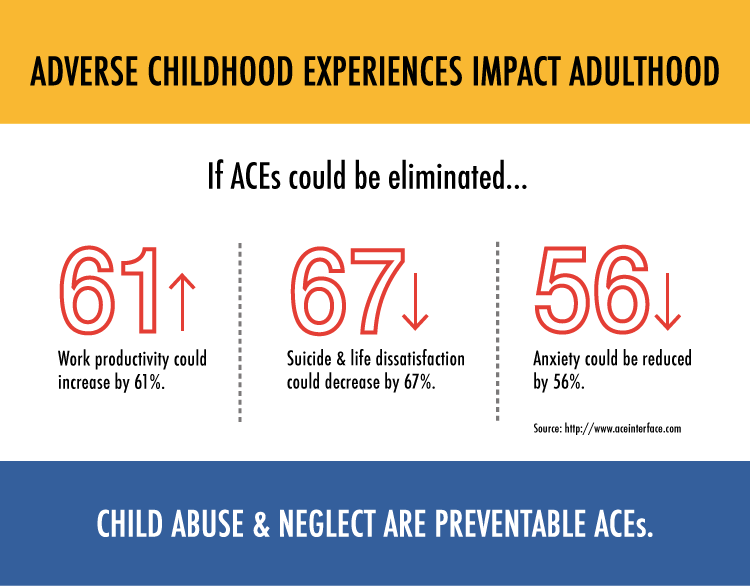
Factors such as divorce, domestic violence or having an incarcerated parent are called adverse childhood experiences (ACEs). Four or more ACEs can result in chronic health conditions such as heart disease or diabetes. In the long term, living with ACEs or other negative factors, such as poverty, can literally change your brain chemistry.

What does it look like for a young person to live with several ACEs and no supports ?  What does a foster parent experience when bringing a middle school or teenage foster youth into their home ?

It might be not being able to sleep without a light on. Or it could be eating even when one is full or not hungry. Some children become “runners” — they leave school whenever they become upset.

And the symptoms can become even worse.  The child may become a cutter; may be suicidal. Such children can have trouble forming appropriate friendships. Maybe they trash their room; in one fight-or-flight moment, climb out of their window and tumble to the ground. Even jump out of a moving car.

A foster parent could find themselves restraining the child physically by wrapping their arms around the child’s shoulders or waist, using all their strength to keep the child from leaving or hurting their self. Maybe you raised your hand only to motion toward something and the child flinched or even ducked.

And your heart breaks for this young person.  You had hoped they knew you would never hit them.  You are a foster parent.  You signed up for this because you thought you had something to give — time and care and love — to kids who desperately need that.

You might become the person the county calls when a child is removed from a home and has nowhere else to go, or when a foster family needs a break. This is known as emergency respite.

Most foster kids want to be happy.  After a lifetime of abuse and neglect, they may not know how.  A foster parent is also there to be a support for reunification with the biological family.

The best foster parents build a fortress of protective factors around their foster children. Protective factors are those things that most of us take for granted — a friend to call when we need advice; someone to help whenever we aren’t enough on our own.

Some of us are born privileged to have built-in protective factors (a supportive family, enough money).  Most foster kids will need to collect them from somewhere else (perhaps a chosen family made up of friends). At school, they require trauma-informed teachers and staff who understand how ACEs can be reflected in behavior.

National data shows that more than 20 percent of children up to age 17 have experienced two or more ACEs.  Beyond abuse (physical, emotional, sexual) and general neglect these include the loss of a parent to death, divorce and abandonment.  A family member addicted to drugs or alcohol.  A family member that is incarcerated. Being exposed to domestic violence and mental health issues among the family’s members.

Brain toxicity exists. A child can have post-traumatic stress disorder. ACEs are not limited to low-income neighborhoods, domestic violence and substance abuse take place in higher income homes and are every bit as toxic. Learn to look at all people through a trauma-informed lens. Ask, if you suspect this, “What happened to you?” and then listen without adding your own opinions.

Every domestic-violence shelter worker or child-care provider, anyone who works for child-protective services, anyone associated with family court, law enforcement personnel and physicians – ALL need to be trained appropriately to deal with trauma related behavior

Trauma is not the fault of any child.  Understanding ACE impacts allows adults to see the reason behind the behaviors.  Baby steps in a positive direction are progress.


Just A Fact

Adoption is taking a mother’s child from her. You cannot argue this fact. You may seek to be an exception but you are not. You are really just the same as every other person who has ever adopted a baby.

How do you go to the hospital and walk out with someone else’s baby ? Their BABY ! Someone’s baby she spent 9 months with.

Why is the suicide rate so high for adoptees and also for natural mothers and never discussed ?

It is true that sometimes caring for a child outside her primary family is necessary.  It should be rare.

Some answers to the above from a “woke” adoptive mother –

You basically delude yourself into believing the lie that this is a “good” thing.

It starts with the narrative from adoption agencies. They parade “first moms” into the orientation meetings to tell you how choosing adoption for their babies was the best decision they ever made. They believe the lie, too.

You listen to your friends and family members who have adopted children. You see the beautiful families they built. They all seem so happy. You want that for yourself.

You are chosen by an expectant mom. She tells you how grateful she is to have found you. You tell her how brave she is. You really feel like you’re a team doing this together.

Here comes the hard part. The birth. I have never felt more uncomfortable as when I was in the labor room with my son’s mother. She was alone and asked me to be with her during her planned c section. If not for her being alone, I wouldn’t have gone in with her. I felt like a total intruder.

Our minds are powerful. We can convince ourselves of just about anything. Even justifying taking someone else’s baby. That’s my cross to bear. Now that I’ve acknowledged the cold hard truth of it, I can do my best to help our kids understand it.

When Genetic Family Won’t

There are times and situations when it seems that adoption is the only answer.  The mother dies and the genetic family does not volunteer to step in and care for the child.  Or a father is overwhelmed.  That happened in my father in law’s family.  His grandmother died young after giving birth to her 3rd child.  There were two older children to care for, so the baby was given to and adopted by a childless couple.

In my own family’s circumstances, my parents (both adoptees) were never willing to take on that responsibility for their grandchildren.  With one sister, they led her down the path of surrender.  The daughter seems to do as well with the situation as any adoptee can be expected to – issues of concern about the feelings of her adoptive mother if any attention is given to her genetic family.

The other sister does have a debilitating mental health illness – paranoid schizophrenia – and is prone to irrational responses.  In that case, I am grateful she gave up my nephew and he is a high quality person.  There are probably issues related to having been adopted for him and we aren’t close, though I have been warmly welcoming and answer any questions he or his adoptive mother have asked of me.

There is no simple answer to children needing care and each person/family has to make their own decisions for their own reasons.  I understand that.  I do try to share some of the impacts and implications because there have been more adoptions and related issues in my family than most people experience.  About the only blessing for me is that I wasn’t given up when my unwed teenage mom discovered I had taken up residence in her womb.  I consider that a minor miracle for which I am deeply grateful.

In the case of mothers who die after giving birth – realistically and ideally – the mother intended and wanted to raise her baby.  She most likely did not want to die (unless it was a suicide which is complicated regardless).  The mother would not have planned for her family to raise her baby, if she had survived.

It seems a little unfair to put that expectation of taking responsibility on the genetic extended family.  Those who do are heroic in my own perspective.

The Forgotten Children

One of the better known adoption failure stories is that of the Harts.  Since I grew up with the surname Hart, I suppose this really caught my attention.  One may remember that a same sex couple drove their SUV off a cliff with the children inside.

Less known is the sadly typical story of their older brother.  The biological older sibling spent eight years in the Texas foster care system.  He had acted out violently when the state removed him and his siblings from their home in 2005.  He became a victim of the foster care-to-prison pipeline: separated from his brothers and sister, heavily medicated, shuffled between foster homes and shelters, institutionalized in a psychiatric hospital and placed for years in a restrictive treatment center. By age 19, he was in a Texas prison serving three years for robbery.

Sadly, “Once they get diagnosed with something like this, it’ll stay on their record and show up on their permanency reports, and it’s assumed to be true.”

He never gave up on reuniting with his siblings.  He didn’t learn of his siblings deaths until he was released from prison in October 2018, more than six months after their fate had been widely reported in the news.

“That was the last little hope I had in my life, you know? I had that hope that I was gonna see my little brothers again; one day we gonna kick it,” he said. “I used to cry sometimes thinking what we could be doing, growing up.”

Days after he was separated from his siblings for the last time, the 10-year-old tried to commit suicide by strangling himself with a belt at a therapeutic foster home.

Siblings placed together have fewer “non-progress” placement disruptions for reasons such as incompatibility with the caregiver.  Research has linked changes in caregivers to child delinquency, even for children not in foster care.  Those who experience two or more changes in their primary caregiver before age 10 are significantly more likely to engage in serious violence during adolescence — including homicide, robbery and aggravated assault — than those who do not experience multiple caregiver changes.

There’s no real sustained public awareness about these child welfare systems — how broken they are, and what they do to kids.  Sharing this story is my attempt to raise awareness a little more.