Is It Wonderful Or Painful ?

A trans-racial adoptee complained about the all things adoption group I belong to. She said – It seems this is a group about hating adoption. Not at all what I thought I was joining. Adoption is wonderful and painful. It’s not more one than the other. It isn’t only bad. If you choose to only see bad, you’re missing the true picture. So far no actual adoptees weighed in on the thread I was in, only those who cannot speak to what being adopted is like. That’s like white people trying to tell people what other races feel like. You can’t! Nothing I love more than people who haven’t been adopted telling me what it’s like.

Maybe I can unpack that a bit. First of all the group is NOT about hating adoption but a sincere desire for some reforms. Yes, it is a mixed up kind of experience. From what I know, wonderful perhaps . . . if there was real disfunction for the original genetic, biological parents. Yes, it definitely can be that sometimes a child is better off elsewhere. Most of the reforms that adoptees are seeking have to do with transparency and hiding their true origins from them one way or another – either adoptive parent lying and pretending like they gave birth to the child or simply the way the courts and adoption system insist on altering birth certificates and usually changing the child’s name. A trans-racial adoptee is someone who has been adopted by parents who come from a different culture. That’s usually a difficult situation for the adoptee, as I have read in the words of adoptee’s own voices many times. I don’t know what thread she was indicating but this particular post received 72 comments, so I doubt that it lacked genuine adoptee voices and perspectives. I do understand as a white person who did spend a significant amount of time during the Black Lives Matter protests educating myself, that no matter how much I learn, I have not lived as a Black person nor experienced the realities of their lives and would never try to claim I understood, only that I have tried to become more informed.

It’s true – I was not adopted (thankfully – I think in my case that was a close call – when my high school student, unwed mother conceived me). Both of my parents were adopted. I know somewhat more about how my mom felt about it than my dad. Because my dad was not sympathetic to my mother’s need for knowledge and seemed to simply accept his status, my mom confided in me. The loss was my father’s because his half-sibling was living only 90 miles away when he died and could have told him so much about his mother.

Both of my sisters gave up babies to adoption and both have made it back to my family in seeking their own roots. I think that for both, what they learned answered some of the questions they had before they met us. I love them both dearly and they seem to have in their own ways resolved their own issues.

Never would I say that adoption does not include some degree of trauma. For myself, after over 60 years of knowing nothing about my grandparents and my cultural genetics, it means the world to me to know a LOT of those details now – closed and sealed adoptions kept that information not only from my adoptee parents but from me as well.

Why Does It Surprise You ?

From a Transracial Infant Adoptee – When you adopt, you are not disillusioned to the reality of privilege. In a lot of cases, you know the situation surrounding the reason adoption is being chosen, and the circumstances. So when your adult adoptees eventually come back and question everything, why does it surprise you ? Why is there such a need to gaslight them about the truth behind their origins ? Or determine the narrative for them ? You knew coming into all of this where they came from and you should have known the trauma you would be placing on them, if you participated. So why is it such a shock when they decide to see the child trafficking for what it is ? Or the fact that you gained from the tearing apart of a family ? As an adult adoptee, all of the above truly does baffle me. If anything, I would expect adoptive parents to be the most sympathetic, empathetic and empowering individuals that they could be. Rather than shocked, butt hurt & defensive about a situation they themselves created. Especially in regards to the child fully recognizing what the industry is and the trauma it intentionally inflicts.

One adoptee responded – I think they forget that we grow up ! Oh, and of course, they believe they are different.

The original poster wanted responses from adoptive parents and one answered – In all 3 of my cases, I knew the circumstances as they were told to me. 2 cases ended up being much worse and one was slightly different. My adult adoptees have not come back to question because they were told their story from birth, and retold as often as they wanted to hear it. As adults, the two older ones have been in contact with birth family. They were given all the truths I knew. Yes, we knew that raising adopted children would cause them different emotions, thought, feelings than raising biological children. Not one of my 3 have compared their adoption to child trafficking, so I have not had that shock to deal with. I have admitted since the first day I held my first child all that I have gained. The biological moms were not teenagers and were not without resources. All of the adoptive parents I personally know are sympathetic, empathetic and empowering individuals. I know that is not true in all cases. I’m so very sorry that so many adoptees have had such traumatic experiences. And I’m thankful that there are groups where adoptees can share what they experienced with others to lean on. There are times when adoption is the best solution for a child to have a stable home. If anyone comments, I will gladly respond.

Another adoptee suspects – Some adoptive parents are so blinded by their “need” for a child that they become deluded and believe that the adoptee is truly “as if born to” and should gratefully play along with their own delusion. They don’t want to discuss the adoptee’s start in life and family because it threatens their delusion.

And one who was in foster care from birth and then put into a forced adoption at age 10 during the LINK>Baby Scoop Era in a closed adoption writes – I also think that too many adoptive parents (and hopeful adoptive parents) really do not recognize the crucial part that they play in an adoption – the rewards are theirs – the power dynamics are theirs too (once the adoption is finalized and they get what they wanted, including name changes, erasure of first family and a new birth certificate that proclaims them as the owners). They keep telling themselves that they are doing it all in the ‘best interests of the child’ (or baby). But is it really ? Could they have imagined a different way to help ? To care for and love ? Could they have fought harder for Legal Guardianship instead ? Can they make the promise that they will do everything possible (and really mean that) ASAP to discover the child’s natural family, heritage, family medical information and to keep the child’s own culture and needs truly front and center as a focus, while that is child is being raised outside of their own genetic, biological family ? Unless an adoptive parent is willing to go all in and do that – they will be shocked when the youth (or adult adoptee) scorns or derides their actual intent notes that they are an integral part of the broken system that helps to keep it chugging along.

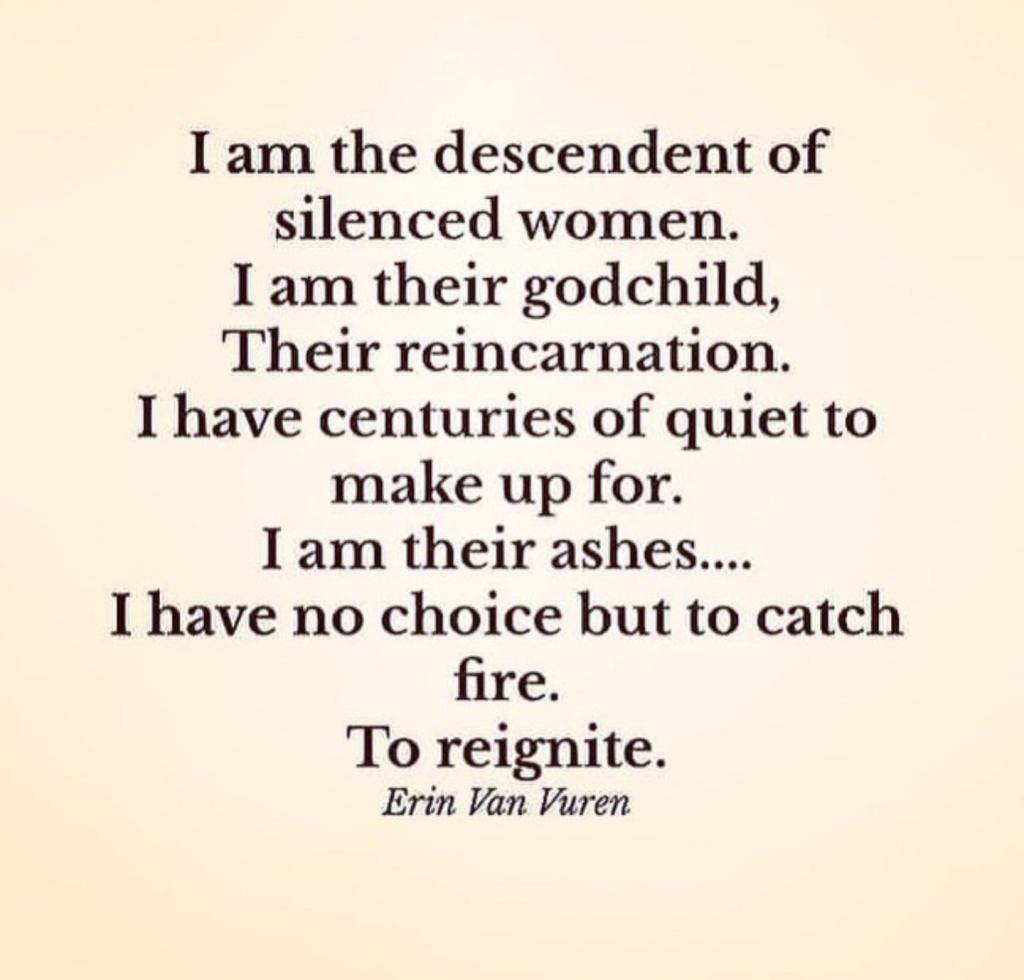
Silenced Women

When I saw this graphic, it went straight to my heart like an arrow. My grandmothers, forced by circumstances to give up their first born, and in two cases only child (which includes a grandfather who never was given the benefit to know he had a son), to go on with their lives as though nothing happened.

I don’t think I’ll ever truly 100% get over it and I probably should not because adoption is still a thing that drives mothers and their babies apart. I now have an unflinching awareness of what it means to be adopted.

At almost 70 years old now, having to live through a full 6 decades before I knew the truths of my origins, I do fell as though I was born to re-connect the broken threads of my family’s beginnings, that I have somehow managed to fulfill my destiny in having been born at all.

In learning about my family’s ancestors, I also discovered what a miracle it was that in the mid-1950s, I was not given up for adoption, with my parents forced to suffer the same fate their own parents encountered. My teenage mother and my father only having just started on his university studies – both interrupted when I decided to take up residence in my mother’s womb.

My grandparents could not tell their own stories of loss that hurts for a lifetime because no one would have been sympathetic regarding their plight but for adult adoptees today, there is a growing awareness of the trauma and pain of being cut off from one’s roots and some are even choosing to attempt parenting when they had thought to give up their child and they are finding a lot of support in society all around them.

May the reform of attitudes continue to take over the dominant narrative that adoption saves babies and children from a worse fate.

Exploitation

I’m reading this morning about the surrogacy baby factories in India in the current issue of Time magazine. I personally know of more than one family who has acquired their child using surrogacy. I’m not a fan. Learning about the in utero mother baby bond has done it for me. Separating the baby from its gestational mother creates trauma in the child.

Both India and Africa are hot beds in the trade of women’s bodies to create babies for their intended families. There is also surrogacy in the United States. Always it is a matter of poverty and money.

One poor woman writes – she went to the clinic to live out her pregnancy because she was worried that being pregnant while divorced would subject her to malicious rumors. “If I tell anyone, they think that I am going to give away my own child. They don’t understand that I am simply giving my womb on rent.” Still, as far as that baby in her womb is concerned – it IS her own child.

I do have sympathy and compassion for the poor women who turn to surrogacy as their only method of creating revenue. This is a difficult situation. Without a doubt, commercial surrogacy takes advantage of low income women. I do not believe that making only Altruistic Surrogacy legal is the answer as it does not address the poverty that drives woman to provide their wombs in service to prospective parents. It will likely only drive the practice underground. A 9 month long commitment is a huge demand on any woman’s life.

Legal protection is needed – for both the surrogates and the intended parents. There needs to be medical insurance for the surrogates and a minimum amount of compensation for the time they are devoting. Don’t get me wrong – I still do not favor surrogacy. However, I am being realistic about the financial circumstances that drive a woman to agree to this. Banning the procedure will not work any better than it has worked for banning alcohol or illicit drugs. One needs to look at the source of what is motivating the behavior – poverty and desperation.

Sital Kalantry is a clinical professor at Cornell Law School and has written extensively about surrogacy. She worries about the lack of informed consent and notes that many of the women are unable to read the contracts, which are written in English, and they sign them using a thumbprint. The clinic highlighted in the Time magazine article has a C-Section rate of 70%. It probably is safer for the fetus than a vaginal birth but it is definitely more convenient for the doctor (your blog author raises her hand that she has had 2 C-Sections – these were said to avoid transmission of the hepC virus she co-exists with). And it is more convenient for the intended parents because they know when to pick up their baby.

A ban on commercial surrogacy in India will only send the practice underground. The conditions for the surrogates will be worse and it will still be in effect unregulated. Underground the surrogates will have no protections whatsoever. An example is China – despite commercial surrogacy being banned there – it is estimated that more than 10,000 children a year are still being born through that process.

You can read the entire Time magazine article here – India’s Ban on Commercial Surrogacy.

The Ideal Perspective ?

The most common experience from those I have witnessed is a lifetime of regret on the part of the birth mother. That is why my all things adoption group encourages expectant mothers to at least try and parent their newborn for some significant period of time before giving their precious baby up for adoption.

On the other side are voices trying to convince expectant mothers that the BEST thing they can do for their baby is let them go. And so today, I saw this description of that mindset . . .

This is from a “Bravelove testimony”. Although this perspective is from an adoptee testimony, it could have just as easily come from adoptive parent testimonies, birth mother testimonies or adoption professional testimonies. It is often seen as the desired perspective that adoptees should hold of their adoptions. It is often praised as a perspective showing love and respect for birthmothers, yet to me, it is reducing women who are birthmothers to the decision they made and dismissing them as complex people who were dealing with complex situations.

“A birth mother has three options. She can choose to have an abortion, and I wouldn’t be here right now. She can give birth, but choose to say “no this is my child and I don’t care what kind of life she has, she is mine and I’m not going to let her go,” and be totally selfish, but my birth mom chose the most selfless option. And probably the hardest; to carry me for nine months, give birth to me through all that pain and suffering and then look me in the eyes” and say “I love you so much I can’t keep you.”

Some version of the above, maybe not so direct but with similar implications, is often seen as the ideal attitude for an adoptee to have in order to “come to terms” with their adoptions.

I have reversed my own thinking about adoption (both of my parents were adoptees and both of my sisters gave up babies to adoption). I’ve done my best to understand the history of adoption and my grandmothers who surrendered their babies in the 1930s as well as how the thinking about adoption has changed over time, fewer births due to Roe v Wade, more open instead of closed adoptions, the advent of inexpensive DNA testing and matching sites opening up a whole new wave of reunions between adoptees and their birth parents. It appears to me no matter how good of a job adoptive parents did in raising a child, no matter what kind of wealth supported amenities they were able to offer (private school, horseback riding or ballet lessons, etc) adoptees and their birth parents seem to yearn for one thing throughout their lifetimes – to be reunited. This says something powerful to me about the whole push to separate women from their babies. When those adopting are evangelical Christians (whether the good people adopting believing they are doing some kind of saving grace for any unwanted child are motivated by that or not) the leadership of that religious persuasion is seeing adoption as taking the children of heathens and converting them to the faith.

I never did think that the choice a woman makes – to surrender her child or not – was selfish or selfless. All birth mothers are simply human beings who were doing the best they could under whatever circumstances they were dealing with. Each one has my own sympathetic compassion for the effects of that decision on the remainder of their lifetimes.

Spiritual Godmothers

When I was a child, we had godmothers. It was actually a religious thing, associated with the infant baptisms that were part of being raised Episcopalian. I never really knew my godparents. I got a gift or two early in my life but when I was old enough to actually know I received it and from whom.

However, today being Mother’s Day, it occurred to me that adoptive mothers are like godmothers who are present all the time. One could also put step-mothers in that category if the were the “good” kind and not the evil kind. For some people, aunts or even mother-in-laws are like godmothers (mine certainly was and treated me like a daughter the many years, decades really, we were together).

While the wound that adoptees suffer in being separated from their gestational mother is serious and primal, and while much not appreciative nor grateful can be said about any woman who takes a child in that they did not give birth to, I think that on a day like today, when mothering in general is celebrated, it is fair to take a step back from reform interests, just for today to acknowledge “god” mothers. These are mothers sent to us by the spiritual heart of Life itself to assist us in one way or another. Foster mothers fit into this category as well.

The all-pervading, all embracing, unchanging, and unceasing Love that evolves, supports, nurtures, protects, and provides space for its children to reach maturity. Some religions have made the effort to move away from concepts of a male god or they conceive a wholeness of the duality mother/father god. During my later adult years, for some extended period of time I entered into a practice called the Gaia Minute. In doing this practice, twice a day, I came to think of the Earth herself as my mother, the Sun as my father. Larger than the human entities that provided for us during our childhoods and for some time beyond that, indeed while we were made of these, this continues to be true throughout our human incarnation.

Sadly, some children lose their mother so early, they have no clear memories of her physically. That certainly happened to my paternal grandmother, who’s own mother died when she was only 3 mos old. That certainly happens to adoptees who are given to adoptive parents within hours or days of birth.

The maternal nurturing energy of the feminine is not bound by birth, nor even by gender (my husband is surprisingly nurturing as a human being). Our spiritual godmothers, however we obtain them, whenever we obtain them, help birth our soul’s journey by their grace. They encouraged us when we were down, they were they for us when our heart and soul ached (my own human mother could sense me in distress when I was in a different room).

The Divine Feminine of mothering energy is there to remind us that we are never alone in this thing called Life. Happy Mother’s Day to each and every person who has ever fulfilled that calling to serve another human being with the energy of Love, compassion, nurturing, safety, provision and presence.

There was something complete and nebulous

Which existed before the Heaven and Earth,

Silent, invisible

Unchanging, standing as One,

Unceasing, ever-revolving,

Able to be the Mother of the World.

~ Tao Te Ching

Using Bio in Reference to Family

When one spends time within the larger adoption community (this includes original family, adoptees and former foster youth as well as adoptive and foster parents) the precise use of language sometimes becomes an issue. For my own self, I am entirely willing to learn to use the most appropriate language while giving a large tolerance to the words anyone else uses because we are all doing our best to improve and reform circumstances that have historically not been in the best interests of the child who ends up adopted or in foster care. That is really the most important issue – the well-being of our children overall.

Some of the adoptees or former foster youth have had reunions with their original family that have not gone well at all, only heaping more heartbreak and rejection on already wounded souls. Some had really crappy experiences with their adoptive or foster care families. Life can be incredibly hard at times for a lot of people. I try to always remember that and I too fail to be compassionate and sympathetic enough at times. We all do. Rather than beat ourselves up over our mistakes in judgement and actions, we really can only try to do better in the next instant – every instant after every instant. Life is for evolving ourselves and through our efforts to make ourselves a better human being overall, we evolve our families, our communities, our countries and our planet. It is an on-going process that never ends.

Whatever we call our parents, it can only be whatever feels right to each of us personally. I think every one of my own children has called me by my familiar first name of Debbie at some time or other and it has never truly bothered me. It does get complicated when adoption is in one’s family history. I called my mom’s adoptive parents – Grandmother D and Grandfather D – they were very formal people. I called my dad’s adoptive parents – Granny and Granddaddy. They were very humble, salt of the earth kinds of people.

When I learned who my parents actual original parents were – in my heart, they did take the place of my adoptive grandparents because they are truly the genetic, biological ones. However, I never use a “grandparent” identifier with them. It is their names that I use – Lizzie Lou, JC, Delores and Rasmus (though he preferred Martin, I like the more Danish version personally). So though, when I think of grandparents now (having only learned of them after the age of 60, after they were long deceased and I will never know them but second hand through other descendants of theirs), I think of the original ones but I never use the childhood identifiers for them.

There has long been a raging controversy over the use of the word “birth” to denote the parents who conceived and birthed children who were later surrendered either voluntarily or involuntarily (forcefully taken). Here is one perspective on that issue –

I personally loathe the term ‘birth mother’ and prefer ‘bio’ to differentiate between adoptive parents and family I’m related to by biology. I don’t understand why Lee Campbell (founder of Concerned United Birthparents) insists that ‘birth’ is not offensive but ‘bio’ is. Biology denotes DNA; genetically unrelated surrogates can give birth, so it’s not an inclusive term, as far as I can see. Anyway, as an adoptee—the only person among ANY of my family who had NO CHOICE—I’ll use whatever term I please. I adore my maternal biological family, including my late momma, whom I didn’t get to know past infancy. I feel far more connected to her than I ever did to my adoptive mother. I have three living maternal uncles and we are CRAZY about each other. We don’t use qualifiers referring to each other, but in cases when clarification is needed, I specify with ‘bio’.

Some of the push related to language was actually influenced by the adoptive parents when the whole industry was going through radical change in the 1970s. Social workers started to push positive adoption language. You had adoptive families complaining about the previous terms: they didn’t like natural mother because then they were unnatural. They didn’t like real because that made them unreal.

Many original mothers and their offspring do dislike the term “birth” because a woman who has given birth to a child is much more than just a woman who gave birth. There is a bond formed in the womb and all the conditions and circumstances that occur during gestation that will forever be a part of any human being and of course, there is the genetics as well.

Here is another perspective from a former foster youth who has adopted a child out of foster care – I always refer to my own parents as my biological parents. I honestly don’t have much relationship with either of my parents. I have learned through the years they are truly incapable of having a safe parent/child relationship. And honestly they are simply my biology. Nothing more. As an adoptive parent, I have learned and respect my daughter’s mom and family and refer to her mom when speaking to her as simply – her mom. In posts on the internet I try to always use first family. I will add that I only use first family in areas of the internet when needing to differentiate. In real life, it is simply family, mom, dad, grandmother, etc and no one has ever been confused over whether I was talking about adoptive or her first family.

Another one added – I call my son’s Mom, his Mom. His first family, his family. I can’t handle the terms that make the moms less than.

I totally agree.

And many of these women really don’t like “tummy mom.”

There is also another kind of family where the adoptive parent is actually “kin” related to the adoptee. I know one of these kinds of situations rather well. So one who is a former foster youth wrote –

Normal 0 false false false EN-US X-NONE X-NONE MicrosoftInternetExplorer4

I will call my bio parents whatever I want. They are not my “real” parents, because neither of them raised me. It is incredibly offensive when people ask “your adoptive (kinship) mom, or your real mom?” No. My kinship mom IS my
“real” mom. Our relationship is far from perfect. My raising was far from perfect. But she’s the only person who I’ve ever felt comfortable enough regarding our relationship to call “mom”, and I’ll continue to do so.  I hate the phrase “real mom.” My mom is my mom.  Period.

In my own case, my biological, genetically related daughter was not raised by me after the age of 3. She ended up being raised by her dad and step-mother.  My daughter considers my ex-husband’s wife her mom. I accept that. I carry enough conflicted emotions for not raising her – regardless of the reasons that came to pass. But I do acknowledge that her step-mother was the one that was there when my daughter was sick, in trouble or needed a compassionate heart to listen to whatever. I do have a decently good adult relationship with my daughter. I am grateful for that much.

The Long Song

February is officially what is known as Black History Month. Some of my black friends joke about there being a month for something that has been going on all along – that being “history.” Never-the-less, after all the consciousness raising of last summer’s protests and my own significant efforts at self-education regarding racial inequality, as this month comes to an end, a story came into my awareness that seems to fit my blog’s topics and themes.

Here is the post that brought this story to my attention – “Today I watched The Long Song on PBS. **spoiler alert** When the recently freed black slave mother’s baby is stolen by her white master and his wife, I cried. So many thoughts came over me. My brain made a correlation. So many mothers get their kid’s ripped away. Sure, it may be due to drugs, neglect, violence and/or abuse. But I believe for most of these mothers, exposure to these things all come with ‘normal’ life in their world.”

“Often times, when their kids are taken, they don’t understand why. They were never rescued. Why do their kids need rescuing ? And despite all their parenting issues, I believe they most often deeply love their children. I do believe losing them, regardless of the state they are in, cripples them further. So, whether it’s right or wrong on the kid’s behalf, they are removed. It’s always a tragedy. It’s always traumatic. And there is always sorrow and grief. And today this 3 part series made me feel my sympathy for these mothers. Losing a child has to be one of the worst and longest lasting pains known to humankind.”

That true – one of the worst and longest lasting pains known to humankind.

The following is courtesy of Masterpiece theater’s What To Know Before You Watch

Told through the eyes of July, a slave and spirited survivor, The Long Song is set in the 19th century and explores the last days of slavery in British-ruled Jamaica. The story is about injustices humans inflict on each other and the unexpected ways in which people’s humanity can overcome harsh circumstances.

Born into slavery at the Amity sugarcane plantation, July gets taken from her mother as a child simply because the owner’s sister, Caroline Mortimer, spots her out in the fields and thinks she’s cute. There are many painful scenes yet to come, but this one is particularly crushing in its simplicity. Her kidnapping, which alters the course of her life and devastates her mother, is nothing more than a casual whim from people who have no awareness of their own cruelty. 

The story unfolds with the strong-willed July working as a lady’s maid for Caroline . When Robert Goodwin, a new overseer at Amity arrives, both July and Caroline are intrigued by his revolutionary spirit and intent to improve the working conditions on the plantation. But the winds of change across the hot plantation fields end up not being without consequences.

Robert Goodwin is a white Brit who initially sweeps July off her feet with promises of fidelity and fair wages for all the recently freed slaves on the plantation. And yet, he sours the second the Black people in his employ stand up for themselves, twisting into a hard, gnarled version of the idealistic man July fell for.

Based on the award-winning novel by the late Andrea Levy, the fictional story is inspired by Levy’s family history. Levy was born in England to Jamaican parents who arrived in Britain in 1948. “I’ve always used my books as a personal journey to understand my Caribbean heritage – and with that sooner or later you have to confront slavery,” Levy said.

After the book was released, research by a family member proved just how personal The Long Song truly was. “It was all done and then my niece found out a lot about our own family history,” Levy explained. “She found out that my great grandfather was born a slave. His mother was a housekeeper on a plantation called Mesopotamia and her mother was a field slave called Minnie. We found out that my great, great-grandfather was from Gainsborough in Britain, his name was William Ridsguard and he was the attorney on the plantation, and he had a child with his house keeper…that child, Richard Ridsguard was my great grandfather.”

Regarding the 3 main characters it is said –  “Andrea Levy really created three people who can be complete contradictions – I think you will find yourself doubting, hating, loving them. They are complete human beings.” The novel which was published in 2010 was the recipient of the Walter Scott Prize. 

Evolving Approaches

Why are so many foster parents uneducated about trauma ? It’s 2021.

Yes, training is lacking but it’s frustrating to keep seeing things like the comment below from a foster parent. If I have a biological child with special needs, we change to accommodate her. We change for biological kids. Why not do the same for a foster child ?

The question above was raised by one foster parent, after reading this comment below in quotes from another foster parent.

“I don’t know. This is sad because the foster family shouldn’t have to change everything for a child. It’s give and take. Obviously the child should feel accepted, but that’s also a choice on their part. Half this stuff (sleep in the bed, no TV after bedtime, eat what we’re eating, bond with us, doing chores) is not unreasonable.”

“I’m sorry, I don’t bend rules for the ‘undamaged’ kids in my home, not everything changes for the new arrivals. Foster kids need to understand the world doesn’t evolve around them. In the real world people don’t care if you’re in foster care. They don’t care if you have trauma. You do what your boss tells you to do. They don’t make accommodations for you.”

“We need to stop making excuses for foster children and stop letting others feel sorry for them. Being in foster care shouldn’t be used as an excuse. Everyone is treated the same in the real world. So why should we bend the rules to foster kids? A foster child shouldn’t force you to change your household or your rules. You’re the boss of your own home.”

“They should follow the rules and the values that the family that decided to open up their home to them has in place. We can’t keep allowing foster kids to take and we always give. It’s unfair. It doesn’t teach them anything about giving back or teach them anything about following the rules in life”.

So why wouldn’t foster parents want to provide specialized care when traumatized kids need this so critically ? Why do they choose to be foster caregivers ? Oh right, it is the money, the stipends foster families are paid to take in stranger’s children.

There could also be another aspect. Some foster parents are there for the glory and accolades from other people. This person’s perspective is simply justification for a rigid response. In reality, what should motivate anyone to be a foster caregiver, would be to help the child heal from whatever trauma has put them into the system to begin with. Just removing the child from their parents and home and being put into foster care IS trauma to begin with.

Think about it – if the injuries were visible and the child was then refused help to heal because of BS excuses like, the “real-world” is unsympathetic to your pain and suffering, many people would judge such a foster caregiver (like the one quoted above) as some unfeeling monster who neglects the children in their care. There should be zero tolerance for an attitude like this.

Truth is, parenting should be individualized to the unique person each child is. As parents, we should give more to children who need more. Parenting is not about one’s self or selfishness. A parents job shouldn’t be to make the kid’s lives crappy, even if we ourselves feel we have it crappy.

Finally, this foster parent writes as though fostering wasn’t a choice they made freely. A child who is unwillingly placed in your home doesn’t owe you gratitude or deference. And “everyone is treated the same in the real world”….what a sad excuse for having closed off your heart. One gets the sense that this foster parent has come from a middle to upper class white family and has not experienced a whole lot of the “real” life they speak so freely of upholding.

If Others Are Uncomfortable

It seems to depend upon what your life experience has given your perspective. An adoptive parent writes – My 6 year old’s story is a rough one for both she and her mommy. We have shared her story with her with the help of a therapist because we want her to feel empowered and never feel like she has to hold any kind of shame. As she is getting older, she has begun to just kind of drop her story to friends of hers and their parents and I can often tell that people are caught off guard and at times seem uncomfortable. Is it better for us to let her share as she feels comfortable or, should we teach her to guard her truth?

From adoptees come these responses –

Never make her guard her truth, always let her define her story.

and

I kind of don’t care if others are uncomfortable. That’s their problem. Feeling like we have to hide to make others comfortable creates shame in my opinion.

Then, from a professional –

I  work in the field of mental health/sex offenders/criminal justice/substance abuse. I think an age appropriate discussion about disclosing appropriately, and over sharing to people she doesn’t really know, is definitely warranted. While it’s her story, her ideas of boundaries are just being formed at 6, and people who endure trauma can often overshare as a coping mechanism, something that she may battle throughout the rest of her life. She should start practicing healthy boundaries now. I personally struggle with this, and often have to remind myself that every conversation I have with others isn’t a therapy session. I’d definitely bring this up with her therapist to help her work on boundaries; if she doesn’t have one, you might consider getting one to help her navigate her past trauma in healthy ways.

In response, another woman asks – what consequences are you worried about as she shares her story as she feels comfortable ? I’m asking about consequences to her, not related to people around her being uncomfortable.

To which the professional responds – what someone wants to share at 6, isn’t necessarily what someone wants to share at 16, or 36, etc. I’m not saying that because it’s shameful, because it’s not, but it can be harder to gauge at that age who is safe to disclose private information to.

I work with sex offenders, so I’m paranoid. Let’s say the child mentions to an adult in their life (who happens to be an undiscovered sexual predator) that they’ve previously been victimized, sexually. Sex Offenders are opportunistic, and may see the child as a viable option for future abuse. This isn’t something that’s rare. Survivors are often revictimized. The original comment didn’t say this was the specific scenario, I’m just pointing out why it may be a concern.

Another woman affirms this perspective by sharing – My therapist told me about over sharing my child abuse and my past domestic violent relationship and how it can definitely make you a target for people that look for vulnerable people. They’ll take your trauma and use it against you when the time is right. My Domestic Violence Survivors class also told me this. I was over sharing at 21 as a way to cope, to see if people were like me or had sympathy.

And yet another – Yeah as a survivor of serious childhood abuse and former over sharer, learning that I could choose what to share and who with was a big piece of recovery. And some people can have some really fucked up and dehumanizing reactions to hearing someone else’s pain, reactions I wouldn’t wish on a little kid. They sucked enough as an adolescent and young adult.

These situations are not rare, here’s another – Oversharing can go from awkward at best to seriously dangerous really fast and in ways that can’t be taken back. Oversharing has showed up in my life as a fawning trauma response. I didn’t learn how to think critically about what kinds of things I was actually disclosing to people until I was in my 20s and I feel like thinking about it in age appropriate ways at age 6 could have been a huge advantage in life.

And one more example –  A young woman I know really well shared her abuse story with potential boyfriends because it was important for her to be accepted and she attracted some pretty yucky pedophiles who got off on just hearing her story.

And to balance things out, here is another adoptive parent’s perspective –

Our daughter likes to share her story on her terms as she chooses. Sometimes she shares a lot, sometimes only pieces (like “I have two moms and two dads” and nothing else). I always tell her it’s her story, and she can share what she chooses. If people don’t understand and ask questions, she can answer or say “I don’t care to share that part.”

None of us owe other people parts of ourselves. We gift to others the chance to know parts of us, and those gifts, depending on how they are received, may or may not lead to more sharing. Our daughter is carrying a heavy load and will have to navigate a challenging life as a result of her adoption. I decided (based on hearing so much from adoptees) to learn how to make her feel empowered by owning her story since so much has been taken from her. This sharing can at least belong to her and be on her terms.

PS. If she shares in a school environment, like an “About Me” project, I inform the teacher ahead of time that I will be attending class to help support her if there are difficult questions. Nothing has ever come up, but our daughter has appreciated me having her back.