Often They DO Have A Family

The Davis Family with Ugandan Adoptee

I was previously aware of this issue – adoptees from outside of the US actually having a family before the adoptive family. Saw a story today that was on CNN by Jessica Davis titled LINK>The ‘orphan’ I adopted from Uganda already had a family.

Jessica writes – I’ve always hoped to make a difference in this world. To bring goodness, peace or healing to a world that often seems inundated with loss, hardship and a vast array of obstacles that make life difficult for so many. When it came to the decision to adopt, it seemed like a no-brainer. I thought this was one way to make a difference, at least for one child. My husband, Adam, and I would open our home and our hearts to a child in need.

Adam and I thoroughly researched at each step of the process in the hopes of ensuring a proper and ethical adoption. You see, we were already parents to four biological children, so this was not about “having another child” or simply “growing our family.” For us, adopting was about sharing our abundance – our family, love and home with a child who lacked these basic necessities.

She writes – I remember reading that there are almost 3 million orphans in Uganda, and with that statistic in mind (and a bit more research), in October of 2013 we began the journey to adopt from there. We did piles of paperwork, got countless sets of fingerprints and spent tens of thousands of dollars. It took a little over a year to get through all the formalities, but I was driven to get to the best part of this process, meeting the needs of a child.

In 2015, we welcomed a beautiful, strong and brave 6-year-old girl named Namata into our home. It took a little over a year and a half to realize the things “our” child was telling us were not adding up to the stories told within the paperwork and provided to us by our adoption agency, European Adoption Consultants, Inc. In fact, later on, the US State Department debarred the agency for three years, meaning it could no longer place children in homes. The State Department said it found “evidence of a pattern of serious, willful or grossly negligent failure to comply with the standards and of aggravating circumstances indicating that continued accreditation of EAC would not be in the best interests of the children and families concerned.”

When she began listening with openness, instead of being clouded by her own privilege and experiences, she realized what her adopted daughter was so desperately trying to get her to understand. The child we had struggled for years to adopt was not an orphan at all, and almost everything that was written in her paperwork and told to us about her background was not an accurate description of her life in Uganda.

Jessica continues – we eventually uncovered that she had a very loving family from which she had been unlawfully taken, in order (we believe and are convinced) to provide an “orphan” to fulfill our application to adopt. Namata’s mother was told only that Adam and I were going to care for her child, while we provided her with an education, which is a central pathway to empowerment and opportunity in Uganda. She never knowingly relinquished her rights as Namata’s mother, but once there was a verbal confirmation that we would adopt Namata, those on the ground in Uganda forged paperwork and placed Mata in an orphanage.

The truth is that there are villages in Uganda and across the world where mothers, fathers, siblings and grandparents are desperate to be reunited with the children who were unlawfully separated from them through international adoption. It has been heartbreaking for me to realize that so beautiful and pure an act can be tainted with such evil. But as with so many beautiful things in this world, corruption and greed are a reality – one we can’t simply ignore.

Jessica notes – Throughout the journey to reunite Namata with her family, I have been met with so much resistance, saturated in entitlement and privilege. More than once I have been asked, why don’t you just “keep her”? These are words I use when describing something I purchased at the grocery store! I never owned Namata; she is a human being who deserves better than that type of narrow-minded and selfish thinking. I was told that it was my Christian duty to keep her and “raise her in the proper faith.”

Jessica affirms – My race, country of origin, wealth (though small, it’s greater than that of the vast majority of people in the world), my access to “things,” my religion – none of these privileges entitles me to the children of the poor, voiceless and underprivileged. If anything, I believe these privileges should come with a responsibility to do more, to stand up against such injustices. We can’t let other families be ripped apart to grow our own families!

She shares – I have seen the beauty of a family restored and there is nothing quite like it. Adam and Namata took the long journey to her remote village in Uganda together, while I remained at our home with the biological children. We could not afford for both of us to go, and my husband was concerned for my safety after the corruption I had exposed. He was also just as concerned for Namata’s safety and wanted to be at her side until the moment she was home in the protection of her mother’s arms. So I reluctantly said my goodbyes to her here in America. In September of 2016, Namata’s mother embraced her child with joy and laughter abounding and they have not spent a day apart since. Namata has flourished since being home and I am thankful for that.

Her perspective changed, she adds – What if we decided to do everything in our power to make sure those children could live their lives with the families God intended for them in the first place ? I’m not talking about children taken by necessity from abusive or neglectful homes, but those whose loving families were wrongly persuaded to give them up. Families who thought the decision was out of their control because of illness, poverty, lack of access to education, intimidation, coercion or a false idea about what the “American dream” means for their child.

I have also seen a new wave of opened eyes among parents who adopt children – parents who understand the losses their adopted children have suffered, who listen to them, who rise to the huge obligations and high standards that adoption requires. Only through listening and acknowledging hard truths can adoption lead to an ethical and positive outcome. It may mean a lifetime of making sure a child holds on to his or her cultural or racial identity, or keeping alive his or her ties to their birth family, no matter how hard that may be.
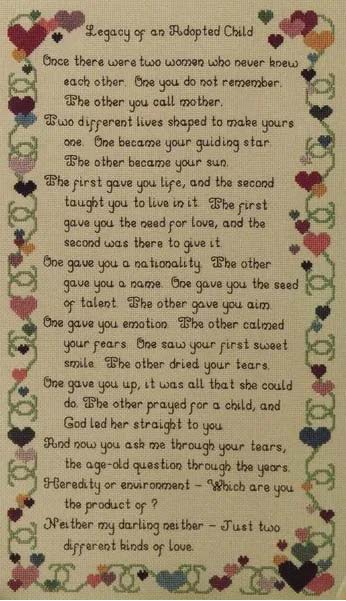
Heredity Or Environment

I had not heard of this poem before but read about it today. A lot of adoptees are familiar with it and many hate it (so a word of advice to adoptive parents – just don’t). One notes that for an adopted child – culture, facial features, accents – all of it is so important. Blogger’s note – for the child of 2 adoptees, all of that mattered to me as well.As to the question – heredity or environment ? – I would quickly say that I am the product of both.My ancestors’ genes and the Mexican border region where I grew up.

One adoptee notes that – for some reason A LOT of adoptive parents seem to not really like their children… (Not all of them but MORE THEN I could have imagined). Blogger’s note – I would say that my adoptee mom often felt like she disappointed her adoptive mother. Now that I have the whole adoption file from the state of Tennessee, I can see letters in my adoptive grandmother’s easily recognizable handwriting about how over the moon happy she was initially with my baby mom. But children grow up – always.

One adoptee actually re-wrote the poem – (Blogger’s note, the sentiments match so much I’ve read over the last few years)

Legacy Of An Adopted Child
The Rewrite

Once there were two women,
who never knew each other

One you learned how not to remember,
the other you learned to call mother

Two different lives,
shaped to make you a pretend one

One became your deep black hole,
The other your imploding sun

The first one gave you life,
yet chose to give you away

The second taught you to live it,
in all but fake way

The first gave you a need for love,
that soon would be denied,

The second there to give it,
if only you learn to comply

One gave you a nationality,
that they chose you to not live,

The other changed your name,
your own mother chose to give

One gave you emotions,
that you would soon learn to squash,

The other fed your fears,
that they themselves had taught

One saw your first sweet smile,
still chose to hand you off,

The other dried your tears,
forgetting your deep loss

One made an adoption plan,
which sounds so politically correct,

The other prayed for a child,
and thinks God let her collect.

And now you ask me through your tears,
which of these you’re a product of,
One, my darling, one

Adopters can be so smug

~ Joy Belle, 2018

A transracial adoptee also wrote one and said “I’ve always hated that poem”.

The Fallacy of the Transracially Adopted Child

Once there were two women who never knew each other
One you don’t remember, one paid to be your mother

Two women’s lives forever changed to shape your little one,
Leaving you with trauma that could never be undone.

One gave you ethnicity, and one erased your name,
and then was called your rescuer for “saving” you from pain.

One gave you emotions that you struggle to suppress
with performative gratitude to mask your deep duress.

One coerced to give you up, told it was best for you,
But if she’d had that 30k, she could have raised you too.

One prayed for her own white babe, but met with sticker-shock,
And then she saw your bargain price on the modern auction block.

That same one finally took you home, her consolation prize
with curly hair, and plump full lips, brown skin and deep brown eyes

The other one left wondering if she made the right decision,
Or if her heart will ever heal from the pain of your excision.

And so you wonder through countless years
Of expectations and hidden fears

Was your arrival preordained by a hand from heaven above,
Or did your 2nd mom purchase you to fill her need for love?

~ Renata Hornik, 2021

Blogger’s note – The originaI version is author unknown. I do hope the poets don’t object since I do not have express permission to share these, though they are signed with a copyright date. These are true unfettered adoptee voices and I honor them today by sharing their feelings with my readers.

Have You Noticed ?

Lately, it seems every few days or weeks there is a new story that reaches my awareness related to Korean adoptees. Today, I have 2 to share in this blog. The Korean War was fought between North Korea and South Korea from 1950 to 1953. A lot of Korean born children came to the US after the war and in the decades since.

I discovered Kristen Kish in the current issue of Time magazine’s feature – 100 Next – The World’s Rising Stars and then found an interview in Bon Appetit – LINK>How Being an Adopted Korean Influences the Way Kristen Kish Cooks by Alyse Whitney, who notes – I was also adopted from Seoul (by a white family in upstate New York). She talked to Kish about feeling disconnected from Korean culture—especially the food.

Even before this, my husband pointed out a story in The Huffington Post – I Was Told My Parents Were Dead. 38 Years Later, I Got An Email That Changed Everything by Cat Powell-Hoffmann. As a Gemini, stories about twins fascinate me. She observes – “Was this why I could never shake that lonely gnawing in my belly when I was growing up? Was she the reason?”

Something that seems clear to me in reading both stories is how this cultural “exchange” failed to truly provide these adoptees with any cultural foundations. Kish was born in Seoul, South Korea as Kwon Yung Ran. After living in a few orphanages as an infant, she was adopted when she was four months old. Cat’s adoption records noted that she had been “abandoned at birth with no living relatives.” Contacted by a woman who worked at the adoption agency 38 years later, she is told – “you have family in South Korea. Your mother is alive and well.” And “You have a twin sister.”

The woman from the adoption agency forwarded two letters to Cat. The one from her birth mother addressed her by her orphan name, Yi Soon. Her words were tender and fragile. Her twin’s letter felt like living distant but parallel lives. Her reunion occurred in Tulsa Oklahoma, at the adoption agency’s corporate headquarters. She notes the “two women raced toward me with their arms outstretched and tears in their eyes.” She said meeting her twin was “like looking at a stranger wearing my face and using my voice — but one of us spoke Korean and the other did not. It was disorienting and bizarre to think I’d shared a womb with another human being and now I was meeting her again 38 years later.” Then she says, “The very first words my birth mother said to me were ‘Mianhae,’ which means ‘I’m sorry’ in Korean. Then she said ‘Saranghae,’ which means ‘I love you’.” Turns out that when she was born in 1973, twins were considered bad luck in Korea. Her mother had to choose and chose the first born twin. The cultural differences meant they didn’t understand each other, and they were accustomed to living very different lives. She says, “because of our language barrier, we were mostly forced to play charades to communicate, and I could barely get across the most basic sentiments, much less hold the heart-to-heart conversation I so desperately wanted to have with them.”

Back to Kristen Kish’s story – she writes, “As I grew up, I realized just how incredible it was to go from unwanted and abandoned by my birth mother to being part of a new, welcoming family, who felt only joy at my arrival.” Kish writes that adopted children are like “real-life Cabbage Patch Dolls” because they have their own special dates and certificates for when they are adopted and become citizens of the United States. Kristen Kish was adopted into a family in Kentwood Michigan. She says, “I love to eat Korean food, but I don’t need to cook it. Other people can do it better.”

Kish writes – “I don’t know anything about Korean culture. I was raised by a white family in Michigan, and I didn’t look in the mirror and think about why we didn’t all look the same. They are my family, and that’s all I know.” Also that “There’s this fondness I’ve always had for older Korean women—I soften up, and I can legit feel it inside my heart. They’ll be like ‘I’m so proud of you’ and it just crushes me, in this really sweet way,” Kish explained. “My life is f—king fantastic and I don’t want a Korean family, but we both know that there was another life that could have potentially happened. It’s the ‘what ifs?’ that get you.”

She has a positive perspective on her adoption but still hopes to one day at least go to the clinic where she was born. She notes – “I feel oddly disconnected because my family is my family. Maybe I wouldn’t have become a chef if I grew up in Korea. I was put up for adoption for a reason, whether I was unwanted or they couldn’t care for me, and my life wouldn’t have been as great. Being in a family that wants you, that life is much better.” Kish has been named as the new host of Bravo’s popular and long-running series “Top Chef,” which she won in it’s tenth season.

Not An Economic Product

After seeing this graphic, I went looking and found the opinion piece and found it in the LINK>Philadelphia Inquirer. Wow, the author was adopted by people in Las Cruces New Mexico (the place where I was born). She writes of seeing “a delivery slip my adoptive mom signed upon picking me up from the airport intact, not unlike an Amazon package delivered on someone’s front stoop.”

I understand completely what her experience growing up there would have been like. She writes – Growing up in Las Cruces, I never learned any Korean history, language, or culture. The racial dissonance of being Korean in a white family in a white community proved immense and unrelenting. I did not meet or see another Asian person until I was in the sixth grade. My personal history is a product of the Korean War.

Due in part to Holt International, an estimated 200,000 Korean children have been adopted overseas. The organized, systematic practice of Korean adoption formed a template that has been used to facilitate adoptions from other countries — including Vietnam, Ethiopia, Guatemala, and Haiti. Rich Westerners rush in to “rescue” children after wars or earthquakes. The pull toward international adoption has also been openly encouraged by evangelical Christian leaders. Parishioners are encouraged that this is one way to live out their faith and purported pro-life principles.

The truth is, without a doubt, that adopting and relocating children from their home countries removes them entirely from their racial, social, and historical context. Children placed for international adoption, often have known family members who visit them frequently, after placing them in orphanages only for temporary care. (blogger’s note – this really tugs at my heart, for that is exactly the kind of thing that happened to my maternal genetic grandmother.)

The author questions what that amount of resources (up to $350,000 for adoption and raising the child to adulthood) could do to support families in other countries suffering from poverty? Could that money be used instead to place children with other families in their home countries, and rebuild local economies and reunify families after disasters — which would all benefit the same children adoption aims to help?

Meredith Seung Mee Buse is a longtime Philadelphia public schoolteacher, writer and Korean American transracial adoptee who lives in South Philadelphia.

A Very Mixed Bag

Angelina Jolie with all 6 of her children

I recently saw LINK>Angelina Jolie in the movie The Bone Collector. I was fascinated by what has been defined as her “bee-stung lips.” I remembered she had adopted children from several countries. So I thought, as I had never written in this blog with her circumstances in mind, I would give it a go. I wondered about her ethnicity and did a deep dive down the rabbit hole of her parentage. It is no wonder she is a humanitarian because her mother, LINK>Marcheline Bertrand was. Her mother was involved with the activist John Trudell at the end of her life. It is worth spending some time looking into the Wikipedias for both Jolie and Bertrand for more insight. I was never a huge fan, though I have seen more than one movie that she acted in.

Today, I will focus on her children and an intersection with her humanitarian work – Maddox Chivan Jolie-Pitt who was born in Cambodia, Pax Thien Jolie-Pitt who was born in Vietnam, and Zahara Marley Jolie-Pitt who was born in Ethiopia, are all adopted. Shiloh Nouvel Jolie-Pitt was born in Namibia. Her twins – Knox Léon Jolie-Pitt and Vivienne Marcheline Jolie-Pitt were born in France. Her twins were conceived via in-vitro fertilization and she gave birth to them via caesarean section at the age of 33.

In an article at LINK>Harper’s Bazaar, Angelina Jolie discusses her adopted children. There is more at the link but here are a few quotes attributed to her – “All adopted children come with a beautiful mystery of a world that is meeting yours. When they are from another race and foreign land, that mystery, that gift, is so full.” She has also been quoted as saying – “They are not entering your world, you are entering each other’s worlds.”

Regarding Maddox, she has said “Cambodia was the country that made me aware of refugees. It made me engage in foreign affairs in a way I never had, and join UNHCR. Above all, it made me a mom.” Jolie has said that “Each (adoption) is a beautiful way of becoming family. What is important is to speak with openness about all of it and to share. ‘Adoption’ and ‘orphanage’ are positive words in our home. With my adopted children, I can’t speak of pregnancy, but I speak with much detail and love about the journey to find them and what it was like to look in their eyes for the first time.”

She has been heavily involved in humanitarian work, something her mother was known for. She has created with her wealth various foundations – the Maddox Jolie-Pitt Foundation which created Millennium Villages in Cambodia and Kenya as well as funding schools, roads, and a soy milk factory in Kenya. Some of the employees in Kenya were former poachers who are now employed as rangers. She is also a patron of the Harnas Wildlife Foundation, a wildlife orphanage and medical center in the Kalahari desert. She established the Shiloh Jolie-Pitt Foundation to support conservation work by the Naankuse Wildlife Sanctuary, a nature reserve also located in the Kalahari. She has also funded large-animal conservation projects as well as a free health clinic, housing, and a school for the San Bushmen community at Naankuse.

I have read more than one op-ed by Jolie in Time magazine related to her United Nations work for refugees and the welfare of people living in conflict zones. I don’t intend to judge her for anything related to her very public life, including her marriage to and divorce from Brad Pitt. Whatever one thinks of her and her life, they also cannot deny she has made a difference in the world.

Releasing Belongings

I suspect what this adoptee is dealing with is not all that unusual. Today’s story –

Have any other adoptees here experienced an increased difficulty in parting with meaningful material items? I’m in my late 30s and still have my childhood blanket and stuffed animal. The area rug from our living room when I was growing up that we called my dancing rug. I was devastated when my adoptive dad got rid of it in my twenties without offering it to me first. Those items seem to make sense as being emotionally important but I guess what I’m really asking about is other objects. For example, I have a 2007 Honda Accord that I’ve had since she only had driven 11 mi. I’m close to 190,000 now. I am dreading the day we really start to discuss replacing it. It feels like I’m abandoning it after a lifetime of taking care of me.  It’s not missing it, it’s the abandoning it that I struggle with. I know that it’s only a car in my logical brain but when the day comes to leave her at the dealer, I’m going to feel like the worst person alive. I’m not talking about hoarding at all. I’m talking about specific items with a large sentimental value. This isn’t about keeping trinkets or large amounts of items, it’s about attaching an emotional connection to a less traditional personal item, like a vehicle or piece of furniture.

blogger’s note – We have a 2007 Volvo Cross-Country Stationwagon that has spent too much time at our mechanic’s. Hopefully, this last fix is more lasting. We also have a 2005 Suburban that we inherited from my deceased in-law’s. We have less trouble with that one. None of it is about attachment but rather finances.

One adoptee realizes – Oh snap, I think you may have opened a door I’ve never considered before. I have trouble getting rid of things like this as well. It’s the “took care of me part” sigh.

And another notes – I turned 30 this year and still sleep with my blankie. It’s literally falling apart but I have to have it.

One who grew up in kinship care notes – I am 31 and mine is too. I keep mine in a pillowcase to protect it. I hope, if you aren’t, then maybe it might help preserve it for you longer. Mine is just little shreds of fabric basically. It was all I had for a long time for what got to come with me.

Yet another adoptee shares – My adoptive mom threw out my blanket when I was 18, I’m still extremely sad about it (I’m 32 now). She claims “it was the size of a toonie” (slang for a two-dollar coin) but my brain remembers everything and it was still a normal size lovely blanket. I miss it so much.

Yet another adoptee says – I am the opposite, I place partial blame for this on the family that adopted me, as nearly every adult I grew up with is a hoarder. I keep next to nothing, I have a minimalist apartment, and frequently worry that because it is small, it will look cluttered. I have had conversations with my adoptive mother, where she acknowledges that she is a hoarder and she has no plans to change, so when she dies, her 4 bedroom house with a basement full of boxes of “momentos” will be left for me to clean and dig through. And how anyone can do that to their child is beyond my comprehension.

The original poster asks a question – what about big items? I actually don’t really have that many trinkets but it’s more about these big ticket items that have been with me for a long long time like my car. Do you just not form attachment to those types of items? I’m just trying to figure out how other people experience these emotions, if at all.

This is her reply –  I have never felt attached to something in a way that it would hurt me if it weren’t there. If I have the opportunity to drive a safer, newer vehicle, I will always choose that as I have had to push some of my cars off 4 lane highways. If I have the opportunity to replace furniture that I know will be more comfortable or better on my body (like a mattress) I will save to be able to do that and discard the old one as soon as possible.

A mom who lost one of her children to adoption notes –  I struggle with letting material things go – I lost one of my children to forced adoption. I have my other 3. I still see him, thankfully his adoptive mum is supportive and encourages his relationship with us. Anyway, I have kept everything I had bought him – a crib, changing mat, wardrobes of clothes etc. I gave it to his adoptive parents, so he would still get use of them but asked that they be returned to me once he had outgrown them. Thankfully, they respected my wishes. It’s all packed away in boxes under a bed in my house. I have a lot of paperwork from the forced adoption and I can’t look at it – I find it too triggering but I’m scared to part with it. What if he wants to see it when he’s older? It’s in boxes all over the house as there’s that much of it.

Yet another older adoptee admits – I’m not really a collector of things, I prefer not to have a lot of stuff but a few certain things I can’t part with. I still have things from childhood and I’m 58.

I found this one very sad – When I was a kid, if my parents got us anything (me and my 2 not-adopted siblings) I always got “the defective one”. This happened so many times that it became a joke that still happens to this day. Just a few months ago, my family ordered take out and when it arrived, there was nothing for me, because they forgot to ask me. My adoptive dad joked that I got the defective one again. It’s not the most hilarious joke, even when I tell it. It shouldn’t be a thing. My childhood Little Pony toy was shaved and given to the dog as a chew toy. My favorite pair of shoes that I bought with my own money from working after school jobs were thrown out by my adoptive mom because they were too ratty, in her opinion. I wonder if any of this has caused me to continue to be hanging onto things for so long now.

One adoptee responds to an insensitive remark with this truth – I am going to challenge you to flip that. Imagine being given away because you didn’t spark joy. Because for a lot of us… that is how we feel.

The original poster thanked one adoptee by saying – I needed help to advocate for myself with some of these responses from adoptive parents (blogger’s note – I have chosen NOT to share those here). In a post about abandonment and sentiment, I don’t really need to hear from the purchasers of the abandoned, who literally depended on our disposal (nice word choice there) and gained from it.

From a trans-racial adoptee – Not just meaningful items, but possessions in general. Although meaningful items are much harder. My issues were absolutely compounded by my adoptive mother often going through my room and giving away my things without my knowledge, much less consent. And never mind my adoptive parents giving away multiple pets without telling me either. So if an item was gifted to me, or has any sort of good memory attached to it, I have difficulty getting rid or disposing of it in any way.

Another trans-racial adoptee adds – I can never part with anything. I hate change. I get very attached to things.

Yet another has an odd combination of traits – I’m a minimalist but am very tied to items with sentimental value. It can be challenging.

If The Heavens Have Feelings

Kati Pohler with her adoptive parents

The story tells of an intense desperation to hide a pregnancy. You can read the full piece at this LINK>After Receiving a 20-Year-Old Letter, Woman Discovers the Truth About Her Birth Parents. Due to China’s one-child policy, a couple pregnant with their second child hide by moving from place to place, eventually living on a boat at the end of the mother’s pregnancy. Out of fear, they deliver their own child on the boat with the father using a pair of sterilized scissors to cut the umbilical cord himself. Next, they left the baby in the market with a note attached –

“Our daughter, Jingzhi, was born at 10am on the 24th day of the seventh month of the lunar calendar, 1995. We have been forced by poverty and affairs of the world to abandon her. Oh, pity the hearts of fathers and mothers far and near! Thank you for saving our little daughter and taking her into your care. If the heavens have feelings, if we are brought together by fate, then let us meet again on the Broken Bridge in Hangzhou on the morning of the Qixi Festival in 10 or 20 years from now.”

The Qixi Festival is a Chinese festival celebrating the annual meeting of Zhinü and Niulang (the Cowherd and the Weaver Girl) who are characters found in Chinese mythology. They appear in a Chinese folk tale about the romance between them. The festival is celebrated on the seventh day of the seventh lunisolar month on the Chinese lunisolar calendar. This story became a BBC documentary titled Meet Me on the Bridge.

I encourage you to watch the YouTube. It gives the perspectives of the birth parents, adoptive parents and the adoptee. I read that Katie returned to China to learn more about the country she was born in and is teaching English. I don’t know whether she is still there or not.

Child Removal

A point was made in my all things adoption group that “Child removal is a separate issue from adoption.” My image comes from a post at Generocity by Steve Volk titled LINK>Black families confront a child welfare system that seems intent on separating children from parents. I already had encountered information about that before.

In my group, an adoptee admits – It was 100% right for me to be removed from my biological mother, it was 100% wrong for me to be adopted when I could’ve aged out of the system. I was 17 when I got adopted. I had less than 8 months til I turned 18.

Another adoptee says – there’s a big difference between foster care and infant adoption but the effects on us remain the same. Not one of us, who care about reform, advocate for a child to remain in harm. Those with a lived experience of adoption and foster care know – it often does more harm than good.

One adopted as an infant says –  I have to remind people that external care may be necessary but adoption is not. I required external care. I did not required adoption.

One person with experience with the foster care court system has questions – Why is adoption considered to be creating permanency and pushed so heavily? Initially one would think cost of care, but when subsidies are factored in, is this cost really an issue? I guess there could be more governmental cost incurred due to employing caseworkers, etc. Is the current system a “fix” for the broken system where kids remained in long term foster care most of their lives and never have a “family” atmosphere? Where did the Adoption and Safe Families Act come from, that made it a federal law that kicks in at 15 to 22 months after removal?

Some possible answers come – society, on the whole, has specific views about adoption that have been absorbed into the mainstream view. What percentage of people in the whole of society are CONSCIOUSLY AWARE that an adoption can be disrupted by the adoptive parents, that children are rehomed by their adoptive parents, or that adopted children are over-represented in residential treatment centers? Only a small percentage of people who have no experience with adoption know these things. However, there are also people who ARE involved in some part with adoption situations that don’t realize these either.

There are systemic issues. Some stem from sociological issues that could be addressed on a larger scale (and, to an extent, are now being addressed on social media). Because of systemic issues, removals happen that shouldn’t. Those children are sold to couples who can afford to pay, instead of giving their actual parents support. 

From another – Honestly. It makes adults feel better that this brings permanency and that it makes the kid feel stable. It only brings that, if you’ve told the kid that’s what brings stability. The local foster group always bashes anyone who says they’re going for guardianship. Telling them how the biological family will be dragging them into court every month. Saying how it’s awful and the kids deserve better.

And yet another perspective and a story from real life – it came out of frustration with children being held in foster care and shifted from home to home with no permanency over many years (5-10 or more) while parents made no progress towards reunification. The United States loves big one-size-fits-all solutions to complex problems. This act created massive incentives for states to get kids out of foster care and into adoptive homes. Arizona is one of the WORST examples. My friend was forced to adopt her granddaughter after just 12 months in care. Had she not been adopted by her grandma, Child Protective Services was going to place her with strangers who would. She was young (about 3), blonde and white appearing (although ~3/4s Hispanic), healthy, etc. Quickly out the door for a kid like her. Did the girl need to be removed from her situation with her mother? 100% but the timeframe for reunification was totally unrealistic. The mother eventually did get sober and stable but it took her 5 years, not 1. They eventually went to court to vacate the adoption and won a huge settlement from the state. After living with her mother for a few years, this girl is now back with my friend as her guardian because the mother could not stay sober, housed etc. But she is safe and loved and with family without being adopted. This time Child Protective Services was not involved. Incidentally, my friend was raised by her aunt because her own mother had many issues and my friend was never adopted. She wanted to do the same for her grandchild (as she is now) but the state forced her to do it their way.

An adoptee wants to clarify – When people just say they’re anti-adoption, it sounds to abused kids like you think they should be left with their abusive birth parents no matter what. When you’ve been abused by your birth parents, some people act like that’s their right – you’re their property. It’s very important to know that’s NOT what you mean.

One transracial adoptee notes – my mother did nothing wrong but my brother and I were taken. He’s still out there somewhere because the Catholic church recommended we didn’t stay together.

One person notes – it should also be possible to support families *before* abuse becomes an issue. Our society isn’t equipped for that right now. Our government would prefer to throw money at foster care, rather than at family preservation.

From an adoptive/foster care parent – There’s a difference between feeding the adoption industry and helping kids whose family has let them down. I’ll always push to help parents get the resources and help they need, but I also believe that kids deserve a safe space to grow up. Some parents/relatives get it together and some don’t. That’s a reality.

blogger’s note – I share what I do in this blog to help others, without a direct familial experience of adoption or foster care, understand the long term effects of decisions that are being made every day that directly affect many children and their families.

Not The Same

Someone was asking adoptees if it’s OK to identify as “half adopted.” They were raised by their biological mom but their biological dad was absent. Then they were later legally adopted by mom’s next husband.

She goes on to note – The amount of tone deaf, “Of course, you were adopted” by non-adopted people and one adopted person was really irritating. They have their own loss and trauma, but they had their mother and only learned their father’s name when they were already in their teens.

The responses in my all things adoption group were interesting and somewhat surprising. The points chosen seem valid. I think what might be different is the degree of trauma that accompanies an infant or young child being separated from their mother.

If you were legally adopted, you’re an adoptee. I was adopted twice (blogger’s note – so was my adoptee dad) and not raised by birth parents, but it feels weird to tell someone who was legally adopted that they can’t call themselves adopted.

The person who was adopted gets to identity however they want to, in my opinion. Your identity is valid.

They were adopted, so they could decide – adoptee, half adoptee or not as an adoptee. It is their choice.

Half of their stuff was still changed. They are still not involved with the family of half of them.

Step-parent adoption or kinship adoption –  I do see them as different than a stranger adopting an infant. (Same as the point I made above – less trauma effects in these situations.) Another one added – I’m a kinship adoptee (adopted by maternal grandma) and I identify as a kinship adoptee.

Yet another response – Step parent adoptions are in no way equal to full adoptees. In most cases, step parent adoptees got to stay with their biological mother – therefore not experiencing the “primal wound’ trauma that connects so many adoptees or the trauma of being completely separated from your biological family.

Sure they are “technically” adopted – but not at all in the same way.

The issue arises when they try to say they’ve experienced the trauma discussed by full adoptees or try to say they are privileged voices in spaces where they really are not because they don’t have that shared life experience. Some of these “half” adoptees have even misrepresented themselves in order to dupe hopeful adoptive parents and profit financially as “consultants” or the like.

It really bugs me when those who were adopted by a step parent try to say they are “adoptees” in the same way that I am. Because they just aren’t. Full stop. I’m pretty surprised by the other responses here so far actually.

And a last valid point – Part of me wants to know to what purpose, to what end? A lot of people are just trying to find their identity, to explain some of their trauma responses, to understand how to describe their situation to other people.

But if the purpose is that they want to come into adoptee spaces and converse about adoption as a privileged voice to elevate their own opinions–which has happened before in the adoptee community on TikTok–they most likely will be schooled on that before too long.

I see it as a facet of adoption just like any other. There is a LOT of intersectionality here. People can be adoptees but not infant adoptees, or transracial adoptees, or late-discovery adoptees, all of which come with unique sets of issues. No two experiences will be identical. I recognize I cannot speak for transracial adoptees, for example, and so, I know not to minimize their experiences by pretending mine is just like theirs. I don’t have x, y, or z issues.

Believing in Colorblindness is a Privilege

Colin Kaepernick with his parents, Teresa Kaepernick, Rick Kaepernick and girlfriend, Nessa Diab

Read the link to Colin’s story at the end of this blog to understand more completely why his photo is here.

Articles that mention adoption always catch my attention. Today, I saw one in the Huffington Post – Like Colin Kaepernick, I Wish My Adoptive Family Had Talked About Race by Melissa Guida-Richards. She was adopted from Colombia in 1993 and her adoptive parents were one of many that believed in the colorblind ideology. Her adoptive parents believed that giving a child a loving home was all that was necessary. 

For most of her life, the family didn’t talk about her race and ethnicity. Actually, she was not aware of her true racial identity until she was 19 and found her adoption paperwork. Her parents had believed that if they raised her as Latina, she would be treated differently than the rest of the family. However, people often questioned her about where she was from ― particularly when her adoptive family wasn’t around. When she was out in public with her white parents, she found that she was included under their umbrella of privilege. But the moment she was out on her own, people treated her differently.

Many BIPOC adoptees eventually learn that the world is divided into how they are perceived with their adoptive families versus when they are alone. And this is especially true in today’s climate where an Asian adoptee shopping for groceries can be attacked, a Black adoptee pulled over by police is potentially in danger, or a Latina adoptee walking in their town is told to go back to their own country. Adoptive families can think that it will never happen to their child, but for most transracial adoptees, it does. It’s just part of the reality of being a person of color.

Transracial adoptees do not have the privilege of believing in colorblindness. It can be fatal for a Black adoptee to “forget” that they are Black. If that adoptee approaches a police officer the same way their white parents do, they could find themselves in danger. When adoptive parents do not properly prepare their transracial adoptee for a racialized world, they are left playing a game of catch-up that they hopefully can win before it costs them their very life.

Current policies disallow considering race when placing children in adoptive homes. This is due to laws like the Multiethnic Placement Act (MEPA), which prevents child welfare agencies that receive federal funding from denying or delaying a child’s placement based on race. MEPA was amended in 1996 to establish that states could be fined for using race in placement decisions. While MEPA also requires agencies to “diligently recruit families that reflect the racial diversity of the children in need of homes,” it does not fine states that fail to do so.

Currently over 70% of adoptive parents are white and over half of adopted children are of a different race than their adoptive parents. One key issue with MEPA was that, while it made it significantly easier for white middle-class adoptive parents to adopt children of other races, it neglected to require anti-racism and transracial adoption education before or after placement.

The adoption industry perpetuates the idea that adoption ends in a beautiful happily ever after. When we think of adoption as an ending, we forget that it has a lasting, constant impact throughout the adopted person’s life, not just their childhood. Race should not be an afterthought in adoption. Adoptees are often pressured to be grateful and simply be happy that they have a family, to forget all of the challenges and trauma they experience.

When you are a person of color, you know how the world sees and treats you, and when your family refuses to be open to simple conversations about ethnicity and race, you start to wonder what’s so negative about acknowledging your identity. It impacts how you see yourself and how you believe your family sees you.

The author found that her adoptive family avoiding conversations of racial differences led to her having feelings of rejection and shame. She struggled to understand how her parents and relatives could love all of her, when they refused to acknowledge a big piece of her identity. Adoptive parents need to get comfortable having uncomfortable conversations about race. Race may be a construct but its ramifications are very real.

At the beginning of her essay, the author also mentions Kaepernick’s interview in Ebony magazine. Worth the quick read.