Who Is Really Responsible

Sharing some intelligent and knowledgeable thoughts today (no, not my own but so good, I had to share) –

Responsibility In Adoption

WHO IS REALLY RESPONSIBLE FOR FORCED ADOPTIONS?

A few people make the point that sometimes foster parents are forced by the state to adopt their foster children. Since there was some demand for a topic addressing forced adoptions from foster care, I thought this topic was important. Let’s start with some language.

ARE FOSTER PARENTS FORCED OR ARE THEY COERCED?

According to the Oxford Dictionary, “force” includes situations where a person may be threatened into cooperating with an action they would prefer not to perform. In this way, you can say that adoptive parents are “forced” to adopt from foster care under some circumstances. But I think the word “coerced” is better because it is a more nuanced word that conveys the fact that while there were no good choices, adoptive parents still made a choice.

WHO IS RESPONSIBLE FOR THESE FORCED ADOPTIONS?

There’s a who and there’s a what. Let’s start with the “what.”

What we’re talking about is the Adoption and Safe Families Act (ASFA), a Clinton-era law intended to encourage state agencies to find and secure permanent homes for children waiting in foster care following the termination of parental rights. This act provides Federal monies for state agencies for each child adopted out of foster care in a given fiscal year. In order to continue to receive this stipend, the state agencies must increase the number of adoptions compared to the previous year. Agencies, therefore, train their caseworkers to push for (or coerce) adoptions so that they continue to receive these federal funds for their services. The Adoption and Safe Families Act (ASFA) is largely responsible for the number of children in foster care waiting to be adopted as well as the coercion in adoption.

The “who” is the adoptive parent.

I know you don’t want to hear this. It is so much easier to blame someone else for your involvement in a system of oppression. But let me put this simply: You would not have been forced to adopt, if you had not been involved in foster care as a foster parent in the first place.

Leaving aside any feelings many of us have about adoption and foster care in the first place, this is factually true. The caseworker could not have coerced you to adopt, if you had not already been fostering, which most of you signed up for in the first place.

THE REALITY OF FORCED ADOPTIONS

They do happen. Period. But when we put the emphasis on adoptive parents, we shift the tragedy of forced adoptions away from the helpless party: The adoptee. We also shift the emphasis from the party who truly had no choice and was literally forced: The natural family. Because the adoptee didn’t choose to be in foster care — the adoptive (formerly foster) parent did. Because biological parents didn’t choose to engage with the system — the adoptive (formerly foster) parent did.

Before you argue that biological parents chose to engage with the system, sit down and listen. Please.

The Adoption and Safe Families Act (ASFA) demands a supply of children to be adopted out of foster care, and Child Protective Services uses increasingly aggressive techniques to source these children. Many children in the system, even post-Termination of Parental Rights, are in the system because their parents were facing temporary situations and then the system saddled them with requirements they simply could not complete. When parents don’t complete the objectives of their case plan, their rights are terminated. Their children may be adopted “for the sake of permanency.”

ADOPTIVE PARENTS AREN’T VICTIMS

It is harmful to adoptees and their original families when adoptive parents make themselves out to be the victims in adoption. Not only does this potentially (likely) harm the adopted child and/or their first family, but it prevents the adoptive parent from healing the parts of them that are wounded by whatever causes led them to adoption. You have to be responsible for your choices. Period. As a first mother who lost her children to CPS and is now in reunion, I strive to recognize that whatever I may feel, I am not the victim. My children were. For the sake of your child, keep things in perspective. In the long run, it will also help you.

BUT WHAT ABOUT KINSHIP ADOPTION?

Kinship adoption is a true tragedy. The majority of kinship adopters didn’t set out to foster or adopt in the first place and accept responsibility for a relative’s children to keep them out of the system. In many states, they are then threatened with stranger placement, if they don’t adopt their kinship child. Adoption isn’t the right answer, but keeping children with family has to come first whenever possible. No adopter gets a free pass, but if there is an argument that can be made that kinship adopters have almost no choice because they didn’t choose to participate in the system apart from the pressure applied by the need for care inside the family.

YOU CAN DO THE WRONG THING WHILE TRYING TO DO THE RIGHT THING

It’s easy for those suffering cognitive distortions (often as a result of childhood abuse and trauma) to believe that participating in a broken system makes them a bad person.

Nobody’s saying that. We recognize the choicelessness you felt when confronted with the option to either adopt or allow a child you care deeply for to be removed from your home to be adopted by strangers — and you may never see them again.

But it is important, for the sake of your adopted child — that you not make yourself the victim of some third party — especially when that third party is faceless and nameless (“the system”).

LET’S GET VISIBLE!

Reactions and short comments can bump this topic. But comments of five words or more will help boost it in the algorithm, so it will show up in people’s personal news feeds. The way Facebook and WordPress function, your comments contribute to making sure more people see valuable content. Thank you for your support!

Adoptive Parent Myth

God in so powerful He can create a crisis pregnancy in another woman’s womb, so you can be a mother. Her loss is your gain because you’re so special and deserving, right?

A baby loses his/her mother and all biological connections causing trauma, increased suicide risk, identity issues, etc because you are so special and so deserving.

So basically God says f* everyone else because you are so special and deserving. You’re better than the mom with the crisis pregnancy and your need for a child matters more than what is best for the child, which is to stay with his/her biological mother.

God does all this, right? If He is this powerful, then why didn’t he fix your infertility, so you could carry your own child?

God does NOT place babies in the wrong womb and they aren’t born wanting a stranger. God does not make mistakes.

The Story of an Open Adoption

Short on time, as is usual on Tuesdays. So I am just sharing a birth mother’s story.

Initially, I had the most open adoption experience with my son’s adoptive family. Saw him the day after we left the hospital, at least weekly for the first three years of his life and so often since. He’s nearly 21 and is close with me and my family. For years I would have called his adoptive mother one of my best friends. But we have no relationship now and I’ve been angry for a long time.

It started when I started listening to adoptees, began to understand the trauma, and told her I regret not parenting. We continued our relationship but I felt things change that day. Then, I left our previously shared faith. She was not able to continue after that and asked for a “step back” in our friendship. I didn’t know what that looks like. She crushed me when she said “we’re not family”. I literally felt broken.

But after that, I began to be able to see old things more clearly. I could look back on my pregnancy and see how coerced and unsupported I was. I kept a journal from that time, so even though memories are tricky, I have evidence of some of this. I wrote how badly I wanted to parent. I wrote about the time she (the adoptive mother) asked how she could pray for me and I said “pray that God will let me keep my baby”.

The adoptive parents were family friends, so I already knew them but they never offered me any support other beyond taking my child. She knew childcare was my biggest obstacle. She was a stay at home mom. She had already given the gift of childcare to another young single mom previously. She had the ability to help me with my biggest obstacle and supposedly prayed for me and supported my choice – but she never considered helping me.

The thing is back then I believed the rainbows and unicorns narrative of adoption. I didn’t know what I didn’t know and I didn’t go looking. Obviously, I understand now that we should always listen to the people most impacted in order to learn about a thing. (To learn about homelessness, we need to listen to unhoused people). And I have no excuse for not knowing that back then. But I didn’t. And she didn’t know about family preservation either (although she knew a little about the trauma he would experience).

My sister also offered me childcare and then rescinded her offer because she believed it was “God’s will” that I choose adoption and she didn’t want to encourage me to go against God’s will. We have since talked through a lot of this. My sister is willing to listen, has remorse and regret and has asked me to forgive her.

Even though my family was coercive and unsupportive, I continue to have a relationship with them but I want nothing to do with my boy’s adoptive mother. She continues to give me Christmas gifts every year (sends them through him) but I give her the cold shoulder, since she asked for a change in relationship.

But bitter and angry isn’t who I want to be, so I was thinking last night about what a reconciling with her might look like. And I know what it would take. I would need her to say “I didn’t know what family preservation was back then. I thought we did what was best when you decided to relinquish. I’m sorry I didn’t support you in parenting like I could have. Imagine what a beautiful thing we could have done together – our family supporting yours.” I don’t think that will ever happen and obviously those words can’t take away the loss and the pain – ALL the missing times. But those words could allow us to form a new relationship I think.

I’m NOT talking about my son here. He and I talk openly but he isn’t sure how he feels yet, isn’t ready to acknowledge or talk openly about trauma. I’m not ignoring his feelings but I won’t put the words in his mouth. I just want you to know that I’m not forgetting about him. He’s the most important piece – but this is about my relationship with her.

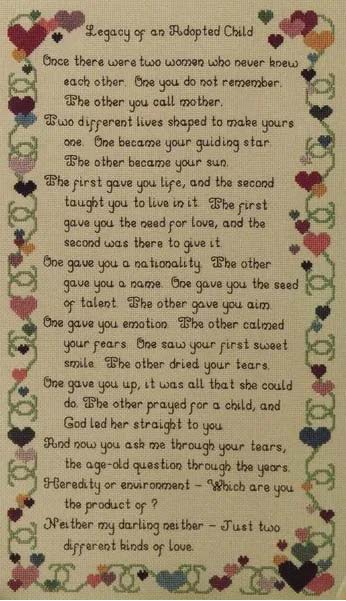
Heredity Or Environment

I had not heard of this poem before but read about it today. A lot of adoptees are familiar with it and many hate it (so a word of advice to adoptive parents – just don’t). One notes that for an adopted child – culture, facial features, accents – all of it is so important. Blogger’s note – for the child of 2 adoptees, all of that mattered to me as well.As to the question – heredity or environment ? – I would quickly say that I am the product of both.My ancestors’ genes and the Mexican border region where I grew up.

One adoptee notes that – for some reason A LOT of adoptive parents seem to not really like their children… (Not all of them but MORE THEN I could have imagined). Blogger’s note – I would say that my adoptee mom often felt like she disappointed her adoptive mother. Now that I have the whole adoption file from the state of Tennessee, I can see letters in my adoptive grandmother’s easily recognizable handwriting about how over the moon happy she was initially with my baby mom. But children grow up – always.

One adoptee actually re-wrote the poem – (Blogger’s note, the sentiments match so much I’ve read over the last few years)

Legacy Of An Adopted Child
The Rewrite

Once there were two women,
who never knew each other

One you learned how not to remember,
the other you learned to call mother

Two different lives,
shaped to make you a pretend one

One became your deep black hole,
The other your imploding sun

The first one gave you life,
yet chose to give you away

The second taught you to live it,
in all but fake way

The first gave you a need for love,
that soon would be denied,

The second there to give it,
if only you learn to comply

One gave you a nationality,
that they chose you to not live,

The other changed your name,
your own mother chose to give

One gave you emotions,
that you would soon learn to squash,

The other fed your fears,
that they themselves had taught

One saw your first sweet smile,
still chose to hand you off,

The other dried your tears,
forgetting your deep loss

One made an adoption plan,
which sounds so politically correct,

The other prayed for a child,
and thinks God let her collect.

And now you ask me through your tears,
which of these you’re a product of,
One, my darling, one

Adopters can be so smug

~ Joy Belle, 2018

A transracial adoptee also wrote one and said “I’ve always hated that poem”.

The Fallacy of the Transracially Adopted Child

Once there were two women who never knew each other
One you don’t remember, one paid to be your mother

Two women’s lives forever changed to shape your little one,
Leaving you with trauma that could never be undone.

One gave you ethnicity, and one erased your name,
and then was called your rescuer for “saving” you from pain.

One gave you emotions that you struggle to suppress
with performative gratitude to mask your deep duress.

One coerced to give you up, told it was best for you,
But if she’d had that 30k, she could have raised you too.

One prayed for her own white babe, but met with sticker-shock,
And then she saw your bargain price on the modern auction block.

That same one finally took you home, her consolation prize
with curly hair, and plump full lips, brown skin and deep brown eyes

The other one left wondering if she made the right decision,
Or if her heart will ever heal from the pain of your excision.

And so you wonder through countless years
Of expectations and hidden fears

Was your arrival preordained by a hand from heaven above,
Or did your 2nd mom purchase you to fill her need for love?

~ Renata Hornik, 2021

Blogger’s note – The originaI version is author unknown. I do hope the poets don’t object since I do not have express permission to share these, though they are signed with a copyright date. These are true unfettered adoptee voices and I honor them today by sharing their feelings with my readers.

You Are A Light

It is that season of hope and light. Listening to Rev Jason Daveon Mitchell’s message at LINK>Agape last Sunday echoed stories of how so many lives bring light with them. He said – . . . the world is already blessed because you are here. You are a light that entered into an aspect of darkness. Some of you lit up and opened up a crevice in the parents that you had. Some of you lit up the fire station that you were set out in front of. For some of you, the family that you were born into, delivered you to somewhere else. Some of you went into the foster care system.

Just to say that regardless, you are not defined by the conditions of your birth. There may be trauma that you will have to struggle to overcome, perhaps with some good trauma informed therapist. All of you have gone through all manner of conditions on your life’s journey.

Adopters=Co-dependancy

An adoptive parent admits she is co-dependent. She was learning all about co-dependency, due to an unrelated (to adoption) life situation, when it hit her that adoptive parents are co-dependent. She writes – that she is ‘not always/not all’ aware, so no need to point it out. But she is certain there is a high likelihood of adopters being co-dependent AF.

She notes that the reason she posted this is – we can only grow and do better from what we know. And we won’t know we are codependent, unless we learn about it. Co-dependent people thrive on being needed. They find taking care of others more fulfilling than anything. They make other people’s problems their own. It’s more of a personality type, than a disorder but it can get unhealthy very easily, if we are not aware. She added – “My goal is to cause as little additional trauma to my kids as possible….I will learn and do better !”

An adoptive parent who is also a therapist notes – I see that as a theme with some who adopt. I don’t want to over categorize people, but the place I have noticed this the most is with those who adopt from other countries or foster care, after they have had their biological kids. That role appeals to them. It becomes part of their identity. And yes, it is important to see how that leads to wanting gratitude and other unhealthy patterns. One adoptee responded to that with this – “WOW! CAN YOU ELABORATE MORE?! I have become so hyper independent, it’s bad/sad. My adoptive parents had two biological kids and adopted me 15 years later.” Someone else understood – We learned to try and control the situation, so we could be safe.

A mother who lost her child to adoption writes – Yeah if I wasn’t co-dependent (as a result of trauma growing up) then, I’m sure I wouldn’t have given my son up. I would’ve had the confidence to say no and stand up for myself. Another responded – I would not have bought into the idea that another mother would be better than me.

The more common trait in adoptive mothers is narcissism. One wrote – the two are similar and it’s important we don’t try to diagnose ourselves. But those who try to break the trauma cycle are more likely to be the co-dependent one. Narcissists usually don’t have the self awareness or empathy to admit their mental health needs. If you’re curious look at covert narcissists. (from LINK>VeryWell Mind – A covert narcissist is someone who craves admiration and importance, lacking empathy toward others but may act in a different way than an overt narcissist. They may exhibit symptoms of narcissistic personality disorder (NPD) but often hide the more obvious signs of the condition.)

Cobbled Together

True, the one is very dangerous and does not apply to all cobbled together parent/child relationships, which is what adoption does. However, there are frequently cases of abuse that make it into the news and the natural parent usually has love that stays their worst potentials, whereas an adoptive parent would not have an equal bond. And, I do know a thing or two about severed origins. All of mine were severed – all 4 grandparents lost to me – I only rediscovered who they were and something about their families and histories, after I was well over 60 years old and they were long deceased.

One adoptive parent commented in my all things adoption group – When I saw this I really didn’t look at it from the perspective of being zapped, it was more like natural fit verses cobbling something together, yet the world pretends that they are equal. One is designed to fit and the other is like “let’s see how we can make this work” but it should be abundantly obvious that they aren’t the same. (blogger’s note – thanks to her, I had a title for today’s blog.)

One adoptee notes – there is no “bond,” only attachment.  A bond exits more through deep secure connection and unconditional love, attachment is developed through trauma and having expectations and conditions. As an adoptee, it took DECADES to understand the difference.

There can be trauma bonds. Emotional bonds with an individual from a cyclical pattern of abuse, perpetuated by intermittent reinforcement through rewards and punishments. The concept was developed by psychologists Donald Dutton and Susan Painter.

Googling “Adoption Severs Origins”, I arrived at a site – LINK>The Ex-Puritan and saw this – Imagine learning the word “adoption” at the same time you learn words like “mother,” “father,” “home,” ”birth,” or “safe.” (blogger’s note – How confusing, I think.) It continues, other words you learn are “abandoned,” “given up,” “loved,” “wanted,” and “adopted.” You learn that the one who gave birth to you is a parent, that you have a mother but she gave you up. You learn that the people looking after you are also your parents, a mother and father, who took you and kept you. You are not related to them, but you are. They could not have babies of their own, so they adopted you. You are told your biological mother wanted to keep you, but couldn’t because she was too young. You are told that she loved you, and that you are wanted, yet you know you were still given up. You must reconcile the fact that you have no power to choose for yourself, that these people you find yourself with are your parents, and that you may never fully know who or where you came from. You don’t remember a time where you weren’t told any of this.

More at the link above, if you are interested in reading further into that story.

Little Orphan Cassidy

I am somewhat a fan of the program Saturday Night Live though I never watch the whole program and rarely the sketches. Usually on Sunday morning, it is a guilty pleasure, to look up the cold open and weekend update segments. I started doing this in 2016 after our former president was elected. Therefore, I missed this sketch until I learned about this in my all things adoption group.

The video, LINK>YouTube, for this indicates that an orphan (Chloe Troast) sings to the moon (Timothée Chalamet) about not getting adopted in a Saturday Night Live sketch – Little Orphan Cassidy. I noticed the old building has a sign over the door – Ms Pippinstuffs’ Home for Unwanted Girls.

So, I just watched the sketch (link above, if you want to watch it your self). Certainly, the feeling expressed at the beginning won’t be totally alien to people who were adopted later in childhood but not as infants. However, if she is really 26 years old, she should have aged out of the system 8 years earlier. Actually, then she admits that she is already 27 years old. It goes downhill from there. No wonder some adoptees found it troubling, however, SNL sometimes does go a bit too far attempting humor.

Here is what some adoptees said about this sketch –

First, the adoptee who shared a link to the video wrote – I saw this SNL skit and feel a lot of emotions about it but don’t know exactly how to express them. I’m curious what everyone else thinks about it

Adoptee – not cool or funny. Two things really irk me. [1] I do not enjoy having my trauma being the gag. How many other traumatized people have theirs twisted like this? [2] The theme is there is something wrong with you to not get adopted. Like it’s a life goal.

From someone in foster care as a youth – I also saw this and not sure what to think. I love Timothée Chalamet and SNL, but they do offensive things all the time and that’s their thing. For me, I think the most important voices are former Foster Care teens or adults who have lived through group homes.

So Perfectly Expressed

Podcast by Ande Scott, a late discovery adoptee

This was NOT in her podcast but was posted by my friend on Facebook. It was so good (and I am short on time today) that I wanted to share it here.

When people tell me Adoption isn’t like it was when you were a baby – in many ways the adoption industry is worse. On the one hand, they will acknowledge that adoption is trauma, but continue to do “outreach” to coerce pregnant people in crisis to give up their children. They will acknowledge that our families are traumatized by our loss, but throw platitudes and promises at them, in order to convince them to relinquish. They acknowledge the pain, but pursue policies that deny reproductive rights, prevent sex education and access to contraceptives , and promote a false narrative that children will be better off with strangers. They acknowledge that people who lose their families should know they are being raised by others, and say they promote openness. Without advising our families that this is usually not enforceable, and still advocating for falsified birth certificates. They promote foster to adopt as the solution, but do not disclose the way this has been turned into a racket; one that involves increased policing of families, especially families of color.

They’ve gotten better at the con, out of long years of practice and access to billions of dollars. They use their lobbying and political and religious and social power to disempower others and perpetuate marginalization, when they could put the weight of their influence behind family preservation and the programs that would make our society healthier. But that would mean a loss of money and power.

Every day another child is robbed of their identity and family and culture and history via the practices of the dual birth certificate system, closed adoption (knowing you are adopted does not equate to open adoption ), private adoption, transracial adoption, transnational adoption.

None of these practices are necessary to help a child in crisis.

Seven Core Issues

I’ve not actually read this book but learned about it today. It comes highly recommended by many and who have actually read it and is rated right up there with The Primal Wound and Twenty Things Adopted Kids Wish Their Adoptive Parents Knew. Also Being Adopted: The Lifelong Search for Self. So, I thought I should share it. I was happy to see that the book also covers Third Party Reproduction (in fact the book includes donor insemination and surrogacy).

Originally published in the 1980s, it was ahead of it’s time. One adoptee says, it is something that I wish my adoptive parents had read. The new edition has been updated and was released in 2019. The seven core issues are loss, rejection, guilt and shame, grief, identity, intimacy, and mastery/control.

One person familiar with this book said it was “A classic and foundational to the way I think about these issues and the importance of reform in adoption practices.”

At Amazon it is said – “the first conceptual framework of its kind to offer a unifying lens that was inclusive of all individuals touched by the adoption experience.” It is further noted that – “Attachment and trauma are integrated with the Seven Core Issues model to address and normalize the additional tasks individuals and families will encounter.” The book also claims to access “a range of perspectives including: multi-racial, LGBTQ, Hispanic, Asian, Native American, African-American, International,” as well as those that cover openness, search and reunion.

Penny Callan Partridge, Co-founder in 1973 of the Adoption Forum of Philadelphia, wrote – “For decades, I have been responding to these ‘seven core issues’ as an adopted person, as a parent by adoption, as a poet. Now I imagine myself as a therapist trying to help someone in the adoption constellation. I would definitely want this book close at hand.”

Another, Keith Silverstein, a voice actor and adoption advocate, noted – “As an adopted person, I’m very familiar with the seven core issues, both comprehensively and experientially. Yet even with my prior knowledge, there was a deeper understanding to be attained through the pages of this book. Having had the pleasure to work with and consider both Sharon and Allison my friends, I’ve seen first hand the passion they have for adoption and helping children find permanence. Their collective expertise, contained here, is, in my opinion, the gold standard for understanding and working towards permanence in adoption.”