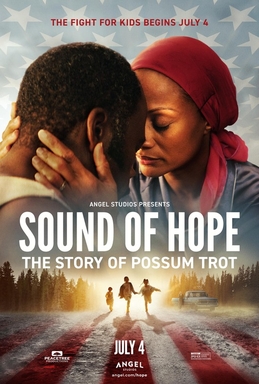
Possum Trot

I’m more than average familiar with Possums (the animal is common where I live in Missouri). A mom’s friend of mine once named her first born Possum – I was stunned. She passed away and both of her kids (the other one she named Lynx) changed their names according to their dad who I once met and stayed in contact with for awhile.

imdb says of this film – Sound of Hope: The Story of Possum Trot is the true story of Donna and Reverend Martin and their church in East Texas. 22 families adopted 77 children from the local foster system, igniting a movement for vulnerable children everywhere.

One reviewer described it this way – “not your typical feel good adoption story. This movie is raw, real, and gives you an honest glimpse into the harsh reality of the traumas that children in foster care have experienced and what it takes for families to love them to healing and wholeness. The power of love, community, and hope was a clear message throughout !”

However, in my all things adoption group (which got me to look at this upcoming theatrical release) wrote – “It looks like there yet another movie pushing the savior agenda within foster care and claiming that foster children are unwanted. I volunteer for an annual summer camp that provides teens in local foster care with 3 days of fun activities and the organization sent me an invite to go see this movie with volunteers as a group. The trailer gave me enough information to know it’s not something I can support. I’m assuming the goal of the movie is to tug on people’s hearts and make them want to “save” children by fostering/adopting.”

Here is that trailer –

One adoptee said – I want to crowd fund Jordan Peel to make a horror film of the exact same to opposite plot.

One former foster now adoptive parent noted – LINK>Angel Studios is also heavily involved in the Tim Ballard/OUR drama. I wouldn’t support anything they make anyway. blogger’s note – so I went looking, as I suspected they are known for making “Christian” movies. I also looked up LINK>Tim Ballard and he was associated with the Operation Underground Railroad. Unfortunately, I do believe that we once watched LINK>Sound of Freedom with Jim Caviezel on dvd. He portrays Ballard.

One adoptee added –  “I would be curious though to know what gets classified as neglect. I feel like that’s a catch all phase that isn’t applied equally. Obviously, no kid should be abused. How does this actually support kids ? I feel like this will just piss people off without providing real concrete action to change lives. Adding, I just wanna see a movie/read a book from an adoptee that centers them.”

Can Scapegoats Recover ?

Painting by Bea Jones

The short answer is yes. So often I read about adoptees who have been psychologically abused, usually by a narcissistic adoptive mother but it could just as easily be a narcissistic adoptive father.

There is so much to learn about scapegoating, when one goes looking. I read that the concept of a scapegoat has a very long history, some of it religious. It has even been an animal, a literal goat, upon which a community would place the blame for all of it’s sins. Then the goat was sent away.

One male adoptee wrote an essay for Severance magazine – LINK>I Am More Than My Fathers by David Sanchez Brown. He notes “I was not the dream son my adoptive parents envisioned I’d be. I was a clumsy, overweight kid with Coke-bottle thick glasses and learning disabilities who couldn’t seem to do anything right . . .” He later writes “I never connected my feelings about myself with having been adopted. I thought I was a failure and unworthy of unconditional love.” He also notes the common plight of many adoptees – “I didn’t look or act like anyone else in the family. I stuck out like a sore thumb and I became the family scapegoat.”

My interest in looking at this concept was triggered when I read this from a Facebook acquaintance – “I was a scapegoat. I knew I got blamed for things and then I learned it’s called scapegoating. And, I knew I had been scapegoated.” Then she notes – “I am now a recovering scapegoat.” Yet, owns this – “I’m just saying I find claiming what I can change empowering. I’m a scapegoat who is a massive people pleaser.” And many adoptees do become people pleasers in an effort to find acceptance.

Dr Elvira Aletta has some suggestions in her LINK>”10 Tips to Survive Being the Scapegoat at Home.” She ends this piece with “If you’re just beginning to understand how scapegoated you are, take it easy. Once your eyes are opened you might begin to see it everywhere.” Yes, it does seem to be rather common, sadly.

I end this blog today with some thoughts from the Daily Guide in the Science of Mind magazine – “You ae whole and also part of larger and larger circles of wholeness you may not even know about. You are never alone. and you already belong. You belong to life. You belong to this moment, this breath.” ~ Jon Kabat-Zinn

And this one might apply especially to adoptees – “All human endeavor is an attempt to get back to first principles, to find such an inward wholeness that all sense of fear, doubt and uncertainty vanishes.” ~ Ernest Holmes, The Art of Life pg 9

The truth for every human being is that we are neither bad nor broken. We have the absolute ability to become clear, confident, aware and certain. We can chose wholeness over limitation. We can understand that there have been no mistakes but only opportunities for us to learn about ourselves and our world. We grow in wholeness as we learn to be vigilant, not assigning fault or blame to ourselves – or to others. Better to see everything that has happened or that happens, even the things we do not like, as a piece that fits in the fabric of what is our actual lived experience. It is ours to define.

Like Dominos Tumbling

Yesterday, as I was considering how the pieces of my own roots journey unfolded, I had this image of Dominos – one leading to the next. I had been in the dark about my own genetic, biological roots for more than 60 years. My mom had tried to discover her own but was denied and rejected when she made her attempts. My dad never seemed to want to know or maybe he was just afraid of what he might discover.

Never the less, one amazing revelation after another and in only 1 year’s time, I knew most of it. Some additional pieces have come my way since then but nothing as absorbing and amazing as that year since. Was I just lucky or was it just the appropriate time for everything that had been hidden and sealed off to reveal it self ? It was like there was an energy of disclosure that would no longer be denied.

From my mom’s biological, genetic mother and father to my dad’s biological, genetic mother and father, one after the other, doors opened and the truth was revealed. It feels very solid now – I know from whom and where I came from. Not that dark place of knowing nothing that I lived with for over 60 years.

I’m grateful for my success. I could have just as easily failed – or could I have ? Somehow, it was just finally the time for the truth to out itself. All I did was follow the bread crumbs, from one piece of information to the next, until there were not a lot more to follow – though some turn up from time to time – a relative in Denmark, where my dad’s father immigrated from. More recently from that same family line via Ancestry, the wife of another one who is highly interested in genealogy.

I will follow any that come but mostly I’ve arrived at wholeness and that has meant everything I could have ever hoped for. I believe I fulfilled the reason I wasn’t given up for adoption by my young, unmarried parents who were both adoptees (they did manage to get married before I was born). Thanking all that is good in this world.

My Life’s Purpose

In 2012, I participated in an online course with Jean Houston titled Awakening to Your Life’s Purpose. In 2016, I spent a week at her home in Oregon with other participants attending what was titled Electing Yourself. I remember that she was certain that Trump would not be elected but as we all know, he was (regardless of how one might interpret the validity of his election).

In the August 2016 Salon, I took the “hot seat” and commented that I had not discovered my Life’s Purpose previously. I didn’t discover it at that Salon either.

But beginning in the fall of 2017, I began a personal roots journey to discover who my genetic grandparents were, since both of my parents were adoptees and both died with almost no knowledge of their origins (1930s closed, sealed adoptions). I succeeded beyond any of my wildest dreams and now feel whole in ways I did not feel for almost 6 decades of my life. Now that I and my related family members know who these people were, no one can take that back away from any of us. I am still integrating my own new awareness and this has had to include re-owning my relatives via adoption. Once I knew my family’s truths, for awhile, the adoptive family no longer felt “real” to me. Now I can embrace all of them (personally known and never having met) as important in my own lifetime.

Part of that new understanding was realizing what a minor miracle it was that my unwed, high school student mother had not been forced to give me up for adoption.

I believe I was preserved in the family I was conceived within to reconnect the severed threads of my family’s origins. Having done that, I continue to educate myself about all things adoption and that has led me to write this daily blog (with some gaps unavoidably occurring). Sometimes, I think I have written enough, sharing what I learn with anyone else who is interested for whatever reason. But there always seems to be something more to say. My daughter once said to me – it seems like you are on a mission. I accept that is true – I do what I can to spread the word about the trauma and unintended consequences experienced by adopted persons. Until there isn’t anything more to share, I will continue to write here.

The late Dr Wayne Dyer wrote in Staying on the Path, pg 68 – “A purpose is not something that you’re going to find. It’s something that will find you. And it will find you only when you’re ready and not before.” Dr Dyer actually died just before my own mother did in 2015. My dad died a short 4 months later. They had been high school sweethearts and remained married for over 50 years. Both were gone before I could share my own family origin discoveries with them.

A Little Bit Of Everything

Happy Original Mother Reunited With Son

Short and sweet today because I don’t have much time. From an original mother in reunion.

She has yet to figure out the shortest way to self ID for she IS the adoption triad –

-International infant adoptee

-Former foster youth

-Former kinship guardian

-Adoptive parent of adult who was placed with me for kinship guardianship but asked to be legally adopted at the age of 20

-Natural mother and sole guardian of a child formerly in the system

The picture was posted with the child’s permission – from a mother and son reunion and reunification a week ago. They are still well inside their “honeymoon” period, but so far, everything is great. The child so happy to be back with his mom again and she feels whole again for the first time in years.

Betty Jean Lifton

Born 1926 – Died 2010 at age 84

I didn’t know of her until today. One of the many defining things that BJ was – she was adopted. And those of us who are adopted ones know that the world infantilizes us and constantly refers to us as ‘adopted children’ even when we are 30, 40, 50, 70 and so on.

BJ was “an adopted child” and it is fitting that she be referred to that way, because she kept a clear and present focus on children, on children’s issues, and on children’s literature. Though I have personally pretty much maxed out on my own adoption related reading, if you have not, she is a good author to look up and read.

BJ is described as being swan-like, quiet but magnetic, slowly turning her head left and right in regal greeting whenever she made her way to a podium at a speaking engagement related to adoption. There was an old-Hollywood glamour to this Staten Island-born, Cincinnati-bred, first-wave adoptee. Her birth name was Blanche. That somehow fit her with her clipped consonants and languid vowels, dramatic mien and throaty chuckle. She easily managed to come across as both mysterious (what did that smirk of hers signify ?) and searingly direct, when discussing the issue closest to her heart: openness meaning open records, openness about origins, open acknowledgement of the adoption experience’s impact on all members of the triad.

She had been adopted through Louise Wise Services. At the time, the only option for Jewish birth mothers and adoptive parents in New York City. She seven years old when she learned about her adoption. She was told her adoption was “a secret.” She described herself as a “good adoptee” — unrebellious, eager to please and to belong. She had an idea of “shadow selves.” Meaning the child the birth parents lost, the child the adoptive parents couldn’t have, and the person the adoptee might have been if raised elsewhere. I get this concept related to my adoptee parents.

Her adoption related books include – Journey of the Adopted Self and Lost and Found, as well as her 1975 memoir, Twice Born. BJ is described as a wise woman and an amazing and magical writer. She has been referred to as the Gloria Steinem of adoption. She saw things through a prism that included more than what most people saw, or wanted to see in the world of adoption. She was a pioneer.

BJ told many tales – like this one about the ‘possible self. To illustrate that, she would give an adoptee two dolls: one was who the adoptee would have been, if she had stayed on the course that she came into the world as – her birth self – and the other was who she actually became in real life. I think my own adoptee mother would have related well to that tale. BJ stated that ‘our possible selves’, as adopted ones, had a huge influence on our current selves and only by bringing them together would we be whole. As the child of two adoptees who now has two kinds of families – the ones my parents were born into and the ones that adoption gave us, I also understand and though it IS complicated, I have that sense of wholeness that I didn’t ever fully know I lacked before I found out during my roots journey.

BJ was a storyteller. Like the one called The Deep Sleep. In adoption circles, the fog may be a similar concept. This is that state that people go into when their original lives are taken from them and are made a secret. She also told stories of brave people who saved children and the brave children who asked questions and found the truth that saved the grownups.

BJ made an amazing difference in the lives of adopted people, birthparents, and adoptive parents as well as professionals in the field. She never wavered in her beliefs, and in her stand for human rights in adoption. She helped the individuals that she spoke with, testified with, did therapy with, worked with and played with. She helped the adoption reform movement and left her indelible mark is on everything that has evolved in adoption reform. She bequeathed us with a passion for the truth.

I credit a lot of my content today to two essays about Betty Jean Lifton – [1] “Goodbye, Betty Jean” by Sarah Saffian at the LINK> Adoptive Families website and [2] to an essay simply titled, LINK> Betty Jean Lifton, by Joyce Maguire Pavao at the Jewish Women’s Archive website.

Losing My ?

As the child of both parents being adoptees and as the sister to my only two sisters, who both gave up babies to adoption – I’ve said “adoption” was the most natural thing in the world for me. But that isn’t quite right – it’s not natural – and all of the kids I grew up going to school with didn’t have adoptee parents (though thankfully, my parents were NOT my adoptive parents) and adoptive grandparents and adoptee uncles. So, I can’t really say it was commonplace to have adoption be so primary in our lives.

The closest I can come is that it was the reality. Not having a medical history for my parents when asked about that in doctor’s offices was just the reality.

Not knowing our racial heritage was just the reality. In fact, it may seem a bit odd but until I knew better (in 2017, when I was already 63 years old and both of my parents deceased), I honestly thought my mom was half African American and my dad was half Mexican – not kidding about that – that is how I was able to explain to myself that my parents had been given up for adoption – they must have been mixed race, which made me at least 50% mixed race along with 50% white (because I was definitely light skinned, blond haired and blue eyed). The truth was far from my creative imaginings. My mom had a lot of Scottish along with some English and thanks to slavery a smidgeon of Mali. My dad is half Danish.

My 4 adoptive grandparents were all wonderful people. My mom’s original parents were highly thought of and loved by their relations. My dad’s mother was loved and his dad, well he was a lot like my dad. Never knew he had even one child, let alone a son. More’s the pity – I think they would have made great fishing buddies.

Yet for about 5 years now, I’ve been reading the thoughts of adoptees wherever I find them and my perspective has entirely changed. I do not think adoption is a good thing in most cases. I actually thought my parents were orphans for the longest time – like until I was grown and heard from my mom that she was trying to get the state of Tennessee to release her adoption file to her because she was CONVINCED her adoption had been inappropriate (to a great extent because Georgia Tann had been involved) and she wanted to contact her original mother. Then, the state of Tennessee broke her heart because they told her that her mom had already died a few years earlier. She knew her dad was likely (and even that was not certain) older than her mom, so probably dead too. About 2 years after my mom died, I was able to do what she never could – get her entire adoption file from the state of Tennessee.

I do have Ancestry as well as 23 and Me to thank for most of my progress on my dad’s side. I now know who all 4 of my original grandparents were (something my own parents died never knowing). I have contact with some genetic, biological relations who are still living. I feel whole in a way I never even knew I did not feel before I learned all of that.

Somehow this song speaks to my feelings about all of this . . .

Telling The Truth

The same can be said for your donor conceived child. Way back when, the suggestion was to begin to tell “the story” very early in the child’s life. That it would be good practice and that the truth would never feel as though it had been concealed. With the advent of inexpensive DNA testing and matching sites, I’m glad we followed that advice with our two sons. My mom’s group from over 18 years ago, once divided into two camps – telling and not telling. I am compassionately understanding of those who chose not to tell. Once I was talking to a friend who was stressing about telling her children they were donor egg conceived. While we were on the phone, her husband was in the backyard committing suicide. Understandably, the disruption of that tragic event has now robbed her of any good time to come out with the truth.

I do know of some late discovery adoptees (this is someone who finds out after maturity that they were adopted). One shares her point of view today – An adopted person should know they are adopted before they ever understand what it means. When is the right time to tell someone they’re adopted? Yesterday. The day before. The day before that. If you’re asking this question, you’ve already done it wrong.

If there is an adopted person in your life and you cannot say with 100% certainty that they know they’re adopted, you and the people around that adoptee have failed them. Withholding this information from an adopted person isn’t about the comfort of or what’s best for the adoptee, it’s about the unwillingness of the people around the adoptee to be uncomfortable.

Telling a person they’re adopted should never be done in a public setting. To do so is meant only to protect yourself from reaction and backlash. It’s cruel. There needs to be space and grace allowed for all the feelings that come with having your world turned upside down. This needs to be done with the understanding that your relationship with that person may never ever be the same moving forward. This needs to be done with the understanding that there might be no more relationship after this. And you need to understand *this*isn’t*about*you*. It’s about doing what’s right to make an adopted person whole. Because while it may seem that they don’t consciously know, their body does. The trauma of their separation from their natural mother has been stored within their bodily cells. To withhold this information from someone is emotionally abusive.

A Complicated Relationship with Love

“No one has a more complicated relationship with love than a child who was adopted.” from an article in Psychology Today titled The Complicated Calibration of Love by Carrie Goldman. Children are the only ones who simultaneously crave, reject, embrace, need, challenge, inhale, absorb, return, share, fight, accept, and question your love on a daily basis.

How does the world convince an adoptee they are loved and valued ? The same world that thrust a great injustice upon this child by separating them from their first mother and possibly siblings, the world that passed them along to a doting foster mom to whom they became attached and then separated them again, the world that dropped this child into the outstretched, naïve, and eager arms of adoptive parents, their greatest joy intricately tied to the child’s greatest sadness, the world that views this child’s story as a happily-ever-after and now expects them to be grateful, happy, well adjusted, and perfect at all times—how does such a child learn to trust the love of that world?

Carrie notes – To match the giving of love with the exact need of any recipient is a moving calibration. There is no reliable unit of measurement for something so imprecise as human affection. We try. We offer up our love in words and actions, hoping to meet the ever-changing needs of our lovers, our children, our friends, and our families – every relationship that matters takes some work.

When one person in the relationship inhales the sour breath of the beast that is insecurity, a beast whose presence twists the very air between two humans and makes greater the flaws that beckoned it in the door. Insecurity, also known as fear, feeds on the dark and scary parts of the mind, growing in strength and power as it distorts what is real and what is imagined.

Sometimes insecurity grows too large until there is almost no space left for the relationship. But the antidote to such despair is hope, and hope, fortunately, needs less fuel to stay alive. These dynamics occur in any relationship, and the intensity can be magnified by a thousand when one of the partners is an adoptee.

The choice to be an adoptive parent is built on mountains of hope, oceans of hope, forests filled with the hope that a thousand seeds planted might one day yield a mighty tree. What combination of internal resilience, good parenting, genetics, access to birth history, love, acceptance of grief, and endless empathy is needed to raise an adoptee to wholeness ?

An adoptee did not choose to be adopted at a very young age; it was foisted upon them and packaged as “you’re so lucky” by the world. An adoptive parent must allow and validate all the feelings and viewpoints, even the ones that don’t fit the happily-ever-after narrative. 

An adoptee is unlucky. They are not growing up with their first family. If biological children for their adoptive parents are also in the picture, they cannot help but wonder if the adoptive parents love their biological children more. Many adoptees worry they will never be good enough. Most adoptee do battle with legitimate fears of abandonment in every relationship they enter into throughout life. Often an adoptee rages against the unfairness of being adopted and basically hates being adopted.

~ Carrie Goldman writes a parenting blog called Portrait of an Adoption.

The Archaic Shadow Of Secrecy

Parent Child Match

The closed, sealed adoption records of yesterday are much easier to pierce with today’s inexpensive DNA testing. Today’s story from Severance Magazine.

It begins this way – in 1967, I’d given birth to my first-born child in an unwed mothers maternity home in New Orleans, Louisiana. I had been a typical 17-year-old high school senior with plans for the future that evaporated overnight. In the sixties, it was considered close to criminal for a girl to become pregnant with no ring on her finger. The father of my child had joined the Army, preferring Vietnam to fatherhood. After my parents discovered my shameful secret, I was covertly hurried away and placed in an institution for five months. There, I was expected to relinquish my baby immediately after giving birth to closed adoption and I was repeatedly assured my child would have a better life without me. After his birth, I was allowed to hold my son three times. My heart was permanently damaged when I handed him over the final time. The home allowed one concession—I could give my baby a crib name. I named him Jamie.

In the Spring of 2016, this woman and her husband submitted DNA tests to Ancestry.com. By October 2016, a  ‘Parent/Child Match’ message popped up on her iPhone, causing me to stop me in my tracks, as my knees gave out from under me. After 49 long years, Jamie had found her. Who was he? Where was he? Would he hate me? How would this affect my life? My family? His family? She had always dreamed of finding Jamie but never thought past that point.

She relates – that night I heard my son’s voice for the first time. The wonder I felt when he said, “I know your voice” transformed me. In minutes, the secret of my son changed from fear of anyone knowing about him to wanting to shout out to the world, “My son has found me!” She also learned she had three new grandchildren.  Within four days, her son flew from Louisiana to California to meet her. She describes that first meeting as magical. She says, “My son was back in my life, and suddenly I was whole.”

Due to severe depression brought on by the COVID pandemic as a messy divorce, the loss of his job, and unhealthy isolation began to destroy him, she worried from a distance. In February 2021, they had what would be their last conversation. Before hanging up, her son said, “I love you, Mom. You’re the best thing that ever happened to me.” Two days later, the son she had mourned for 50 years, the son who had found her, left her again. He took his own life. Now she had lost him twice and this time was forever. Even so, she cherishes that phone call.

She ends her story with this – “I wish I could speak to all the birth mothers out there, who continue to carry the shame and guilt that society placed on us. For those who refuse to allow their relinquished child back into their lives. I want to say I know your fear. I know your uncertainty. I lived it and still live it. It is deep-seated in us, regardless of the circumstances that resulted in us leaving our children. Please know if you are brave enough to welcome that lost child into your life again, you may create a peace and a bond worth all the fear and guilt. There is nothing quite like reuniting a mother and her child, and you may be giving a gift of connection to that child and yourself, as it should have been all along.”