Adopt Change

Hugh Jackman and Deborra-Lee Furness

I don’t really “follow” celebrities but news that the two are divorcing caught my attention and then further this information – Hugh and Deborra-Lee Jackman are the parents of two children, whom they adopted as young children: Oscar, 23 and Ava, 18. “To be clear, Deb and I always wanted to adopt. So that was always in our plan,” Hugh Jackman told Katie Couric in 2012. Someone in my all things adoption group wrote – “didn’t they hold themselves up on a pedestal as superior (as wealthy 2 parent family) to the biological families of the kids they purchased & promise a better life & ‘forever family’.”

It is said that “After the past few years, the love they had for each other turned more into a friendship which got broken during COVID, as the lockdown didn’t help their marriage at all and really put a strain on their relationship. They worked on it and couldn’t get it back.”

Then, I read this – Deborah Furness is the driving force behind a not for profit adoption advocacy group in Australia called LINK>Adopt Change. Their key argument is to make it quicker and easier to adopt in Australia – they’re trying to make it more like the system in the USA. It’s revolting. They’re trying to campaign government departments to make Australia’s version of Termination of Parental Rights easier – it’s backwards thinking, to aid the stealing babies from poor families in order to give them to rich families. Someone else noted –  as much as it’s a very very ‘small mercy’ comparative to the huge traumas they have already experienced in their lives – I am grateful that the children (of Hugh and Deborra-Lee) are both adults.

The Adopt Change website also notes that Deborra-lee is the co-founder of LINK>Hopeland, a US-based platform driving awareness around the issue of vulnerable children. The mission of Hopeland is to ensure children belong in loving families. Hopeland is about family strengthening and community empowerment and driving creative solutions for vulnerable and abandoned children globally. Sounds un-impeachable on the surface.

In discussing this story, one mother who surrendered her child to adoption writes –  I was definitely encouraged to give my son a “two parent” family and that is touted in Christian circles as a reason single moms should choose adoption. My son’s adoptive parents divorced. And it turns out that I wasn’t given all the facts when I chose them as my child’s home and family. I’ll grant that she didn’t likely have the word “abuse” in her marriage vocabulary yet – because I was in an abusive marriage and can remember the day my subconscious allowed that word into my mind – but she did already know that the way her husband presented himself to the world was different than the way the family experienced him. And that was something I deserved to know when making such a life changing decision.

I know it happens. This happened with my sister’s choice of adoptive family (it was a private adoption through a lawyer). I think that sometimes adoption is a hoped for cure in a struggling marriage and it doesn’t always bring about that outcome.

A Very Mixed Bag

Angelina Jolie with all 6 of her children

I recently saw LINK>Angelina Jolie in the movie The Bone Collector. I was fascinated by what has been defined as her “bee-stung lips.” I remembered she had adopted children from several countries. So I thought, as I had never written in this blog with her circumstances in mind, I would give it a go. I wondered about her ethnicity and did a deep dive down the rabbit hole of her parentage. It is no wonder she is a humanitarian because her mother, LINK>Marcheline Bertrand was. Her mother was involved with the activist John Trudell at the end of her life. It is worth spending some time looking into the Wikipedias for both Jolie and Bertrand for more insight. I was never a huge fan, though I have seen more than one movie that she acted in.

Today, I will focus on her children and an intersection with her humanitarian work – Maddox Chivan Jolie-Pitt who was born in Cambodia, Pax Thien Jolie-Pitt who was born in Vietnam, and Zahara Marley Jolie-Pitt who was born in Ethiopia, are all adopted. Shiloh Nouvel Jolie-Pitt was born in Namibia. Her twins – Knox Léon Jolie-Pitt and Vivienne Marcheline Jolie-Pitt were born in France. Her twins were conceived via in-vitro fertilization and she gave birth to them via caesarean section at the age of 33.

In an article at LINK>Harper’s Bazaar, Angelina Jolie discusses her adopted children. There is more at the link but here are a few quotes attributed to her – “All adopted children come with a beautiful mystery of a world that is meeting yours. When they are from another race and foreign land, that mystery, that gift, is so full.” She has also been quoted as saying – “They are not entering your world, you are entering each other’s worlds.”

Regarding Maddox, she has said “Cambodia was the country that made me aware of refugees. It made me engage in foreign affairs in a way I never had, and join UNHCR. Above all, it made me a mom.” Jolie has said that “Each (adoption) is a beautiful way of becoming family. What is important is to speak with openness about all of it and to share. ‘Adoption’ and ‘orphanage’ are positive words in our home. With my adopted children, I can’t speak of pregnancy, but I speak with much detail and love about the journey to find them and what it was like to look in their eyes for the first time.”

She has been heavily involved in humanitarian work, something her mother was known for. She has created with her wealth various foundations – the Maddox Jolie-Pitt Foundation which created Millennium Villages in Cambodia and Kenya as well as funding schools, roads, and a soy milk factory in Kenya. Some of the employees in Kenya were former poachers who are now employed as rangers. She is also a patron of the Harnas Wildlife Foundation, a wildlife orphanage and medical center in the Kalahari desert. She established the Shiloh Jolie-Pitt Foundation to support conservation work by the Naankuse Wildlife Sanctuary, a nature reserve also located in the Kalahari. She has also funded large-animal conservation projects as well as a free health clinic, housing, and a school for the San Bushmen community at Naankuse.

I have read more than one op-ed by Jolie in Time magazine related to her United Nations work for refugees and the welfare of people living in conflict zones. I don’t intend to judge her for anything related to her very public life, including her marriage to and divorce from Brad Pitt. Whatever one thinks of her and her life, they also cannot deny she has made a difference in the world.

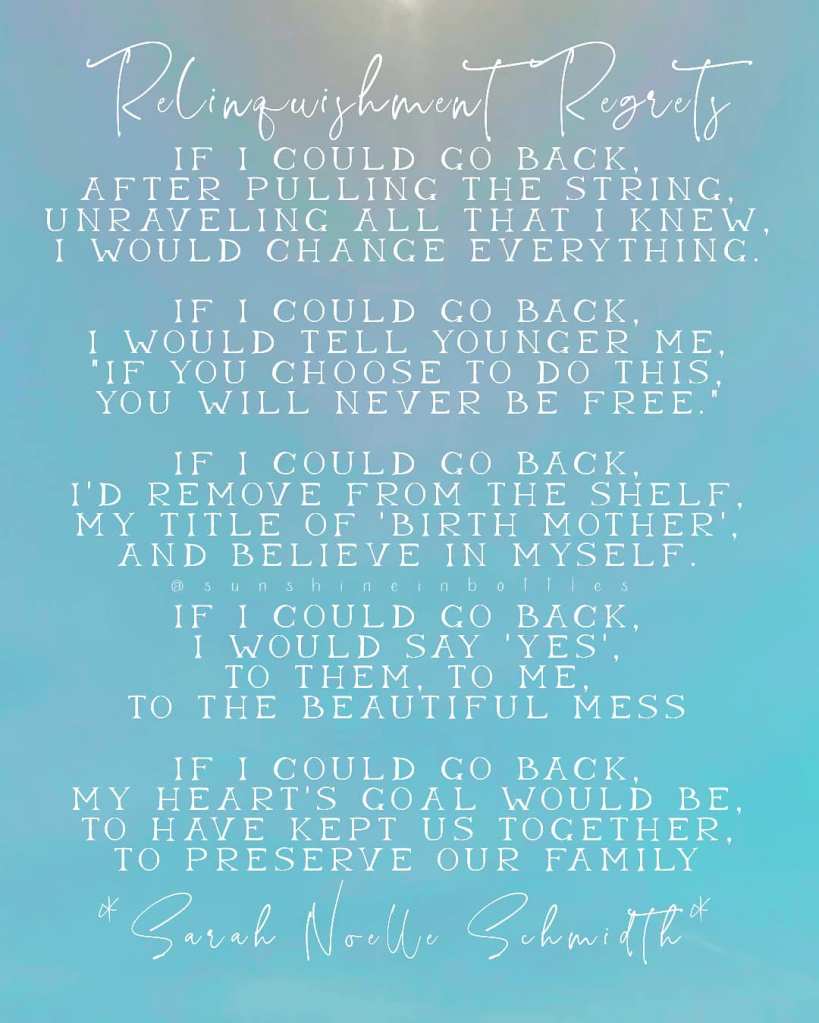
Relinquishment Regrets

Written by a mother who knows. She says of the above poem – I wrote this yesterday and thought there might be some other first/natural/birth/mothers of relinquishment moms who feel the same.

I am coming up on 22 years since my first relinquishment (I placed twice, nineteen months apart, with the same couple, who are now divorced) and the things I would change, if I could go back with all I now know about the billion dollar industry of adoption and how it uses and spits out so many mothers and adoptees, just keeps piling up and adding on with the more I learn about what I participated in, twice, all those years ago.

Another woman with the same experience writes – I feel this so SOOO hard. I’ve been struggling with being stuck with this regret for years now. My son is 20. I’ve never spent time in regrets before this one because we wouldn’t be who we are without the experiences we’ve had and choices we’ve made. And right now, I love my life – and I can literally trace the steps and KNOW that if I had parented, I would definitely not be here. But it doesn’t matter. I would give anything to change it. To not be that woman who was scared and unsupported, who didn’t know everything I should have known about adoptee trauma, and who believed there was another mother out there who was better for my own son than I was.

A Reality Check

So a struggling mother asks – Is it wrong to give your kid up for adoption if you deal with depression/anxiety and don’t really have much help ? A part of me feels like I will get over everything and be just fine .. another part of me wants to give my kid up for adoption so that they can have 2 parents and grow up in a loving home with good opportunities. Is any of it feasible ?

The reality – Adoption won’t guarantee a better life for your child, only a different one. Adoption is random. Hopeful adoptive parents are not evaluated for mental health, as biological parents are when Child Protective Services is after their kids. Also, divorce is just as common for adoptive parents as it is for everyone else.

Adoption is permanent.

So, you could give your kid away to some random strangers, then go on to win the lottery, meet the love of your life, and meanwhile the adoptive parents could get divorced, lose their jobs, your kid could be raised by an alcoholic hoarder who won’t allow any contact with you, and then when they do find you, they could resent you for depriving them of the life they could have had with you.

Someone else who suffers from depression/anxiety admits – I go through this thought process with every episode. It’s so hard. Adoption doesn’t always equal better.

Someone who experienced both foster care and adoption notes – People have all sorts of reasons to justify giving up their child. They often sell themselves the line that 2 parents are better than a single one, or they are better off because I am dealing with x/y/z. Your kids love you in spite of all of the hard things in life, and honestly, if its something you struggle with – they likely will too. And no one is better to help them navigate it than their birth parent because often times adopted parents just gaslight their kids and don’t get them the proper therapies and then, its compounded by attachment trauma too. Hugs. You are a good mom no matter how you are struggling because you love your kids enough to ask tough questions about your own mental and emotional health. That’s more than most hopeful adopted parents will ever do!

The issue of abortion often comes up in adoptee circles with a variety of opinions. Comparing the trauma on the biological mother of placing her child for adoption as opposed to what she might feel after having an abortion – studies have found that 95+% of people who’ve ended their pregnancies, have no regrets and felt nothing but relief.

One adoptee says – I’ve had an abortion, I don’t regret it at all. Sure, I sometimes wonder what might have been, but I’m not sad about it at all. At least there’s nobody out there wondering why they weren’t good enough to be anyone’s first choice.

Yet another who aged out of foster care, and was never adopted, says – I’m really really grateful and lucky to have not been aborted. For me, I don’t know if its right to decide for someone without their choice that they’re better off dead than adopted.

Then an all-of-the-above person notes – This is hard… I believe that if someone has never had a child they might regret their abortion. I’m a biological mom and an adoptee … I have my own child I parent, I have a biological child that was given up for adoption, and I had an abortion. By far my abortion was the easiest on me emotionally and mentally. I have been tormented emotionally and mentally by the adoption that turned out a total lie regarding it’s openness. I think about her every single day. I wish I would have aborted her but I was selfish. Of course, I would also rather have kept her, if I had the right mindset then. Hindsight is 20/20. But I also know that if I had never given her up, then I wouldn’t have chosen to have an abortion so easily the next time because giving up another child would have never happened again or I’d be dead. But I know, if I had aborted the child I gave up, I would probably have huge regrets because I wouldn’t know how awful it was to give a child up to adoption.

It always is a matter of perspective and circumstance. This blogger notes – I have a biological, genetic daughter that I surrendered to her father due to my own financial struggles (he refused to pay child support, I went into an employment where I could not take her along with me. I was seeking a financial gain that would support us both – I did not foresee leaving her with her paternal grandmother would become her father’s non-legally mandated permanent custody). Then, I had an unplanned, unexpected pregnancy with no interest expressed by that father-to-be. I did end that one with an abortion. Later on in life, in a better marriage and with good financial circumstances, I gave up my genetics to allow my husband to become a biological, genetic father through assisted reproduction. Many women have multiple varieties of reproductive experiences. I do believe ALL women deserve a legal private choice in all reproductive matters.

Why Is It Different Here ?

How come infant adoption doesn’t exist in countries with social safety nets??

Because women don’t willingly give up babies without coercion and desperate circumstances.

The point above is that many countries outside the US have less than 200 adoptions annually…some only a handful. WHY?

  • Because they don’t allow it to be a multi billion dollar industry
  • It is NOT privatized
  • It is illegal to adopt on your own – no internet/friend matches
  • They have a social support system to help families stay together.

Some additional comments –

The social nets in the US need serious overhaul. I work in a hospital and some of the situations I’ve seen people in are heartbreaking, infuriating, sickening. It makes sense that countries with ACTUAL support see fewer broken families all around.

It was sad to see this one – I wish it was like this everywhere. I’m from Ukraine and it’s a sh*tshow – lots of kids abandoned, horrific dysfunction, zero support. It’s terrible.

Safety nets include but are not limited to: proper science based sex ed, access to birth control of the patients choice, access to medical care, plus abortion accessibility. Access to housing and therapy. I have found a lot of people assume support is $$$ and while that is true to a degree, it is not the whole picture. Building community is the best thing we can do. To which someone else noted – but realistically money solves a ton of issues.

From an adoptee – Safety nets and social resources are so important. It is deeply disturbing that we pay so much lip service to “children are our greatest resource” and pretending that we are all about “family values,” but when push comes to shove, it’s really about greed and selfishness. We need to elect politicians who are more interested in people than money and power.

A transracial adoptee notes – I hate it when they try to make it seem like there are soooo many abandoned babies. Even if there is an expectant mom who wants to give birth (which how many pregnant people are truly willing to give birth, especially in a country with a high mortality rate, to just relinquish the baby) but does not want to parent (as in they have the ability/support/the means to parent but truly do not want to & wouldn’t/couldn’t abort), then what about the father? And if he really absolutely does not want to parent, do they really not have a single family member or honestly even close family friend who would take in the baby? Like the leap to having absolute strangers adopt the baby is just too much for me honestly. I frankly find it a bit hard to believe that there are so many situations where there are 2 capable expectant parents who simply don’t want parent and for not a single family member be capable/willing to take care of the child.

Another explains –  it’s the private adoption industry taking the foster care statistic of approximately 100,000 post-Termination of Parental Rights youth in this country, and just conveniently not mentioning that almost none of them are babies or toddlers. And then, if challenged, they will say ‘but this prevents them from ending up in foster care, aging out without a family,’ although I imagine that would not be relevant to the majority of parents who relinquish privately.

Which brought this recognition – I’ve actually found it incredibly bizarre how some very educated and intelligent people in my life, people who understand systems of oppression in regards to other demographics, a) don’t seem to get that no one gets pregnant to happily turn around and relinquish and b) refuse to understand that different age groups in the foster care system likely have different needs and require different approaches.

And this story from an expectant mother – I’m 42, expecting my 4th. My 1st, I was a single mother when her father left when she was 15 months old. I was a single mother for 10 years when I met my husband. But I thrived. I had a career, bought my own house, could afford a comfortable life. When I married, we had 2 boys over 8 years of marriage. My husband comes from a long line of mental illnesses, which he inherited. Both our boys are special needs, ASD among others. I’m in the middle of a long divorce as my husband is dragging it out and controlling it all as long as he can. I’m now a single mother for a second time. Eventually started casually seeing someone and got pregnant the second time we were together. He immediately jumped ship and was adamant he doesn’t want anything to do with it. Doesn’t want to be on the birth certificate. Nothing. This pregnancy will make me a single mother for essentially a 3rd time, at the age of 43. I am over being a single mother. I don’t want to do this for 40 years straight. I am older. I have no family that would take a baby. I had zero interest in abortion, I live in a state where it’s still legal, but that’s not something I agree with and I couldn’t live with myself. So, yes, I’m the mom that would carry to term just so I wasn’t killing the baby. I also couldn’t live with the what if’s with adoption. So I’m simply left with parenting. Do I want to? No. It’s simply the only option that doesn’t leave me with what ifs for the rest of my life. I fit everything you said is a far stretch. Father does not want, I would not abort, I have already been a single mother most of my entire adult life, so I know I CAN do it, but I don’t want to anymore. I’ve lived that phase of my life. I’m currently reliving that phase of my life with 2 challenging kiddos. And now, my awful luck has me starting all over again a 3rd time. And being in this position, I’ve come to realize there are lots of older women in my position for different reasons. Thought they went through menopause, Birth Control failed, whatever. Married, divorced, there are lots of us. So many people think this is a “young mom” issue, but there is an older crowd no one considers because we aren’t the norm.

Another agreed – the majority from the statistics I’ve seen who are getting abortions are married or divorced older women. I don’t see many choosing adoption at that age.

And a perspective from the United Kingdom – The UK has plenty of adoption, largely because our social services and safety net are so full of holes, struggling families don’t get help and their kids get taken away. What we don’t have is abandoned babies or people voluntarily giving up their infants. Because we have free, readily available abortion for people who really don’t want a kid, free healthcare (even if the government is currently running the service into the ground) and enough of a basic safety net (however fraying) that is usually sufficient that people who choose to give birth don’t feel they have to then give away their children due to poverty. I have a mountain of criticism for the ways our society is failing families, and letting them fall apart, but I still look at the United States in horror at how much worse it is.

The Jim Twins

Jim Lewis and Jim Springer

I am a Gemini, so I’ve always been fascinated by the idea of twins. I often fantasized that there was a twin that didn’t make it to make my birth but there is no proof that ever happened. I have a sister only 13 months younger than me and when we were young, we were often dressed alike, as though we were twins – then she got much bigger than me. When I had my daughter, she would say that we were twins when she was still very young and I wondered if she was my missing twin, later born to me as her mom instead. That probably didn’t happen either. In assisted reproduction, there is a circumstance known as a vanishing twin (I experienced that with my oldest son’s conception). Adding to my own interest is the fact that I married a man who’s father is a twin. His twin brother, who was deaf due to an illness he was afflicted with when he was very young, was always tickled when local people would mistake him for my father-in-law.

Twins who were separated after birth have often been studied with remarkable results considering they were not raised together. These kinds of identical twins provide a rare opportunity for scientists to study how environment versus heredity influences human development – nurture vs nature.

Such is the case with the Jim twins. Identical twins that were separated at birth after they were placed for adoption. They did not meet one another until they were finally reunited at the age of 39. Even their wives have the same name as both married women named Linda and both divorced their wives several years later. Then both brothers married a second time to women named Betty. They also both had sons who each named – James Allan.

The Jim twins were born in 1940. Each was given the same first name by their respective adoptive parents. They even grew up just 40 miles apart from each other, their lives lived in a kind of parallel existence. Jim Lewis grew up knowing that he had a twin brother. Jim Springer’s mother had told him that his twin had passed away as a baby. Both had a brother named Larry and a dog called Toy. They shared the same interests in school – mathematics and woodwork – and both hated spelling. They shared a common interest in mechanical drawing and block lettering.

Both ended being heavy chain smokers and even owned the same make of car – a Chevrolet. They took vacations and went to the same Florida beach resort. Even so, they never encountered each other at the time. While their employment was not identical, their jobs were similar – Jim Lewis worked as a security guard and Jim Springer became a deputy sheriff.

Eventually, Jim Lewis went to an Ohio courthouse seeking contact details for his long-lost twin brother. They spoke to one another on the phone and subsequently agreed to meet. Even though Jim Springer did not know his twin was still alive, he said he had “always felt an emptiness” growing up.

A study of the two men by Dr Thomas Bouchard, director of the Minnesota Study Project – Twins Reared Apart, discovered that their medical histories and even their brain-wave tests were almost identical. They both suffered a type of migraine headache that began when they were at the age of 18. Both suffer the same degree of disability and the same frequency — and they even use almost identical words to describe it. The cause may be far more biological than doctors in the field have believed. The twins also scored nearly identical on a personality test. During that study, when asked to create a picture, they even drew the exact same thing.

“We even use the same slang,” Jim Lewis notes. “A lot of times, I’ll start to say something, and he’ll finish it!” Researchers have said this phenomenon can be attributed to the twins having remarkably similar brain waves. This causes the perception that some identical twins “think alike.” One has to wonder if there are genetic influences that affect our life choices.

Information about twins is being gathered and analyzed globally. Most of the Scandinavian countries maintain a twin registry. The Swedes, for instance, have data on 26,000 pairs of twins, dating back as far as 1886. In Rome, more than 15,000 pairs of twins are registered with the pioneering Gregor Mendel Institute for Medical Genetics and Twin Studies. And here in the United States, there is another one at the National Academy of Sciences — National Research Council’s Twin Registry. That director is Zdenek Hrubec. He keeps tabs on 16,000 pairs of male twins, in which both have served in the military.

There are an estimated 100 million twins in the world. Identical twins are called monozygotic twins because they develop from a single fertilized egg that later divides to produce two embryos that are genetically identical. About 3.5 identical twins occur in every 1,000 live births, a rate that has remained constant without regard to socio‐economic factors or even individual characteristics such as maternal age. In extremely rare cases (usually involving some chromosomal abnormalities), twins of opposite genders are born. Only one in three twin births produces identical twins. Much more common are fraternal twins. This occurs when two eggs are fertilized about the same time. Genetically speaking, these “twins” are no more similar than any other siblings.

There is some progress in adoptionland – identical twins are rarely separated and reared apart today. Thanks to more enlightened welfare policies and changing social attitudes that have removed the social disgrace that was once associated with illegitimacy.

There is much more information than I have shared here in this New York Times article – LINK>Twins Reared Apart: A Living Lab.

Being Fatherless

From Huffington Post LINK>I Was Told My Father Was A ‘Deadbeat.’ After He Died, I Found Out Everything I Knew About Him Was Wrong. “In the foster care system, being a fatherless daughter was the status quo.” by TJ Butler.

Growing up, all I knew about my father was that he was a “deadbeat.” My parents divorced when I was 4. He was a musician, playing bass in rock and country bands ― the only job he’d ever had ― and child support payments were always contentious. I remember Mom complaining that Dad would show up to the court hearings wearing torn jeans and T-shirts. In one hearing in the ’80s, she was awarded less than $70 for two children, based on his income. (blogger’s note – I remember being awarded $25/mo, when I didn’t ask for child support at my divorce because I knew he would never pay it and I wasn’t going to spend my life in court fighting for it.)

When I was a few years older, my younger sister and I spent an occasional weekend with him. I have little recollection of the infrequent visits, but I have colorful memories of his apartment. Framed Beatles albums covered the walls, sharing space with antique Civil War memorabilia and his many bass guitars. My stepmother, who I thought of only as “my father’s new wife,” was beautiful; the coolest adult I’d ever met. When I got my first period at 10, she was the one who explained how to use tampons.

Like my father, my mother entered a new relationship shortly after my parents divorced. But her boyfriend was an alcoholic, prone to verbal abuse and physical violence. At 13, I ended up in foster care, living in group homes and residential children’s centers. There was little talk of family reunification during those years; the night I left my mother’s house at 13 turned out to be the last time I ever slept there.

The group homes and children’s residential centers where I lived during my teens focused on independent living. As I neared 18, I learned about adulting: grocery lists, budgeting money for rent and utilities, and how to write a resume. In the system, communication with family members is regulated. Since I didn’t grow up with him and he didn’t seem interested, none of my counselors or my social worker encouraged me to have a relationship with my father. Being fatherless was just another box to check when I filled out questionnaires for therapy.

When I aged out of foster care, I was angry, but it was directed inward. Rather than hurting others, I hurt myself. There were drugs and alcohol, body piercings and tattoos, and years of nude modeling. A decade later, I had an epiphany that I couldn’t continue the way I was living and quit the adult business. I took out my piercings and had my most visible tattoos removed. I finished a BA in management, secured a corporate job with good benefits, and married my wonderfully supportive husband.

When my father died in 2011 of Parkinson’s with Lewy body dementia, I didn’t go to his funeral. My feelings were confusing. Why was I sad that a man I hardly knew passed away? It took some time to realize that I wasn’t crying over the loss of a father. Instead, it was the realization that now he’d never be able to change his mind and become my dad.

Moving forward, she decided she wanted to meet her half-brother. Rather than admit that she planned to drive 700 miles to see him out of the blue, she told him she had “a writing thing” near him and asked if he wanted to meet for coffee while she was in town. He agreed. She was excited and nervous, and eager to learn about what life was like growing up with their father. He began to fill in the blanks about their father. The person she’d known little about transformed from a deadbeat into a man. She learned how good-natured he was before he got sick and about how their house had been the magnet for kids in the neighborhood to hang out. He told her that he could see a lot of their father in her face. Since she felt she didn’t resemble the people on her mother’s side, she was thrilled to finally look like someone she was related to. (blogger’s note – this is a common experience among adoptees in reunion as well – having a genetic mirror.)

She goes on to share – I began seeing a therapist to work out some issues with my mother. Although it wasn’t family therapy and we didn’t connect, my perspective changed dramatically. I saw her as a flawed human, rather than simply a bad mother. This new way of thinking answered many questions about why I ended up in foster care and why she chose not to let me come home. This clarity has brought me some closure. She ends with how meeting her half-siblings was “about connecting with a family who welcomed me with open arms. Spending time with them gave me something that wasn’t even on my radar to wish for. For the first time in my life, it felt like I belonged somewhere.”

Satanic Panic

Melvin Quinney

I heard the story about this man (who could be any white person’s kindly grandfather) on NPR last night. He is a San Antonio man wrongfully convicted in 1991 during the so-called Satanic Panic hysteria. In court last Monday, Melvin Quinney had his charge dismissed by 227th District Court Judge Christina Del Prado. The state exonerated Melvin Quinney of his conviction of indecency with a child back in February but Monday’s hearing made the exoneration official. “It’s like the beginning of the end of a very long nightmare,” Quinney said.

I wish I could say these kinds of “miscarriage of justice in the name of religion” cases were only in the past but unfortunately, even today, I know evangelicals who still believe these kinds of things. Satan and evil in this world especially related to child trafficking (QAnon certainly is on that page). It’s not that I don’t think that such things happen and I do feel that anytime a child is sexually abused – it is a travesty. But under religious fervor, these heartfelt feelings, can do a lot of harm. A friend said to me once, “It has everything to do with pagan rituals and actual Satanic influence in many places. It’s because of my love for children that I will fight with all I have to rid this world of those things. If I had not studied Biblical Prophecy and Pagan rituals I probably wouldn’t understand what I am seeing now.” Sigh. I understand it is heartfelt for her.

Today, I found this blog – Friendly Atheist by Hemant Mehta LINK>A victim of the “Satanic Panic,” Melvin Quinney has finally been exonerated. The “Satanic Panic” was a conspiracy theory that really took hold among a certain kind of Christian in the 1980s. Perfectly innocent people were accused of ritualistic child abuse, bad behavior was blamed on the devil, and the modern-day witch hunt ruined countless lives. No evidence ever proved this organized abuse was occurring—certainly not the way accusers insisted it was—but as with so many conspiracy theories, its power had nothing to do with the facts.

Melvin got trapped by this when he and his wife were going through a divorce in 1990. It was she that accused the 43-year-old Quinney of leading a Satanic cult that murdered people. His kids were soon taken into custody by Child Protective Services. John, his 10-year-old son, accused Quinney of sexual abuse. After weeks of coercion from therapists, their mother and other adults, Sarah and John developed “memories” of abuse and occult rituals. John came to believe that their father was the leader of a satanic cult that had committed murder and sexually abused him and his sister Sarah as part of satanic rituals. Melvin was arrested in 1990 and charged with indecency with a child. John testified at trial about his “memories” of his father’s abuse of himself and Sarah.

Melvin was released from prison in 1999, an early release for good behavior. However, even then, he was forced to register as a sex offender. This deprived him opportunities to get his life back on track. It wasn’t until 2012, that he finally attempted to get back in touch with his kids (who had grown up believing their father abused them). His children had grown up in foster care. Finally, in 2020, his children testified that there was no evidence that their father ever did those things he was accused of. His son told the court he realized much later, that those stories were entirely fictional. They had been fed to him by his mother, her evangelical friends, and other adults working against his father as a way to override the “good memories” he had of him.

His ex-wife was unable to care for the children not long after he was imprisoned and so, they were pushed into the state’s foster care system. His wife mother passed away in 1999. Her son says that she was clearly mentally ill. He says, “Instead of getting help with the real mental problems she was experiencing, she was persuaded and kept mentally ill with pseudoscience and superstition.” For years, the children thought they would be targeted by satanic cult members. He has since forgiven her.

The blog ends on this thought – the Satanic Panic has always been that no matter how many bad faith actors use Satan as a metaphor for what they hate, there are many pastors who spend every week convincing their congregations that Satan is real and needs to be eradicated from their lives. They’ll never admit they’re lying because they genuinely don’t believe they are. As long as that belief perpetuates in churches, it’s next to impossible to convince people that Satan and the abuse associated with Satan are entirely fictional. That means, much like sin itself, conservative Christians have invented their own problem out of thin air, while presenting themselves as the only solution.

Be Careful What You Wish For

Dr James Wittig with adopted son Ronnie

Metaphysically, I’m a fan of synchronicities. I like this perspective – “The universe listens,” Wittig said, and gives you what you need. “Have you heard of synchronicities?” he asked. “It’s God’s way of giving you what you want.” James Wittig notes that “Years ago, I was engaged to be married, and we used to joke about having kids and we’d say: ‘Wouldn’t it be great if we have a child, send him away and then get him back when he’s 13, after the hard years?’ Then funny enough, a 13-year-old boy falls into my lap.”

Today’s blog is from a story in LINK>USA Today originally published on a North Jersey website. The story doesn’t tell us whether Ronnie wanted to be adopted but given the circumstances, I really don’t have a problem with this. The story does say that “When asked, Ronnie, now 20, said he did not want to be interviewed. He’s not comfortable talking about his story, but his father said following his graduation from Seton Hall Preparatory School last year, Ronnie enrolled in a welding program at a technical school. He fell in love with welding during a summer program shortly after he moved in with Wittig. He recently used his welding skills to make a firepit that now sits in their backyard.”

The connection between the doctor and the boy runs from the doctor’s work in his profession. About 20 years ago, when orthopedic surgeon James Wittig was a resident in training, his mentor gave him a photo of two young girls he had treated for bone cancer during the 1980s. The photo was meant to be a reminder to the young doctor of the importance of their life-saving work. Wittig had no way of knowing then that the 14-year-old girl in that photo would forever change his life. The other girl in the photo was 10 years old at the time. 15 years later, now in her 30s, this younger girl developed an infection in her leg and became Wittig’s patient. The doctor and patient kept in touch following treatment via Facebook.

The two girls remained friends long after they posed for that photo. Their close age and shared illness had created a strong bond. The older girl grew up, married and had two sons. She had to undergo more surgeries and eventually, her husband and the woman divorced. He moved to Colorado where he died a few years later. She remarried but died (due to complications of her cancer) only a month later. Her boys were just 11 and 7 years old. They went to live with their grandparents, but they also unfortunately died of cancer a year later. This sent them back to live with their stepfather. He fostered them, but did not have the resources to care for them properly. The younger of the two girls (now mature), took temporary custody of the two boys, now 17 and 13. The older boy already planned to join the military on his 18th birthday.

Thanks to a request for help by this woman on Facebook, where she was already remained in contact with her doctor, the younger boy found a home and a man gained a son, already 13, as he has fancifully mused about many years earlier. The adjustment was not easy for either of them. Understandably, the boy struggled with the death of his mother. He had not had a strong person in his life who he really trusted for a long time. Eventually trust came but it was slow.

Feeling Rooted In Ireland

This St Patrick’s Day, I am happily feeling my roots. It is something I was denied by both of my parents being adopted, until I was able to discover them thanks to my own efforts, when I was already well into my own 6th decade. The “advice from a flower” in the graphic above certainly suits the experiences of some adoptees necessitating that they grow through adversity.

My dad’s name was changed from his birth name, Arthur Martin, to Patrick (plus more than one adoptive father’s name for his middle, as his adoptive mother divorced an abusive alcoholic and later married a WWII veteran, who adopted my dad for the second time in his life at the age of 8). Turns out that my dad’s grandmother was full blooded Irish. My dad’s adoptive parents were poor and I remember stories of him almost starving to death as a youth in New Mexico while they staked a prospector’s claim near Magdalena New Mexico hoping to strike it rich – they did fail.

St Patrick’s Day always reminded me that my dad’s birthday would be on the following day. He also liked to drink beer but not the green kind LOL. Lately, I listen to the calm, relaxing music of Tim Janis while do my 6 blood pressure checks. If I can totally quiet my mind (not always possible but good practice), I can get my blood pressure down. Today I chose his Celtic Country offering with images from Ireland and flute music. I managed to get my blood pressure down 14 points over the 6 readings.

We used to go to a neighbor’s house for Corned Beef and Cabbage on St Patrick’s Day. She made the best and her parents came from County Cork so it was in her genes. She was a tiny elf like lady but often drank too much (maybe a cultural tendency) and was not patient with the arrival of our oldest son as he became a toddler, so we quit attending. After her husband ended up in a nursing home, we hiked up to their house. It was located up the perennial creek that flows by our own home and so we arrived to visit her, staunchly holding down their home base next to a lake.

We don’t eat beef anymore and potatoes are strictly a no-no given my blood sugar issues. Sigh. We won’t really be doing anything to celebrate “the” day this year (though quietly in my own way, I am). Even so, as I listened to Tim Janis’ music, I was able to feel deep into my Irish roots. What a wonderful feeling it is to know I have very old and deep roots. It will always be wrong in my own heart’s understandings that adoptees are robbed of this knowledge. There can be no good excuse and many adoptees are working to change that issue.